An unfunded commitment in private equity is the part of an investor's commitment to a fund that the general partner has not yet called: the commitment, less contributions to date, plus any distributions the agreement makes recallable. It is a promise to pay on a few days' notice for up to a decade, so the limited partner must hold cash for it or arrange where cash will come from, and both mistakes cost money. Cash parked too early earns less than it would invested; a call that finds an entity short forces a credit-line draw, an asset sale or, at worst, a default. Botminds' Capital Call Processing keeps each entity's unfunded figure current from every notice and forecasts calls 13 weeks ahead, by entity and currency, from confirmed notices and a pacing model.
The sample figures come from fictional data: Quillfield Capital, an LP with 412 commitments to 168 GPs through 23 investing entities, as its notices run through the solution. Research on how fast funds call capital is linked where it appears; the cost arithmetic is ours and says so.
Commitments are called slowly, unevenly, and never quite in full
3.7 yrs
average time for a fund to call 80% of commitments; the median was 4 years
93.6%
of commitments the average fund had called by year 10, the end of its expected life
7–10 yrs
lock-up of private debt funds, with no option for investors to redeem
What is an unfunded commitment?
An unfunded commitment is money an investor has legally promised a fund but not yet paid. The investor signs for a total at subscription; the GP calls it in instalments as the fund invests and pays fees; what has not been called is unfunded, also called uncalled capital or remaining commitment.
It is a real obligation, not an intention. Delaware's partnership act lets the agreement impose penalties on a partner who fails to contribute, and European law counts it in the fund's capital: under the 2024 amendments to the Alternative Investment Fund Managers Directive, "capital of the AIF" means "aggregate capital contributions and uncalled capital committed to an AIF" (Directive (EU) 2024/927). For the LP's treasury it is a liability with an unknown schedule.
It is also illiquid. The Federal Reserve notes that private credit has historically been raised through private debt funds that lock investors in for seven to ten years and offer no option to redeem (Financial Stability Report, May 2026). An investor cannot redeem its way out of a commitment it no longer wants to fund; it can only sell the interest, with the GP's consent, or default.
How do you calculate unfunded commitments?
Calculate the unfunded commitment as the commitment, less every contribution counted against it, plus every distribution the agreement makes recallable, less any part of the commitment that has been released or has expired under the agreement. Each term has to come from the notices themselves, not from a summary, because each one can be booked wrongly.
Unfunded commitment, term by term, and where each term comes from
Commitment
As signed at subscription
Including any increase or transfer since
Subscription documents
Contributions
Sum of every call paid, all purposes
Investments, management fees and fund expenses all count unless the agreement says otherwise
Capital call notices
Recallable distributions
Distributions the GP may call again
Only the recallable part, and only until the agreement's limit or expiry
Distribution notices
Released or expired
Commitment the GP may no longer call
An agreement can limit calls after the investment period to follow-ons, fees and expenses
The partnership agreement
Two sample notices show the arithmetic. After Call 12, Quillfield's commitment of $60,000,000 to Tollan Ridge Partners Fund VI had contributions of $32,050,000, so $27,950,000 remained unfunded. After Call 7, its €50,000,000 commitment to Rheinau Infrastruktur Fonds III had €23,342,500 called, leaving €26,657,500. The Rheinau notice printed the same figures in its own commitment summary, and the solution's rebuild matched it to the cent.
The reconciliation that matters is between the GP's figure and the LP's. The GP calculates each call as a share of commitments and prints the investor's running totals on the notice; if those totals differ from the investor's books, one side has missed a call, a recallable distribution or a transfer. Checking at every notice finds the difference while it is one item; checking at year-end finds it buried in a year of activity.
How fast do private equity funds call capital?
Fast at first, then slowly, and never quite in full. In Ljungqvist and Richardson's data, the average fund called 16.28%, 20.35% and 20.15% of commitments in its first three years, "so it is 56.8 percent invested by the end of year 3", reached about 90% three years later and stood at 93.6% by year 10 (NBER Working Paper 9454).
A commitment's life: calls come early, distributions late
- Called by year 356.8%
- Called by about year 6≈90%
- Called by year 1093.6%
- Commitment returned by year 312.9%
- Years 4–7: invested capital back<7 yrs
- Years 8–10: mostly gainsgains
The average hides the decision an LP has to plan for. The same paper found that "some funds draw it down immediately, while others take as long as ten years to invest 80 percent or more of their commitments". Pace follows opportunity: in a study of 207 buyout funds investing in 2,274 companies, Ljungqvist, Richardson and Wolfenzon found that "established funds accelerate their investment flows and earn higher returns when investment opportunities improve, competition for deal flow eases, and credit market conditions loosen", while first-time funds were less sensitive to market conditions (Financial Management, 2020).
One more thing changes when calls arrive: whether the fund borrows first. A fund that draws on a subscription line of credit and calls investors later shifts the calls in time without changing their total; subscription lines and NAV facilities are covered from the lender's side.
Do capital calls rise in a downturn? Distributions fall faster
Calls do not reliably rise in a downturn; distributions fall more, and that is what squeezes investors. Robinson and Sensoy, studying quarterly cash flows of venture and buyout funds from 1984 to 2010, found that "While both capital calls and distributions rise with public equity valuations, distributions are more sensitive than calls. Net cash flows are therefore procyclical and private equity funds are liquidity providers (sinks) when market valuations are high (low)" (Journal of Financial Economics, 2016).
For an LP that plans to fund calls from distributions, that is the risk in one sentence: in a weak market the calls keep coming and the distributions that were meant to pay them slow down. Venture, they found, is "considerably more procyclical than buyout". The same paper offers the forecaster's consolation: "most cash-flow variation is idiosyncratic across funds, and most predictable variation is explained by the age of the fund". A pacing model built on each fund's age and history captures most of what can be captured.
The cost of cash that waits
Cash held for calls costs the difference between what it earns while waiting and what it would earn invested, for as long as it waits. The arithmetic is simple; the hard part is the waiting time, which the drawdown curves say can be years for the last part of a commitment.
What $10 million held for calls costs in a year, by the return it gives up
Run the sum for the whole book and the stakes become visible. An investor that holds a year of cash against every unfunded commitment, rather than a forecast's worth, is holding the commitment's tail, the part that the drawdown curves say arrives in years five to ten if at all, at the cost of the gap every year. An investor that holds too little pays a different price.
The cost of a call that finds you short
A call that finds an entity short costs whatever the fastest source of cash costs, plus the risk of missing the due date. The fast sources are a credit line, at its rate; a sale of liquid assets, perhaps at the wrong moment; or a request to the GP for time, which is a negotiation before the due date and a default after it.
The default remedies make the downside asymmetric. Delaware allows an agreement to subordinate, sell or forfeit a defaulting partner's interest, so a shortfall of a few days can put at risk everything contributed to date. What happens if you miss a capital call sets out the remedies; for planning, the point is that the cost of being short is not the interest on a few days' borrowing.
How much cash should an LP hold for capital calls?
Enough to pay the calls you know about and the calls you can forecast over the horizon in which you could not raise cash any other way, less the distributions you are confident of, plus a buffer for the forecast's error. There is no regulatory figure; the answer is a treasury policy, and the inputs are the confirmed notices, each fund's age and history, and the entity's other sources of liquidity.
Thirteen weeks of calls and distributions, and the one entity short
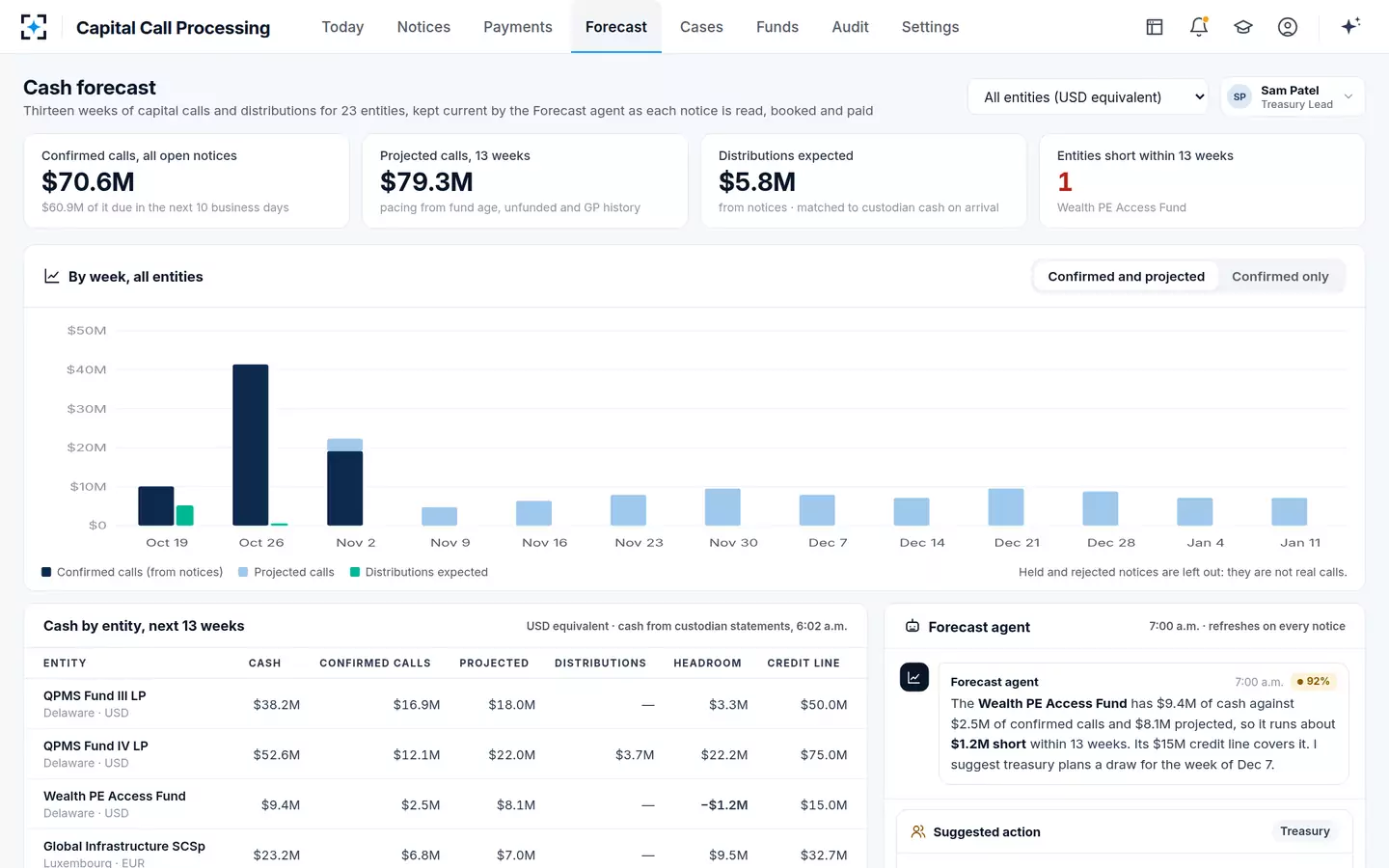
The sample shows the method at work. Across 23 entities, confirmed calls from open notices came to $70.6 million and projected calls over 13 weeks to $79.3 million, against $5.8 million of expected distributions. Most entities had headroom; one did not. The Wealth PE Access Fund held $9.4 million of cash against $2.5 million of confirmed and $8.1 million of projected calls, about $1.2 million short, and the suggestion was to plan a draw on its $15 million credit line in the week of December 7, weeks before any call was due.
Sizing cash for capital calls: a method in six steps
- Start from confirmed notices only
Every open call by entity, currency and due date; exclude anything held as suspect.
- Add projected calls from each fund's age and history
Young funds in their investment period call most; funds past it call mainly fees, expenses and follow-ons.
- Count only distributions already noticed
Distributions are more market-sensitive than calls; do not fund calls from distributions you expect.
- Set the horizon to your slowest source of cash
If raising cash takes six weeks, a 13-week view with a six-week buffer is the minimum.
- Keep a credit line sized to the forecast error
Measure how far last year's projections missed, and cover that gap.
- Re-run it on every notice
A forecast refreshed monthly is stale for most of the month.
What is commitment pacing?
Commitment pacing is planning new fund commitments so that, as old funds call and distribute and new ones start calling, the investor's exposure to private markets stays near its target and its unfunded commitments stay within what it can pay. It is the long-horizon version of the 13-week forecast, built from the same ingredients: drawdown and distribution curves by fund age, adjusted for each GP's history.
Pacing needs good data more than a clever model. The research says fund age explains most predictable variation, so the most valuable input is each fund's own history of calls and distributions, booked correctly and by character; a recallable distribution booked as final, or a net notice booked net, distorts every curve built on it.
How Capital Call Processing keeps the unfunded number and the forecast current
Capital Call Processing updates each commitment's contributions, distributions and recallable balance from the notices themselves, after an analyst books them and a manager checks them, and shows the roll-forward on every booking. The Forecast agent keeps a 13-week forecast by entity and currency current as each notice is read, booked and paid, adds projected calls from a pacing model, and flags an entity running short. It never moves cash: it suggests, and treasury decides.
It is not a portfolio-construction tool, and it does not set the investor's pacing policy. What it gives the people who do is a correct unfunded figure for every commitment, every day, built from the same notices the GP sends. To see the forecast beside the notices it comes from, start from Capital Call Processing; recallable distributions and the unfunded figure explains the term most often booked wrongly.
Questions people ask
What is uncalled capital in private equity?
It is the same as the unfunded commitment: the part of investors' commitments the GP has not yet called. At fund level it is the sum across all investors; for one investor it is its commitment less its contributions, plus anything recallable.
Do unfunded commitments expire?
Partly, depending on the agreement. An agreement can limit calls after the investment period to follow-on investments, fees and expenses, and once the fund's term ends nothing more can be called; the exact limits are in each fund's terms.
Does a recallable distribution increase my unfunded commitment?
Yes, by the recallable amount, until the agreement's recall period ends. An investor that books a recallable distribution as final understates what the GP can still call.
Why does the GP's unfunded figure differ from mine?
Usually because one side has booked a notice the other has not, treated a recallable distribution differently, or missed a transfer of interest. Compare the running totals printed on each notice with your own at every notice, not once a year.
How accurate are capital call forecasts?
Less accurate fund by fund than in aggregate. Robinson and Sensoy found most cash-flow variation idiosyncratic across funds, with fund age explaining most of what is predictable, so a forecast across many funds is steadier than any one fund's, and confirmed notices should always override projections.
Should an LP hold all its unfunded commitments in cash?
Rarely: the average fund called only 56.8% of commitments in its first three years and 93.6% by year 10, so cash held against the tail waits years. The alternative is to hold a forecast's worth of calls plus a buffer and a credit line, sized by the investor's own treasury policy.