A capital call works like this: an investor commits a sum to a private fund but pays almost nothing at signing, and each time the fund needs cash the general partner (GP) sends a capital call notice asking for part of that commitment. The limited partner (LP) then has a few business days to read the notice, check the amount against its commitment and the fund terms, confirm the bank details, book the call and wire the money. The work looks clerical, and it is where an LP's cash is most exposed: a notice is a PDF or an email asking for a wire, and fraudsters copy them. Botminds' Capital Call Processing does the reading and checking for LP operations teams, holding every wire against the bank details on file, while people book and pay.
Every example below that names a fund or a person is fictional sample data: Quillfield Capital, an LP with 412 commitments to 168 GPs held through 23 investing entities, as its notices run through the solution. Figures about the market come from regulators, a financial intelligence unit and peer-reviewed studies, each linked in the sentence that uses it.
Why the call deserves more care than its paperwork suggests
56.8%
of committed capital an average fund had called by the end of year 3
NBER working paper, funds 1981–2001
93.6%
called by year 10: commitments are rarely drawn in full
same study
60%
of the email-fraud suspicions Luxembourg's FIU reviewed involved fake capital call notices
Jan–Nov 2025
$3.05bn
lost to business email compromise in complaints to the FBI in 2025
What is a capital call? A commitment paid in instalments
A capital call is the GP's written demand for part of an investor's unfunded commitment, payable by a stated date to a stated account. The commitment itself is the ceiling. In the words of Ljungqvist and Richardson, "The capital commitment is the maximum amount of money an investor can be asked to contribute over the life of the fund", and GPs draw against it when they need cash rather than taking it on day one (NBER Working Paper 9454).
The money a call asks for usually has three parts: cash for a new or follow-on investment, the management fee for the period, and the fund's own expenses. A call is also called a drawdown, and the notice a drawdown notice; the mechanics are the same in buyout, venture, private credit, infrastructure and real estate funds.
The law treats the uncalled part as real money. European law counts it in the fund's capital: the 2024 amendments to the Alternative Investment Fund Managers Directive define a fund's capital as the contributions already paid plus the commitments not yet called (Directive (EU) 2024/927). Delaware's partnership statute lets the agreement attach consequences to a failure to pay, and banks lend to funds against the uncalled commitments themselves. For the LP, that means an unfunded commitment is a liability to plan cash for, not an option to consider.
How does a capital call work, step by step?
Step by step, a capital call moves from the GP's notice through five pieces of LP work: read, recompute, verify, book and release. By hand they are done by one or two analysts and a treasury approver; in Capital Call Processing the first three are done by agents and the last two stay with people.
Capital Call Processing: five steps from a GP's notice to a paid call
Agent
Read the noticeGP, fund, investing entity, amount, due date, the breakdown by purpose and the wire block, each value cited to its page, in the notice's own language.
Never: fills a value it cannot read; it marks it unreadable
Agent
Recompute the amountRebuilds the call from the commitment, contributions to date, the call percentage, the LPA fee terms and side letters; moves a weekend due date to the business day before.
Never: recommends paying less than the call
Agent
Verify the wireHolds the bank details and the sender against the details verified for that fund; any change blocks payment until a call-back to a number on file.
Never: uses a phone number or contact from the notice
A person decides
Book and checkAn analyst books the capital activity; the operations manager checks it before anything reaches portfolio accounting or treasury.
Never: lets the checker be the maker
A person decides
Release the paymentTreasury releases to the verified account before the wire cut-off; in the sample settings, two approvers for anything over $5,000,000.
The order matters. Recomputing before verifying means a wrong fee is queried while there is still time, and verifying before booking means a fake notice never becomes an accounting entry that someone later pays from. The step most often done by eye, comparing the wire with last quarter's notice, is the one fraud is built to pass, because a good fake keeps everything else the same.
What a capital call notice tells you, line by line
A capital call notice should let an LP check the call without opening any other document except the fund terms. The essential lines are the fund and the investing entity, the notice number and date, the total due and the due date, the breakdown by purpose, the commitment summary before and after the call, and the bank details. Many notices carry each LP's own figures on a page of their own and the fund-level totals on another.
A German capital call notice, read and rebuilt to the cent
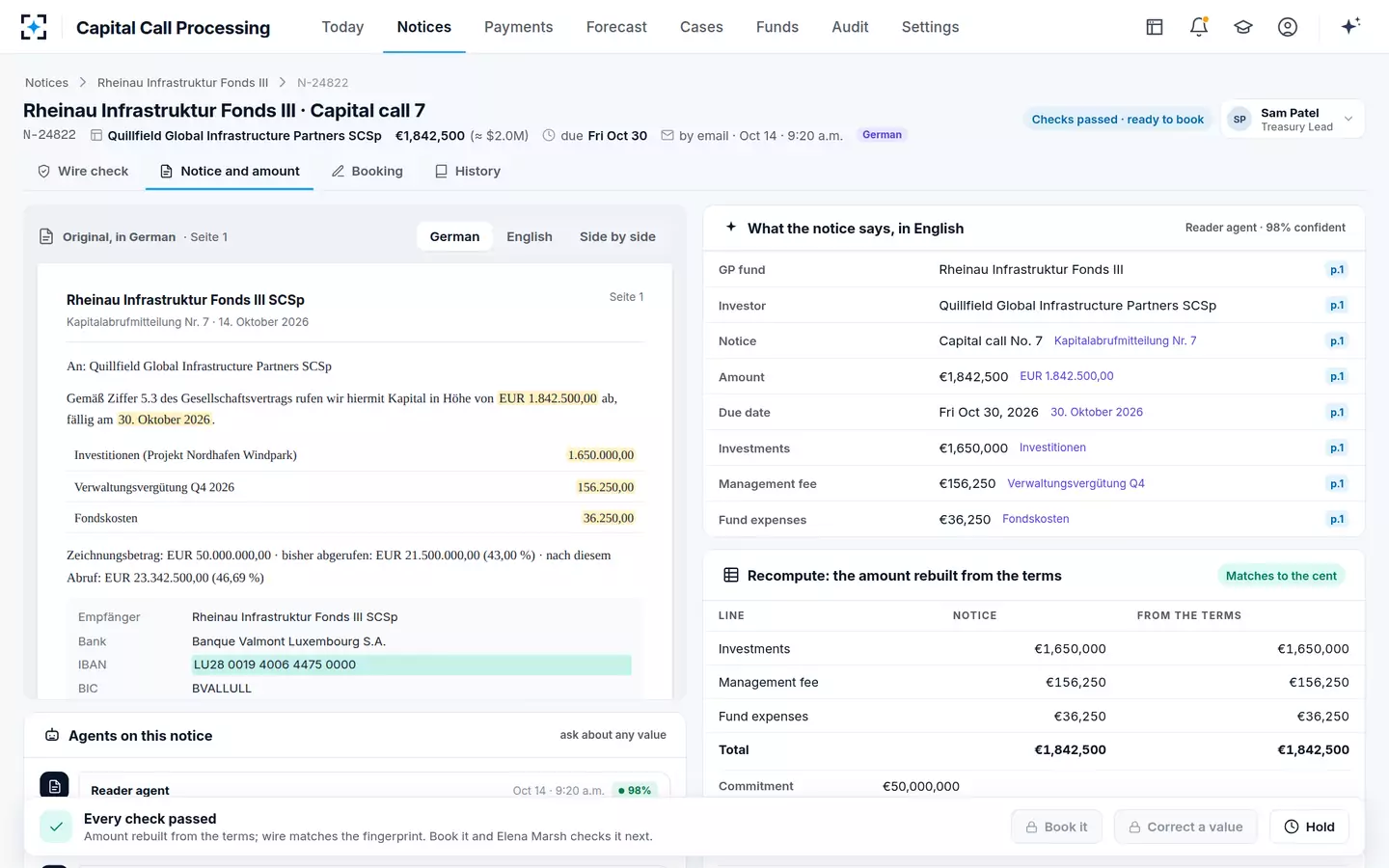
Read the commitment summary first. If called-to-date plus this call does not equal the after figure, or the percentage does not match the commitment, something in the GP's register differs from the LP's, and the difference is cheaper to find now than at the year-end confirmation. Then read the purpose lines: a call that is mostly fees early in a fund's life is normal, and one that is mostly fees in year eight deserves a question.
The wire block is the part to read last and trust least. A notice copied by a fraudster has the right fund, the right amounts and the right layout; Luxembourg's financial intelligence unit found that fraudsters know the look and structure of the genuine documents of the firms they impersonate (CRF Trend alert #2). A capital call notice template, set against a fake one field by field, shows which lines a fraudster changes.
How much notice do you get for a capital call?
The notice period is whatever the limited partnership agreement says; no regulator sets one, and agreements state it in business days or calendar days. Read it in each LPA, because the clock runs from the date the notice is delivered under the agreement's notice clause, which may be the day it is posted on the GP's portal rather than the day someone in the LP opens it.
The sample call shows how the days go. Tollan Ridge Partners Fund VI posted Call 12 on its investor portal on Friday, October 16, due Saturday, October 24. A due date that falls on a weekend moves to the business day before in the sample settings, so the payment went with value Friday, October 23, released by treasury on Thursday. Two of the eight calendar days between posting and the due date were a weekend.
By hand, one notice can take five and a half business days of the LP's time
- Waiting to be picked up1
- Reading and keying1
- Checking the amount1
- Checking the wire, call-back1
- Booking and second check1
- Treasury release0.5
- Picked up, read and amount checked0.25
- Checking the wire, call-back0.25
- Booking and second check0.5
- Treasury release0.25
The lesson for a short notice period is arithmetic. If an agreement gives ten business days and the LP's process takes five and a half, there is room for one query and no room for a second. A notice that sits unopened in a portal over a weekend has already used two calendar days of an eight-day window.
How often do capital calls happen? Mostly in a fund's first four years
Capital calls come irregularly, whenever a fund makes an investment or owes a fee, and most of the commitment is called in the first three to four years. In Ljungqvist and Richardson's data, the average fund drew 16.28%, 20.35% and 20.15% of committed capital in its first three years, reaching 56.8% by the end of year 3; "it takes another three years to hit a 90 percent rate", and by year 10 the average fund was 93.6% invested (NBER Working Paper 9454).
Calls are front-loaded: share of commitment called, average fund
Averages hide a wide spread. In the same paper some funds called their capital almost at once while others took a decade to invest 80% of it; the median fund took four years to reach 80%. Timing also moves with markets. Robinson and Sensoy, using quarterly cash flows for venture and buyout funds from 1984 to 2010, found that calls and distributions both rise when public equity values rise, distributions more sharply, and that a fund's age explains most of what can be predicted (Journal of Financial Economics, 2016).
For an LP with hundreds of commitments, irregular per fund becomes steady in total. The sample LP receives about 3,100 notices a year, calls and distributions together, more than one for every working hour of the year. Planning cash for that flow is its own discipline, and unfunded commitments and the cost of cash that waits works through it.
Where the money in a call goes: investments, fees and expenses
Each purpose line in a call is booked differently, so the breakdown is not decoration. The investment line raises the LP's cost in the fund; the management fee and the fund expenses are also contributions against the commitment, but they buy no asset, and an LP's performance and fee checks both depend on keeping them apart.
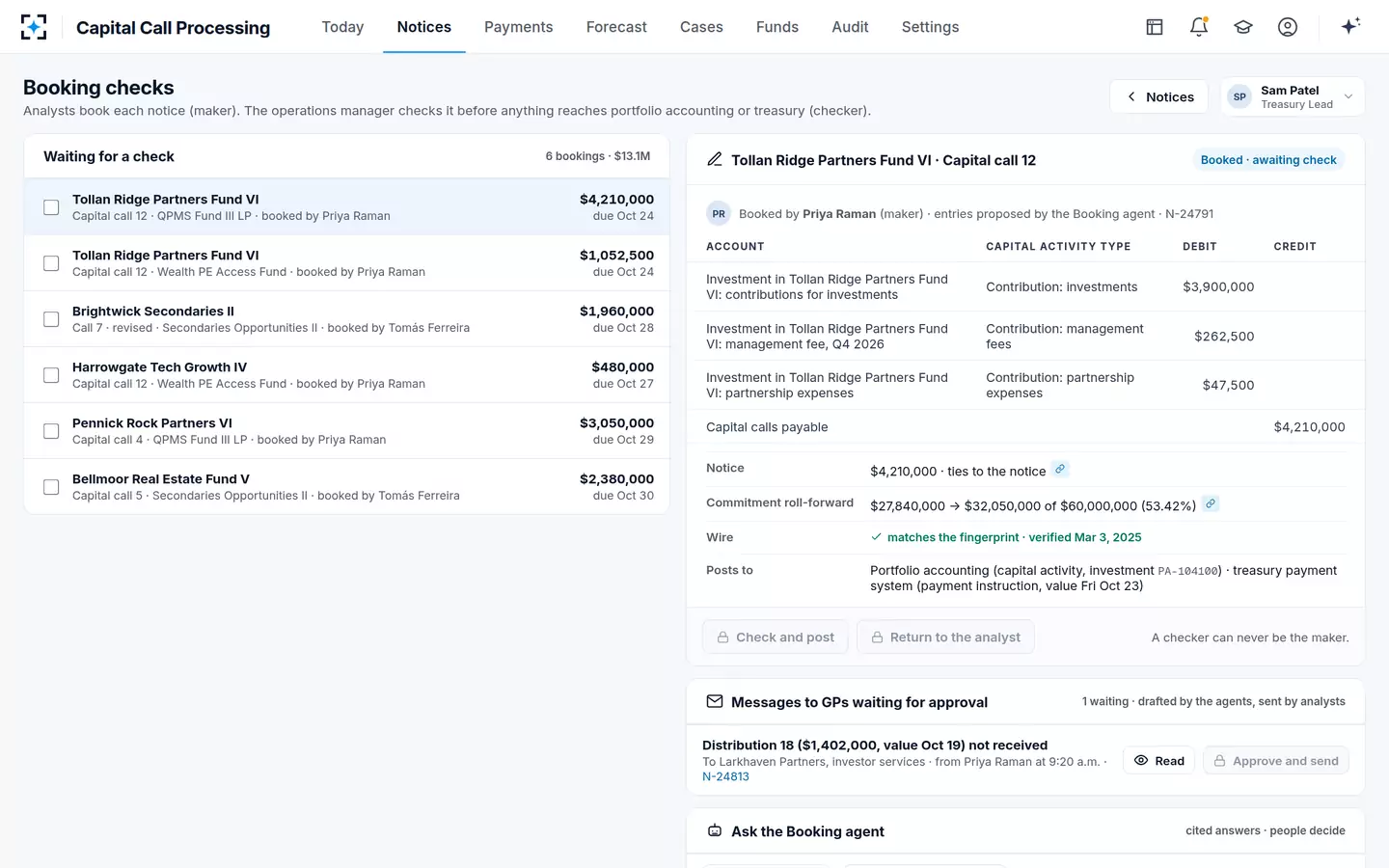
Take the genuine Tollan Ridge Call 12 for $4,210,000. It asked for $3,900,000 for investments, $262,500 of management fee and $47,500 of partnership expenses. The fee is easy to check: 1.75% of a $60,000,000 commitment is $1,050,000 a year, and a quarter of that is $262,500. Whether a fee should still be charged on commitments at all depends on the fund's terms; fees on committed capital versus invested capital explains the switch.
The same call as journal entries, waiting for a checker
Why the wire check is the step that matters most
The wire check matters most because a wrong fee can be recovered on the next notice and a wire to a fraudster usually cannot. FinCEN's advisory on email compromise explains why: these schemes succeed by "prompting financial institutions to execute seemingly legitimate but unauthorized or fraudulently induced transactions", and such transfers are hard to reverse once made (FIN-2019-A005).
The fraud is aimed at exactly this work. In the reports Luxembourg's financial intelligence unit reviewed for January to November 2025, 60% of suspicions involved fraudulent capital call notices, 70% of cases used spoofed or lookalike email addresses to alter payment instructions, and the average amount per report was €1.5 million; only 45% of cases were identified before any money moved (CRF Trend alert #2). In the United States, business email compromise complaints to the FBI reported $3,046,598,558 of losses in 2025 (IC3 2025 report).
The control that works is a comparison with something the fraudster cannot edit: the bank details verified when the LP subscribed, and a call-back to a number from the subscription documents, never one printed in the notice. In the sample, a Monday-night email with "updated wire instructions" for the same Tollan Ridge call was blocked three minutes after it arrived, and the GP's CFO confirmed on the number on file the next morning that nothing had changed. Testing your own capital call wire checks with planted fakes shows how to find out whether your process would have done the same.
Booking and paying: who does what in Capital Call Processing
Booking and payment are where the work leaves operations and becomes money, so the solution keeps them with people and separates them. An analyst books the entries the agents propose; the private markets operations manager checks entries he or she did not book; treasury releases only to accounts that match verified bank details; and a financial crime officer owns any suspicious notice as a case.
The separation is not ceremony. A notice that passes every check still waits for its booking check before treasury can select it, and a held notice cannot be selected at all. In the sample, the genuine Tollan Ridge call waited in the payments queue as "Booking not checked" until the manager signed, then paid a day before its Saturday due date. Every read, check, call, decision and payment is recorded with who did it and why, on an audit trail chained so that entries cannot be changed afterwards.
Can a capital call be paid late?
Only if the partnership agreement allows it; otherwise a late or short payment is a default, and the consequences are the ones the agreement lists. Delaware's limited partnership act lets an agreement set penalties or other consequences for a partner who fails to make a required contribution (6 Del. C. §17-502(c)), and what happens if you miss a capital call walks through them. The penalties themselves, from interest to forfeiture, are written fund by fund.
That is why a disputed amount is paid in full and queried, not short-paid. In the sample, a credit fund charged its fee on a $40,000,000 commitment when a side letter moved it to $35,000,000 of invested capital, $18,750 too much; the agents recommended paying the full $2,640,000 and sending the query, because under the sample LPA a short payment is a default. What happens if you miss a capital call walks through the remedies and the decision.
Questions people ask
What is a capital call notice?
It is the GP's formal request for part of an LP's commitment: the amount, the due date, what the money is for and where to send it, usually with the LP's commitment summary before and after the call. It arrives through the GP's investor portal, by email or from the fund administrator, and the partnership agreement says which delivery counts.
How do capital calls work in private equity?
The fund closes with commitments, then calls them as it invests and as fees fall due, over an investment period that is set in the agreement. In one large investor's records, the average fund had called 56.8% of commitments by the end of year 3 and 93.6% by year 10, so an LP should expect most calls early and some never.
What is uncalled capital?
Uncalled capital, or the unfunded commitment, is the part of a commitment the GP has not yet called: the commitment less contributions, plus any distributions the agreement makes recallable. EU law counts it as part of the fund's capital, alongside contributions already made.
Who sends capital call notices?
The GP issues them, often through a fund administrator that calculates each LP's share and posts the notices. LPs receive them through investor portals, email and administrator file feeds, and a large LP may see the same fund's notice in more than one channel, which is why duplicates and revised notices need checking.
Can an LP refuse a capital call?
Not if the call meets the agreement's conditions. An agreement may excuse an investor from a particular investment for legal or regulatory reasons, and a call outside the permitted purposes can be disputed, but those rights come from the agreement, not from a general right to decline.
What is the difference between a capital call and a capital commitment?
The commitment is the total an investor agrees to provide over the fund's life; a call is one instalment of it. The commitment is signed once, at subscription, while calls arrive for years, and each one reduces what remains unfunded.