The capital call process at a limited partner runs through four desks: an LP operations analyst reads each notice and checks its amount and bank details, books it, a private markets operations manager checks the booking, and treasury releases the payment before the due date, with a financial crime officer called in when a notice looks wrong. By hand, most of the analyst's day goes on logging in to GP portals, downloading PDFs, keying figures and chasing call-backs, so the work that protects money, re-reading the side letter behind a fee and refusing a bank change that came by email, gets the time that is left. Botminds' Capital Call Processing takes the reading, recomputing, comparing and calling off the analyst, and leaves the booking and the decisions with people.
The day below is fictional sample data: Tuesday, October 20, 2026, at Quillfield Capital, an LP with 412 commitments to 168 GPs through 23 investing entities and about 3,100 notices a year, as it runs through the solution. The people are characters, not customers.
One genuine call and one fake, on the same desk, in the same week
- Posted on the GP portal, FriFri
- WeekendSat–Sun
- Booked by the analyst, MonMon
- Booking check, then release by ThuTue–Thu
- Value date, FriFri
- Due date, SatSat
- Before the email
- Arrives and is blocked, Mon nightMon
- Call-back and rejection, TueTue
What is the capital call process? Five hand-offs between four desks
The capital call process is the chain from a GP's notice to a paid, booked call: receive, read, check the amount, check the wire, book, check the booking, release. Each hand-off exists because a different person must own each risk. The analyst owns accuracy, the manager owns the booking control, treasury owns the payment, and the financial crime officer owns anything suspicious.
The chain is long because the inputs are scattered. Notices arrive through GP investor portals, the operations mailbox and fund administrators' file feeds, each GP in its own layout and some in other languages. The terms they are checked against sit in the partnership agreements, side letters and subscription documents. And the outputs go to two systems the desk does not own: portfolio accounting and the treasury payment system.
What does an LP operations analyst do?
An LP operations analyst turns GP notices into correct entries and safe payments: collecting capital call and distribution notices, checking each against the commitment and the fund terms, confirming bank details, booking the capital activity and answering for it at the year-end confirmation. In the sample, the analysts' work is split by investing entity and region, one covering US entities and outsourced CIO accounts, another the European entities.
Five people on one capital call, before and after the agents
Today
Downloads notices from portals and the mailbox and re-keys each PDF; side letters are re-read only when something looks odd.
With agents
Books notices the agents have read and recomputed, and raises the fee queries they drafted.
Still theirs: The booking, and the judgment on every query
Today
Reads notices in German, French, Swedish and Spanish and translates the figures before he can check them.
With agents
Sees the original beside the English, each value tied to its page.
Still theirs: The check on anything the agents could not read
Today
Answers for every booking, message to a GP and bank change, from spreadsheets and email.
With agents
Checks and posts entries she did not book, and approves each message to a GP.
Still theirs: The second signature
Today
Releases 20 to 40 wires a week against the cut-off, trusting someone compared each with the last one.
With agents
Opens the payment that should not be made with the call-back already done, and decides with a reason code.
Still theirs: Release and rejection
Today
Hears about a suspicious notice in a forwarded email and rebuilds the story from inboxes.
With agents
Receives a case with its evidence and drafted actions.
Still theirs: Every action, and the reporting decision
7:00 a.m.: what arrived overnight
The analyst's first hour by hand is collection: logging in to each GP portal that has posted something, downloading the notice, saving it to the right entity's folder, then working through the mailbox and the administrators' files. The same notice can arrive through two channels, and a revised notice can replace an earlier one, so each has to be matched by its number.
The Tuesday morning screen: four numbers and what needs a person
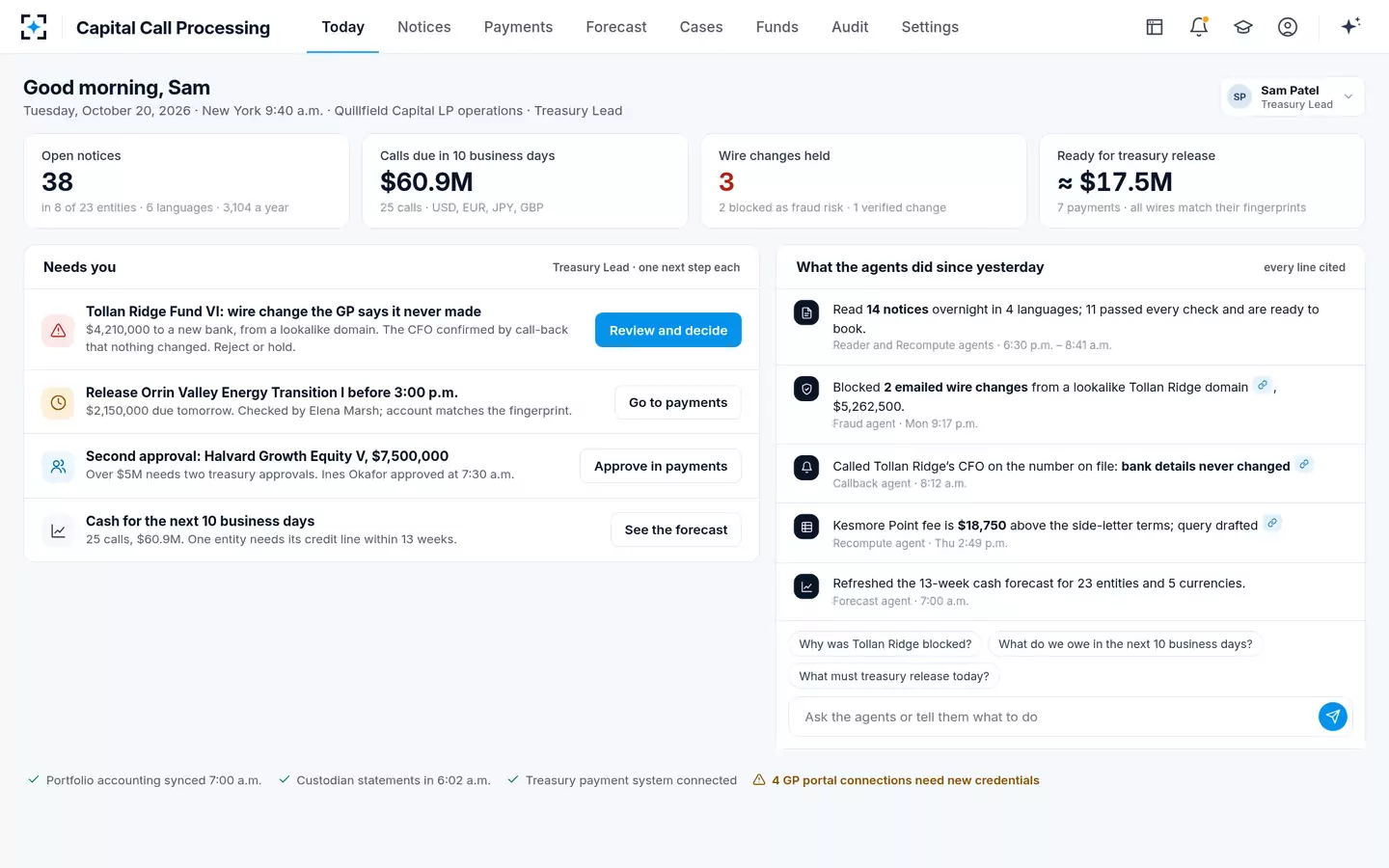
With the agents, the morning starts from the exceptions. In the sample, 14 notices had been read overnight in four languages, 11 had passed every check, and three things needed a person: two emailed wire changes from a lookalike domain, and a fee $18,750 above a side letter's terms. The collection hour is gone; what is left is the part only a person should do.
Mid-morning: reading, keying and the side letter nobody re-read
Keying is where accuracy is lost by hand, and checking the fee is where money is. A notice's total is easy to key correctly and easy to check against itself; whether the management fee is charged on the right basis needs the agreement, every side letter and the date the basis changed, and by hand side letters tend to be re-read only when something looks odd. On the GP's side, the same promises are meant to sit in a side letter tracker with an owner and a date; the LP's desk is the check that they were kept.
The sample's credit fund call shows the cost. Kesmore Point Credit Opportunities III charged its fourth-quarter fee as 1.5% of a $40,000,000 commitment, $150,000, when the investor's side letter moved the basis to invested capital, $35,000,000, after June 30: $131,250, or $18,750 less. Nothing on the notice looked odd. Fees on committed capital versus invested capital explains why that switch is where fees go wrong.
Language adds its own step. A European analyst who reads a German notice, "Kapitalabrufmitteilung Nr. 7", must translate each figure before checking it; with the original beside the English values, each tied to its page, the check takes minutes, and the notice's own commitment summary (€21,500,000 called before, €23,342,500 after, 46.69% of €50,000,000) can be matched to the cent.
The hour that matters: wire changes and call-backs
A changed bank account is the one item on the desk that can lose the whole amount, and it is also the item most likely to arrive under time pressure. FinCEN lists instructions sent so as to leave little time to confirm they are genuine as a red flag (FIN-2016-A003), and a capital call due in three business days is exactly that.
The control is a call-back to a number from the subscription documents, never one in the email, and it takes time an analyst often does not have: finding the right contact, reaching them, asking open questions without reading the new details aloud, and writing it up. Luxembourg's financial intelligence unit put the sector's need in one line: "Confirming your client's designated contact person, along with the authorized individuals for payment validation and signature" (CRF Trend alert #2).
In the sample, the call-back was done before anyone arrived. The Callback agent reached the GP's CFO at 8:12 a.m. on the number on file, recorded a 2 minute 41 second call in which she said nothing had changed, and the treasury lead rejected both payments with a reason code at 9:42. The Case agent added a detail from the analyst's own mailbox: on October 15 the same lookalike domain had emailed her asking who approves payments.
Who approves a capital call payment?
A capital call payment should be approved by someone other than the person who booked it, and released by treasury only to bank details that were verified independently of the notice. FinCEN treats payment authorisation as one of the business processes organisations should harden against email fraud, alongside confirming who they are dealing with and handling changes to payment details (FIN-2019-A005).
Who signs what on a capital call: a separation of duties that holds
- The analyst books; the analyst never releases
Booking creates the payment instruction; someone else decides whether it goes.
- A checker who is not the maker
The operations manager checks and posts entries she did not book; the system should refuse the same person in both roles.
- Treasury releases to verified bank details only
A payment to an account that differs from the verified one cannot be selected at all.
- Two approvers above a threshold
The sample LP requires two treasury approvals over $5,000,000; set your own threshold.
- Bank changes need their own approvals
Two call-backs to contacts on file and two approvers, the operations manager and the financial crime officer, neither of them the requester.
- Every decision carries a reason and a name
Who, when, why, on an audit trail that cannot be edited afterwards.
Afternoon: booking, the second check and the cut-off
The afternoon is about time. Bookings must be checked before treasury can select them, and treasury must release before the bank's wire cut-off; in the sample, 3:00 p.m. Eastern, one business day before each due date. A booking left unchecked at 2:00 p.m. is a payment that will be late.
In the sample, six bookings worth $13.1 million were waiting for the manager's check, among them the genuine Tollan Ridge call for $4,210,000, booked on Monday from entries the agents proposed: $3,900,000 of investments, $262,500 of management fee and $47,500 of partnership expenses. One payment had to go that day, $2,150,000 to Orrin Valley Energy Transition I, and a $7,500,000 call showed "1 of 2 approvals". Nothing in the queue could be paid to bank details that had not been verified.
How many capital calls does an LP receive?
As many as its commitments generate, which for a large LP means thousands a year. The sample LP, with 412 commitments, receives about 3,100 capital call and distribution notices a year, or roughly seven or eight per commitment, across GP portals, the mailbox and administrators.
The flow is not even. Funds call most in their first years: in one large investor's records, the average fund had called 56.8% of commitments by the end of year 3 (Ljungqvist and Richardson, NBER Working Paper 9454). An LP that commits heavily in one year will see its desk's volume rise for the next three. How a capital call works, end to end sets out the steps each of those notices goes through.
Where the time goes, by hand and with the solution
By hand, the elapsed time of a call is spread evenly across collection, keying, checking and booking; with the agents, most of what remains is the human part, booking, checking and release. That shift is the point: the time saved is mechanical, and the time kept is judgment.
Share of a notice's elapsed time, by step: the human steps become most of it
By hand, 5.5 business days
- Waiting to be picked up · 18.2%
- Reading and keying · 18.2%
- Checking the amount · 18.2%
- Wire check and call-back · 18.2%
- Booking and check · 18.2%
- Release · 9%
With the solution, 1.25 business days
- Picked up · 4%
- Read · 8%
- Amount · 8%
- Wire and call-back · 20%
- Booking and check · 40%
- Release · 20%
What changes for the analyst with Capital Call Processing
The analyst stops collecting and keying and starts deciding. The Reader agent reads every notice in its own language and cites each value to its page; the Recompute agent rebuilds the amount from the commitment, the agreement's fee terms and the side letters; the Fraud agent compares the bank and sender details with those verified for the fund; the Callback agent makes and records the call-back; the Booking agent proposes the entries. The analyst books what is right and questions what is not, without re-keying a PDF.
Some things stay exactly where they were. A value the agents cannot read with confidence, such as a faint scan's due date in the sample, is marked unreadable and handed to an analyst rather than guessed. The agents never book, never release a payment, never approve a bank change and never send a message to a GP. And portal credentials still expire: in the sample, four GP portal connections needed new log-ins that morning, a job no agent does. To see the desk's day from the solution's side, start from Capital Call Processing; one notice traced from inbox to payment times each step.
Questions people ask
How are capital calls processed at an LP?
The notice is collected from a portal, mailbox or administrator file, read, checked against the commitment and the fund terms, its bank details compared with those verified for the fund, booked to portfolio accounting, checked by a second person and paid by treasury before the due date. Any changed bank detail stops the process until a call-back confirms it.
What is a capital call process flow?
It is the same chain drawn as a diagram: GP notice, intake, read, recompute, wire check, booking, booking check, treasury release, with a branch to a fraud case when the wire check fails and a branch to a GP query when the amount differs. The branches matter more than the main line, because that is where the risk sits.
What systems does an LP operations team use for capital calls?
Typically GP investor portals and email for notices, a document store for agreements and side letters, portfolio accounting for commitments and capital activity, a treasury payment system for wires, and custodian bank statements for matching distributions. Much of the work is moving figures between them.
What is a call-back verification?
It is a phone call to a known contact at the GP, on a number from the subscription documents or the GP contact list, to confirm a payment instruction before paying it. The rule that matters is never to use a number given in the notice or email being verified.
How long does it take to process a capital call?
By hand, Botminds estimates about five and a half business days of elapsed time per notice at a multi-entity LP, and about one and a quarter with Capital Call Processing; the agreement's notice period is the hard limit either way. Both are estimates, not measured results.
What skills does an LP operations analyst need?
Fund accounting, a close reading of partnership agreements and side letters, and payment controls: knowing how a call should be calculated, how it is booked, and why a bank change is never accepted from an email. Languages help at LPs with European or Asian funds.