Fit-for-purpose biomarker assay development and validation means deciding how much validation an assay owes from the decision its data will carry, writing that purpose down before the experiments start, and then judging the measured performance against it. It is hard in practice for a reason that has nothing to do with laboratory skill: biomarker assays measure substances that are already in every sample, so several of the comforts a drug assay relies on — a fully characterised reference standard, a blank matrix, a settled set of acceptance limits — are not available. Biomarker Strategy Planning puts the purpose, the validation status and the date each assay has to be ready in the same view, so the question "validated for what, and ready when?" has one answer rather than three.
The product examples on this page come from the fictional sample programme the solution ships with — an anti-amyloid antibody in early Alzheimer's disease, with a stability study that missed its acceptance criterion. The study numbers, laboratories and people in it are invented. Everything attributed to a regulator or a journal is real and linked where it appears.
The benchmark definition of method validation has been presented by the International Organisation for Standardisation as "the confirmation by examination and the provision of objective evidence that the particular requirements for a specific intended use are fulfilled".
ISO definition of method validation, as quoted by Cummings and colleagues, British Journal of Cancer 103(9), 2010
What does fit-for-purpose mean in biomarker assay validation?
Read the ISO definition slowly and the whole doctrine is in it: objective evidence, particular requirements, specific intended use. Validation is not a fixed body of experiments; it is a demonstration that stated requirements, for a stated use, are met. FDA says the same thing for biomarkers in one sentence: "Biomarkers can be used for a wide variety of purposes during drug development. Therefore, a fit-for-purpose approach should be used when determining the appropriate extent of method validation" (FDA, Bioanalytical Method Validation for Biomarkers, April 2026).
What fit-for-purpose does not mean is less work. It means differently sized work, and in the directions that matter it often means more: a pre-screening assay that decides who enters a study needs performance characterised around the cut-off, across the matrix and handling conditions your sites will actually produce, which is a larger undertaking than running a standard panel of experiments and filing the report.
Purpose first, experiments second: the definition that makes it work
The sequencing is the part most often lost. Cummings and colleagues, writing for oncology trials, put the test where it belongs: "The critical step in the whole process then rests on the evaluation of technical performance against the predefined purpose. If the assay can deliver to expectations, then it is deemed fit for that purpose. If not, then it cannot be considered fit for the specified purpose."
And they name the failure directly: "Comparing performance specifications against predefined acceptance limits in isolation of purpose does not conform to the strict definition of method validation." A validation report that proves a coefficient of variation under 20% without ever saying what decision 20% is good enough for has measured something true and answered nothing. The same authors observe that "the position of the biomarker in the spectrum between research tool and clinical end point dictates the stringency of experimental proof required to achieve method validation" — which is the same hinge as the context of use, reached from the laboratory's side. How a context-of-use statement sets the evidence bar is the other half of this argument.
The five stages, from defining purpose to routine use
The review describes validation as proceeding through five discrete stages, with continual improvement that "may necessitate a series of iterations that can lead back to any one of the earlier stages". Laying a validation plan out this way makes the dependencies visible, which is what a strategy needs in order to put dates against them.
Five stages: what each settles, what it produces, and how each one fails
| Stage | What is decided | What comes out of it | How it goes wrong |
|---|---|---|---|
| 1. Define the purpose, choose the assay | The decision the data will carry, and which candidate method can carry it. The review calls this stage perhaps the most critical. | A written purpose, and a chosen platform. | Skipped. The platform is chosen because it is already in the building, and the purpose is written afterwards to fit it. |
| 2. Reagents, plan and classification | All components assembled, the validation plan written, and the assay class fixed — definitive quantitative, relative quantitative, quasi-quantitative or qualitative. | A method validation plan with acceptance criteria set in advance. | Criteria are left open "until we see the data", which removes the only thing that makes stage 3 a test. |
| 3. Performance verification | Whether measured performance meets the pre-set criteria for the stated purpose. | The validation report, and a standard operating procedure. | A miss gets renegotiated into a pass by widening the criterion after the fact. |
| 4. In-study validation | How the assay behaves in the clinical context, including patient sampling issues such as collection, storage and stability. | Evidence that the assay holds outside the laboratory that developed it. | Treated as monitoring rather than validation, so a site-handling problem is read as biological variability. |
| 5. Routine use | Whether performance holds run to run: quality control monitoring, proficiency testing and batch-to-batch issues. | A controlled, monitored assay with a drift history. | A reagent lot changes and nobody bridges, so a step in the data is attributed to the drug. |
Stage 4 deserves more respect than it usually gets. It is the stage at which an assay meets forty sites, three couriers and a public holiday, and it is where "fit for purpose" either survives contact with a trial or quietly stops being true.
The characteristics a biomarker assay has to establish
FDA's guidance names eight: "Method validation for biomarker assays should address the same questions as method validation for drug assays. The accuracy, precision, sensitivity, selectivity, parallelism, range, reproducibility, and stability of a biomarker assay are important characteristics that define the method." Each answers a different question, and a validation plan reads better when it is written as answers rather than as a list of experiments.
Eight characteristics, and the question each one answers
- Accuracy
How close is the measured value to the true one? For an endogenous analyte with no definitive standard, this becomes a question about relative trueness and bias.
- Precision
If the same sample is run again, how different is the answer? This is the number the size of your claimed effect has to beat.
- Sensitivity
How low can the assay measure and still be quantitative? Usually expressed as the lower limit of quantitation.
- Selectivity
Does anything else in the sample get counted as the analyte? Haemolysis, lipaemia and cross-reacting isoforms all live here.
- Parallelism
When a real sample is diluted, does the result track the dilution? If it does not, patient samples and calibrators are not behaving alike.
- Range
Between which two concentrations is the assay trustworthy, and do your patients’ values fall inside it?
- Reproducibility
Does the second laboratory, the second analyst and the second reagent lot get the same answer? This is the characteristic that decides whether a transfer is possible.
- Stability
How long can a sample wait, at which temperature, through how many freeze–thaw cycles, before the number changes?
Why endogenous analytes break the drug-assay playbook
Drug assays have advantages a biomarker assay rarely enjoys. The analyte is a synthetic molecule, so a fully characterised reference standard exists. It is absent before dosing, so blank matrix is available. Both of those are what let an industry settle on fixed acceptance limits.
For biomarkers neither holds. As the British Journal of Cancer review puts it, "as most biomarker LBA ligands are endogenous substances and already present in patient/volunteer samples, an analyte-free matrix to utilise during validation studies is more difficult to obtain. Access to a fully characterised form of biomarker to act as a calibration standard is also limited." That is why most protein biomarker assays are relative rather than definitive quantitative, and why the numbers they produce belong to the platform that produced them.
A drug assay and a biomarker assay, characteristic by characteristic
Drug assay: The synthetic drug substance itself, fully characterised.
Biomarker assay: Often a recombinant form that is not fully representative of the endogenous analyte.
Drug assay: Available — the analyte is absent before dosing.
Biomarker assay: Rarely available; the analyte is in every sample, including the control.
Drug assay: Industry-settled: repeat analyses within 15%, 20% at the lower limit of quantitation.
Biomarker assay: Set case by case; the review cites 25% as a common default, 30% at the lower limit, and warns against applying fixed criteria without checking they are relevant.
Drug assay: An absolute concentration.
Biomarker assay: A value on this platform, in this matrix. Comparable across studies only after a bridging study.
Drug assay: Selectivity against metabolites.
Biomarker assay: Parallelism and dilution linearity, where real samples and calibrators part company.
Drug assay: ICH M10 in full.
Biomarker assay: M10 excludes biomarkers; FDA’s 2026 biomarker guidance applies M10’s principles and says some criteria may not fit.
The last row is the one to carry into a planning meeting. FDA states plainly that "the M10 Bioanalytical Method Validation and Study Sample Analysis excludes biomarkers from consideration", and that its own guidance exists to address how validation "should be addressed consistent with the principles" of M10. It then adds the sentence that makes a validation plan a judgement rather than a form: "The Agency realizes that some of the characteristics or criteria in the guidance for industry M10 ... might not be applicable to some biomarker analyses, or that different characteristics should be considered, especially for other types of bioanalytical platforms."
Parallelism, dilution linearity and the matrix problem
Of the eight characteristics, parallelism is the one that most often exposes an assay that looked fine. The review is unusually emphatic: "The study of dilution linearity and especially parallelism in performance verification of relative quantitative assays such as LBA cannot be over emphasised."
The two are easily confused. Dilution linearity asks whether a sample spiked to a high concentration reads back proportionally when diluted — a question about the assay's arithmetic. Parallelism asks whether a real patient sample, diluted in the assay's own diluent, tracks the calibration curve — a question about whether the endogenous analyte behaves like the calibrator at all. Dilution linearity can pass while parallelism fails, and when it does the assay is measuring the standard well and the patient badly.
The consequence is practical rather than theoretical. Non-parallelism means a result depends on the dilution it was run at, so two laboratories running the same kit at different dilutions will disagree, and a cut-off moved between them will move with the dilution. Any assay that will carry a cut-off into a selection decision should have parallelism established before the cut-off is fixed, not after.
Pre-analytical handling is part of the assay
The most reproducible way to produce an irreproducible biomarker result is to leave the sample on a bench. The Global Biomarker Standardization Consortium's consensus handling study measured this systematically for blood-based Alzheimer's markers, and its recommendations read like a protocol appendix because that is exactly what they should become.
Three pre-analytical windows, measured rather than assumed
4hours
maximum delay to centrifugation when plasma tubes are kept at room temperature, or 7 hours refrigerated
7hours
that separated plasma aliquots stayed stable at room temperature pending freezing, for the amyloid peptides
2cycles
the recommended limit on freezing and thawing, although up to four extra cycles left most markers studied unchanged
The pre-analytical clock a protocol has to specify, hour by hour
- Draw, then stand and transportup to 4 hours
- Beyond this the least stable analytes fallmeasurements drift
- Draw, then hold cold until centrifugationup to 7 hours
- Beyond this the window closesmeasurements drift
- Aliquots held at room temperature before freezingstable to 7 hours
- Then into the freezerfreeze
Two points follow for a strategy. First, these windows are assay characteristics, not logistics: a marker whose handling window is four hours cannot be collected at a site that batches its courier runs daily, and that is a site-selection fact that belongs in the assay development plan. Second, the windows are measured for specific analytes on specific platforms. Importing a number from a different marker is the same error as importing a cut-off.
What happens when a result misses its acceptance criterion?
It is recorded as a miss, and the decisions it can carry are narrowed until it is fixed. That sounds obvious written down and is uncomfortable in a room, because the alternative — widening the criterion, or calling the shortfall immaterial — is always available and always looks reasonable. But a criterion set after the result is not a criterion, and an assay judged against it has not been validated in the ISO sense at all.
The honest sequence is short. State what missed and by how much. State which decisions the data can still carry and which it cannot. Name an owner and a date for the remediation. Then let the strategy say so in the gap analysis rather than in a footnote. In the fictional sample programme the solution ships with, a stability study reports 84% recovery after nine months at −80 °C against an 85% acceptance criterion, while Phase 2 samples would be stored for up to eighteen months — a one-point miss that matters because of the storage duration, not because of the one point. It is carried as a high-severity gap with a named owner and a date, and the proposed fix is re-validation with stabiliser tubes.
Every assay activity against the study calendar, with the critical path marked
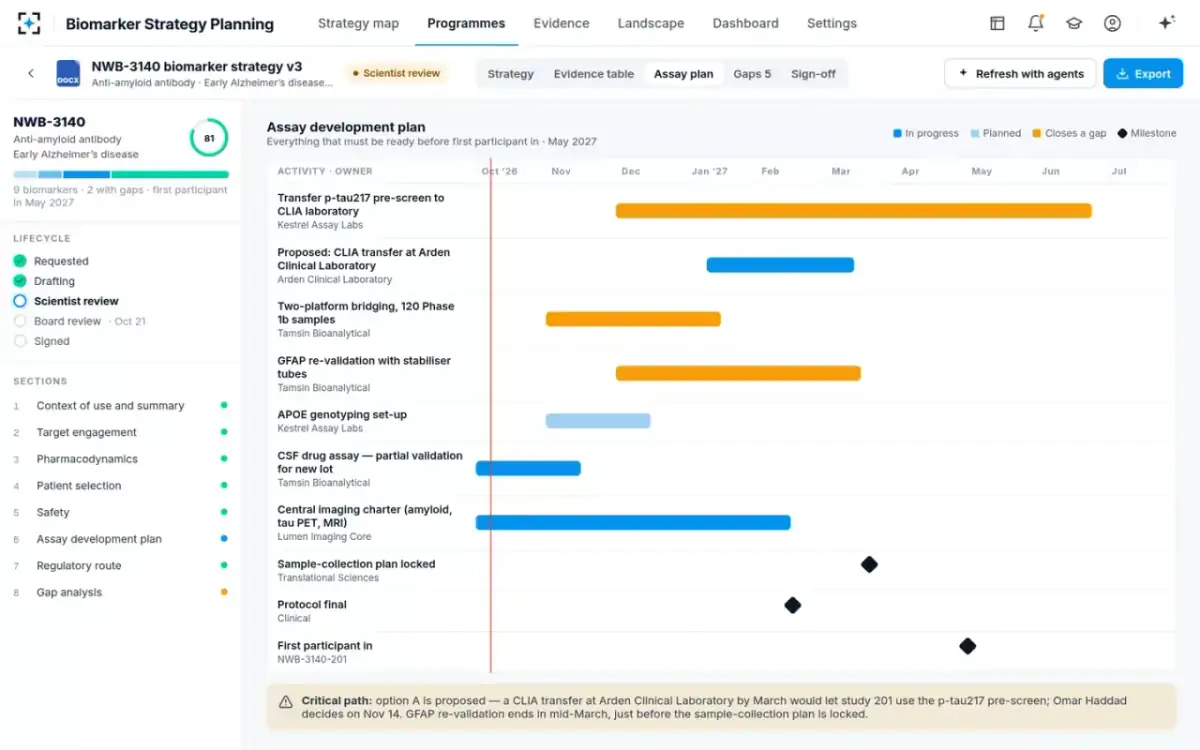
Full validation, partial validation, and the decision that decides
FDA draws the line by consequence, and names both ends. At the top: "when biomarker data will be used to support regulatory decisionmaking, such as the pivotal determination of safety and/or effectiveness to support approval or to support dosage instructions in product labeling, the assay should be fully validated as described in the guidance for industry M10". At the other end: "for assays intended to only support internal pharmaceutical company decision-making (e.g., candidate selection, go-no-go decisions, proof-of-concept), the sponsor should incorporate the extent of method validation they deem appropriate."
What the data will carry, and the validation that follows
| What the data will be used for | Validation depth | Who will ask about it |
|---|---|---|
| Candidate selection, internal go/no-go, proof of concept | The extent the sponsor deems appropriate, with the purpose and criteria still written down in advance. | Your own development committee, and anyone who later wants to reuse the data. |
| Dose selection carried into the next study | Enough precision to distinguish the differences the dose decision rests on, established before the study reads out. | The reviewer of the next protocol, who will ask how the dose was chosen. |
| Eligibility: who enters the study | Characterised around the cut-off, across the handling conditions the sites will produce, with parallelism established. | The medical monitor, and every site that screen-fails a patient. |
| Pivotal safety or effectiveness, or label dosage instructions | Full validation, as described in ICH M10, applied through the biomarker guidance’s principles. | The agency, in the submission. |
| A test that will decide treatment in practice | The above, plus a device conversation that starts years earlier. | The device centre, and the diagnostic partner. |
Two further rules sit beside this. Where a laboratory modifies a cleared test or brings up a method of its own, US clinical laboratory regulation requires it to establish performance specifications before reporting patient results, and lists them: accuracy, precision, analytical sensitivity, analytical specificity including interfering substances, reportable range, reference intervals, "and any other performance characteristic required for test performance" (42 CFR 493.1253). And for qualification, FDA's evidentiary framework observes that although "biomarkers considered for qualification are conceptually independent of the specific method of measurement", a biomarker "cannot be qualified without a reliable method of measurement" (evidentiary framework). The idea may be platform-independent; the qualification never is.
Who signs an assay off as fit for purpose?
Typically the bioanalytical or laboratory lead signs the validation report, and that signature certifies technical performance against the criteria in the plan. It is not the same as certifying fitness for purpose, because the purpose was set by someone else. The second signature — from whoever owns the decision the data will carry — is the one that closes the loop, and it is the easier one to leave out.
One practical arrangement is a two-line sign-off: the laboratory states what was measured against which criteria, and the translational or diagnostics lead states which decisions the assay is now cleared to carry. When a result misses, only the second line changes, and it changes visibly.
The evidence rules, the confidence threshold and the approvers are settings
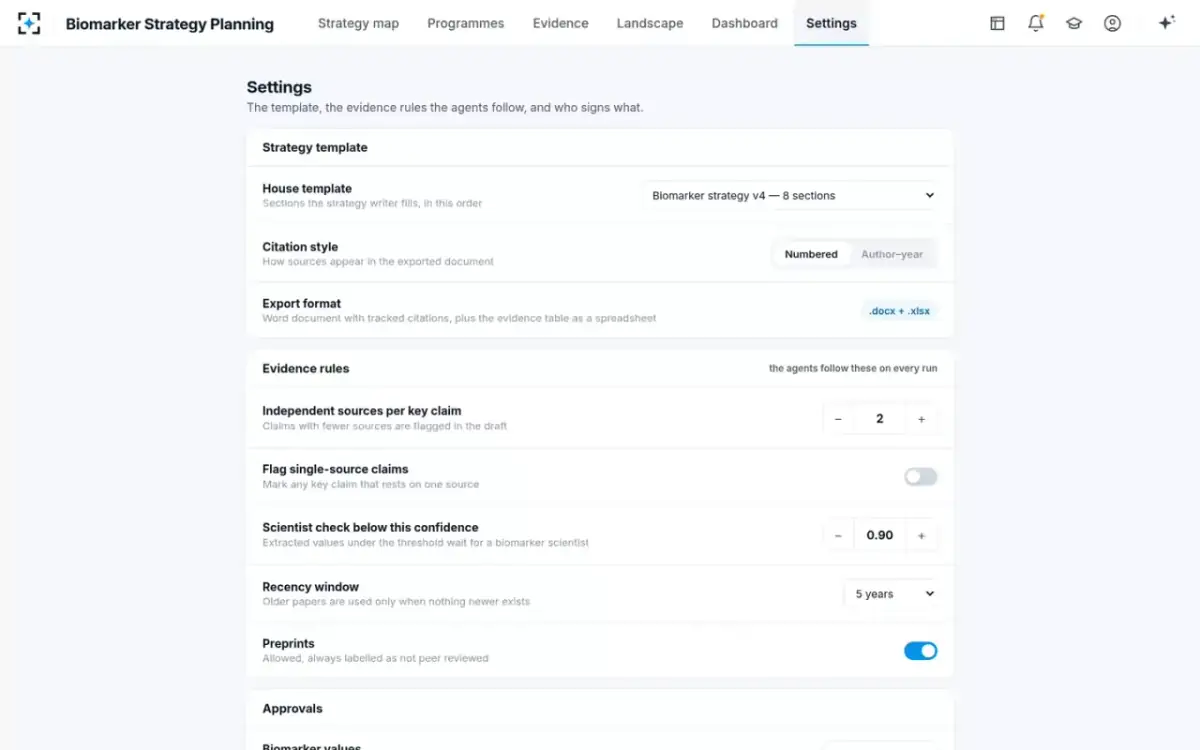
Where Biomarker Strategy Planning fits beside the validation package
Biomarker Strategy Planning does not run assays and does not write validation reports. What it does is read them. An internal data reader extracts effect sizes, confidence intervals, limits of quantitation, precision, parallelism and stability figures from your own Phase 1, validation and stability reports, compares each against the acceptance criterion stated in the report, and flags any value that falls outside. Extracted values below the configured confidence threshold wait for a biomarker scientist, who confirms or corrects them beside the source passage; the strategy writer uses only values a scientist has checked.
The second thing it does is arithmetic nobody enjoys: a gap and risk reviewer times every assay activity against first participant in for the study that needs it, and marks a marker as not ready when the dates do not work. It lists each gap with a severity, an owner and a date, and costs the options — but it never closes a gap or picks an option. To see the assay plan, the flagged values and the gap list together, start from Biomarker Strategy Planning, or read what an enrichment design costs when the assay is late.
Questions people ask
Does ICH M10 apply to biomarkers?
Not directly. FDA states that M10 "excludes biomarkers from consideration", and published its own biomarker guidance in April 2026 to address how validation should be approached consistently with M10's principles. The practical position is that M10 is the reference for a fully validated assay supporting a pivotal determination, while the biomarker guidance governs how its principles are applied — and warns that some M10 criteria may not fit a given biomarker platform at all.
What is parallelism, and why do biomarker assays need it?
Parallelism tests whether a real patient sample, serially diluted in the assay's diluent, produces results that track the calibration curve. It matters because biomarker calibrators are usually not fully representative of the endogenous analyte, so the two can diverge. A non-parallel assay gives a result that depends on the dilution it was run at, which quietly moves any cut-off set on it. Dilution linearity, by contrast, is tested with a spiked sample and asks a narrower question about the assay's arithmetic.
When does a biomarker assay need full validation?
When the data will support a regulatory determination — the pivotal assessment of safety or effectiveness, or dosage instructions in labelling. FDA names those cases explicitly and points to ICH M10. For assays supporting only internal decisions such as candidate selection or proof of concept, the sponsor decides the extent, which is a freedom worth using deliberately rather than as a reason to document less.
What acceptance criteria apply to stability studies?
Whichever ones your plan set before the study ran. There is no universal figure; stability criteria are set from the decision and from how long samples will really be stored. The two mistakes are setting a criterion that the intended storage duration was never going to meet, and setting none, which turns the result into an observation rather than a test. A recovery result just under its criterion still matters when samples will be held for twice as long as the study ran.
Can a validated assay be moved to another laboratory?
Yes, with a transfer and a bridging exercise, and the time that takes is a date in the strategy rather than a detail. Reproducibility is the characteristic that decides whether a transfer is feasible at all, and two-platform or two-site bridging in banked samples is what demonstrates that results from before and after the move can be pooled. A transfer planned after the study calendar is fixed is a common way for a selection marker to arrive late.
Who signs off a biomarker assay as fit for purpose?
Two people, ideally. The laboratory lead certifies that the measured performance met the criteria in the validation plan. The owner of the decision — the translational lead, or the diagnostics lead for a selection assay — certifies which decisions that performance is now good enough to carry. Where only the first signature exists, "validated" gets read as "validated for anything", which is how an assay validated for an internal dose decision ends up deciding eligibility.