Biomarker data management is the work of keeping four things true at once: that the sample was handled in a way that makes its result interpretable, that the assay was validated for the decision the result supports, that the number in a document is the number the instrument produced, and that anyone can follow the number back to the page it came from two years later. Many systems sold for this job solve the first and the third — sample logistics and result capture — and stop before the second and the fourth. The rulebooks do not: source records must be attributable, legible, contemporaneous, original, accurate and complete; unnecessary transcription steps should be avoided; audit trails may not be switched off; study data must arrive in the standards the catalog names. Botminds' Biomarker Strategy Planning is built around the layer those requirements point at — the evidence and the decisions — and it is honest about living beside a laboratory system and a clinical data system rather than replacing either.
The requirements on this page come from ICH's good clinical practice guideline, the electronic records regulation, FDA's study data pages and bioanalytical method validation guidance, and a published consensus protocol, each linked where it is used. The product figures are demonstration data on a fictional programme, and every count, person and threshold in them is invented.
What does biomarker data management have to cover?
Four layers, each governed by a different rule, and each able to invalidate the ones above it.
The four layers a biomarker programme has to hold, and what governs each
| Layer | What has to be held | What governs it |
|---|---|---|
| The sample | Identity, consent scope, and the pre-analytical facts: tube type, draw time, time to centrifugation, aliquot volume, storage temperature, freeze–thaw count, shipment conditions. | Published consensus protocols for the analyte, and the assay's own validated sample handling. FDA's bioanalytical method validation guidance for biomarkers asks directly how collection, handling and storage affect the reliability of the data. |
| The assay | The validation report, its acceptance criteria, the lot and instrument used, and the status of the method for the decision the result supports. | The laboratory's own duty to establish or verify performance specifications and to document all of it, before results are reported. |
| The value | The number as the instrument produced it, who entered or transferred it, when, what changed and why — and an audit trail that cannot obscure the earlier entry. | ICH E6(R3) on source records and data governance; 21 CFR 11.10 for electronic records in closed systems. |
| The claim | The sentence in a strategy or a submission, the source it rests on, and a link that opens that source at the passage. | No single regulation — which is why it is the layer easiest to leave out. It is what a reviewer asks for when they ask where a number came from. |
Six words that decide whether a record counts
ICH's good clinical practice guideline, adopted on 6 January 2025, states the test in one sentence: "Source records should be attributable, legible, contemporaneous, original, accurate and complete. Changes to source records should be traceable, should not obscure the original entry and should be explained if necessary (via an audit trail)" (ICH E6(R3), section 2.12.2). Those six adjectives are usually quoted as a slogan. Read as six separate tests applied to a single biomarker value, they are a specification.
The six words as six tests a biomarker value either passes or fails
- Attributable — can you name who produced this number, and who touched it since?
Not the laboratory: the operator, the run, the person who transferred it, the person who confirmed it. An unattributed value cannot be defended by anyone.
- Legible — can a reader who was not there understand what this value is?
Units, matrix, analyte, assay and the acceptance criterion it was read against. "GFAP 142" is a number, not a result.
- Contemporaneous — was it recorded when it happened?
The pre-analytical facts are the hard case. A draw time written down the next morning is not contemporaneous, and nobody can tell afterwards.
- Original — is this the first capture, or a copy of a copy?
If the instrument output exists, the value in the document should be traceable to it rather than to a spreadsheet somebody built from it.
- Accurate — is it the number the instrument produced, unrounded and unconverted?
Rounding and unit conversion done by hand on the way into a document is a ready source of a number nobody can reconcile later.
- Complete — is the failing run in there too?
A set of values with the inconvenient ones missing is not complete, whatever else is true of it.
Why every transcription step is a risk you chose
The same section of E6(R3) carries a sentence that reads like a design rule because it is one: "Unnecessary transcription steps between the source record and the data acquisition tool should be avoided." Every hop a number makes — instrument to spreadsheet, spreadsheet to summary table, summary table to a slide, slide into a strategy document — is an opportunity for a transposition, a rounding, a stale version, or a value that loses the caveat it was carrying.
In biomarker work the hops are unusually numerous, because the number starts in one organisation and ends in another. A laboratory produces it, a report summarises it, a translational scientist pulls it into a strategy, and a medical writer re-states it in a submission. Nothing in that chain is wrong individually. Collectively it is four chances to introduce a difference nobody will be able to explain in two years, which is why the only durable answer is a link back to the original rather than a better habit of copying.
The guideline sets the proportion of effort as well. It asks that "the systems and processes that help ensure this quality should be designed and implemented in a way that is proportionate to the risks to participants and the reliability of trial results" — so the value that decides who is enrolled deserves more of this discipline than an exploratory measurement nobody will act on. That proportionality is a legitimate reason to treat some values as critical and others as not; it is not a reason to leave the critical ones in a spreadsheet.
Metadata: the pre-analytical facts without which a value is noise
For blood-based markers, handling is not context around the result — it is part of it. The Global Biomarker Standardization Consortium's consensus protocol for blood-based Alzheimer's biomarkers puts the problem plainly: "The widespread clinical validation and adoption of the AD-related BBM assays can be hindered by variability in pre-analytical sample handling, as this can substantially affect BBM levels and consequently their diagnostic accuracy" (Verberk et al., Alzheimer's & Dementia 21(10):e70752, 2025). That paper's recommendations are specific — prompt centrifugation of plasma tubes, with a stated maximum delay at room temperature and a longer one if the tubes are kept refrigerated, and a limit on freeze–thaw cycles — and each of them is a field that must travel with the sample if anyone is later to know whether a value is usable.
FDA asks the same question from the method side. Its bioanalytical method validation guidance for biomarkers lists among the questions a method has to answer: "How do sample collection, handling, and storage affect the reliability of the data from the bioanalytical method? For example, what steps need to be followed while collecting samples? Do the samples need to be frozen during shipping? What temperatures are required to store the samples, and how long can the samples be stored? How are samples affected by benchtop manipulations?" A system that holds the result but not the answers to those questions has stored a number whose interpretability cannot be established.
What has to travel with one plasma sample, from the vein to the run
- Tube type and lottube
- Draw timedraw time
- Time to centrifugation, and temperature until thentime to spin
- Aliquot volume and tubealiquot
- Freezer and temperaturefreezer
- Freeze–thaw countfreeze–thaw
- Shipment conditionsshipment
- Instrument, reagent lot, operator, runrun detail
- Acceptance criterion appliedcriterion
Audit trails, and the rule that they may not be switched off
Two instruments say the same thing from different directions, and together they settle many vendor conversations. The electronic records regulation requires audit trails that are secure, generated by the computer and time-stamped, recording independently when an operator created, changed or deleted an electronic record. Its most important clause for a buyer is that a change to a record may never hide what the record said before. The audit trail documentation must be retained at least as long as the records themselves and be available for agency review and copying. The same section also requires the system to be validated for accuracy, reliability and consistent intended performance, and for its ability to detect invalid or altered records (21 CFR 11.10).
ICH E6(R3) closes the obvious loophole: among the responsibilities for relevant metadata is "ensuring that audit trails, reports and logs are not disabled. Audit trails should not be modified except in rare circumstances (e.g., when a participant's personal information is inadvertently included in the data) and only if a log of such action and justification is maintained". It also asks that audit trails be interpretable and able to support review, that systems log user account creation and permission changes, that data changes be documented with a reason where appropriate, and that the capture of date and time be unambiguous — coordinated universal time, for example.
The phrase "not disabled" is worth taking literally when buying. A system with an administrator setting that turns the trail off has a feature that the guideline tells you not to use, and the existence of the setting is itself a question to ask about.
Retention is the half of this that gets designed last and asked about first. ICH E6(R3) requires that "the trial data and relevant metadata should be archived in a way that allows for their retrieval and readability and should be protected from unauthorised access and alterations throughout the retention period", and that they may be permanently destroyed only when no longer required under the applicable regulatory requirements. The electronic records regulation adds that audit trail documentation must be retained for at least as long as the records it describes, and be available for agency review and copying. For a biomarker programme that runs for a decade, "readability" is the demanding word: a value archived in a format that needs a discontinued application to open is retained in name only, and the metadata that made it interpretable are often the first thing to become unreadable.
Three requirements that are design constraints, not process
Not obscured
a change to an electronic record may not hide the information recorded before it (21 CFR 11.10)
Not disabled
audit trails, reports and logs are not to be disabled, and are modified only in rare, logged circumstances (ICH E6(R3))
Refuse to file
FDA may refuse to file an application whose study data do not conform to the required standards in its Data Standards Catalog
What standards must study data be submitted in?
The ones FDA's catalog names, and the consequence of ignoring it is not a query but a rejection: "FDA may refuse to file for New Drug Applications (NDAs) and Biologics License Applications (BLAs) or refuse to receive for Abbreviated NDAs (ANDAs) any electronic submission whose study data do not conform to the required standards specified in the FDA Data Standards Catalog" (FDA, Study Data Submission for CDER and CBER).
The currently supported standards are the CDISC family — the Standard for Exchange of Nonclinical Data for nonclinical work, the Study Data Tabulation Model for clinical data, the Analysis Data Model for analysis, and Define-XML for the metadata that accompany them — with the technical rejection criteria set out in the Study Data Technical Conformance Guide. For a biomarker programme the practical point is the last of those: the metadata that accompany the datasets are themselves a deliverable, and they describe the same facts the sample and assay layers were supposed to have been holding all along. A programme that captured those facts properly has a conversion problem. One that did not has an archaeology problem.
The traceable link from a claim to its passage
The fourth layer has no regulation of its own, which is why it can disappear from requirement lists. It is also the one that decides whether a strategy survives a question. A board member, a reviewer or a scientist who joins in eighteen months asks the same thing about a number: where did this come from? Three answers are possible. "From the Phase 1b report" is a gesture. "From table 14 of the Phase 1b report" is better. A link that opens the report at the passage, with the sentence the value was read from, ends the conversation.
The same value, captured two ways, and what each one can support later
Captured as a number: The value, a unit and a label in a table somebody built.
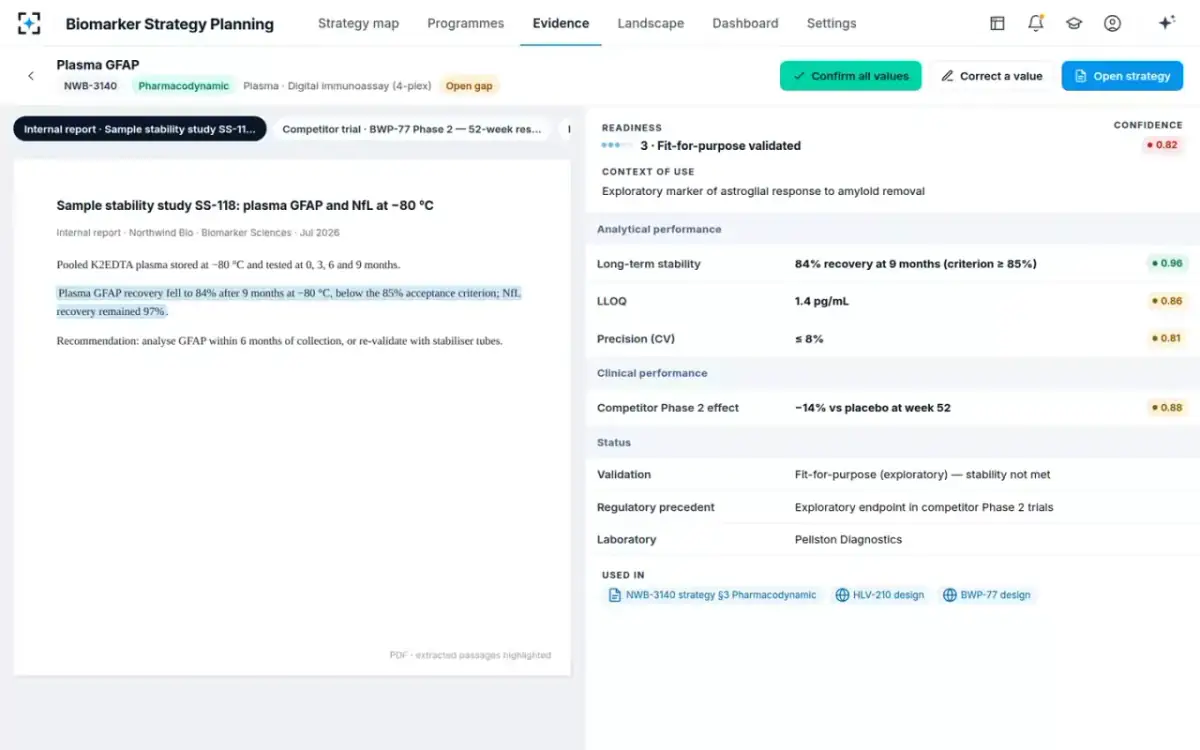
Captured with its evidence: The value, the source, the passage it was read from, the confidence in the extraction, and who confirmed it.
Captured as a number: Someone re-reads the report to work out which number this was, and whether it was the per-protocol or the full analysis set.
Captured with its evidence: The citation opens at the sentence. The question takes a minute.
Captured as a number: Nothing happens. The number in the document is now wrong and nobody knows.
Captured with its evidence: The link still points at the passage, and a superseded version remains readable rather than being overwritten.
Captured as a number: The caveat lived in a footnote in the report and did not travel.
Captured with its evidence: The acceptance criterion travels with the value, so a recovery below the criterion is visible wherever the number appears.
Captured as a number: A slide.
Captured with its evidence: A signed document, a submission section, and an answer to a reviewer.
A value beside the passage it came from, with its confidence
Who owns which part of the data, and who signs for it
Ownership questions are often asked as commercial questions, which is the less useful way to ask them. The useful version is narrower: for each layer, who is accountable for it being true, and what does that person need the system to show them? ICH E6(R3) frames the data governance section as guidance to "the responsible parties (i.e., investigators and sponsors) on appropriate management of data integrity, traceability and security, thereby allowing the accurate reporting, verification and interpretation of the clinical trial-related information" — two named parties, three properties, one purpose.
Four people, four different demands on the same system
Today
Re-checks every number in a draft against papers and reports he has to find again, and carries the caveats in his head.
With agents
Sees each value beside its source passage, and is asked to confirm or correct only the ones below the confidence threshold.
Still theirs: The judgement about whether a number is usable.
Today
Reconciles a laboratory system, a clinical data system and a pile of spreadsheets, and owns the differences between them.
With agents
Holds one evidence layer that points at both, with the pre-analytical facts attached to the value rather than filed separately.
Still theirs: The decision about what is critical data and what is not.
Today
Signs a section whose claims he would have to re-derive to defend.
With agents
Signs with every claim in his section cited to a passage he can open.
Still theirs: Accountability for the section's conclusions.
Today
Reads a static document and asks which parts are still true.
With agents
Reads a document that shows who checked each value, which gaps are open and when each source was read.
Still theirs: Approve, approve with conditions, or return — with a reason.
One number's journey, from a source passage to a signed strategy
Agent
Internal data readerReads the Phase 1 reports, laboratory validation reports and stability studies, and extracts the values against each report's own acceptance criteria.
Never: Never rounds, converts or combines a number; reports it exactly as written, and flags any value outside its criterion.
Agent
Extraction with evidenceStores each value beside the passage it came from, with a confidence figure and the criterion it was read against.
Never: Never stores a value without the passage.
A person decides
Biomarker scientistConfirms or corrects every value below the confidence threshold, looking at the passage rather than at a summary.
Agent
Strategy writerDrafts the section using only scientist-checked values, with every factual sentence cited.
Never: Never writes an uncited factual sentence, and never uses an unchecked value.
A person decides
Section co-signers and the board chairCo-sign their sections and sign the strategy, with the date, time and reason recorded.
Nine questions for a vendor, and the demands that should not bend
Take these to any biomarker data platform demonstration
- Show me one value, and open the document it came from at the passage.
Live, in the demonstration, on their data. This single request separates systems that hold evidence from systems that hold numbers.
- Which pre-analytical fields travel with a sample, and are any of them optional?
Tube, draw time, time to centrifugation, aliquot, freezer, freeze–thaw count, shipment. An optional field is a field that will be empty when it matters.
- Can the audit trail be switched off, by anyone, ever?
ICH E6(R3) says it should not be disabled and should be modified only in rare, logged circumstances. If the setting exists, ask who has it.
- When a record is changed, can I still read what it said before?
Record changes must not obscure previously recorded information. Ask to change something and then read the prior value.
- How many transcription steps are there between the instrument and a sentence in my document?
Count them in the demonstration. Each one is a step the guideline asks you to remove rather than to govern.
- What happens to a value when its source is superseded?
The answer should not be "it is overwritten". A superseded version that stays readable is how a signed document remains explicable.
- Does the acceptance criterion travel with the value?
A recovery of 84% means nothing without the 85% criterion beside it. If the criterion lives in a separate report, the caveat will not survive the first copy.
- What does it do with licensed full text?
Reading a licensed paper in place and citing the passage is not the same as copying the text into your system. Ask which one it does.
- Where does it stop — and what do I still need beside it?
A vendor who claims to be the laboratory system, the clinical data system and the evidence layer at once is describing an integration project, not a product.
What Biomarker Strategy Planning holds, and what it does not
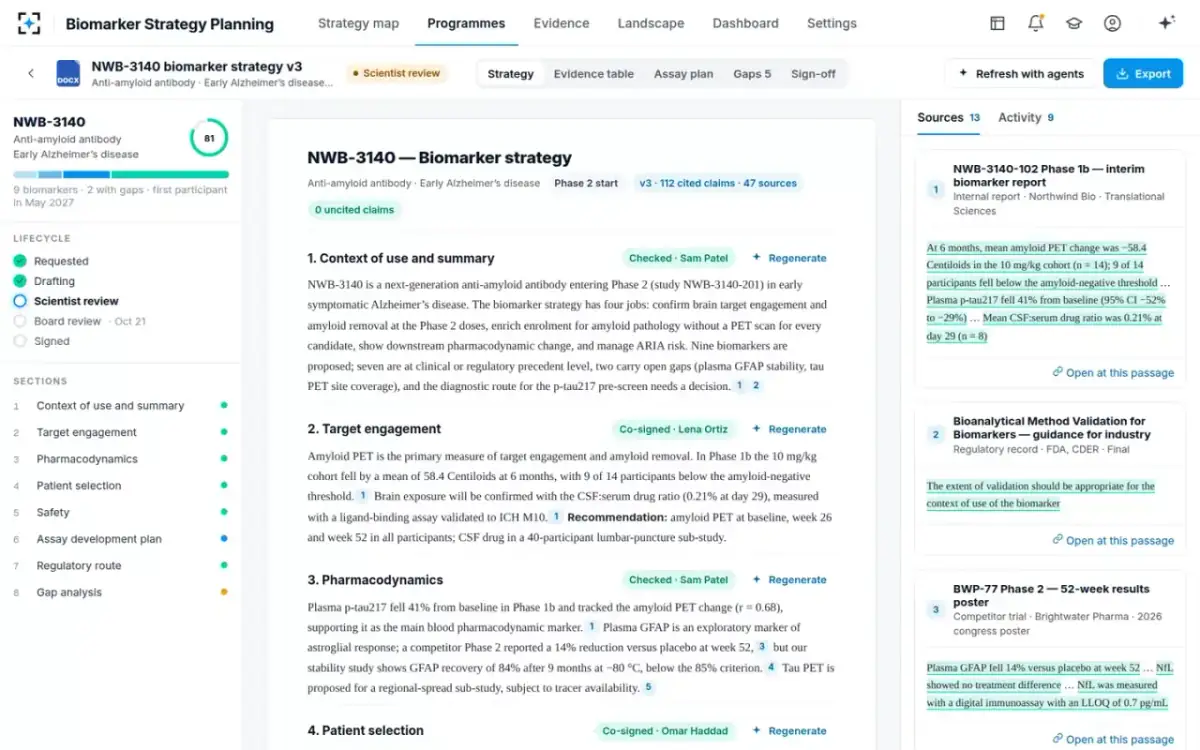
It holds the evidence and the decisions. Every extracted value sits beside the passage it came from, with a confidence figure; values below the threshold wait for a biomarker scientist to confirm or correct them, and the writer uses only checked values. Each citation opens its source at the passage. The activity trail records every agent step, every value check, every co-sign and every decision. Licensed full text is read in place rather than copied out, and a superseded strategy stays readable rather than being replaced. The strategy exports as a document with the evidence table as a spreadsheet, so the evidence leaves with the conclusion rather than staying behind in a system. In the sample programme, that comes to 112 cited claims from 47 sources with no uncited claims — demonstration figures on an invented programme, not a measured customer result.
What it does not hold is as important. It is not a laboratory information management system: it does not receive samples, book them in, or run a freezer. It is not a clinical data capture system: it does not hold case report forms or the trial's operational database. The pre-analytical facts above are produced by those systems, and the evidence layer's job is to carry them to the place where a claim is made — which is why the question to ask about any of the three is what it points at rather than what it owns. The assay side of the same chain, and what a laboratory must document before it may report anything at all, is covered in the guide to CLIA validation requirements, which rests on the laboratory's own duty to document all of it (42 CFR 493.1253).
The portfolio view: coverage, values checked, and where the evidence came from
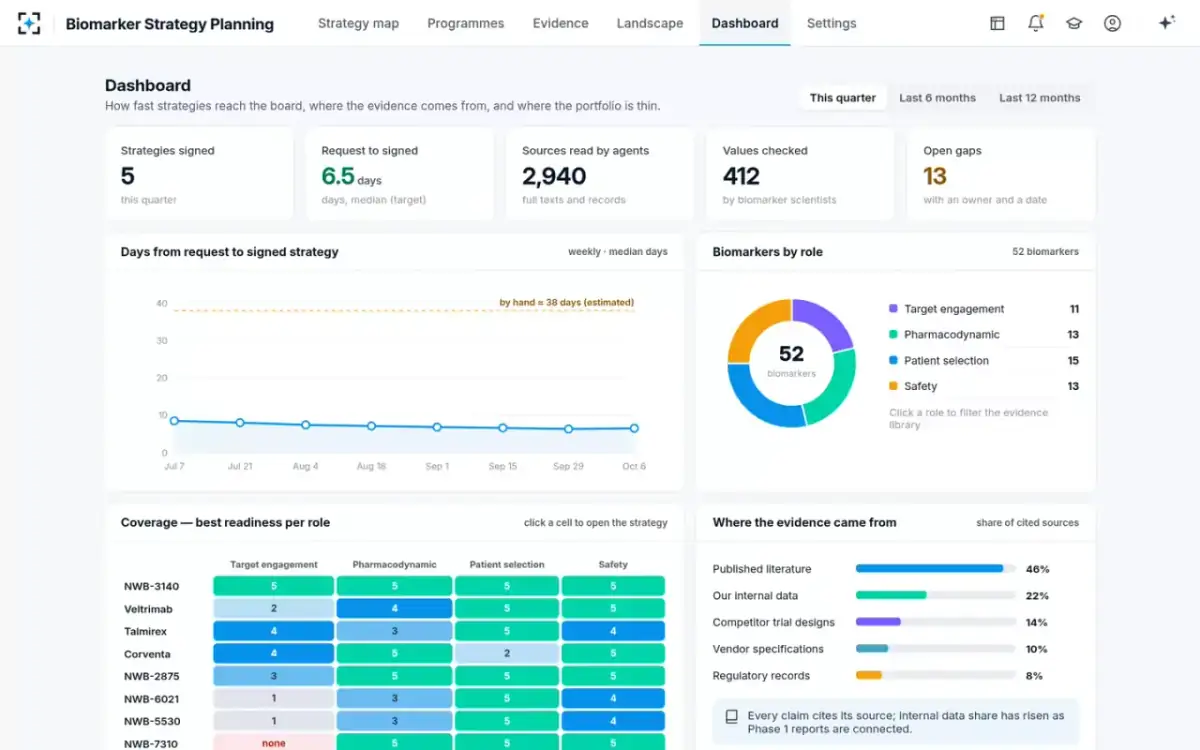
The argument for scoping biomarker data management this way is not that the evidence layer matters more than the sample. It is that the sample layer is often bought and the evidence layer often is not, so the failure arrives at the end, in a document somebody has already signed. For how the whole strategy is assembled around those values, start from how to build a biomarker strategy, or see it working on Biomarker Strategy Planning.
The signed strategy, and who checked each section
Questions people ask
What does ALCOA mean for a biomarker value?
ICH E6(R3) asks that source records be attributable, legible, contemporaneous, original, accurate and complete, and that changes be traceable, not obscure the original entry, and be explained where necessary via an audit trail. Applied to one value that means: you can name who produced and touched it; a stranger can tell what it is; the pre-analytical facts were written down when they happened; it traces to the first capture rather than a copy; it is unrounded and unconverted; and the failing runs are in there too.
What metadata and audit trails are required?
21 CFR 11.10 requires secure, computer-generated, time-stamped audit trails recording the date and time of operator entries and actions that create, modify or delete electronic records, with record changes not obscuring previously recorded information, and retention of the trail for at least as long as the records. ICH E6(R3) adds that audit trails, reports and logs should not be disabled, should be interpretable and able to support review, and that systems should log user account creation and permission changes and capture date and time unambiguously.
What pre-analytical information has to travel with a sample?
Enough to tell whether the value is interpretable: tube type, draw time, the delay before centrifugation and the temperature until then, aliquot volume, storage temperature, freeze–thaw count and shipment conditions, followed by the instrument, reagent lot, operator and run. Published consensus work on blood-based markers sets specific limits for several of these, because variability in pre-analytical handling can substantially affect measured levels and therefore diagnostic accuracy.
What standards must study data be submitted in?
Those specified in the FDA Data Standards Catalog — currently the CDISC standards: SEND for nonclinical data, SDTM for clinical data, ADaM for analysis data and Define-XML for the metadata that accompany them, with technical rejection criteria set out in the Study Data Technical Conformance Guide. FDA may refuse to file an NDA or BLA, or refuse to receive an ANDA, whose study data do not conform.
How do you keep a traceable link from a value to its source?
By storing the link at extraction rather than reconstructing it later, and by removing the copies in between — the guideline asks that unnecessary transcription steps between the source record and the acquisition tool be avoided. In practice that means the value, the source, the passage, the acceptance criterion and the person who confirmed it are one object, and a document cites that object instead of restating the number.
Who owns biomarker data in a programme?
Accountability splits by layer rather than by department. ICH E6(R3) names investigators and sponsors as the responsible parties for data integrity, traceability and security. In practice the laboratory owns the sample and assay records, the clinical data function owns the trial database, the biomarker scientist owns whether a value is usable, section co-signers own their conclusions and the board chair owns the decision. A system is useful to the extent it shows each of them what they are accountable for.