A companion diagnostic is an IVD — an in vitro diagnostic device — with one extra property: the safe and effective use of a particular medicine depends on its result. That is the whole of the distinction, and it is why the companion diagnostic vs IVD question is rarely answered in a diagnostics meeting. It is answered the moment a protocol says that a measurement will decide who is enrolled, which arm they go to, or what dose they get. From that moment the programme has two regulated products on two clocks, and the second one can hold up the first. Botminds' Biomarker Strategy Planning treats the diagnostic route as a line on the assay plan with a named owner and a decision date, rather than a question to be raised after the study calendar is fixed.
The regulatory statements on this page come from FDA's codevelopment guidance, FDA's biomarker qualification framework and EMA's companion diagnostic questions and answers, each linked where it is used. The programme examples come from a fictional sample portfolio inside the solution — Northwind Bio's NWB-3140, Veltrimab, NWB-8840 and NWB-9152 — and every sponsor, molecule, date and cost in them is invented.
Four questions that decide what you actually have
| The question | Answer: no | Answer: yes |
|---|---|---|
| Is the measurement being used to manage a participant — enrolment, arm, dose? | Exploratory measurement. Research-use-only materials may be enough, inside their labelled limits. | The result is driving care. Go on. |
| Is the sponsor intending to market the test for clinical use? | A clinical trial assay: developed or contracted for this trial only, fully specified and fixed while it runs. | A product. Go on. |
| Is the medicine's safe and effective use dependent on the result? | An IVD with its own intended purpose, assessed on its own terms. | A companion diagnostic. In the EU that means a notified body and a medicines-authority consultation. |
| Is the test made and used inside one health institution in the EU? | The ordinary device route applies. | An in-house device, exempt from most IVDR requirements on conditions — but limited to within one legal entity. |
What makes a test a companion diagnostic rather than an IVD?
Start with the wider category. FDA's codevelopment guidance quotes the regulation: in vitro diagnostic devices are "those reagents, instruments, and systems intended for use in the diagnosis of disease or other conditions, including a determination of the state of health, in order to cure, mitigate, treat, or prevent disease or its sequelae", intended for use "in the collection, preparation, and examination of specimens taken from the human body" (21 CFR 809.3(a), as set out in FDA's codevelopment guidance). A plasma assay that tells a clinician something about a patient is an IVD by that definition whether or not any medicine depends on it.
What narrows the category is dependence. A companion diagnostic is the IVD without which a specific medicine cannot be used safely and effectively — because it identifies who should get it, or who is at particular risk from it. The consequence is regulatory rather than scientific: the test stops being an instrument the trial uses and becomes a product the trial's conclusions rest on, with its own evidence, its own submission and its own authorisation date. Nothing about the measurement changes. What changes is the sentence in the protocol.
The European definition, and why it is drawn around the treatment decision
Europe writes the dependence into the definition itself. EMA's questions and answers for sponsors state it plainly: "Within the current regulatory framework, 'companion diagnostic' is defined in the Art. 2 (7) of the IVDR, as a device which is essential for the safe and effective use of a corresponding medicinal product to: • identify, before and/or during treatment, patients who are most likely to benefit from the corresponding medicinal product; or • identify, before and/or during treatment, patients likely to be at increased risk for serious adverse reactions as a result of treatment with the corresponding medicinal product" (EMA/CHMP/821321/2022, 6 December 2023).
Two phrases in that definition do most of the work. "Essential for the safe and effective use" is the dependence test — not whether the test is useful, but whether the medicine can be used properly without it. "Before and/or during treatment" quietly brings monitoring markers into scope: a test that triggers a dose change or a stopping rule can be as essential as the one that selected the patient in the first place.
The route that follows is specific. Under the IVDR, devices meeting that definition "require a conformity assessment by a notified body with consultation of the relevant medicinal product competent authority (EMA for centrally authorised medicinal product) to obtain CE marking", and EMA notes that the consultation "focuses on the suitability of the CDx for use with the concerned medicinal product(s)". That is two assessors, two queues and two sets of questions, and the sponsor does not control either queue.
The same test, two systems: what each regulator asks and when
United States (FDA): FDA, through the device route for the companion diagnostic, alongside the review of the medicine.
European Union (IVDR and EMA): A notified body assesses conformity, with a consultation of the medicines authority — EMA for a centrally authorised medicine.
United States (FDA): Review centres coordinate so that the device and the medicine can be authorised together.
European Union (IVDR and EMA): The consultation "focuses on the suitability of the CDx for use with the concerned medicinal product(s)".
United States (FDA): A "market-ready" assay is "highly recommended at the time of initiation of clinical trial(s) intended to support approval of the therapeutic product".
European Union (IVDR and EMA): Applicants "are advised to plan biomarker assay/CDx development as early as possible during drug development"; co-development is recommended.
United States (FDA): Evidence that the test used in the trial supports the labelled use, and a bridging study where the marketed test differs from the trial test.
European Union (IVDR and EMA): Validation data on the candidate test, because "the robustness of clinical data as determined by the reliability and suitability of a test … is a part of the benefit-risk assessment".
United States (FDA): The labelled use names the population the test identifies.
European Union (IVDR and EMA): EMA recommends section 4.2 refer to "a CE-marked in vitro diagnostic (IVD) or a validated test", with an alternative validated test where no CE-marked IVD is available.
United States (FDA): "Approval of the therapeutic product could be delayed until an appropriate IVD companion diagnostic receives marketing authorization."
European Union (IVDR and EMA): The device needs CE marking to be placed on the market; the consultation has to be timed against the medicine's own procedure.
The clinical trial assay: useful, fixed, and not a product
Most programmes meet the device question through an object that is not a device at all. FDA names it: "Early on in therapeutic product development programs, a test may be developed or contracted by the therapeutic product sponsor solely for the purpose of testing in the therapeutic product trial (i.e., the sponsor does not intend to market the test for clinical use). Such a test is often referred to as a clinical trial assay (CTA)." It is a legitimate and common way to run an early trial, and nothing about it is second-best.
What it is not is a plan. A clinical trial assay supports this trial; it does not become the marketed test by continuing to work well. If a programme intends to sell a companion test eventually, the trial assay is the thing a bridging study will one day have to be measured against — which makes decisions about its samples, its cut-off and its documentation decisions about a future submission. Where that assay sits under CLIA, and what a laboratory must establish before it may report a result at all, is the subject of our guide to CLIA assay validation requirements.
When should companion diagnostic development start?
Both regulators answer this the same way, in different vocabularies, and both answers are earlier than programmes often plan for. FDA: "Ideally, the need for an IVD companion diagnostic would be identified early in the course of therapeutic product development so that an analytically validated test can be prospectively incorporated into the design of the therapeutic product clinical trials." EMA: "Applicants are advised to plan biomarker assay/CDx development as early as possible during drug development to ensure timely access to new medicines approved for patients. Co-development of biomarker assay/CDx and drug candidate is recommended."
FDA also describes the harder case honestly. Sometimes the need appears late — "important safety or efficacy issues related to a particular subpopulation identified by testing with an IVD may not arise until late in the course of therapeutic product development" — and in those cases the guidance says what the consequence is rather than softening it: "approval of the therapeutic product could be delayed until an appropriate IVD companion diagnostic receives marketing authorization."
For a biomarker strategy this is the whole argument for having a regulatory-route section at all. The question "does this marker create a device?" has to be asked at the point the marker is proposed for a decision, not at the point someone asks who will sell the test. In the fictional sample portfolio, one programme illustrates the cost of asking late: Veltrimab selects patients on an immunohistochemistry marker measured by a trial assay, no companion test has been contracted, co-development is reckoned at about 24 months, and Phase 3 is due to start in the fourth quarter of 2027. Those figures are invented — but the arithmetic they illustrate is not, and it is arithmetic anyone can do a year earlier than the point where it becomes urgent.
Co-development drawn against the medicine's own phases
- Early phase: need identifiedneed identified
- Prototype assay in early trialsprototype
- Pivotal trialpivotal
- Reviewreview
- Feasibilityfeasibility
- Analytical validation to market-readymarket-ready
- Clinical performance in the pivotal trialin the trial
- Device submission and assessmentassessment
- Trial assay onlytrial assay only
- Need recognised late
- Build, validate, bridge, submitbuild · bridge · submit
Market-ready at the start of the pivotal trial, not at filing
A costly misreading in this area is that the companion test has to be ready when the medicine is filed. FDA's recommendation sits much earlier: "Although codevelopment as a process does not require simultaneous development of the IVD companion diagnostic and the therapeutic product from beginning to end, the availability of an IVD with 'market-ready' analytical performance characteristics (i.e., a test that is completely specified with complete analytical validation and meets the therapeutic product sponsor's expectations for performance) is highly recommended at the time of initiation of clinical trial(s) intended to support approval of the therapeutic product."
Read the parenthesis rather than the phrase. "Completely specified" means the components, the instrument, the protocol and the cut-off are settled. "Complete analytical validation" means the analytical work is finished, not under way. The recommendation is that this state exists on the day the pivotal trial starts enrolling, because the trial is the clinical evidence for the test as well as for the medicine. A test that is still moving during the trial produces evidence about a thing that no longer exists.
Bridging studies: proving the marketed test matches the trial test
When the trial did not run on the test that will be sold, the gap has to be closed with evidence. FDA describes the instrument: "If a test other than the candidate IVD companion diagnostic is used for the major efficacy trial(s), the IVD sponsor should demonstrate that the candidate IVD companion diagnostic has performance characteristics that are very similar to those of the test that was used in the trial (sometimes referred to as the clinical trial assay or CTA). This is generally demonstrated through a bridging study between the two tests, using the original clinical trial samples and a pre-specified statistical analysis plan."
Three design facts are buried in that sentence and each one is a decision taken years earlier. The study uses the original trial samples, so the biobank and its consent have to allow it. It needs a pre-specified analysis plan, so the acceptance criteria are agreed before anyone sees the concordance. And FDA goes on to say the study assesses "both concordance and discordance between the two tests using the same specimens from subjects who were tested for trial eligibility", including, where possible, samples from subjects excluded from the trial — which means the trial must have kept samples from the people it turned away. A programme that discards screen-failure samples has quietly removed a future option.
A bridging study, as FDA describes it
A person decides
Before the trial: the sample planDecides what is collected, in what matrix and volume, from whom — including participants who screen-fail — and under what consent it may later be re-tested.
Never: Never assumes a sample that was not collected can be recovered later.
A person decides
Before the analysis: the planPre-specifies the statistical analysis, the acceptance criteria and how missing samples will be handled.
Agent
Assay and precedent readerKeeps each test's validation status and regulatory precedent for the decision it supports, read from records it can open at the passage.
Never: Never infers that a test has been cleared or that a marker has been formally accepted without a record saying so.
A person decides
The studyRuns both tests on the original trial specimens and measures concordance and discordance, not agreement alone.
A person decides
Diagnostics leadReads the result against what the labelled use will claim, and decides whether the candidate test can carry the trial's evidence.
Contemporaneous authorisation, and what happens when it slips
The organising principle on the FDA side is that the two products arrive together: "an IVD companion diagnostic should be approved, granted a de novo request or cleared by FDA contemporaneously with the approval of the corresponding therapeutic product for the use indicated in the therapeutic product labeling." The guidance is explicit that it describes how to obtain contemporaneous marketing authorisations, and that review centres coordinate for that purpose.
Europe reaches the same destination by a different road. The device needs CE marking, which needs a notified body's conformity assessment, which needs the medicines-authority consultation — and EMA warns applicants to contact a notified body in good time, with the timing of the consultation procedure in mind. Meanwhile the medicine's own dossier is affected by the test regardless: EMA states that "the robustness of clinical data as determined by the reliability and suitability of a test … used in a pivotal clinical trial(s) … is a part of the benefit-risk assessment", and that validation data on the candidate test should be provided with the marketing authorisation application.
There is also a labelling consequence worth knowing before the product information is drafted. EMA recommends that "the wording in section 4.2 of the SmPC makes reference to a CE-marked in vitro diagnostic (IVD) or a validated test, e.g. '… should be assessed by a CE-marked IVD with the corresponding intended purpose. If the CE-marked IVD is not available, an alternative validated test should be used.'" That is the sentence a clinician eventually reads, and it is written on the strength of what the programme did about the test years earlier.
Three dated statements to anchor a regulatory-route section
Art. 2(7)
the IVDR article that defines a companion diagnostic by the medicine that depends on it, as EMA sets it out in EMA/CHMP/821321/2022 of 6 December 2023
15 Jul2016
FDA's draft codevelopment principles, which recommend a market-ready assay at the start of the trial intended to support approval
Dec2018
FDA's draft biomarker qualification evidentiary framework, whose footnote separates qualification of a marker from clearance of a device
In-house tests, central laboratories and the one-legal-entity limit
A question that comes up in European trial design: can a hospital's own validated test be used to decide eligibility? EMA's answer has two halves. Devices manufactured and used only within health institutions established in the Union are exempted from most of the IVDR's requirements, provided a number of conditions are satisfied — and then the limit: "To be noted, the use of 'in-house' devices is limited to within one legal entity."
That sentence settles a good deal of trial design. An in-house device cannot be the mechanism by which thirty sites across six countries test their candidates; it works within the institution that made it. A multi-site trial that needs one result to mean the same thing everywhere is back to a central or specialty laboratory, a single fixed protocol and evidence that the sites agree. In the United States the parallel question — how far a laboratory's own test sits inside the device regime — moved twice between 2024 and 2025 and ended where it started, which we set out with the dates in the CLIA guide (FDA, Laboratory Developed Tests). Either way the laboratory still owes the performance specifications that 42 CFR 493.1253 requires before it reports a patient result.
Qualification of the marker does not clear the device
One misunderstanding is worth isolating, because it is expensive when it happens.
"Qualification of a biomarker does not connote approval or clearance of a diagnostic device or of a companion or complementary diagnostic device for use in clinical practice, and it also does not qualify the biomarker for use in clinical practice."
FDA, Biomarker Qualification: Evidentiary Framework, draft guidance, December 2018, footnote 14
The two systems answer different questions. Qualification says a marker can be relied on for a stated purpose in drug development; device authorisation says a particular test may be sold and used to make a clinical decision. Neither delivers the other, and a programme that treats a qualified marker as a cleared test has mistaken a scientific conclusion for a commercial permission. What qualification does buy, and when it is worth seeking at all, is the subject of our guide to the FDA biomarker qualification programme.
A proposal with an owner and a date, not a question for later
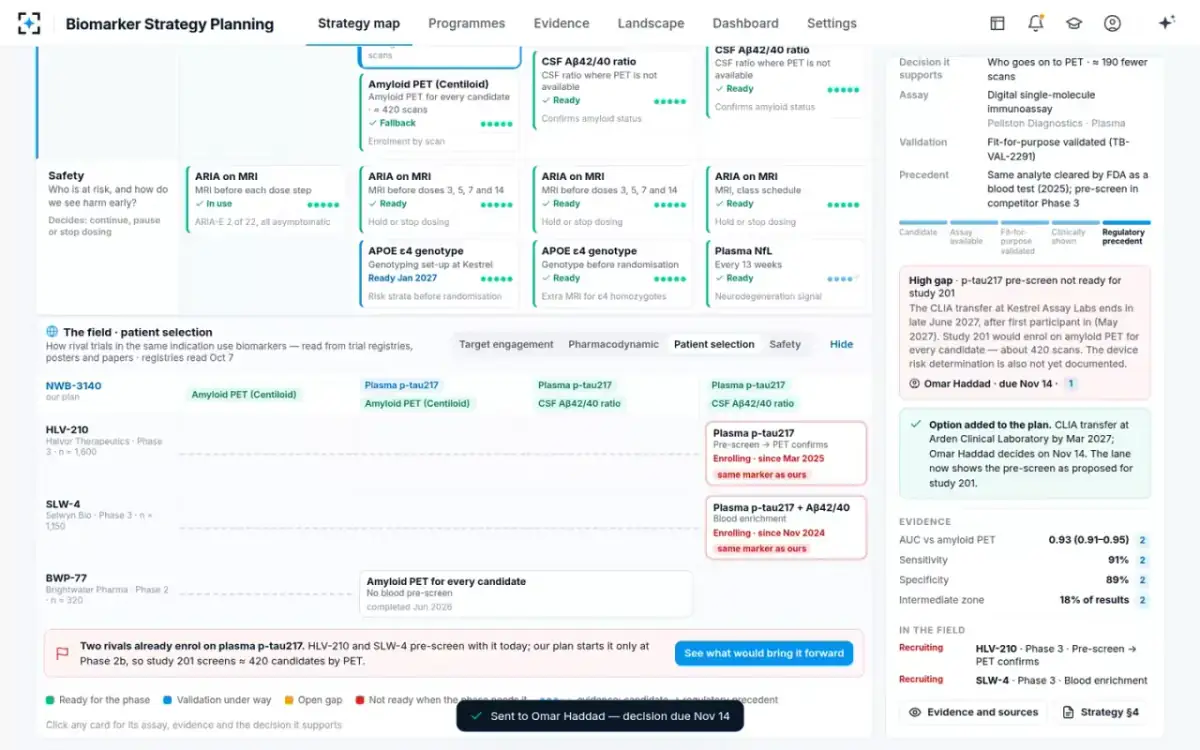
What Biomarker Strategy Planning puts in the plan
The reason this question is usually answered late is not ignorance; it is that the answer depends on four things that live in four places — what the protocol says the marker will decide, what validation the assay has today, what precedent exists for the marker in that role, and when the study needs it. A translational lead assembling those by hand gets one paragraph in the regulatory-route section and no way to keep it true.
In the solution they are one object. Each marker carries its validation status for the decision it supports; the assay and precedent reader flags tests that decide treatment as device-relevant, and never infers a regulatory acceptance that no record supports. Each assay activity sits on a plan drawn against the study's milestones. And the route itself is a decision with a name on it: in the fictional sample programme the diagnostics lead co-signs patient selection and decides the laboratory and diagnostic route, with a due date, and his summary of why this matters is a familiar one — the science was ready, and the laboratory was not.
The portfolio view is where it earns its place. Asked which programmes lack a validated patient-selection assay, the sample portfolio returns three, with the reason for each: a trial assay with no companion test contracted and a Phase 3 approaching, an assay not yet validated, and an exploratory signature that was never meant to select anyone. Those are invented programmes. The question is not invented, and it is hard to answer quickly when the facts live in four places.
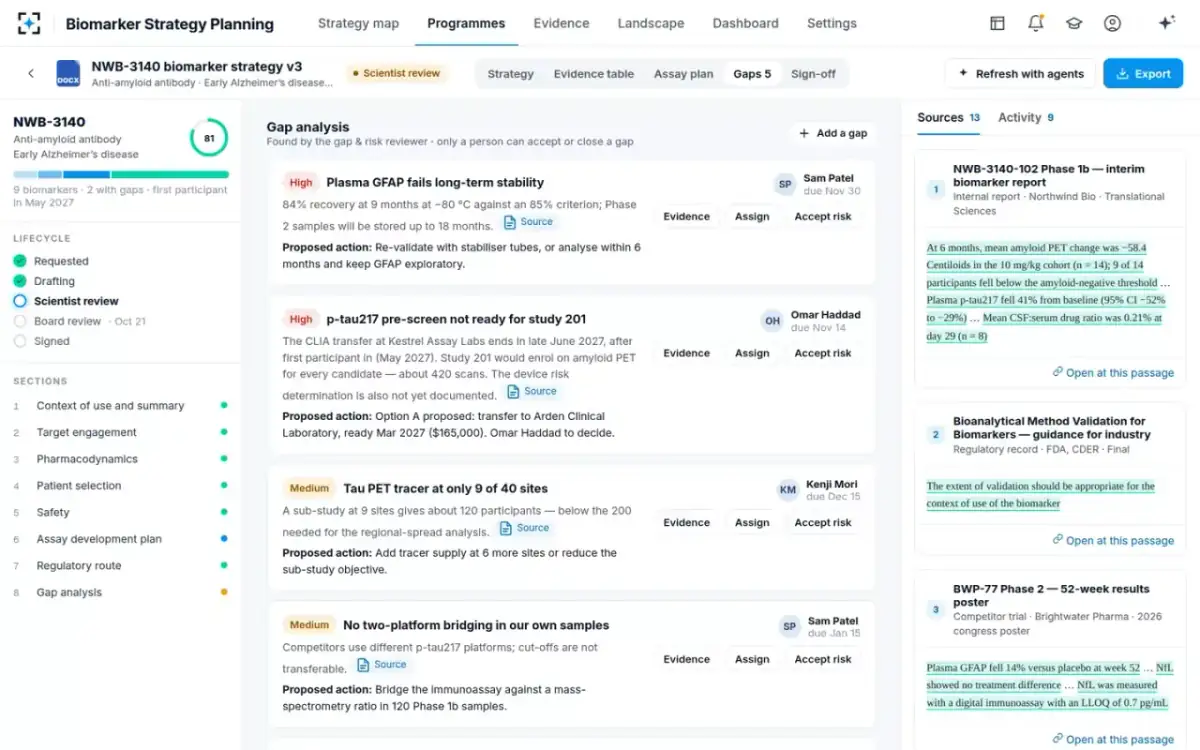
Gaps, each with a severity, an owner and a date
Eight things to settle with a diagnostic partner
Before the pivotal protocol is final, agree these in writing
- What exactly is the intended purpose of the marketed test?
The wording that will appear on the device and in the medicine's product information. Everything else is validated against it.
- Will the pivotal trial run on the candidate marketed test, or on a trial assay?
If the latter, a bridging study is already in the plan, and its samples have to be collected prospectively.
- Is the assay completely specified and analytically validated before first participant in?
Components, instrument, protocol, cut-off. FDA recommends market-ready at the start of the trial intended to support approval.
- Which markets, and which routes in each?
A notified body and a medicines-authority consultation in the EU; the device route in the US. Both have queues the sponsor does not control.
- Who owns the regulatory submission for the device, and who pays for it?
Co-development agreements differ. Write down who files, who answers questions and what happens if the partner stops.
- What happens to screen-failure samples?
Bridging benefits from specimens of subjects excluded from the trial. If consent and logistics do not allow it, say so now.
- What is the change-control rule for the test during the trial?
A fixed assay means no change to components, protocols or instrumentation while it is in use. Agree in advance what a discontinued reagent triggers.
- If the device is late, what does the medicine do?
FDA states that approval could be delayed until the companion diagnostic has marketing authorisation. Decide now what the fallback is, and who decides it.
Questions people ask
What is the difference between a companion diagnostic and an IVD?
An IVD is any reagent, instrument or system intended for use in examining specimens from the body to diagnose a disease or determine a state of health. A companion diagnostic is the subset of IVDs that a particular medicine depends on: under the IVDR it is "a device which is essential for the safe and effective use of a corresponding medicinal product" to identify who is most likely to benefit, or who is at increased risk of serious adverse reactions. Every companion diagnostic is an IVD; the dependence on one medicine is what makes it companion.
When does a selection biomarker become a companion diagnostic?
When a treatment decision starts to depend on its result and the test is intended for clinical use. In practice that moment arrives with a protocol sentence — this measurement will decide enrolment, arm or dose — rather than with a diagnostic decision. A test used only inside the sponsor's own trial, with no intention to market it, is a clinical trial assay rather than a companion diagnostic, but it is the thing a future marketed test will have to be bridged to.
What is a clinical trial assay, and how does it differ from a companion test?
FDA describes it as a test developed or contracted by the sponsor solely for testing in its own trial, where the sponsor does not intend to market the test. It is legitimate and common early on. The difference is intent and consequence: a trial assay supports this trial, must be fully specified and fixed while it runs, and carries no marketing authorisation; a companion diagnostic is a product with its own evidence, submission and authorisation date.
What is a bridging study, and when do you need one?
It is the study that shows the candidate marketed test performs very similarly to the test actually used in the pivotal trial. FDA expects it when a test other than the candidate companion diagnostic was used for the major efficacy trials, demonstrated using the original clinical trial samples and a pre-specified statistical analysis plan, assessing both concordance and discordance. Because it runs on the original specimens, the decision that makes it possible is the sample plan written before the trial started.
Can the therapeutic approval be delayed by the diagnostic?
Yes, and FDA says so directly. Where issues in a subpopulation identified by testing arise late in development, "approval of the therapeutic product could be delayed until an appropriate IVD companion diagnostic receives marketing authorization." The guidance adds that FDA will consider the timing of the therapeutic approval in certain circumstances after discussion with sponsors, but the dependency is real and it runs in only one direction.
Can a hospital's own in-house test be used to select patients in Europe?
Within limits. Devices manufactured and used only within health institutions established in the Union are exempted from most IVDR requirements if a number of conditions are met, but EMA notes that the use of in-house devices "is limited to within one legal entity". That makes an in-house device unsuitable as the mechanism for a multi-site, multi-country trial, which generally returns the design to a central or specialty laboratory with one fixed testing protocol and evidence that the sites agree.