The CLIA assay validation requirements are set out in one regulation, 42 CFR 493.1253, and they divide into two cases. A laboratory running an unmodified, FDA-cleared test must demonstrate it can match the manufacturer's accuracy, precision and reportable range, and verify that the manufacturer's reference intervals suit its own patient population. A laboratory that has modified a cleared test, or built its own, must establish six performance characteristics from scratch — accuracy, precision, analytical sensitivity, analytical specificity, reportable range and reference intervals — plus any other characteristic the test needs, and must document every activity. That second case is the one translational programmes often meet, because the assay that selects patients is often a laboratory's own. Botminds' Biomarker Strategy Planning exists partly for this reason: it times each assay's readiness against first participant in for the study that needs it, and turns a late laboratory into a dated, costed decision rather than a surprise.
The sponsor-side figures on this page come from a fictional sample programme as it runs through the solution: Northwind Bio's NWB-3140, an anti-amyloid antibody in early Alzheimer's disease, with study 201 (n = 180) due to start in May 2027. Every laboratory, date and cost in that example is invented sample data. The regulation, the certificate rules and the federal history come from the sources, linked where they appear.
42 CFR 493.1253: what a laboratory owes, by what it did to the test
Unmodified, FDA-cleared or approved test system: Verification. "Demonstrate that it can obtain performance specifications comparable to those established by the manufacturer."
Modified, in-house, or no manufacturer specifications: Establishment. "Establish for each test system the performance specifications for the following performance characteristics, as applicable."
Unmodified, FDA-cleared or approved test system: Demonstrate comparability to the manufacturer.
Modified, in-house, or no manufacturer specifications: Establish it.
Unmodified, FDA-cleared or approved test system: Demonstrate comparability to the manufacturer.
Modified, in-house, or no manufacturer specifications: Establish it.
Unmodified, FDA-cleared or approved test system: Demonstrate comparability to the manufacturer.
Modified, in-house, or no manufacturer specifications: Establish it.
Unmodified, FDA-cleared or approved test system: Not separately required.
Modified, in-house, or no manufacturer specifications: Establish it.
Unmodified, FDA-cleared or approved test system: Not separately required.
Modified, in-house, or no manufacturer specifications: Establish it, "to include interfering substances".
Unmodified, FDA-cleared or approved test system: "Verify that the manufacturer's reference intervals (normal values) are appropriate for the laboratory's patient population."
Modified, in-house, or no manufacturer specifications: Establish them.
Unmodified, FDA-cleared or approved test system: Nothing further named.
Modified, in-house, or no manufacturer specifications: "Any other performance characteristic required for test performance."
Unmodified, FDA-cleared or approved test system: "The laboratory must document all activities specified in this section."
Modified, in-house, or no manufacturer specifications: The same sentence applies.
What does CLIA require before a laboratory reports a result?
It requires that the laboratory already knows how the test behaves, in its own hands, on its own instrument, with its own staff — and that it wrote the evidence down. The regulation puts the duty before the first patient result rather than at inspection: a laboratory that modifies a cleared test or introduces one of its own "must, before reporting patient test results, establish for each test system the performance specifications" for the six named characteristics and any other the test needs (42 CFR 493.1253(b)(2)). Nothing in that sentence is about a trial, a sponsor or a protocol. It is about the laboratory, and it binds whether the result goes into a patient's chart or into a screening decision at a study site.
Two consequences follow for a biomarker strategy. The first is that readiness is a laboratory event with a date, not a scientific conclusion. A selection marker can have an excellent published discrimination against the reference standard and still be unusable in May, because the laboratory that will run it has not finished establishing precision. The second is that the work is not transferable by assertion: each laboratory establishes the specifications for its own test system, which is why moving an assay to a second site is a project rather than a shipment.
What is the difference between verifying and establishing performance specifications?
Verification asks a laboratory to reproduce someone else's claims; establishment asks it to make the claims. The regulation splits the two at paragraph (b)(1) and (b)(2), and the split turns on what the laboratory did to the test. If it runs the cleared test exactly as the manufacturer sells it, it verifies three characteristics and confirms the reference intervals fit its patients. If it changed anything — a different tube, a different sample type, an extraction step, a cut-off of its own, a platform the manufacturer never validated the assay on — or if it built the method itself, or if the supplier simply never published specifications, it is in the establishment case and owes the full six.
The workload is not twice as large; it is a different kind of work. Verification is usually a defined set of runs against known material with pre-agreed acceptance criteria. Establishment means designing the experiments that define the claim: how low the assay can measure and still be quantitative, what cross-reacts with it, what the interval is in a population that resembles the one being tested, and how all of that behaves across operators, days and lots. That design work, and the writing of it, is what fills the weeks that a study calendar rarely leaves. The platform-level thinking behind it — what "enough validation" means for the decision a marker supports — is the subject of our guide to fit-for-purpose biomarker assay development and validation; this page is about the regulatory floor and the clock.
The six performance specifications, in plain words, and what each one costs in calendar time
| Specification | The question it answers | Where the time goes |
|---|---|---|
| Accuracy | Does the number sit where the truth sits, against a comparison method or reference material? | Finding and consenting enough characterised samples across the measuring range; a comparison run against the method the claim will be read against. |
| Precision | If the same sample is measured again, how much does the answer move? | Repeat runs across days, operators, instruments and reagent lots. This is often the longest single item, because it is a calendar problem, not a bench problem. |
| Analytical sensitivity | How little of the analyte can the assay still measure reliably? | Dilution series near the bottom of the range, repeated enough times to describe variability where it is worst. |
| Analytical specificity | What else does the assay respond to? | Interference and cross-reactivity panels — haemolysis, lipaemia, common medicines, related molecules — each with a pre-set acceptance limit. |
| Reportable range | Between which two values may the laboratory issue a number? | Linearity across the claimed range, and the rules for what happens above and below it. |
| Reference intervals | What is normal in the people this laboratory tests? | Either a defensible transfer of the manufacturer's interval or a local study; for a plasma marker read against age, both are slow. |
Are laboratory developed tests regulated by the FDA?
As the law stands after September 2025, the regulation defining in vitro diagnostic products does not carry the words that would have brought a laboratory's own tests squarely inside it. FDA's own page records the sequence without commentary: on 6 May 2024 the agency "issued a final rule amending the definition of 'in vitro diagnostic products' in 21 CFR 809.3(a) to add the words 'including when the manufacturer of these products is a laboratory'"; on 31 March 2025 "a federal district court vacated that final rule"; and on 19 September 2025 FDA "issued a final rule reverting to the text of the regulation as it existed prior to the effective date of the May 2024 final rule" (FDA, Laboratory Developed Tests).
For a sponsor the practical reading is narrow and worth stating plainly. The federal device route for a laboratory's own test is not where the 2024 rule would have put it, so the CLIA requirements above remain the operative floor for a laboratory reporting results in a trial. That is a statement about the test, not about the medicine: the moment a treatment decision depends on the result, a different set of questions opens, which is why the line between a trial assay and a regulated device is treated as its own topic. What a biomarker strategy should not do is record the federal position as settled fact without a date, because this particular position moved twice within eighteen months.
Three dates that moved the answer, and then moved it back
6 May2024
final rule adding "including when the manufacturer of these products is a laboratory" to the definition of in vitro diagnostic products
31 Mar2025
a federal district court vacated that final rule
19 Sep2025
final rule reverting to the text of the regulation as it stood before the May 2024 rule took effect
Why the answer moved twice between 2024 and 2025
The mechanism matters more than the politics, because it tells a planner what to write down. The 2024 rule did not create a new regime out of nothing; it added one phrase to a definition, and everything else followed from the definition. Vacatur removed the amendment, and the September 2025 rule put the prior text back on the page rather than leaving the regulation in an uncertain state. The result is that the regulation reads today as it read in early 2024.
What a sponsor carries away is a habit rather than a conclusion. Any sentence in a biomarker strategy about the federal status of a laboratory's own test should name the instrument it rests on and the date the page was read, so that a reviewer twelve months later can tell whether the sentence is still true. In the solution, that is not a discipline anyone has to remember: the assay and precedent reader sets each marker's validation status and regulatory precedent from a source it can open at the passage, and it never infers that a marker or a method has been formally accepted where no such record exists.
Research use only, clinical trial assay, CLIA test: three different things
The three statuses are easily used as if they were points on one scale. They are not; they are different objects with different duties, and a protocol that confuses them tends to discover the fact late. FDA's codevelopment guidance is blunt about the first: products labelled for research use only "are not required to be designed or manufactured with the level of control required for investigational use or clinical diagnostic use, and they are not evaluated by FDA" (FDA, Principles for Codevelopment of an In Vitro Companion Diagnostic Device with a Therapeutic Product, draft, 15 July 2016). The same guidance notes it may be possible to use such products inside a clinical trial assay if the sponsor relabels them for investigational use and complies with the applicable requirements of 21 CFR Part 812.
One measurement, three statuses: what each one may be used for
| Status | What it is | What it may support | What it may not do |
|---|---|---|---|
| Research use only | A product labelled "For research use only. Not for use in diagnostic procedures." Not evaluated by FDA, and not built to investigational or diagnostic controls. | Exploratory measurement, method development, hypothesis work inside a research setting. | Be relied on, as sold and labelled, to manage a participant in a trial. |
| Clinical trial assay | A test developed or contracted for use in the sponsor's own trial, with no intention to market it. Fully specified and fixed for the trial, with one testing protocol across all sites. | Selecting or assigning participants and investigating outcome hypotheses within that trial. | Be treated as a marketable product, or be changed mid-trial without consequence for the evidence. |
| CLIA-validated test at a certified laboratory | A test whose performance specifications the laboratory has verified or established under 42 CFR 493.1253, documented, at a laboratory holding the appropriate certificate. | Reporting a patient test result — which is what a screening decision at a site actually is. | Carry its validation to a second laboratory without that laboratory doing its own work. |
The middle row carries the sentence every protocol with a trial assay needs. Where a clinical trial assay informs the management of participants — enrolment, arm assignment, dose — FDA "recommends that a single testing protocol be used in the trial, and that the CTA be fully specified (i.e., all components, protocols, instrumentation, etc. are specified and fixed) without any changes during its use in the trial". Fixed means fixed: a mid-study change of tube, platform or cut-off is not a laboratory improvement, it is a split in the evidence.
What is a CLIA certificate, and when does a laboratory need one?
A certificate is the permission to test, and it precedes the testing rather than following it.
"Under CLIA, laboratories are generally required to have the appropriate certificate before they can begin testing."
Centers for Medicare & Medicaid Services, CLIA Certification Quick Start Guide, March 2026
CMS's own quick-start guide sets out the types a sponsor is likely to meet. A Certificate of Registration is the temporary one: it is "issued to temporarily allow the laboratory to conduct nonwaived (moderate and/or high complexity) tests until the laboratory is inspected and found to be in compliance with CLIA regulations", it is valid for no more than two years, and only laboratories applying for one of the two durable certificates receive it. A Certificate of Compliance is "issued to a laboratory after the State Agency or CMS surveyor finds the laboratory in compliance with all applicable CLIA requirements". A Certificate of Accreditation is issued instead by a CMS-approved accreditation organisation, which the guide describes as private non-profits that meet the federal participation requirements but "may have more stringent health and safety requirements". Both durable certificates run on a two-year cycle.
For planning, three things follow. Nonwaived testing — which is where a high-complexity plasma immunoassay sits — needs one of these before the first participant sample is measured for a decision. A registration certificate is a bridge, not a destination, and it has an expiry. And if a central laboratory offers a site that is mid-application, the question to ask is not whether it is "CLIA" but which certificate it holds today, for which specialty, and when it was last surveyed.
How long does an assay transfer to a second laboratory take?
There is no published general figure, and a strategy that states one without naming its source is guessing. What can be planned is the shape of the work, because the steps are the same everywhere: the receiving laboratory must have the platform, must have a slot in its validation queue, must establish or verify its own specifications under 493.1253, must document them, and — if two laboratories will produce results that are read together — must be shown to agree with the first.
In the fictional sample programme, the agents checked six CLIA laboratories for the same digital immunoassay platform. The option that came back as viable was a laboratory with the platform already in place, a validation slot opening on 11 January, a transfer costed at 14 weeks, and a ready date ahead of first participant in, in May 2027, at $165,000. Those numbers describe one invented laboratory in one invented programme. They are not a lead time to copy: the only honest general statement is that a transfer is measured in months, that its start depends on someone else's queue, and that the queue is not under the sponsor's control.
One assay transfer drawn against a study calendar, in weeks
- Wait for the validation slot6 w
- Establish and document specifications14 w
- Two-platform bridgingbridging
- Site comparabilitysite qualification
- Protocol final · sample-collection plan lockedlocked
- Marginmargin
Two laboratories, one result: bridging and site comparability
Once more than one laboratory can produce the number, the trial has to prove the number does not depend on which one did. FDA's codevelopment guidance states the expectation directly: "To assure that results are not affected by site of testing, FDA recommends that the sponsor evaluate comparability of test results among potential sites prior to initiating trial testing at those sites", and adds that this "can be achieved through a site qualification scheme or other mechanism". The same guidance warns what happens otherwise — multiple assay protocols, different technologies or a method that lacks reproducibility across laboratories "could result in variable test performance and lack of comparability among test results", which can compromise the trial's ability to show an effect at all.
Two things follow for the plan. Comparability work is before testing starts, so it belongs on the critical path rather than in a risk register. And it needs samples: in the sample programme, bridging across two platforms is planned in 120 Phase 1b samples, which is a reason to have collected and stored them well — the subject of our guide to what a biomarker data system has to hold. Where enrichment depends on a marker whose test will also be used in practice to pick patients for treatment, FDA's enrichment guidance makes the analytical validity of the test a central concern rather than a technical footnote (FDA, Enrichment Strategies for Clinical Trials, March 2019).
The assay development plan: every activity against the study calendar
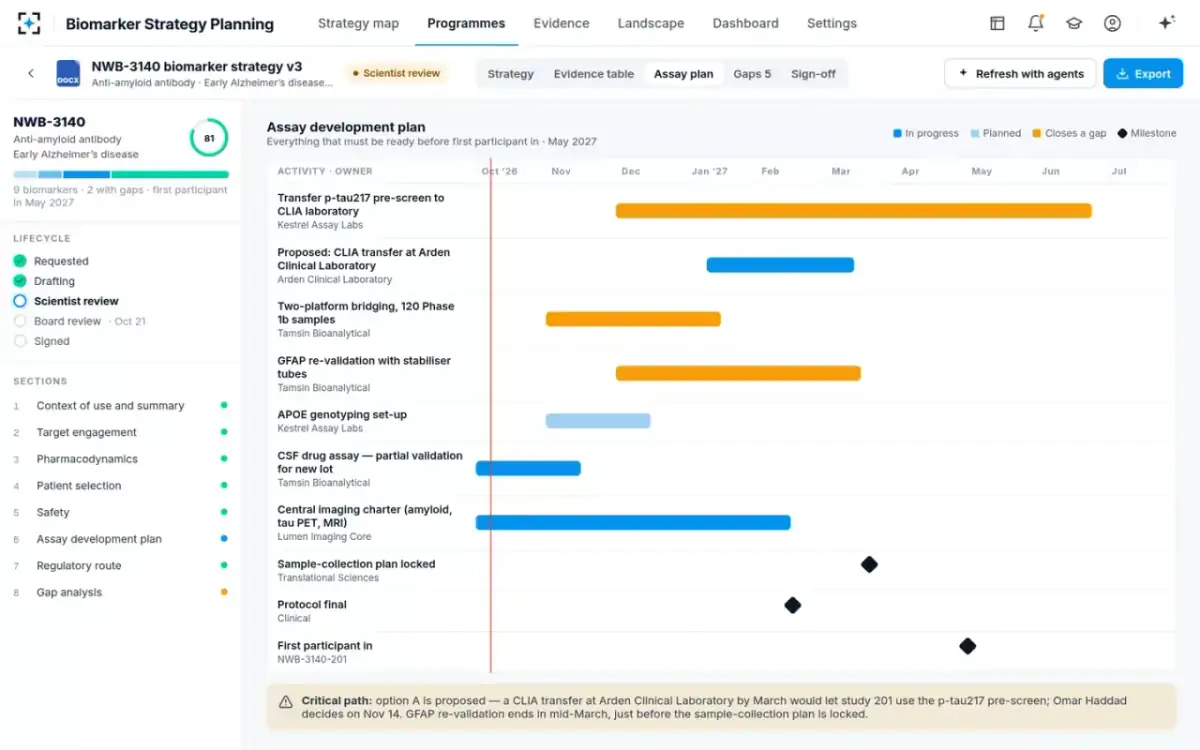
Timing the laboratory against first participant in
The test a strategy has to pass is simple to state and easy to fail: for every marker that drives a decision in a study, does the assay that measures it become reportable before that study needs it, with margin? In the sample programme the answer for one marker was no. Plasma p-tau217 had the science — the entry for Phase 2a patient selection carried the measurement and a transfer ending in late June 2027 against a study starting in May — and that single line turned the whole pre-screening design into a question about scans instead of a question about biology. The gap and risk reviewer reads each activity against first participant in and marks the lane entry red when the dates do not meet.
The critical path is where this becomes operational. In the sample plan, a separate re-validation of a safety marker ends in mid-March, just before the sample-collection plan is locked — so a two-week slip in an activity nobody was watching would change what samples the trial collects for the next two years. The useful habit is to draw every assay activity against the study's own milestones (protocol final, sample-collection plan locked, first participant in) rather than against a laboratory's internal plan, and to treat the gap between ready and needed as a number with an owner.
Who owns each step of laboratory readiness, and where no agent may decide
Agent
Assay and precedent readerReads vendor specifications, validation reports and regulatory records; sets each marker's validation status for the decision it supports, and finds laboratories and slots when an assay is late.
Never: Never infers that a marker or method has been formally accepted where there is no source saying so.
Agent
Gap and risk reviewer · timingTimes each assay activity against first participant in for the study that needs it, and lists the shortfall with a severity, an owner and a date.
Never: Never marks a laboratory ready, and never closes the gap it found.
Agent
Gap and risk reviewer · optionsCosts the alternatives — a second laboratory, a different platform, or keeping the plan — with what each one buys and what it risks.
Never: Never chooses between them.
A person decides
Translational medicine leadProposes the option she wants, which puts it in the plan as a proposal with a decision date against it.
A person decides
Diagnostics leadDecides the laboratory and diagnostic route, and co-signs patient selection. Until he decides, nothing is booked.
A person decides
Translational board chairApproves the strategy, approves it with conditions, or returns it, with an electronic signature carrying the date, time and reason.
What to settle with a central laboratory before the protocol is final
Nine questions for a central or specialty laboratory, before the protocol is locked
- Which certificate do you hold today, for which specialty, and when were you last surveyed?
A registration certificate is temporary and expires; a compliance certificate followed a survey; an accreditation certificate came from an approved organisation. "We are CLIA" is not an answer.
- Is the exact platform already installed and in routine use here?
Not the family, the instrument and the reagent lot chain. A platform arriving for this study adds installation, staff training and a first validation to the timeline.
- Are you verifying or establishing — and which is it for this configuration?
A changed tube, matrix, extraction or cut-off puts the test in the establishment case and the full six specifications with it.
- When does the validation slot open, and what else is in that queue ahead of us?
The slot, not the duration, is often what moves. Ask what happens to our date if the study ahead of us overruns.
- What are the acceptance criteria, and who set them?
Get them in writing before the work starts. A specification established against criteria nobody agreed is a result waiting to be argued about.
- How many samples do you need for bridging, and who supplies them?
Bridging comes out of the trial's own biobank. If the samples do not exist in the right matrix and volume, the bridging date is fiction.
- How will comparability across sites be shown, and before which date?
FDA asks for it before trial testing begins at those sites. Ask for the qualification scheme and when it runs.
- What exactly will we receive as documentation, and may we read it?
The regulation requires the laboratory to document all of it. A sponsor that cannot open the validation report cannot defend the result.
- What is the change-control rule once the trial starts?
A fixed assay means no change to components, protocols or instrumentation during use. Agree in advance what a reagent discontinuation triggers.
How Biomarker Strategy Planning times the laboratory
None of the above is hard to know. It is hard to hold together, because the facts live in different places: the regulation in one document, the certificate in a laboratory's file, the slot in someone's queue, the study calendar in a protocol that has already been circulated. A translational lead writing a strategy by hand reads all of it, writes a paragraph, and the paragraph ages the day it is signed.
Biomarker Strategy Planning keeps the four together as one object. Each marker carries its validation status for the decision it supports, with the source open at the passage it came from. Each assay activity sits on a plan drawn against the study's milestones. When an assay is late, the agents find the alternatives and cost them, and a named person decides — the diagnostics lead for a laboratory route, the board chair for the strategy. And nothing in the chain is allowed to assert readiness on a laboratory's behalf. For the wider picture of how the markers, the decisions and the studies fit together, start from how to build a biomarker strategy, or see the whole thing working on Biomarker Strategy Planning.
The strategy map: four lanes, and one entry that is not ready when needed
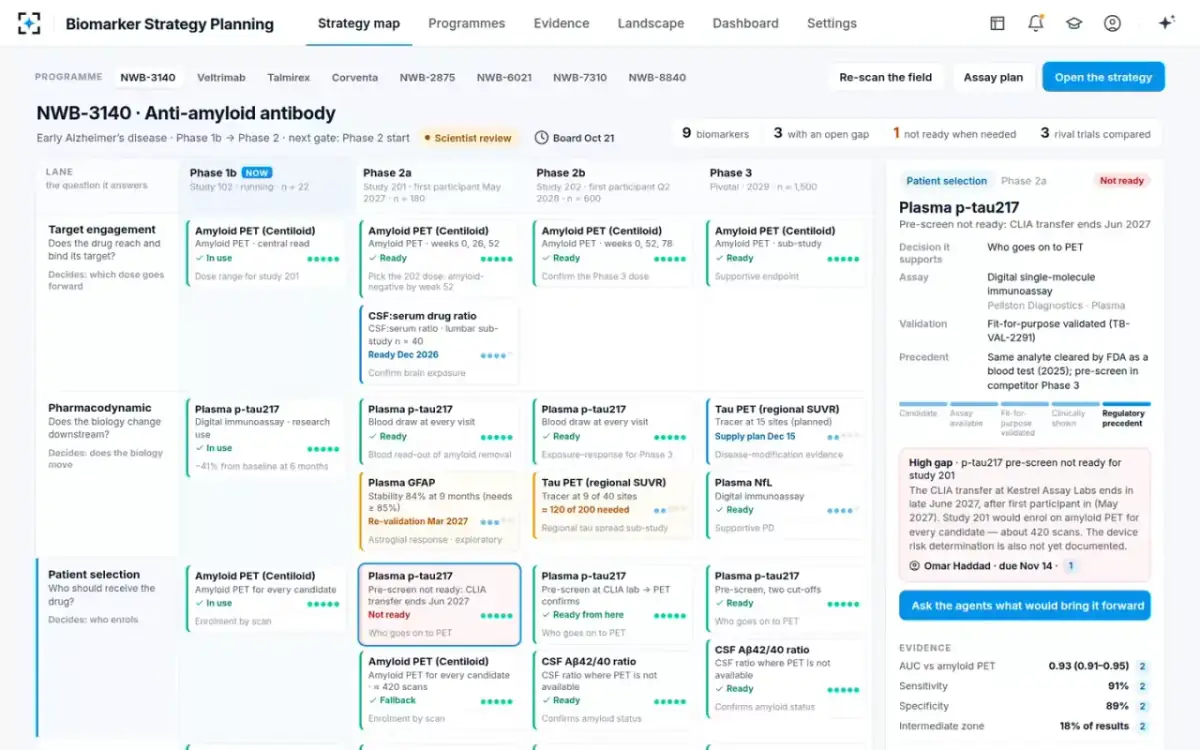
Questions people ask
What are the CLIA validation requirements for a test?
They are set out in 42 CFR 493.1253. For an unmodified, FDA-cleared test the laboratory must demonstrate it can obtain accuracy, precision and reportable range comparable to the manufacturer's, and verify that the manufacturer's reference intervals suit its patient population. For a modified or in-house test, or one with no manufacturer specifications, it must establish accuracy, precision, analytical sensitivity, analytical specificity including interfering substances, reportable range and reference intervals, plus any other characteristic the test needs — and document all of it, before reporting patient results.
Can a trial use a research-use-only assay to select patients?
Not as sold and labelled. FDA's codevelopment guidance notes that research-use-only products are not required to be built to investigational or diagnostic controls and are not evaluated by FDA. It does allow that such products may be usable as part of a clinical trial assay if the sponsor relabels them for investigational use and complies with the applicable requirements of 21 CFR Part 812, and it expects the assay to be fully specified and fixed for the trial. A result that will be reported as a patient test result sits under the CLIA requirements instead.
What is a CLIA certificate, and when do you need one?
It is the permission to perform testing, and CMS states that laboratories are generally required to hold the appropriate certificate before they can begin testing. A Certificate of Registration temporarily allows nonwaived testing until the laboratory is inspected, for no more than two years. A Certificate of Compliance follows a State Agency or CMS survey; a Certificate of Accreditation comes from a CMS-approved accreditation organisation instead. The two durable certificates run on a two-year cycle.
Who is responsible if the laboratory is late?
Contractually, whatever the agreement says; practically, the sponsor, because the trial pays the cost. That is why a biomarker strategy should carry the readiness date as an owned item rather than a vendor assurance — a named person who can say which certificate the laboratory holds, when its validation slot opens and what the fallback is. In Biomarker Strategy Planning the owner and the decision date are part of the gap itself, and an agent is not permitted to mark a laboratory ready.
Does a second laboratory inherit the first laboratory's validation?
No. Each laboratory verifies or establishes performance specifications for its own test system and documents them. A transfer therefore repeats the work, which is why it is usually measured in months and why its start depends on the receiving laboratory's queue. If both laboratories will produce results that are read together, the trial also owes evidence that they agree — FDA recommends evaluating comparability among potential sites before testing begins at them.
Should a biomarker strategy state the federal position on laboratory developed tests?
Only with a date. The definition of in vitro diagnostic products was amended in May 2024, the rule was vacated by a federal district court in March 2025, and in September 2025 FDA issued a final rule reverting to the earlier text. Any sentence about this should name the instrument it relies on and when the page was read, so a reviewer can tell later whether it still holds.