A biomarker strategy in drug development is the document that says which biomarkers a programme will use, what decision each one is there to support, in which study, measured by which assay, and how much evidence stands behind each claim. It is hard to write well because four different kinds of work collide in it: reading the literature, pulling numbers out of your own Phase 1 and laboratory reports, judging what a regulator will accept for a given use, and timing assay readiness against a study calendar that is already fixed. Botminds' Biomarker Strategy Planning builds that document for one programme at a time, with every factual sentence cited to the passage it came from, and shows each marker as a position in a map of decisions rather than as an entry in a list.
The worked examples below come from the fictional sample programme the solution ships with: Northwind Bio's NWB-3140, an anti-amyloid antibody in early Alzheimer's disease, moving from Phase 1b into Phase 2. The company, the molecule, the laboratories, the people and the rival programmes are invented sample data. Everything attributed to a regulator or to a journal is real, and linked where it appears.
Why the selection question is worth arguing about
10.3%
overall probability of success for trials that use biomarkers to select patients, against 5.5% for trials that do not
13.8%
of all drug development programmes eventually reach approval, in an analysis of 406,038 trial data entries
4,486scans
amyloid PET scans performed in one prevention trial to find 1,323 eligible participants
What is a biomarker strategy?
A biomarker strategy is a plan for the measurements a programme will make, written as decisions rather than as candidates. For each marker it names the category it belongs to, the exact use it is being put to, the study and the time point where it will be read, the assay that will measure it and that assay's validation status for that use, and the evidence — cited — that the marker behaves as claimed. Where the evidence or the assay is not there yet, the strategy says so, names an owner and gives a date.
That is a narrower thing than most documents called a biomarker strategy. The common failure mode is a literature review with a table of markers at the end: nine candidates, each with references, sensitivities and specificities, and no statement of what any of them will be used to decide. Such a document cannot be wrong, because it does not commit to anything, and it cannot be useful either. A reviewer at a stage-gate meeting has one question — what will you do differently depending on what this measurement says — and a list of candidates does not answer it.
The same nine markers, written as a list and written as a strategy
A candidate list: One row per marker, ordered by how promising it looks.
A strategy: One row per decision, ordered by the study that needs it. A marker can appear twice, or not at all.
A candidate list: Published sensitivity, specificity and AUC, with references.
A strategy: The category, the use, the study and time point, the assay, its validation status for that use, and the cited evidence.
A candidate list: Nothing. Every marker stays interesting.
A strategy: A measurement that will be made on a date, and a decision rule for what follows.
A candidate list: Nobody can say which marker the programme depends on.
A strategy: It fails on a specific, answerable point: this assay will not be ready, or this claim rests on one cohort.
A candidate list: A reading list.
A strategy: A record of why the study was designed the way it was, and what has changed since.
The seven categories, and the decision each one is for
Start with the vocabulary, because it is free and it saves arguments. FDA's evidentiary framework for biomarker qualification says a biomarker "should be classified by the BEST biomarker category", and lists seven: diagnostic, monitoring, pharmacodynamic/response, predictive, prognostic, safety, and susceptibility/risk. Choosing one of those seven words forces the writer to say what the measurement is for, and it tells a reviewer in advance which kind of evidence to look for.
The seven categories FDA names, and the decision each is there to support
| Category | What it claims | The decision it supports | Evidence a reviewer looks for |
|---|---|---|---|
| Diagnostic | The patient has the disease or condition. | Who is eligible, and which disease the result belongs to. | Accuracy against an accepted reference standard, in the population you will enrol. |
| Monitoring | The status of the disease or the exposure is changing over time. | When to read it, and what change counts as a change. | Repeat measurement precision and the within-patient variability over the interval you will use. |
| Pharmacodynamic / response | The patient has responded biologically to the exposure. | Dose range, dose selection and interim futility. | A dose-response relationship, and the size of the change against the measurement error. |
| Predictive | This patient is more likely to benefit, or to be harmed, by this drug. | Who goes into the study, and later who gets the drug in practice. | An interaction between marker status and treatment effect, not a correlation with outcome. |
| Prognostic | This patient is more likely to have the event, whatever the treatment. | Enrichment for event rate, and stratification. | Event rates by marker status in an untreated or standard-of-care population. |
| Safety | Harm has occurred, or is likely to. | Monitoring schedule, stopping rules and the label. | Sensitivity to the specific hazard, early enough to act, with an acceptable false-alarm rate. |
| Susceptibility / risk | This person is more likely to develop the condition. | Who to screen into a prevention study. | Incidence by marker status over a period as long as the study. |
The distinction that causes the most trouble is predictive against prognostic, because the same measurement can be both and the evidence required is quite different. A prognostic claim needs event rates by marker status; a predictive claim needs an interaction — the treatment effect must differ by marker status — and a single-arm cohort cannot supply one. A strategy that labels a marker predictive on the strength of a prognostic dataset has made a claim it cannot support, and it will be found at the worst moment, which is when someone asks for the label language.
Why the statutory definition of a biomarker includes a surrogate endpoint
The definition in US law is wider than most practitioners assume, and the width is deliberate. Section 507 of the Federal Food, Drug, and Cosmetic Act, added by the 21st Century Cures Act in December 2016, defines a biomarker as a characteristic that is "objectively measured and evaluated as an indicator of normal biologic processes, pathologic processes, or biological responses to a therapeutic intervention" — and then adds a second clause.
The term "biomarker" — (A) means a characteristic (such as a physiologic, pathologic, or anatomic characteristic or measurement) that is objectively measured and evaluated as an indicator of normal biologic processes, pathologic processes, or biological responses to a therapeutic intervention; and (B) includes a surrogate endpoint.
21st Century Cures Act, Public Law 114-255, section 3011, adding FD&C Act section 507(e)(1)
Clause (B) is the one that matters for a strategy. It means the same statutory object spans a measurement you take in a Phase 1b cohort to decide whether to keep going, and a measurement a regulator would accept in place of a clinical outcome to support approval. Nothing about the measurement changes between those two uses; what changes is the weight of the decision resting on it, and therefore the evidence owed. FDA's own working definition on its biomarker qualification pages is deliberately plain about the measurement side — "a defined characteristic that is measured as an indicator of normal biological processes, pathogenic processes, or responses to an exposure or intervention, including therapeutic interventions" (CDER, Biomarker Qualification Program) — and silent about weight, because weight is the use, not the marker.
The practical consequence is the single most useful habit in this work: never write a marker's name without writing its use beside it. The regulators' term for that pairing is the context of use, and it is a two-part statement — the category, and the proposed use in drug development. How to write a context of use, and how it sets the evidence bar, is worked through separately, because it is where most strategies either become defensible or stay vague.
Organise by decision and phase, not by marker
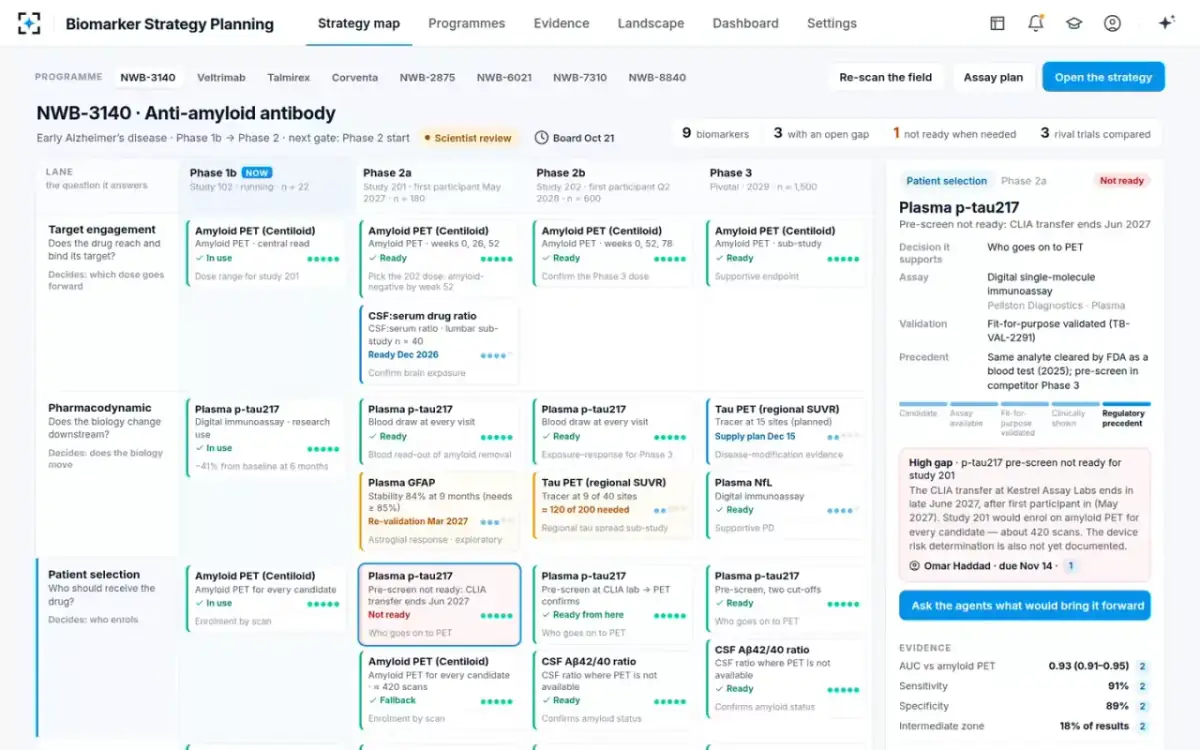
Once every marker carries a use, the document almost arranges itself. Four lanes hold nearly every biomarker in a small-molecule or biologic programme — target engagement, pharmacodynamic, patient selection and safety — and the phases of the development plan give the columns. Each cell holds the decision the measurement is there to support in that phase. Markers then appear where they are needed, which is sometimes twice and sometimes nowhere.
Four lanes against four phases: the decision in each cell, not the marker
Target engagement
Did the drug reach the target, at this dose, in this tissue?
Phase 1bOccupancy or displacement at two or three doses. Decides whether the programme continues at all.
Phase 2aEngagement confirmed at the dose carried forward, in the target population rather than in healthy volunteers.
Phase 2bExposure and engagement narrowed to one dose for the pivotal study.
Phase 3Supportive only. No decision in the pivotal study should rest on it.
Pharmacodynamic
Did the biology downstream of the target move, and by how much?
Phase 1bDirection and rough size of the change. Decides the dose range.
Phase 2aEffect size and variability, which set the Phase 2b sample size.
Phase 2bTime course and an interim futility look.
Phase 3Mechanistic support; a registration claim only where the marker is qualified or accepted as a surrogate endpoint.
Patient selection
Which patients should be in the study, and which test decides?
Phase 1bNone. Enrol broadly and bank samples, so the selection question can be asked later.
Phase 2aPre-screen, then confirm. Decides the screening funnel and the enrolment curve.
Phase 2bThe same test with the cut-off locked, so Phase 3 inherits a decision rather than a debate.
Phase 3The test that will be described in the label. Decides whether a diagnostic has to be co-developed.
Safety
What would tell us early that this drug is harming someone?
Phase 1bMonitoring schedule and the first evidence of the hazard.
Phase 2aA stratifying genotype before randomisation and a fixed imaging schedule.
Phase 2bThe same measures, plus a monitoring marker read at set visits.
Phase 3Unchanged, and carried into the label and the risk management plan.
Two things fall out of the grid that a marker-ordered list hides. The first is that the patient-selection lane has a hard edge: a test that will decide who receives the drug in practice is on its way to becoming a regulated device, and that conversation has to start years before the pivotal study. The second is that the safety lane is the one that most often has no gap at all, because the measures in it are usually established assays run to a schedule — which is exactly why it is the lane that gets least attention in review, and the lane where a strategy can say the most in the fewest words.
Nine markers, three with an open gap, one not ready when it is needed
What a claim about a marker has to carry
A strategy is read by people who will not re-derive it. That makes traceability the document's load-bearing property, and it is cheap to build in at the start and expensive to retrofit. The rule worth adopting is that every factual sentence carries six things, and a sentence that cannot carry all six is rewritten until it can or removed.
Six things every factual sentence in a strategy has to carry
- The category
One of the seven. If the sentence will not take a category, it is a hope rather than a claim.
- The use
The decision the measurement supports, named in the same sentence or the one before it.
- The assay, and its validation status for that use
Not whether an assay exists, but whether the one you will run is validated to the depth this decision needs.
- The study and the time point
Which protocol, which visit. A marker with no time point will not appear in a sample-collection plan, and will not be measured.
- The citation, to the passage
A reference to a paper is not enough. The reviewer needs the sentence, table or figure the number came from.
- The number as published
Not rounded, converted or combined with another study. If two cohorts must be compared, say so and show both.
The sixth item sounds pedantic and is not. Rounding a published 0.91 to 0.9 is harmless; converting a hazard ratio into a percentage, or pooling two cohorts with different reference standards, changes the claim while keeping the citation, and that is the error that survives review. In the sample strategy the solution ships, 112 cited claims come from 47 sources with no uncited claim remaining — demonstration figures on a fictional programme, but the right counter to watch, because the number that matters in a real strategy is not how many citations it has but how many sentences have none.
When should a biomarker strategy be written?
A biomarker strategy should be written before the study it governs is designed, and revised at every phase transition. In practice that means a first version at candidate selection or first-in-human planning, a substantial rewrite before the Phase 2 protocol is drafted, and a further one before the pivotal study, because each of those is the last moment when a measurement can still be added to a protocol cheaply. The date that should drive the calendar is not the stage-gate meeting; it is the date the sample-collection plan locks, because after that a new measurement means a protocol amendment.
Writing it later is common and expensive. Two things cannot be bought back once the protocol is final: samples that were not collected, and assay lead time. A marker nobody banked plasma for in Phase 1b cannot be tested retrospectively, however good the hypothesis turns out to be. And an assay that needs a laboratory transfer needs the months a transfer takes, whatever the science says.
The assay is half the strategy — and the half that slips
Most strategies are strong on biology and weak on dates. The question that decides whether a marker is real is not whether a validated assay exists somewhere, but whether the assay you will run will be ready, in the laboratories your sites will use, before the first participant is enrolled in the study that needs it. FDA's biomarker method-validation guidance, issued in April 2026, is explicit that the depth of validation follows the use: because biomarkers serve so many different purposes in drug development, the extent of method validation should be decided fit-for-purpose (FDA, Bioanalytical Method Validation for Biomarkers). Fit-for-purpose sizes the work; it does not shorten the calendar.
One late assay, and the two routes a programme can take
- Method transfer and validation at the first laboratoryto late June 2027
- Pre-screen available at lasttwo months late
- Waiting for the laboratory validation slot to openslot opens January
- Transfer at a laboratory already on the platform14 weeks
- Pre-screen ready and waitingbefore enrolment opens
The lane above is the shape of the problem rather than one programme's bad luck. A patient-selection assay sits behind a method transfer, a validation package, site qualification and a central laboratory contract, and those run in series. When the arithmetic says the chain ends after first participant in, the study does not stop; it quietly reverts to the older, slower, more expensive screening route, and the cost appears as scans and screen failures rather than as a missed milestone. What an enrichment design actually costs in screen failures, scans and months works that arithmetic through.
What the published record says about biomarker-guided programmes
The case for doing this work carefully rests on a modest, well-measured difference rather than a dramatic one. In Wong, Siah and Lo's analysis of 406,038 clinical trial data entries from 2000 to 2015 — the biomarker comparison restricted to 2005 onwards and to biomarkers used to stratify patients — "trials using biomarkers exhibit almost twice the overall POS (POS1→APP) compared to trials without biomarkers (10.3% vs. 5.5%)" (Biostatistics 20(2), 2019). The same study puts the overall probability that a development programme reaches approval at 13.8%. Both numbers are observational: programmes that use biomarkers differ from those that do not in more ways than the biomarker, and the authors themselves caution against over-reading the results outside oncology.
The operational evidence is sharper, because it is a count rather than a comparison. Schindler and colleagues report that the A4 prevention trial ran 4,486 amyloid PET scans at 67 sites over 3.8 years to find 1,323 participants who were amyloid PET positive (Alzheimer's & Dementia 19(4), 2023). That is the price of confirming eligibility one participant at a time with the most expensive available test, and it is the number that makes the timing argument concrete: an assay that is late does not cost a line in a risk register, it costs three thousand scans.
Eight sections, and who signs each one
Most companies have a house template, and it is usually right. The one the solution ships with has eight sections, and the order is load-bearing: context of use comes first because everything downstream is priced by it, and gap analysis comes last because it can only be written once the rest is on the page.
The eight sections, what each has to settle, and who signs it
| Section | What it has to settle | Who owns it |
|---|---|---|
| 1. Context of use | For every marker: the category, and the use in drug development. One sentence each, written narrowly. | Translational lead, with regulatory |
| 2. Target engagement | Whether the drug reaches the target at the dose, and what measurement will show it. | Clinical pharmacology |
| 3. Pharmacodynamics | Which downstream measurements move, by how much, and how that sets the dose and the sample size. | Translational lead |
| 4. Patient selection | Which test decides eligibility, at which cut-off, and what happens to patients in the grey zone. | Diagnostics lead |
| 5. Safety | What would show harm early, how often it is read, and what the stopping rule is. | Clinical safety, with translational |
| 6. Assay development plan | Every assay activity against the study calendar, with owners and the critical path to first participant in. | Bioanalytical or diagnostics |
| 7. Regulatory route | Whether qualification, a device pathway or neither applies, and what has been agreed with which agency. | Regulatory affairs |
| 8. Gap analysis | Every unsupported claim, missing validation and late assay, with severity, an owner and a date. | Translational lead, reviewed by the board |
Sections 6 and 8 are the two that always arrive last, and both for the same reason: they depend on everyone else's answers. That is an argument for writing them first in draft, badly, and letting them be corrected — a gap analysis written at the start tells you which parts of the strategy are actually at risk, while one written at the end tells you what you already know.
Eight sections, five signatures: who carries the strategy to the board
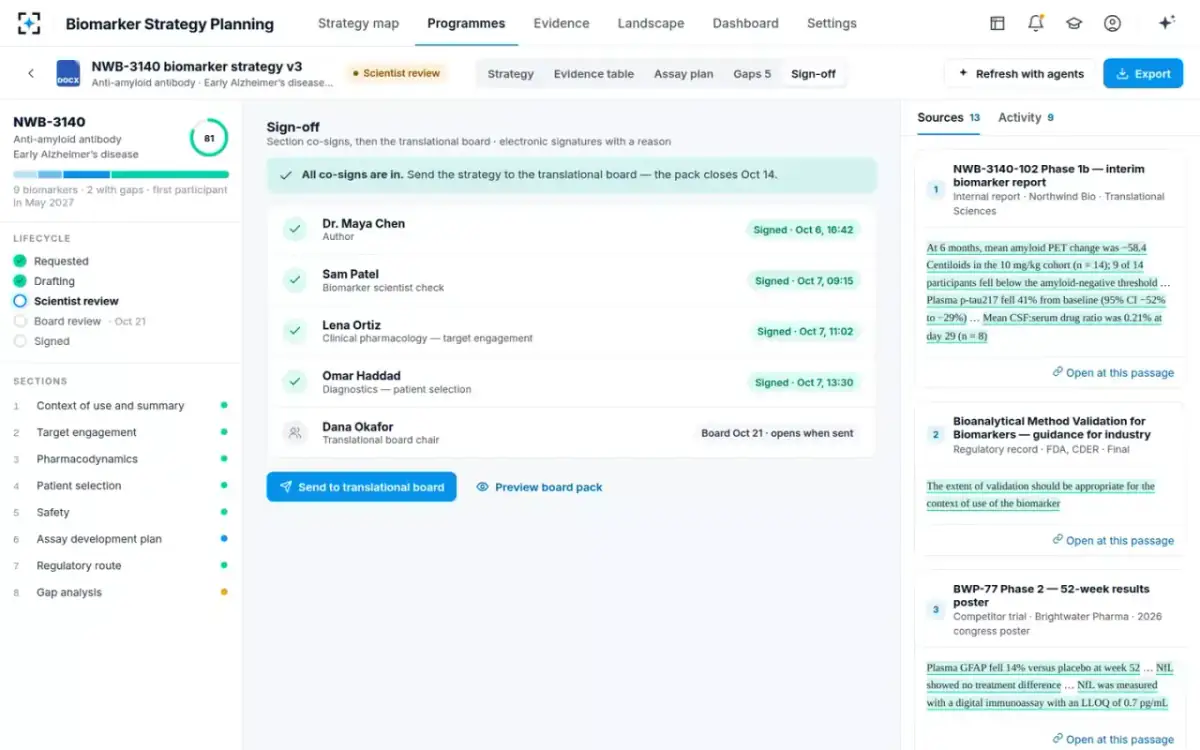
A strategy with one author is a strategy one person can be wrong about. The useful pattern is a single author who holds the argument, a second scientist who checks every extracted number against its source, section co-signs from the people who will have to defend those sections, and a board chair who approves, approves with conditions or returns it with a reason on the record.
The five people who sign, and what each one is actually certifying
Today
Four to eight weeks reading, extracting and drafting, and finds a late assay only once the study calendar is fixed.
With agents
Opens the programme on its strategy map, sees which test is ready for which study, and asks what would bring a late one forward.
Still theirs: The argument. Nobody else can certify that the decisions hang together.
Today
Re-checks every number in the draft against papers and reports he has to find again.
With agents
Sees each value beside the passage it came from, and only values below the confidence threshold wait for him.
Still theirs: Whether a number is the number. A value he cannot trace does not go in.
Today
Reviews target-engagement text without the exposure and occupancy numbers beside it.
With agents
Co-signs her section with every claim cited to the report or paper it came from.
Still theirs: That the engagement argument holds at the dose being carried forward.
Today
Laboratory transfers and device questions surface after the study plan is fixed.
With agents
Gets the gap, the costed options and the decision date in one place.
Still theirs: Which laboratory and which diagnostic route go into the plan.
Today
Asked to sign a static document that ages the day it is signed.
With agents
Reads the co-signs, the open gaps and the competitive comparison in one place.
Still theirs: The decision, with an electronic signature recording its meaning, date, time and reason.
How do you tell a good biomarker strategy from a bad one?
Read it backwards, from the gap analysis. A good strategy has gaps, each with a severity, an owner and a date, because a programme at this stage always has some; a strategy with no gaps has either been finished for a year or had its gaps edited out. Then pick three factual sentences at random and ask for the passage behind each one. If two of the three take more than a minute to find, the document is a summary of someone's reading rather than a record of evidence, and it will not survive the first real challenge.
Then check the dates. For each marker in the patient-selection lane, ask when the assay will be ready and when first participant in is, and compare the two numbers out loud. This is the question that most often has no answer in the room, and it is the one that costs the most when the answer turns out to be the wrong way round.
Where Biomarker Strategy Planning fits, from first draft to signature
Biomarker Strategy Planning is Botminds' agentic solution for exactly this document. Six agents do the mechanical reading: a literature scout that reads papers and preprints in full text and extracts accuracy figures with the cohort, reference standard and page; an internal data reader that pulls effect sizes, limits of quantification, precision and stability out of your own reports and flags any value outside its acceptance criterion; a trial design analyst that reads rival registry entries and congress posters from public sources and records how each one uses the same markers; an assay and precedent reader that sets each marker's validation status for its context of use and never infers qualification without a record; a strategy writer that drafts the house template with no uncited factual sentence; and a gap and risk reviewer that times every assay against first participant in, lists each gap with a severity, an owner and a date, and costs the options.
What the agents do not do is decide. They can move a strategy no further than scientist review. Values below the confidence threshold wait for a biomarker scientist to confirm or correct them beside the source. The reviewer lists and costs options but never closes a gap or chooses one — an option stays a proposal until the diagnostics lead decides. The design target is a median of 6.5 days from request to a signed strategy against roughly 38 days by hand; both are the solution's own figures, the first a design goal and the second an estimate of the manual path, not a measured customer result. To see the strategy map, the assay plan and the sign-off together, start from Biomarker Strategy Planning, or read on into fit-for-purpose assay validation, which is where the dates in the sixth section come from.
The signature set: author, value check, two co-signs, board chair
Questions people ask
How many biomarkers should a programme have?
As many as there are decisions; there is no published norm for the number, and no regulator sets one. The count is a symptom rather than a target: if two markers support the same decision, one of them is insurance and should be labelled as such, and if a lane has no marker in a phase, the strategy should say why rather than leave the cell empty. The sample programme in the solution carries nine across four lanes and three phases.
Does a biomarker have to be approved by the FDA?
No. Most biomarkers in most programmes are used without any regulatory action at all, because they support the sponsor's own internal decisions. Two situations change that: a marker that will be the basis of a regulatory conclusion, where FDA's biomarker qualification programme offers a formal route, and a test that will decide who receives the drug in practice, which raises a device question rather than a biomarker one. The strategy's job is to say, for each marker, which of the three situations applies.
What is the difference between a biomarker and an endpoint?
An endpoint is what a study measures to answer its question; a biomarker is a kind of measurement. The two overlap: US law defines a biomarker as including a surrogate endpoint, and FDA's category list names clinical trial endpoints, including surrogate endpoints, as a use of a pharmacodynamic or response biomarker. The practical distinction is the weight of the decision. A marker used as a registration endpoint has to be accepted as standing in for a clinical outcome; the same marker used to pick a dose does not.
Who writes a biomarker strategy and who approves it?
A translational medicine lead usually writes it and owns the argument. A biomarker scientist checks the extracted values. The sections with the most specialised content are co-signed by the people who will defend them — clinical pharmacology for target engagement, diagnostics for patient selection, regulatory affairs for the route — and a translational or development board approves it. One author with no co-signs is the arrangement that most often produces a strategy nobody will defend in review.
What goes into a biomarker strategy document?
Eight sections, in a sensible order: context of use, target engagement, pharmacodynamics, patient selection, safety, the assay development plan, the regulatory route, and a gap analysis. Templates differ, and a five- or six-section early-development version is often right before first-in-human. What matters more than the section count is that every factual sentence carries a citation to the passage behind it, and that the assay plan is timed against the studies rather than written as a list of activities.
How often should a biomarker strategy be revised?
At every phase transition, and whenever an assay date or a competitor's design changes materially. The two triggers people miss are a laboratory slipping a validation slot, which moves the readiness date without changing anything on the page, and a rival trial opening on the same marker, which changes what a reviewer will expect you to have considered. A strategy that has not been touched since it was signed is a historical document, not a plan.