Clinical trial competitive intelligence does not need to be clever, because the hard part was settled by regulation. A sponsor running an applicable clinical trial must register it within three weeks of enrolling the first participant, and the registration has to carry eligibility criteria, primary and secondary outcome measures, enrolment, study start and primary completion date. Results are due a year after primary completion. Everything a rival is enrolling on, and what it intends to measure, is therefore public by law long before anyone publishes a paper. The skill is in reading it honestly — compliance is partial, dates drift, completion status is often wrong — and in re-reading it, because the value is usually in what changed. Botminds' Biomarker Strategy Planning does that reading for one narrow question: which marker, at which cut-off, for selection, enrichment, stratification, endpoint or safety, since when.
The regulation and the compliance figures on this page come from the Code of Federal Regulations, two peer-reviewed studies and the World Health Organization, each linked where it is used. The rival programmes shown are a fictional sample comparison inside the solution — HLV-210 from Halvor Therapeutics and SLW-4 from Selwyn Bio — and every sponsor, molecule, number and date in them is invented. None of it describes a real competitor.
What is clinical trial competitive intelligence, really?
In this field it is the practice of reading what rivals have already told the public about their trials, and turning it into a decision about your own. It is not espionage and it is not inference from rumour: registration is a legal obligation with a deadline, and the registered entries are a primary source. Nor is it market research. The useful output is not a landscape chart; it is an answer to a specific question that changes a protocol — whether anyone is already enrolling on the marker you plan to use, at what threshold, and for how long they have been doing it.
For a biomarker strategy the question narrows further still, and the narrowing is what makes it answerable. Across the rival trials in one indication, how is each marker used — to select, to enrich, to stratify, as an endpoint, or as a safety measure — at what cut-off, and since when? That question can be answered from the public elements. "What is their strategy?" cannot.
What the law already makes public, and by when
The registration duty attaches to enrolment, not to publication. The regulation gives the responsible party for an applicable clinical trial until 21 calendar days after the first participant is enrolled to submit the registration information (or 26 December 2007, for trials already running then) (42 CFR part 11). Results information is due within a year of the trial's primary completion date.
Updating is also regulated, and the update rules are what make re-reading worthwhile. Registration information must in general be updated at least once a year; overall recruitment status within 30 calendar days of any change to it; and the primary completion date within 30 calendar days of the trial reaching it. A rival's entry is therefore supposed to move when their trial moves, which means a change in that entry is a signal, and a long silence is a different kind of signal.
The statutory clock, from first participant to published results
- From the first human subject enrolled to the registration deadline21 days
- General updates, at least annually≤ 12 months
- Recruitment status change30 days
- Primary completion reached30 days
- Primary completion date
- Deadline to submit results information1 year
The data elements that answer a biomarker question
Most of a registration entry is administrative. Five or six elements do the work for a translational reader, and each is defined in the regulation rather than left to the sponsor's discretion — which is why they can be compared across trials at all.
The registered elements a biomarker strategy actually reads
| Element | What the regulation defines it as | The question it answers for you |
|---|---|---|
| Eligibility Criteria | "A limited list of criteria for selection of human subjects to participate in the clinical trial, provided in terms of inclusion and exclusion criteria and suitable for assisting potential human subjects in identifying clinical trials of interest." | Is a marker used to decide who gets in — and at what threshold? This is where a pre-screen or a cut-off appears, if it appears anywhere. |
| Primary Outcome Measure Information | The name of each primary outcome measure, "description of the metric used to characterize" it, and the "time point(s) at which the measurement is assessed for the specific metric used". | Is the marker the thing the trial is trying to move? The time points tell you the sampling schedule the rival committed to. |
| Secondary Outcome Measure Information | The same three items — name, metric and time points — for each secondary outcome measure. | Where most biomarker work actually sits. A marker that is secondary here may be primary in the next trial. |
| Enrollment | "The estimated total number of human subjects to be enrolled (target number) or the actual total number", updated to the actual number once primary completion is reached. | How big the bet is, and — read against the eligibility criteria — how many people had to be screened to find them. |
| Study Start Date | "The estimated date on which the clinical trial will be open for recruitment of human subjects, or the actual date on which the first human subject was enrolled." | Since when. A rival enrolling on your marker for two years has a head start that a design change cannot recover. |
| Primary Completion Date | The estimated or actual primary completion date, which must be updated to the actual date once reached. | When their answer arrives — and, a year later, when their results information is due. |
| Overall Recruitment Status | The recruitment status of the whole trial, judged from the status of its individual sites; if any site is recruiting, the overall status must be recruiting. | Whether the trial is live. Completion status is measurably unreliable, so read it with its update date. |
How reliable are the registries?
Partly. The honest answer is a number, and it has been measured. A study of compliance with the FDA Amendments Act requirements, published in JAMA Internal Medicine in May 2021, reported: "We identified 27 645 covered trials. Of the 8863 trials due to report results, 3499 (39.5%) did so within the 1-year deadline, and 6099 (68.8%) reported at any time" (DeVito and Goldacre, 2021). Compliance was not uniform across the different duties: "The proportion of trials in compliance ranged from 66.0% for on-time requests for delayed reporting to 99.1% for document submission with results."
Lateness, where it happened, was substantial rather than marginal. The same study found that "trials registered late were a median of 111 (interquartile range, 28-354) days late, trials with delayed annual data verification were a median of 275 (interquartile range, 122-550) days late". A registry entry is therefore a good primary source and a poor clock. Anything read from it should carry the date it was read and, where the registry shows one, the date the sponsor last updated it.
What the measured compliance actually looks like
39.5%
of trials due to report results did so within the one-year deadline; 68.8% reported at any time
66.0–99.1%
the range of compliance across the different requirements studied, from on-time delayed-reporting requests to document submission
16.2%
of trials registered on both ClinicalTrials.gov and the EU register were discrepant on completion status
Completion status, and the records that disagree with themselves
The most quietly misleading element is the one that looks most factual. A cross-sectional study of 10,492 trials registered on both ClinicalTrials.gov and the European Union Clinical Trials Register found that "16.2% were discrepant on completion status", and the disagreement ran overwhelmingly one way: "The majority of discrepancies (90.5%) were a 'completed' trial on ClinicalTrials.gov inaccurately marked as 'ongoing' on EUCTR". The authors put the conclusion in one sentence — "Completion status on registries is commonly inaccurate" — and added that 33.9% of dual-registered trials listed as ongoing on the European register were listed as completed on ClinicalTrials.gov.
For a competitive read this has a direct consequence. A rival trial that appears to be still recruiting may have finished a year ago, and the direction of the error means the mistake usually makes a competitor look slower than they are. Any judgement that depends on a rival's timing — whether to accelerate, whether to change an endpoint, whether to assume a readout is still ahead — should be checked against a second source rather than taken from a status field.
Reading a rival's design as a biomarker question
The useful discipline is to stop reading a trial as a narrative and start reading it as a set of answers about one marker. Five roles cover almost everything a marker does in a rival protocol, and they are usually distinguishable from the registered elements alone: selection (it decides who gets in), enrichment (it concentrates the population likely to respond or to have events), stratification (it balances the arms), endpoint (it is what the trial measures), and safety (it triggers monitoring or stopping). What the registry rarely gives you is the cut-off, which is why eligibility criteria are worth reading in full rather than skimming for a marker name.
One indication, five rival trials: how the same marker is used in each
The two sample rivals in the solution's own demonstration data show how much a single line can carry. One invented Phase 3 programme, HLV-210, pre-screens with a plasma marker and confirms with imaging, and has been enrolling since March 2025. Another, SLW-4, enriches with the same plasma marker plus a ratio, enrolling since November 2024. Both are fictional. What a real pair of entries like that would tell a translational lead is not that rivals exist, but that the pre-screening approach is already being executed at scale by two groups — which turns an open design question into a question about whether your own assay will be ready, and that is a laboratory question rather than a scientific one. We work through that in the guide to CLIA validation and transfer timing.
Congress abstracts, papers and the registry's update date
Registries are one of three public sources and the weakest on detail. The three are worth reading in a fixed order, because each adds something the others omit.
The same rival programme, read three ways
| Source | What it adds | What it omits | How current it is |
|---|---|---|---|
| The registration entry | The committed design: eligibility criteria, outcome measures and their time points, enrolment, start and completion dates, recruitment status. | Cut-offs are often absent or vague; assay platform and vendor are usually absent; nothing about results until they are due. | Supposed to be updated at least annually, within 30 days for recruitment status and primary completion. In practice, often late. |
| The congress abstract or poster | Early numbers, the assay actually used, sometimes the cut-off, and occasionally the screening yield nobody publishes elsewhere. | Peer review. Selection bias towards the positive. Often no denominator. | Fresh — usually the most recent public statement about an ongoing trial. |
| The peer-reviewed paper | Method detail, the analysis plan as executed, limitations, and numbers that have survived review. | Timeliness. By the time it appears, the programme has usually moved on. | The oldest of the three, and the one most likely to be cited as though it were current. |
The international dimension adds a fourth consideration: not every trial is registered in the same place, and the registries do not carry identical fields. The World Health Organization's trial registration data set is the common floor.
"The minimum amount of trial information that must appear in a register in order for a given trial to be considered fully registered."
World Health Organization, International Clinical Trials Registry Platform — WHO Trial Registration Data Set (Version 1.3.1)
There are 24 items in that data set, among them the key inclusion and exclusion criteria, the primary and key secondary outcomes, the date of first enrolment, the sample size and the recruitment status — which is to say that the elements a biomarker question depends on are internationally agreed as the minimum, not as an extra. That is what makes cross-registry reading possible at all, and it is also why the 16.2% disagreement figure above is measurable: the same trial can be compared with itself.
Re-reading beats reading: tracking what changed
A single read of a rival's entry is worth less than it looks, because it has no baseline. The second read is where the value is: an eligibility criterion that acquired a threshold, a secondary outcome that was added, an enrolment target that fell, a recruitment status that went from recruiting to active-not-recruiting. Each of those is a decision someone made, visible without anyone leaking anything.
This is the part that is tedious by hand and therefore easy to skip. It requires revisiting the same set of entries on a schedule, holding the previous version, and noticing a difference that may be one word. It is also the part most easily automated honestly, because the task is comparison rather than judgement. In the solution, the trial design analyst re-reads registry entries and congress abstracts weekly, works from public sources only, and records the registry update date alongside what it found — so a difference can be attributed to the sponsor's edit rather than to the week we happened to look.
What to ask of a tool, and what to refuse
Competitive intelligence software is often sold on coverage and dashboards. Neither is the usual point of failure. What fails is attribution: a number on a chart that cannot be traced to the entry it came from, on the date it said it, so that nobody can tell whether a change is the rival's or the tool's.
Seven questions for any clinical trial competitive intelligence tool
- Does it record the registry update date, not just the date it scraped?
These are different facts. Without the sponsor's update date you cannot tell a stale entry from a stable one, and you cannot attribute a change.
- Can you open the source entry at the passage the claim came from?
A competitive claim that cannot be opened is a rumour with a logo on it. Ask to click one, live, in the demonstration.
- Does it distinguish the five roles a marker can play?
Selection, enrichment, stratification, endpoint, safety. A tool that reports "uses biomarker X" has not answered the question anyone asked.
- Does it keep the prior version, so a change is visible as a change?
The second read is the valuable one. If the tool overwrites, you own a snapshot rather than a signal.
- Does it mark what it could not find, rather than leaving a blank?
A missing cut-off and a cut-off of zero look identical on a chart. Absence should be stated.
- Does it stay inside public sources, and say which?
Registries, congress abstracts, published papers, regulators' own files. Anything else should be named and justified, and nothing should come from a confidential channel.
- Does it refuse to infer?
An assay platform not named in a public source is not knowable from it. A tool that guesses the platform to fill a column is producing a liability, not intelligence.
There is also a limit worth being clear about on the buying side. Reading what a sponsor was legally required to publish is ordinary professional practice, and the regulation exists precisely so that it can be read. Obtaining non-public information about a competitor's programme is a different activity with a different name, and no tool should be bridging that gap for you. The right question to put to a vendor is not "how much do you have" but "where did this particular line come from, and when".
The field lane: rival trials placed under your own, by phase
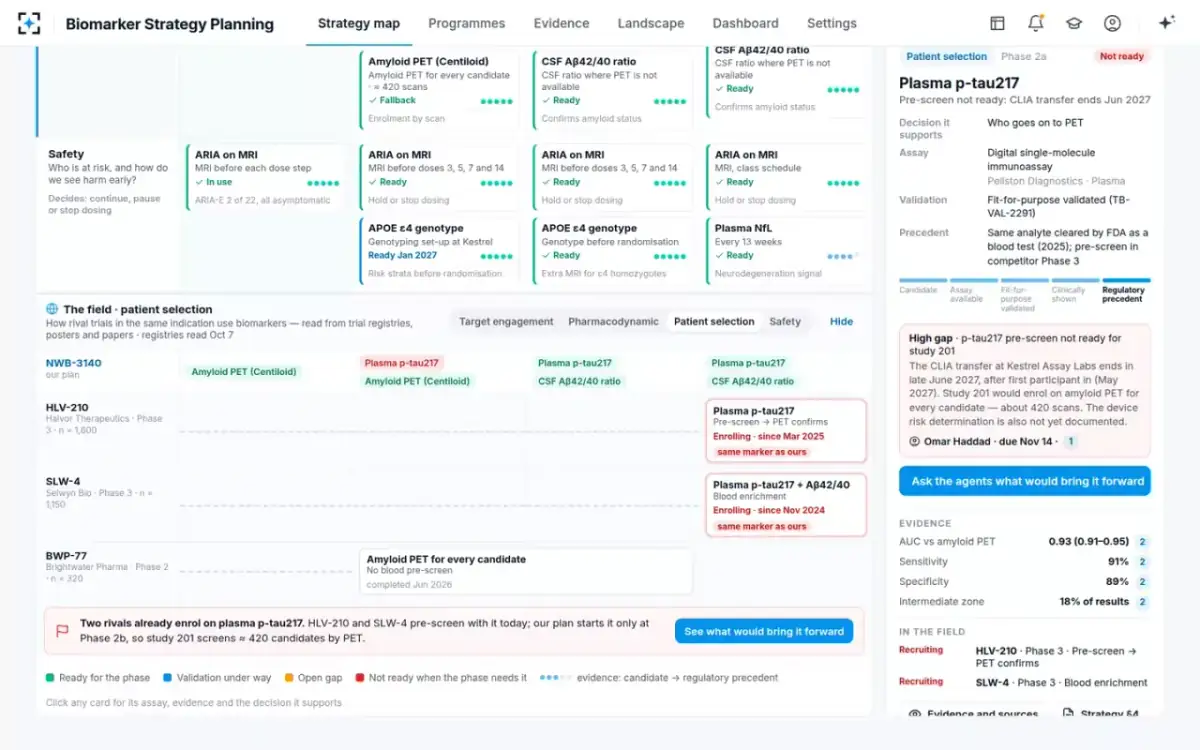
Where the field lane sits in Biomarker Strategy Planning
The competitive read is not a separate product here; it is one of six agents working on one strategy. The trial design analyst reads rival registry entries and congress abstracts, from public sources only, and records how each marker is used — selection, enrichment, stratification, endpoint or safety — with cut-offs and since when, compared with your own design. It records the registry update date. It does not infer, and it does not decide.
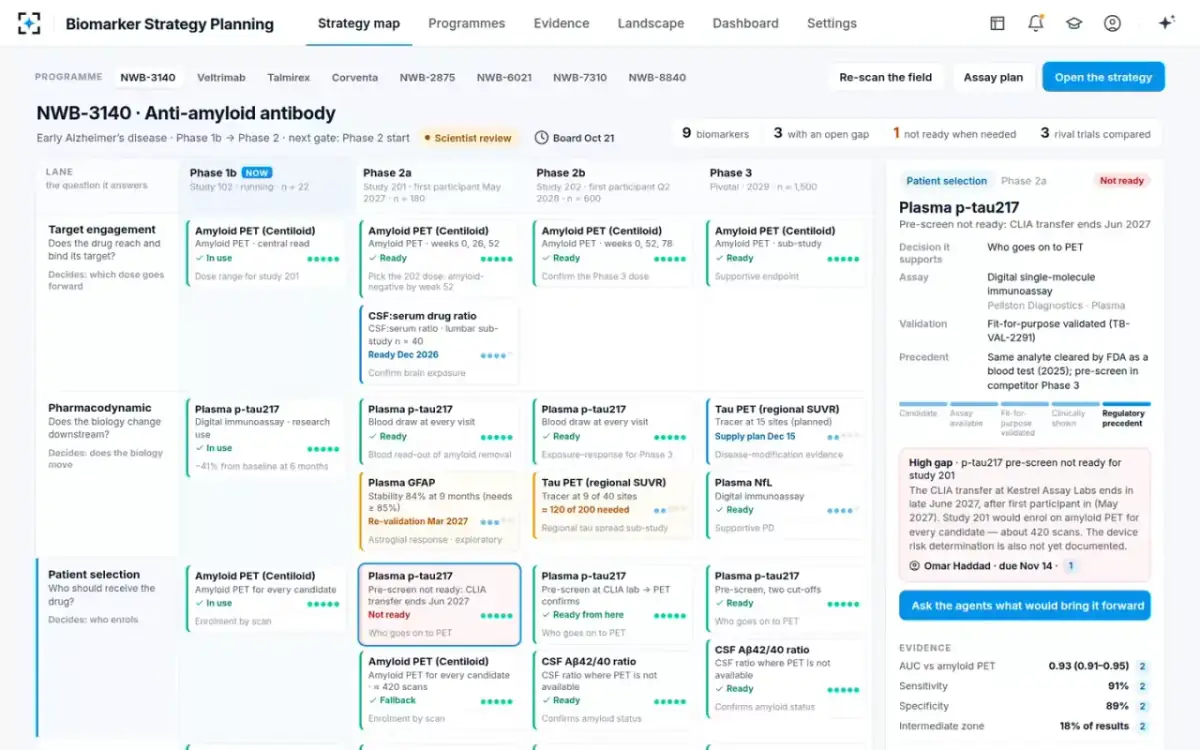
What makes that useful rather than merely interesting is where the output lands. The field lane places rival trials under your own lanes by phase and flags the ones using the same marker, so the question a board chair is likely to ask early — what are other people already enrolling on? — is answered on the same screen as the plan it affects. And because the strategy is a cited document, the competitive claims in it carry their sources like every other claim, which means the board is reading a sourced comparison rather than a slide.
The landscape view: how other sponsors use the same markers
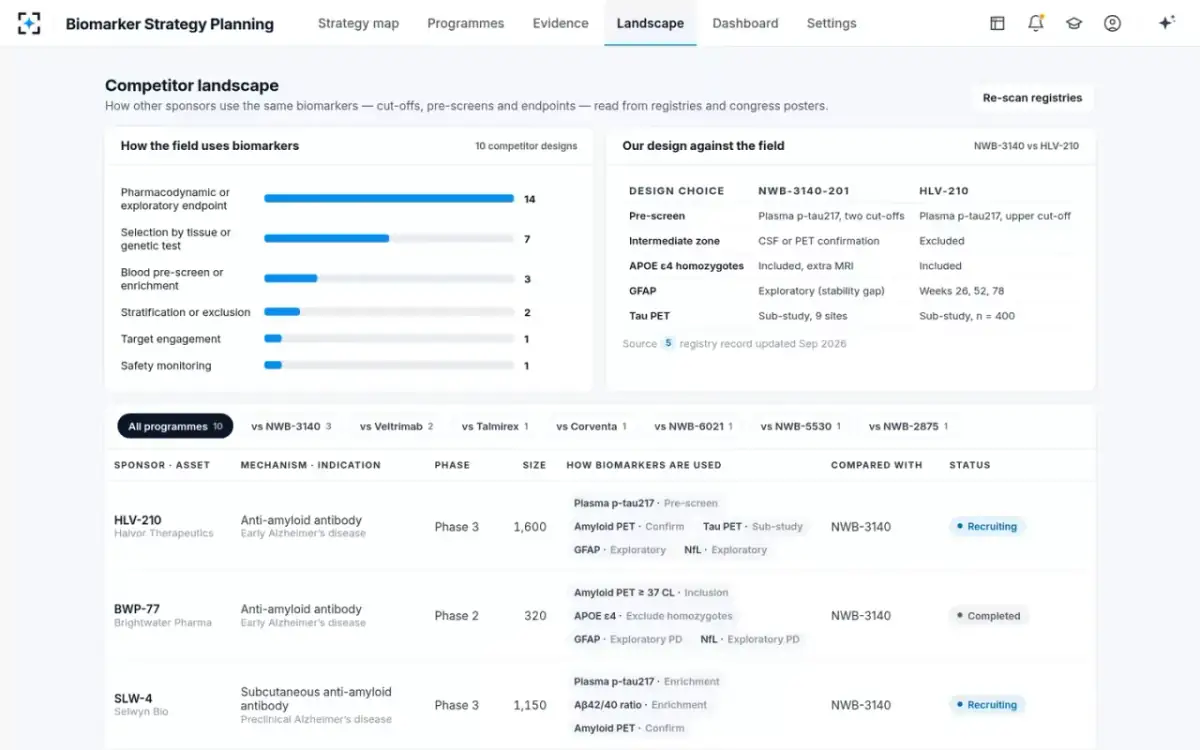
Three honest limits. The solution reads what is public, so a rival's unpublished cut-off stays unpublished. It records what the registry says, so a stale entry is reported as a stale entry rather than corrected. And it never closes the loop on its own: the gap and risk reviewer can raise the fact that two rivals are already enrolling on your marker, but a person decides what to do about it. For the wider picture of how a competitive read turns into a design decision, see enrichment strategies and what they cost, or start from Biomarker Strategy Planning.
One programme's strategy map, with the field lane beneath it
Questions people ask
What information must a sponsor publish about a trial?
For an applicable clinical trial, the registration information required by 42 CFR part 11 — including the eligibility criteria, primary and secondary outcome measure information with their metrics and time points, enrolment, study start date, primary completion date and overall recruitment status — submitted no later than 21 calendar days after the first human subject is enrolled. Results information is due no later than one year after the primary completion date.
How reliable is ClinicalTrials.gov?
Reliable as a primary source for what a sponsor committed to; unreliable as a clock. A study of 27,645 covered trials found that 39.5% of those due to report results did so within the one-year deadline and 68.8% reported at any time, with compliance across the different requirements ranging from 66.0% to 99.1%. Where entries were late they were substantially late — late registrations by a median of 111 days, delayed annual verification by a median of 275 days.
How often are registry records out of date?
Often enough to change a conclusion. In a study of 10,492 trials registered on both ClinicalTrials.gov and the EU Clinical Trials Register, 16.2% were discrepant on completion status, and 90.5% of those discrepancies were a trial marked completed on ClinicalTrials.gov but still shown as ongoing on the European register. The authors concluded that completion status on registries is commonly inaccurate.
What is the WHO trial registration data set?
It is the international minimum: the amount of trial information that must appear in a register for a trial to be considered fully registered. There are currently 24 items in it, covering registry identifiers, sponsors, titles, countries of recruitment, the health condition, interventions, key inclusion and exclusion criteria, study type, date of first enrolment, sample size, recruitment status, primary and key secondary outcomes, ethics review, completion date, summary results and a data-sharing statement.
How do you find out which biomarker a competitor is using?
Read the eligibility criteria and the outcome measure definitions in the registration entry first, because that is where a marker appears as a selection rule or as something being measured, with its time points. Then read congress abstracts, which often name the assay and sometimes the cut-off, and the published papers for method detail. Expect the cut-off to be the thing most often missing, and treat any platform not named in a public source as unknown rather than inferred.
Is reading a competitor's registry entry legal and ethical?
Reading what a sponsor was legally required to publish is ordinary practice, and public registration exists so that trials can be found and compared. The ethical line sits elsewhere: between public sources — registries, congress abstracts, published papers, regulators' own published files — and information obtained from someone who was not free to give it. A competitive read should be able to name its source for every line, which is also what makes it defensible in a document a board signs.