The FDA biomarker qualification program is the formal route by which a biomarker becomes a drug development tool that any sponsor may rely on for a stated purpose, without re-arguing the underlying evidence. It runs on a three-stage process written into statute — a letter of intent, then a qualification plan, then a full qualification package, each of which FDA accepts or declines before the next begins. Entering it is a strategic choice rather than a scientific obligation: most markers that support a decision inside one programme never need it, because the same evidence can be argued inside that programme's own application. Botminds' Biomarker Strategy Planning treats that choice as part of a strategy's regulatory-route section, with the evidence for it attached rather than remembered.
The regulatory text on this page comes from section 507 of the Federal Food, Drug, and Cosmetic Act as added by the 21st Century Cures Act, from FDA's draft evidentiary framework and its program pages, from ICH E16, and from EMA's own qualification procedure, each linked where it is used. The programme examples are from a fictional sample portfolio inside the solution and every sponsor, molecule and date in them is invented. We name no individual qualified biomarker here: FDA publishes the current list of qualified tools, and a strategy should cite that list directly, with the date it was read, rather than an article about it.
"The terms `qualification' and `qualified' mean a determination by the Secretary that a drug development tool and its proposed context of use can be relied upon to have a specific interpretation and application in drug development and regulatory review under this Act."
Federal Food, Drug, and Cosmetic Act section 507(e)(7), as added by the 21st Century Cures Act, Public Law 114-255, 13 December 2016
What is the FDA biomarker qualification program?
It is the mechanism Congress created in 2016 to make a drug development tool public property within a defined purpose. The statute does not limit it to biomarkers: a "drug development tool" includes "(A) a biomarker; (B) a clinical outcome assessment; and (C) any other method, material, or measure that the Secretary determines aids drug development and regulatory review for purposes of this section". Nor does it limit who may ask. A requestor is "an entity or entities, including a drug sponsor or a biomedical research consortia, seeking to qualify a drug development tool for a proposed context of use" — which is why so much qualification work is done by consortia rather than by single companies.
The effect of succeeding is written in equally plain terms: a tool determined to be qualified for a proposed context of use "may be used by any person in such context of use" for supporting or obtaining approval or licensure of a medicine, or for supporting its investigational use. That is the public good, and it is also the reason the evidence bar is high — FDA is not deciding whether one sponsor may rely on a number, but whether everyone may.
It is not permanent. The statute allows the agency to "rescind or modify a determination under this section to qualify a drug development tool" where it is no longer appropriate for the stated context of use, on the basis of new information, with a meeting granted to the requestor on request. A strategy that relies on a qualified tool should therefore note when it last checked, not merely that qualification exists.
The three stages the statute lays down
The process is a sequence of acceptances rather than a single submission, and each acceptance is a decision FDA may decline. The statute sets it out directly: "The Secretary shall establish a process for the qualification of drug development tools for a proposed context of use under which—(A)(i) a requestor initiates such process by submitting a letter of intent to the Secretary; and (ii) the Secretary accepts or declines to accept such letter of intent; (B)(i) if the Secretary accepts the letter of intent, a requestor submits a qualification plan to the Secretary; and (ii) the Secretary accepts or declines to accept the qualification plan; and (C)(i) if the Secretary accepts the qualification plan, the requestor submits to the Secretary a full qualification package".
Two features of that design matter for planning. First, acceptance is on scientific merit — the statute says FDA determines whether to accept "based on factors which may include the scientific merit of the qualification submission", and adds that a decision not to accept "shall not be construed as a final determination … regarding the qualification of a drug development tool for its proposed context of use". A declined letter of intent is not a verdict on the marker. Second, review may be prioritised: FDA may weigh "the severity, rarity, or prevalence of the disease or condition targeted by the drug development tool and the availability or lack of alternative treatments", and whether the tool has been identified as a public health priority. A marker in a crowded, well-served indication is competing for attention with one in a rare disease that has nothing.
The statutory route, step by step, with every point at which FDA may decline
A person decides
Requestor · letter of intentA sponsor or a research consortium describes the tool and the context of use it proposes.
A person decides
FDA · accept or declineDecides whether to accept the letter, on factors that may include scientific merit. A decline is not a determination about the marker.
A person decides
Requestor · qualification planSets out how the evidence will be generated for that context of use.
A person decides
FDA · accept or declineDecides whether to accept the plan. External scientific experts may be consulted, and consortia may be asked for recommendations.
A person decides
Requestor · full qualification packageSubmits the complete evidentiary case: needs assessment, context of use, benefits and risks, clinical validation, analytical validation.
A person decides
FDA · accept for review, then reviewDecides whether to accept the package for review, then conducts a comprehensive review and determines qualification on scientific merit.
A person decides
Public recordThe stage of each submission, the formal written determinations, any rescissions and a comprehensive list of qualified tools are published and updated at least twice a year.
What qualification is, and what it is explicitly not
ICH E16 gives the working definition: "Qualification is a conclusion that, within the stated context of use, the results of assessment with a biomarker can be relied upon to adequately reflect a biological process, response, or event, and support use of the biomarker during drug or biotechnology product development, ranging from discovery through postapproval."
Three boundaries are worth stating in any strategy that mentions the word. The first is that qualification attaches to the marker, not to the instrument: FDA's own program page says "It is important to note that a biomarker is qualified, and not the biomarker measurement method." The second runs the other way, and it is the easier one to get backwards. FDA's evidentiary framework notes that "the approval/clearance of a biomarker test by the Center for Devices and Radiological Health or by CBER also does not indicate qualification of the biomarker for use in drug development" — a cleared test does not qualify the marker any more than a qualified marker clears the test. How the device side works, and where that line is crossed, is the subject of our guide to companion diagnostics and IVDs.
The third boundary is clinical practice. Qualification is about drug development and regulatory review; it is not a statement that clinicians should use the marker to manage patients. A strategy that blurs the three will eventually be read by someone who does not, and the correction tends to arrive at an awkward moment.
Three routes for the same marker, and what each one actually buys
| Route | Who may rely on the result | What it costs you | When it is the right answer |
|---|---|---|---|
| Formal qualification under section 507 | Any person, in the stated context of use, for supporting approval or licensure or for investigational use. | A three-stage process with three acceptance points, evidence sufficient to convince FDA for everyone rather than for you, and a public file — submissions, determinations and any rescission are published. | The marker is needed across programmes and sponsors, an unmet need argument exists, and someone — often a consortium — will carry the cost of evidence that benefits everybody. |
| Supporting the marker inside your own application | You, for this programme, in discussion with one review division. | The same evidentiary logic, argued once, for one context of use, with no public file and no acceptance points to clear first. | The marker supports a decision in your own development, and no other sponsor is waiting on it. This is the common case. |
| EMA qualification of novel methodologies | Developers generally: EMA requires that a methodology "apply to multiple medicinal products and developers, within a defined context of use". | A voluntary procedure with scoping, qualification advice and, at the end, a CHMP opinion published on EMA's site. | The same public-good case, in Europe, or where advice on a qualification plan is worth more than a determination today. |
The evidence a package needs, and what sets the bar
FDA's draft evidentiary framework describes the case in four parts, and each answers a different question. The needs assessment answers why this marker, why now: it "describes why a biomarker is needed for drug development, including how its use might promote drug development in areas where there is an unmet medical need", and FDA notes that it can carry the factors the agency may use to prioritise review. The context of use answers for what exactly. The assessment of benefits and risks answers what happens if it is wrong. And the validation evidence answers does it hold, in two distinct senses.
Clinical validation is the scientific argument. FDA: "Clinical validation establishes that a biomarker's relationship with the outcome of interest is acceptable for the proposed COU. The requestor should describe what is known about the biomarker's role in the causal or outcome pathway of interest, as well as describe knowledge gaps about the pathophysiology and molecular underpinnings of the disease." The guidance adds that the relationship should be supported by statistical analyses and "should come from multiple independent data sources" — one cohort, however good, is not a qualification case.
Analytical validation is the measurement argument, and the framework is careful to keep them apart: it "includes establishing that the analytical performance characteristics of a biomarker test, such as the accuracy and reproducibility, are acceptable for the proposed COU in drug development. This is validation of the test's technical performance, but is not validation of the biomarker's usefulness." FDA also describes a biomarker test as "an assessment system comprising three essential components: (1) source or materials for measurement, (2) an assay for obtaining the measurement, and (3) method and/or criteria for interpreting those measurements" — which is a useful reminder that sample collection and the interpretation rule are part of the test, not context around it. What "enough" looks like for a marker that is not going anywhere near qualification is the subject of our guide to fit-for-purpose assay validation.
An evidentiary case in five questions, with validation split in two
- Needs assessment — why is this marker needed at all?
The current landscape, the limits of what exists, and the unmet need the marker would address. FDA notes it can also inform how a package is prioritised for review.
- Context of use — for what exact purpose, in what population?
The narrower it is, the less evidence it takes to support, and the less it buys. This is the sentence everything else is judged against.
- Benefits and risks — what happens when the marker is wrong?
This is what moves the bar. Tolerance for uncertainty rises when benefits clearly outweigh risks or risks can be mitigated, and falls when they do not.
- Clinical validation — does the relationship with the outcome hold?
The marker's role in the causal or outcome pathway, the knowledge gaps, statistical support, and multiple independent data sources.
- Analytical validation — does the measurement hold?
Accuracy and reproducibility acceptable for the stated purpose, across the source materials, the assay and the interpretation rule. It says nothing about whether the marker is useful.
What moves the bar: the same marker, two different consequences of being wrong
Tolerance for uncertainty can be higher: The potential benefits far outweigh the potential risks, or there are acceptable ways to mitigate the risks.
Tolerance for uncertainty is lower: The potential benefits "minimally outweigh the risks of relying on the biomarker".
Tolerance for uncertainty can be higher: The strength of evidence expected to support qualification could be lower.
Tolerance for uncertainty is lower: "The strength of evidence expected to support qualification should be higher."
Tolerance for uncertainty can be higher: A narrower context of use with mitigations can be supportable on evidence that would not carry a broader claim.
Tolerance for uncertainty is lower: More independent data sources, tighter analytical performance, and a context of use drawn closely around what the data actually show.
Do you need qualification to use a biomarker in your own trial?
No. Qualification is a route for making a tool publicly relied upon; it is not a permission slip for using a marker in your own development. A sponsor may support a marker inside its own investigational application, where it has to convince one review division about one programme — and FDA's own framing makes the distinction clear by defining qualification in terms of what any person may then do with the tool.
The cost side is as important as the principle. FDA observes, without drama, that "accumulating the data to support a biomarker for qualification can take considerable time and resources", and that requestors often do not have adequate data for the context of use they proposed. For a marker that supports one programme's dose selection, that effort buys a public asset the programme did not need. The honest default in a biomarker strategy is therefore: argue it inside the programme, and reserve qualification for the case where the marker is genuinely needed by people who are not you.
Three signals suggest the other answer. The marker is being asked for by several sponsors or by a consortium in the same indication. The unmet need argument is strong enough to carry a needs assessment on its own. And the evidence that would be produced anyway — across cohorts, across sponsors — is close to what a package would need. In those cases the question becomes who carries it, which is usually a consortium rather than a company.
Starting narrow, then widening the context of use
The framework describes a strategy rather than a single attempt. A marker can be qualified first for a limited purpose and widened later as evidence accumulates: FDA's example runs from a pharmacodynamic marker used in dose selection, to the same marker used as a clinical trial endpoint, to — if it is shown to predict clinical benefit or is considered reasonably likely to — use as a surrogate endpoint supporting accelerated or traditional approval.
That ladder is worth drawing in a strategy even when qualification is not on the table, because it describes how a marker's role in a programme ought to grow. A measurement that is trusted to pick a dose is not thereby trusted to decide whether the medicine worked, and the step between those two claims is a body of evidence, not a decision.
One marker, three claims, each needing more than the last
- Evidence neededleast
- Not yet supported
- Evidence neededmore
- Not yet supported
- Evidence neededmost
What Europe offers instead: qualification advice and opinions
EMA runs a parallel route with a different emphasis. "The qualification of novel methodologies (QoNM) is a voluntary EMA procedure that supports the development, evaluation and endorsement of innovative methodologies", assessed within a defined context of use. The eligibility rule is explicit about the public-good requirement: "Methodologies submitted for EMA qualification should apply to multiple medicinal products and developers, within a defined context of use." A method useful only to its owner is not a candidate.
What is distinctive is the ladder of interactions. A developer can start with an informal scoping meeting to confirm eligibility, move to qualification advice "on preliminary data and qualification plans needed to support a future qualification opinion", and only then seek an opinion — a "formal CHMP opinion on the acceptability of a methodology for evidence generation in a defined context of use". EMA also publishes letters of support for promising developments, with the developer's agreement. For a team that is unsure whether its evidence plan is the right one, the advice step is often worth more than a determination it is not yet ready to seek.
Submission shape: E16 and the common technical document
The structure is not improvised. ICH E16 states that "the recommended biomarker qualification submission is aligned with the CTD format to facilitate submission and review", and maps its own sections onto the five CTD modules: regional administrative information to Module 1, summaries to Module 2, quality reports to Module 3, and so on. The summaries section carries the qualification overview — introduction, proposed context of use, a high-level description of the data, an integrated critical appraisal, what additional data are expected from ongoing or planned studies, and the justification for the proposed context of use.
E16 also carries the sentence that answers the question most often asked about the value of qualification in a filing: "if a biomarker has already been endorsed as qualified by a regulatory authority, biomarker data generated within the qualified context of use do not need to be re-submitted to the authority for re-qualification in an NDA/BLA/MAA." The guidance adds that it would be appropriate simply to provide a copy of the authority's assessment report. That is the practical saving, and it is a saving on repetition rather than on evidence.
Three facts worth stating exactly, because they are easy to state loosely
The marker
is what gets qualified — "a biomarker is qualified, and not the biomarker measurement method"
Any person
may use a qualified tool in the stated context of use, for supporting approval or licensure or investigational use
No resubmission
of data generated within the qualified context of use is needed for re-qualification in an NDA, BLA or MAA
Consortia, letters of support, and what the public file shows
Because a qualified tool benefits everyone, the cost of qualifying it is frequently shared. The statute anticipates this in two places: a requestor may be "a drug sponsor or a biomedical research consortia", and FDA may consult such consortia and consider their recommendations when reviewing a qualification plan or a full package. Consortia are defined broadly — collaborative groups that may include government agencies, universities, patient advocacy groups, industry and clinical and scientific experts.
The transparency provisions are the part competitive-intelligence teams can most easily overlook. FDA must publish, and update at least twice a year, the stage of each qualification submission and the date of its most recent change, whether external experts were used, the submissions themselves including data and evidence, the agency's formal written determinations, any rescissions or modifications, summary reviews, and a comprehensive list of qualified tools and of surrogate endpoints that supported approvals. In other words, a competitor's qualification effort is visible while it is happening — a public record of the same kind that makes reading rival trial registries worth the time.
How Biomarker Strategy Planning records a regulatory route
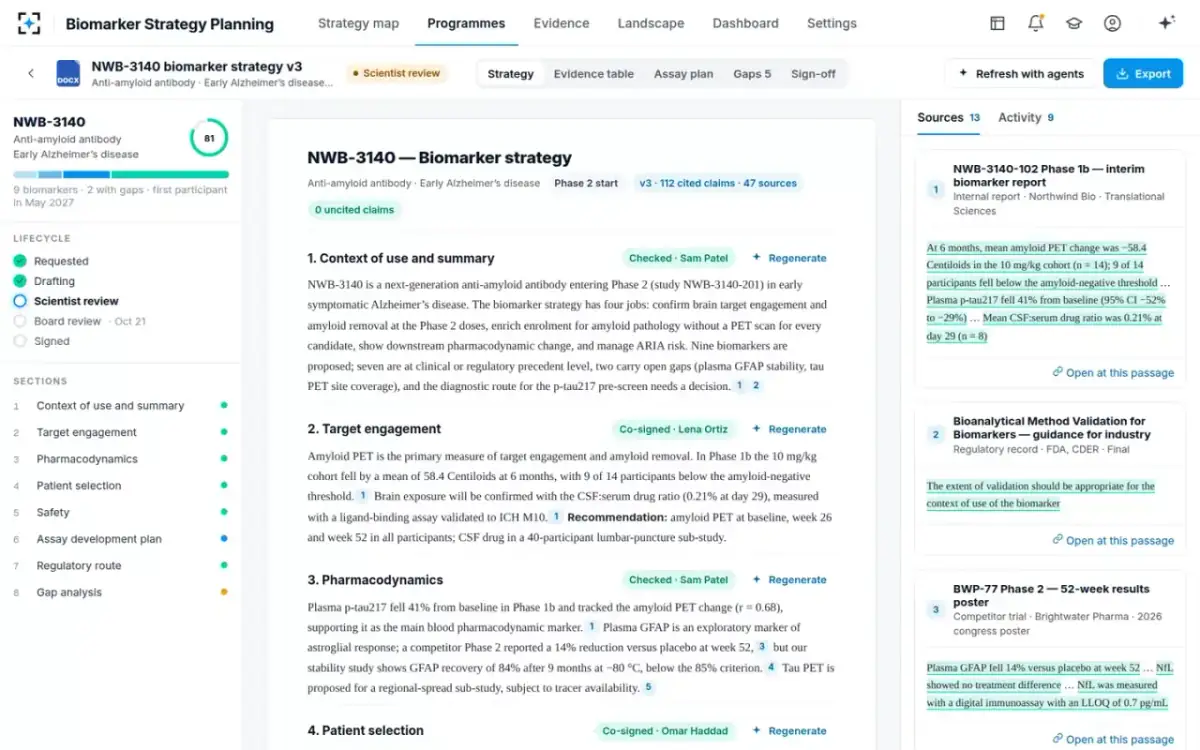
Everything above is a judgement call that has to survive contact with a board meeting a year later. The house template in the solution keeps a regulatory-route section as one of its eight sections, beside context of use, target engagement, pharmacodynamics, patient selection, safety, the assay development plan and the gap analysis — so the route is written down in the same document as the evidence it depends on, with each claim cited to the passage it came from.
Three of the solution's own limits matter here. The assay and precedent reader sets each marker's validation status and regulatory precedent for its context of use and never infers that a marker has been qualified where there is no source saying so — an easy mistake to make from a conference abstract, and a costly one in a signed strategy. Key claims can be required to carry two independent sources, with single-source claims flagged in the draft for a person to look at. And the recency window, the handling of preprints — always labelled as not peer reviewed — and the number of sources per claim are settings a team sets to its own evidence rules rather than conventions buried in a prompt.
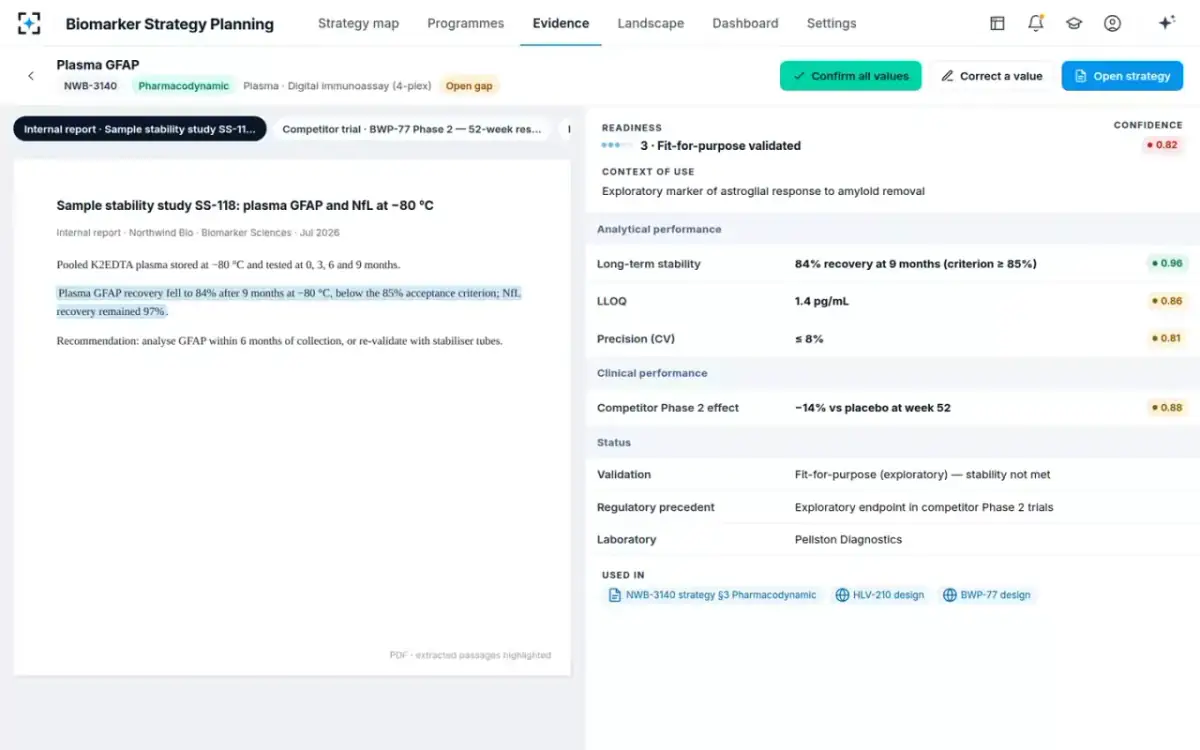
One marker, its evidence and its validation status, side by side
The strategy itself: eight sections, every claim cited
The honest summary for most teams is short. Qualification is a specialised instrument, and for a marker that serves one programme the usual right answer is to argue the marker inside your own development and say so, with the reason, in the strategy. Writing down why not is as valuable as writing down why — it is the sentence that stops the question being reopened at every review. To see how the route sits beside the markers, the assays and the gaps, start from Biomarker Strategy Planning or from how a biomarker strategy is built.
Questions people ask
What are the three stages of biomarker qualification?
A letter of intent, a qualification plan, and a full qualification package. The statute makes each one conditional on the last: FDA accepts or declines the letter of intent; if accepted, the requestor submits a qualification plan, which FDA accepts or declines; if that is accepted, the requestor submits the full package, which FDA decides whether to accept for review before conducting a comprehensive review and determining qualification on scientific merit.
Who can request qualification of a biomarker?
Any requestor, which the statute defines as "an entity or entities, including a drug sponsor or a biomedical research consortia, seeking to qualify a drug development tool for a proposed context of use". Consortia are described broadly enough to include government agencies, universities, patient advocacy groups, industry and individual experts — which is why much qualification work is collaborative: the result is usable by everyone, so the cost is often shared.
What is the difference between qualification and approval of a test?
They answer different questions and neither implies the other. Qualification determines that a marker, in a stated context of use, can be relied on in drug development and regulatory review; FDA's program page notes that the marker is qualified, not the measurement method. Approval or clearance of a test is a device decision about a particular product. FDA states explicitly that clearance of a biomarker test by its device centre or by CBER does not indicate qualification of the marker for drug development.
What does qualification let other sponsors do?
Rely on the tool without re-arguing it. A qualified drug development tool "may be used by any person in such context of use" to support or obtain approval or licensure of a medicine, or to support investigational use. ICH E16 adds the filing consequence: data generated within the qualified context of use do not need to be re-submitted for re-qualification in an NDA, BLA or MAA, and a copy of the authority's assessment report can be provided instead.
What does the EMA offer instead of FDA qualification?
A voluntary procedure for the qualification of novel methodologies, assessed within a defined context of use, for methodologies that "should apply to multiple medicinal products and developers". It offers an informal scoping meeting, qualification advice on preliminary data and qualification plans, and a formal CHMP qualification opinion on acceptability in a defined context of use. EMA also publishes letters of support for promising developments with the developer's agreement.
Can a qualification be taken away once it is granted?
Yes. The statute allows FDA to rescind or modify a determination where the tool is no longer appropriate for the proposed context of use, which may be based on new information that calls the basis for qualification into question; the requestor can request a meeting to discuss it. Rescissions and modifications are among the things FDA must publish. A strategy relying on a qualified tool should record when it last verified the position.