A biomarker's context of use is a short, deliberate statement of how that biomarker will be used in drug development: which category it belongs to, and what it will be used to do, at which stage, in which population, for which mechanism. It matters more than any other sentence in a biomarker strategy because it is the sentence that sets the evidence bar. A narrow context of use makes the evidence you owe finite and the assay validation proportionate; a loose one invites a reviewer to ask for the evidence that would support the widest reading of it. Biomarker Strategy Planning makes that statement a required field on every marker, sets the validation status against it, and keeps it beside the passage that supports it.
The worked statements below are written for the fictional sample programme the solution ships with — an anti-amyloid antibody in early Alzheimer's disease, moving into Phase 2. The disease and the molecule are there to keep the examples concrete; the pattern transfers to any mechanism. Everything attributed to a regulator is real and linked where it appears.
The term "context of use" means, with respect to a drug development tool, the circumstances under which the drug development tool is to be used in drug development and regulatory review.
21st Century Cures Act, Public Law 114-255, adding FD&C Act section 507(e)(4)
What is a biomarker's context of use?
Two definitions are in play, and both are worth having. The statutory one, quoted above, is deliberately wide: the circumstances in which the tool is used. The working one, from FDA's evidentiary framework for biomarker qualification, is the one you write: "The COU is a concise description of a biomarker's specified use in drug development. The COU includes two components: (1) the biomarker category and (2) the biomarker's proposed use in drug development" (FDA, Biomarker Qualification: Evidentiary Framework). The same guidance adds a discipline most teams resist: "Each biomarker qualification effort should identify a single COU."
One sentence, one category, one use. The resistance is understandable — a marker a team believes in usually looks useful for several things at once — but the single-statement rule is what makes the evidence question answerable. Two uses in one sentence produce an evidence package that satisfies neither, and a reviewer who cannot tell which claim is being made will assume the larger one.
The statutory sentence, and the two components FDA asks for
The first component is one of the seven categories: diagnostic, monitoring, pharmacodynamic/response, predictive, prognostic, safety, or susceptibility/risk. Choosing one is not bureaucracy; it tells the reader which kind of evidence is relevant before they read another word. The second component — the proposed use in drug development — has four elements the guidance names, and a statement that carries all four is almost impossible to misread.
The four elements FDA asks the proposed use to carry
| Element | What the guidance says it covers | What goes wrong when it is missing |
|---|---|---|
| Purpose of use in drug development | The job the marker does, with the category attached — for example a prognostic biomarker to support enrichment of a study population, or a safety biomarker to evaluate drug-induced liver injury. | The sentence describes the marker rather than the decision, and nobody can say what changes if the measurement comes back differently. |
| Proposed stage of drug development | Where in development it will be used: Phase 1 clinical trials, nonclinical safety studies, and so on. | The evidence bar floats. The same marker used for an internal dose decision and for a registration claim is not the same proposition. |
| Clinical trial population or model system | Who or what it will be measured in: healthy adult subjects, patients with a named condition, or a named preclinical model. | Accuracy figures get imported from a population you will not enrol, which is the most common unforced error in a strategy. |
| Therapeutic mechanism of action | The mechanism the marker is intended to have value for, where the mechanism is relevant to the marker’s biology. | A marker that tracks one pathway is quietly claimed for a drug that works on another. |
Note the hedge in the guidance — the elements are to be included "as appropriate" — and resist using it as an escape. For a qualification submission, a missing element invites a question. For an internal strategy, a missing element is worse, because nobody will ever ask: the sentence simply travels through the organisation meaning slightly more each time it is read.
Writing the sentence: a pattern and four worked statements
The pattern that falls out of the four elements is mechanical, and that is its virtue. Category, then purpose, then stage, then population, then mechanism, in one sentence. Written this way a context of use is quick to draft and settles arguments that otherwise surface at the worst moment.
One pattern, four statements: the same structure across the four lanes of a strategy
Target engagement
The statementA pharmacodynamic biomarker, used to confirm central target engagement at the doses selected for Phase 2, in patients with early symptomatic Alzheimer’s disease, for an antibody that clears aggregated amyloid.
What it decidesWhether the dose carried into Phase 2 reaches the target in the brain.
What it therefore owesA dose-response relationship in your own cohort, and a measurement whose repeat precision is smaller than the change you claim.
Pharmacodynamic
The statementA response biomarker, used to size the Phase 2b study from the change observed over six months, in the same population, for the same mechanism.
What it decidesThe sample size, and the futility rule at the interim look.
What it therefore owesThe effect size with its variability, from a cohort resembling the one you will enrol, measured on the platform you will use.
Patient selection
The statementA diagnostic biomarker, used to pre-screen candidates before confirmatory imaging in a Phase 2 study, in adults aged 55 to 85 with mild cognitive impairment.
What it decidesWho proceeds to the expensive confirmatory test, and therefore the whole screening funnel.
What it therefore owesAccuracy against the confirmatory standard in that exact population, at a stated cut-off, on a test validated before the cut-off was fixed.
Safety
The statementA susceptibility/risk biomarker, used to stratify randomisation and set the imaging schedule, in the same Phase 2 population, for a mechanism with a known imaging-detected hazard.
What it decidesThe monitoring schedule, and whether a subgroup is enrolled at all.
What it therefore owesEvent rates by marker status, and an answer to what happens to the patients the marker excludes.
Read the four statements and notice what they do not say. None of them says the marker is accurate, promising or well established. Each says what will be done with the measurement, and from that the evidence follows without further argument. That is the whole trick.
Narrow first, broaden later: why scope is a strategy choice
Scope is not fixed by nature. ICH E16, adopted by FDA in 2011, says plainly that "the context of use of a biomarker in a biomarker qualification can be narrow or broad: the biomarker(s) might be useful for only a single drug or biotechnology product, for several drug or biotechnology products in a drug class, or even across several drug classes" (ICH E16). Breadth is a decision the sponsor makes, and it is priced accordingly.
FDA's own advice is to start small. "One approach is to initially qualify a biomarker for a COU that is limited in scope to facilitate the integration of the biomarker in drug development, which could result in the accumulation of additional evidence that can help qualify the biomarker for a COU with a more expanded scope in the future." The guidance's worked example is exactly the sequence a development team would want: qualified first as a pharmacodynamic biomarker for dose selection, then expanded once more data exist.
The same logic applies inside a company, where nobody is qualifying anything. A marker admitted for a narrow internal use starts generating evidence immediately, under real conditions, in the population you actually enrol. A marker held back until it can be claimed for everything generates nothing, and after two years it is still a candidate.
How context of use sets the evidence bar
The link between the sentence and the evidence is stated directly in the framework, and it is not a sliding scale of rigour so much as a judgement about consequence: "The evidence sufficient to qualify a biomarker depends on its COU and the potential benefits and risks associated with its use. The benefits and risks associated with a biomarker's COU drives expectations for the reliability of the biomarker to predict the outcome of interest. If the potential benefits far outweigh the potential risks and/or there are acceptable risk mitigation approaches, there could be increased tolerance for uncertainty. In such a case, the strength of evidence expected to support qualification could be lower."
The same marker, five uses, five different evidence bars
The guidance also supplies four questions for characterising benefits and risks, and they are the most useful free checklist in this field. Does the biomarker have the potential to add value to drug development? What other tools are available for the proposed use, and what does this one add? What are the anticipated consequences if it turns out to be unsuitable? And what would mitigate the risk of relying on it if it does not perform as expected? The fourth is the one teams skip, and it is often the cheapest to answer: the framework's own example is a prognostic marker used for enrichment that fails to identify fast progressors, where "mitigation strategies could include incorporating an interim analysis for sample size reestimation."
Clinical validation and analytical validation are different arguments
Two kinds of evidence hang off a context of use, and conflating them is the most expensive confusion in biomarker work. Clinical validation, in the framework's words, "establishes that a biomarker's relationship with the outcome of interest is acceptable for the proposed COU." Analytical validation establishes that the test's performance characteristics "are acceptable for the proposed COU in drug development. This is validation of the test's technical performance, but is not validation of the biomarker's usefulness."
The two validations: different questions, different evidence, different ways to fail
Analytical validation: Does the test measure what it says it measures, reliably enough for this use?
Clinical validation: Does the thing being measured relate to the outcome of interest, well enough for this use?
Analytical validation: Accuracy, precision, sensitivity, selectivity, range, reproducibility, stability — against pre-set criteria.
Clinical validation: A relationship with the outcome in a relevant population, and an account of the biology behind it.
Analytical validation: It cannot make a biomarker useful. A perfectly measured irrelevant analyte is still irrelevant.
Clinical validation: It cannot survive a change of platform. A relationship shown on one assay is not automatically inherited by another.
Analytical validation: The bioanalytical or laboratory group, and the vendor whose platform you run.
Clinical validation: The translational lead, with the statistician who will defend the relationship.
Analytical validation: A result nobody can reproduce at the second site, discovered when the second site opens.
Clinical validation: A claim that holds in a published cohort and not in yours, discovered at the interim analysis.
The cut-off comes before the validation, not after
There is one sequencing rule in the framework that is easy to break without noticing, and it is worth printing on the wall: "A reliable test should be used to measure the biomarker before the biomarker measurement cutoffs can be established, and the cutoffs should be defined before the biomarker test can be analytically validated."
Read it as three steps in order. A test reliable enough to produce meaningful numbers comes first. The cut-off — the value at or above which a result is called positive — is set on that test. Only then can the test be analytically validated, because validation has to demonstrate performance at the concentrations that matter, which means around the cut-off. Run the steps in a different order and the validation package proves precision in the wrong place, which is a result that looks clean and tells you nothing about the decisions you will make at the boundary.
The order also explains why a cut-off cannot simply be lifted from a paper. A published cut-off belongs to the platform, the matrix and the population it was derived in. Moving it to your assay without a bridging study transfers a number and leaves its meaning behind, and the effect lands precisely on the patients near the boundary — which, in a pre-screening design, is a large share of them.
How much validation does an assay need for this context of use?
Enough for the decision, and no more: that is what fit-for-purpose means, and FDA's biomarker method-validation guidance of April 2026 states the principle directly — a fit-for-purpose approach should be used when determining the appropriate extent of method validation (FDA, Bioanalytical Method Validation for Biomarkers). The practical consequence is that "is this assay validated?" is not a well-formed question. The answerable one is "is this assay validated for this context of use?", and the two have different answers more often than not.
The depth that follows is the subject of its own guide: fit-for-purpose assay development and validation, and the acceptance criteria that bite, works through the stages, the characteristics and what to do when a result misses its criterion. What belongs here is only the hinge: the context of use is written first, and the validation plan is read off it. A validation plan written before the context of use is a plan to do a standard amount of work, which is either waste or a gap, and usually both in different places.
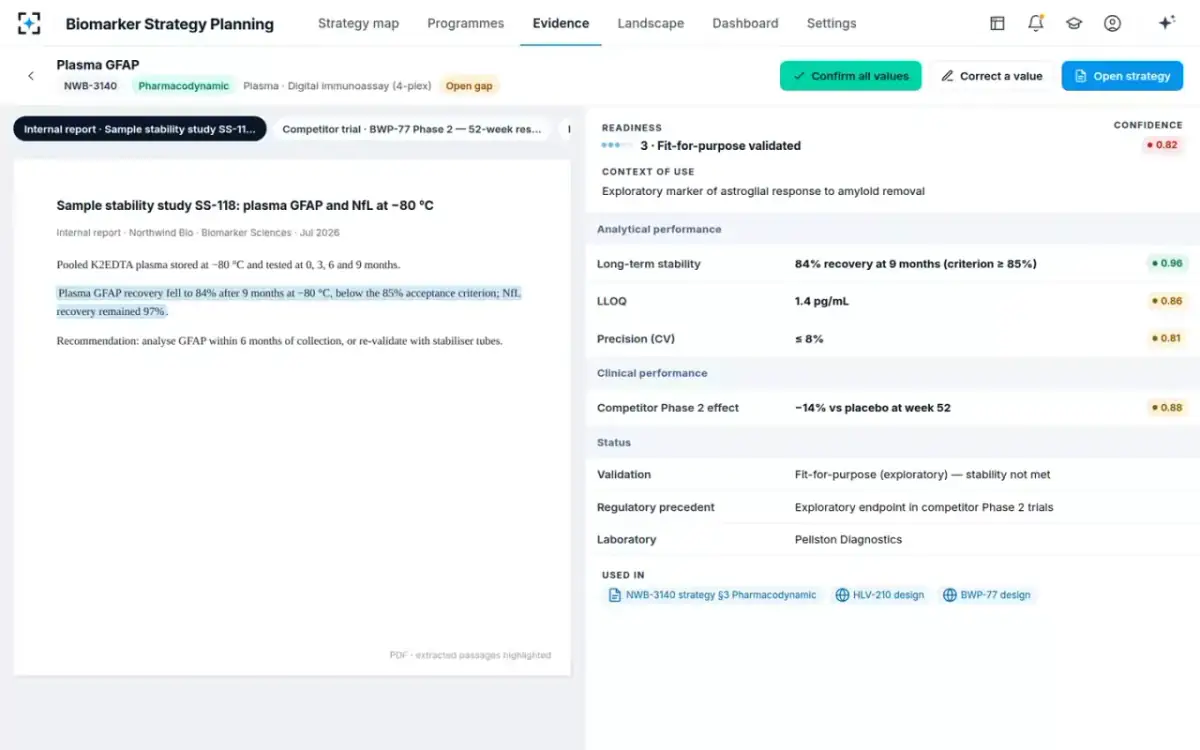
One marker, its statement, and the passage it rests on
The same idea, now applied to AI models in submissions
The strongest evidence that context of use is a general principle rather than a biomarker formality is that FDA has now applied the identical structure to something else entirely. Its January 2025 draft guidance on artificial intelligence in regulatory decision-making for drug and biological products sets out a risk-based way to establish and judge how far an AI model can be trusted for a particular context of use, with that trust resting on credibility evidence gathered about the model's performance in that use (FDA, Considerations for the Use of Artificial Intelligence to Support Regulatory Decision-Making).
The same three moves appear: name the use, judge the consequence of being wrong, size the evidence to that judgement. A translational team that has learned to write a biomarker context of use already knows how to answer the questions that will be asked about a model, and a team that has not will find both conversations hard for the same reason. What AI tools in biomarker work can and cannot be trusted with takes that framework further.
Six tests a context-of-use statement has to pass
Before a statement goes into a strategy, run it through six checks. They take a minute each and they catch the failures that otherwise surface in review.
Six tests, and what each one catches
- Does it name exactly one of the seven categories?
Two categories in one sentence means two evidence packages, and usually neither gets built.
- Does it name the decision, not the marker?
If the sentence survives with the marker’s name deleted, it is describing a measurement rather than a use.
- Does it name the stage and the population?
These are the two elements most often dropped, and they are the two that let evidence from the wrong cohort in.
- Does it change what you owe?
Compare the narrow version with the broad one. If the evidence list does not change, the statement is not doing any work.
- Can the assay plan be read off it?
The statement should determine the validation depth, the matrix, the platform and the date the assay has to be ready.
- Would a reviewer read it the way you do?
Hand it to someone who has not been in the meetings. If they imagine a broader use, a reviewer will too.
Where Biomarker Strategy Planning fits around the context-of-use statement
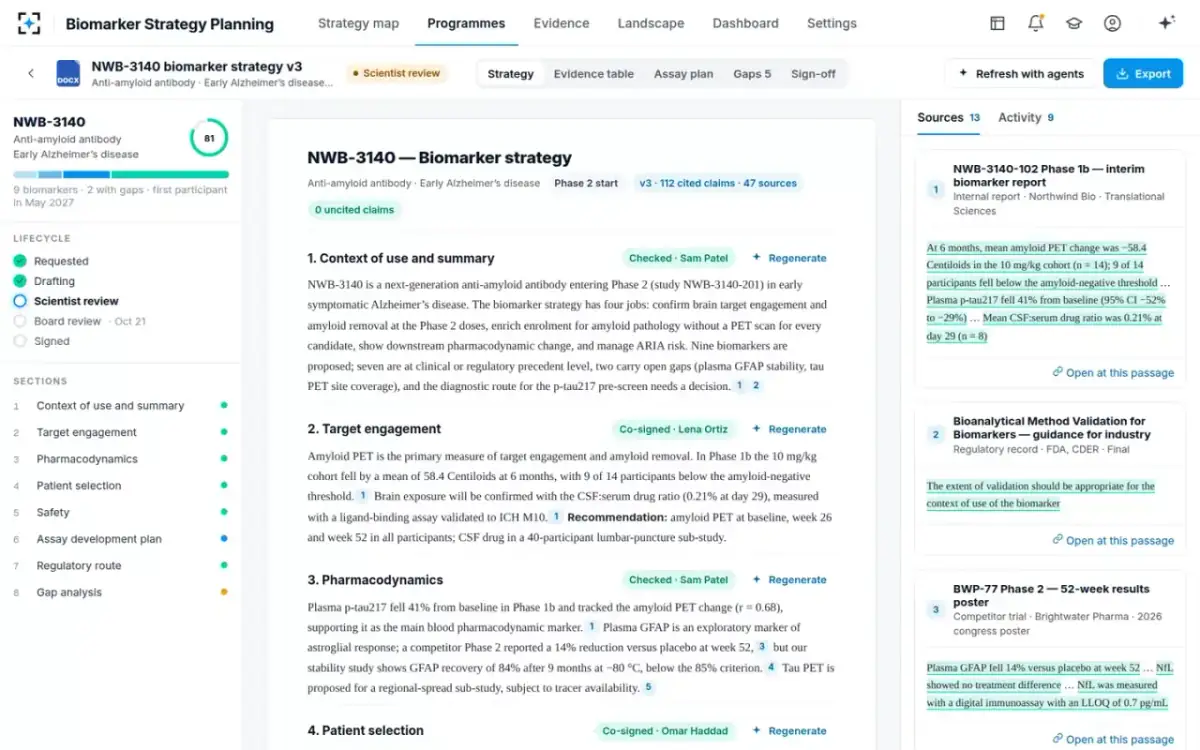
In Biomarker Strategy Planning, the context of use is the first section of the eight-section house template, and it is the field everything else in the strategy is priced against. An assay and precedent reader sets each marker's validation status — from candidate through fit-for-purpose validated and clinically shown to regulatory precedent — for the statement as written, and never infers qualification without a record to point at. On the strategy map, each marker shows the decision it supports beside its readiness, so the depth of validation can be read against the weight of the decision rather than against a habit.
What the solution deliberately does not do is write your context of use for you and then act on it. A statement is an argument about scope, and scope is a judgement with regulatory consequences; the agents draft, cite and flag, and the section owners co-sign. Everything in the sample programme — the molecule, the laboratories, the people and the rival trials — is fictional sample data. To see the statements, the validation statuses and the gap list together, start from Biomarker Strategy Planning, or read how a whole biomarker strategy is built around them.
Context of use opens the template, and every claim beneath it carries a citation
Questions people ask
Can one biomarker have more than one context of use?
Yes, and most useful markers do — but each statement is evaluated on its own. FDA's framework asks that each qualification effort identify a single context of use, and the same discipline is worth keeping internally: write one statement per use, and let the marker appear twice in the strategy. A single sentence covering dose selection and patient selection produces an evidence package that satisfies neither, because the two uses have different populations, different consequences and often different platforms.
Who decides the context of use?
The sponsor proposes it; the agency responds to what is proposed. Inside a company the translational lead usually drafts it, regulatory affairs reviews the wording, and the section owner co-signs. It is worth treating the draft as a regulatory text rather than a scientific one, because a word like "supporting" or "confirming" quietly changes the weight of the decision and therefore the evidence owed.
Does a narrow context of use make qualification easier?
Generally yes, and the framework says so: starting with a limited scope lets a marker be integrated into development, which generates the evidence that can later support a broader statement. The trade is real — a narrow qualification cannot be cited for a use it does not cover — but the alternative, waiting until the evidence for a broad claim exists, usually means the marker is never used at all.
What happens if you use a marker outside its context of use?
Nothing formal, in most cases, because most biomarker use is internal and unqualified. What you lose is the right to rely on the evidence you assembled: a marker qualified or validated for dose selection carries no weight when it is used to decide who receives a drug, and a reviewer will say so. The practical harm is usually discovered late, when a decision that felt well supported turns out to rest on a study in a different population.
What is the difference between context of use and intended use?
Intended use is device vocabulary: it describes what a test is for, and it appears in the labelling of a cleared or approved in vitro diagnostic. Context of use is drug development vocabulary: it describes the circumstances in which a drug development tool is used in development and regulatory review. The same measurement can have both, aimed at different regulators, and a strategy should say which one it is talking about in any given sentence.
How long should a context-of-use statement be?
Usually one sentence; FDA's framework calls it a concise description. If it will not fit in a sentence, the usual cause is two uses hiding in one statement; split it. If it fits in ten words, an element is missing — most often the population, which is also the element whose absence lets accuracy figures from the wrong cohort into the strategy.