A wall cross is the moment a company asks someone to accept material nonpublic information — MNPI — about a transaction that is not yet public, and that person agrees in writing to hold it in confidence and not trade on it. In biopharma business development the information is a licensing discussion or an acquisition, and the people crossed over are the deal lead, the head of Search & Evaluation, outside counsel and the six function leads who will read the seller's data room. Wall crossing and MNPI belong in the same sentence because the cross is what creates the duty: the securities laws do not punish knowing something, they punish trading while you owe someone a duty of confidence about it. Botminds' BD Search & Evaluation is built on that duty — each deal sits behind its own information barrier, only wall-crossed people open it, pages carry the viewer's name and every view is logged.
The hard part is not the paperwork. It is that a licensing deal has to be read by a team of specialists under a bid deadline, and every one of them is a person with a brokerage account, a spouse and a view on the sector. The deals, people and companies used as examples from the solution below are fictional sample data; the enforcement case is real and public, and is cited where it appears.
What a wall cross is, and what it actually binds
The phrase comes from the information barrier — the "wall" — that a bank or a company puts between the people who hold deal information and the people who trade or advise. Crossing someone over the wall means deliberately moving them to the inside. In practice the cross has four parts, and only the last one is paperwork: the gatekeeper asks whether the person is willing to be restricted, explains what being restricted means, obtains consent, and only then reads out the name of the target.
What the agreement binds is wider than most people assume. It binds trading in the target's securities; it binds telling anyone else, including a colleague who is not on the list; and — the part that is routinely missed — it binds trading in anything else whose price the same information would move. It usually also puts the person on a restricted list until the information becomes public or goes stale, which means personal trades in a named set of companies stop, not just trades in the one company being discussed.
A wall cross is not a formality that can be done after the fact. The consent has to come before the name, because once the name is out the person is restricted whether they wanted to be or not, and a person who did not want to be restricted now has a grievance and a trading ban. Deal teams that take this seriously keep a script, and they keep the answer.
Material nonpublic information (MNPI), in the rule's own words
MNPI is information about a company or its securities that has not been disclosed to the market and that a reasonable investor would consider important in deciding whether to buy or sell. The rule that makes trading on it unlawful does not define materiality — courts do that — but it is unusually clear about the shape of the offence. Rule 10b5-1(a) says the devices prohibited by Section 10(b) include "the purchase or sale of a security of any issuer, on the basis of material nonpublic information about that security or issuer, in breach of a duty of trust or confidence that is owed directly, indirectly, or derivatively, to the issuer of that security or the shareholders of that issuer, or to any other person who is the source of the material nonpublic information" (17 CFR 240.10b5-1(a), emphasis added).
Read that last clause slowly, because it is the whole guide. The duty does not have to run to the company whose shares you buy. It can run to whoever gave you the information. For a business development professional, the source is almost always an employer or a counterparty who handed over a secret under an agreement — which is exactly the duty a wall cross creates.
The second thing the rule settles is what "on the basis of" means. Under 10b5-1(b), a purchase or sale is on the basis of MNPI "if the person making the purchase or sale was aware of the material nonpublic information when the person made the purchase or sale." Awareness, not use. A trader who was aware of the deal and claims the trade was for other reasons is arguing against the rule's default, not with it.
Why the duty follows the agreement, not the employer
The misappropriation theory is the reason a licensing deal needs a list at all. It treats deal information as the property of its source, and treats trading on it as a theft from that source rather than a fraud on the counterparty. Rule 10b5-2 sets out, non-exhaustively, when the necessary duty exists — and its first circumstance is the one every confidentiality agreement creates.
For purposes of this section, a "duty of trust or confidence" exists in the following circumstances, among others: (1) Whenever a person agrees to maintain information in confidence
17 CFR 240.10b5-2(b)(1), Code of Federal Regulations, 1 April 2024 edition (rule adopted at 65 FR 51738, 24 August 2000)
The last nine words do most of the work. A licensor's chief financial officer who signs a mutual confidentiality agreement is inside. So is the contract research organisation that holds the study report, the patent counsel reading the family, the consultant retained for a market check and the analyst who was told the code name to run a landscape. None of them is an employee of the company whose shares are at stake; each of them has agreed to maintain information in confidence, and that agreement is the duty.
It follows that the question "whose employee is this person?" is the wrong one. The right question is "what has this person signed, and what did they learn under it?" A deal team that keeps its list by employer will miss people it has an obligation to brief.
Is shadow trading illegal?
Yes — on the record now established, trading in a comparable company's securities on the strength of your own employer's confidential deal news is insider trading, and a federal jury has said so. "Shadow trading" is the market's name for it: using MNPI about company A to trade company B, where the information is expected to move B's price too, usually because B is a close economic peer.
The case that settled the question concerns, pointedly, a head of business development. In August 2021 the SEC charged Matthew Panuwat, "the then-head of business development at Medivation," with insider trading. He had not bought Medivation shares. According to the Commission's announcement, he "purchased short-term, out-of-the-money stock options in Incyte Corporation, another mid-cap oncology-focused biopharmaceutical company, just days before the Aug. 22, 2016, announcement that Pfizer would acquire Medivation at a significant premium" (SEC press release 2021-155). On 5 April 2024, "after an eight-day jury trial in the U.S. District Court for the Northern District of California," the Commission obtained a verdict in its favour (SEC Litigation Release No. 25970).
One email to one verdict: the chronology a business development team should know
| When | What happened | What it establishes |
|---|---|---|
| 12 August 2016 | Medivation's investment bankers sent Panuwat a summary of bids indicating that at least five potential acquirers were offering an all-cash acquisition at a premium, and that all were prepared to move forward quickly. | Deal information reaches business development earlier and in more detail than it reaches almost anyone else in the company. |
| 14 August 2016 | Panuwat attended the board meeting at which the bankers were authorised to send letters to the final bidders. | Seniority is not the test. Proximity to the process is. |
| 18 August 2016 | Panuwat received an email from Medivation's chief executive that the company would be imminently acquired by Pfizer. "Within minutes of receiving this highly confidential news," the complaint states, Panuwat bought out-of-the-money, short-term options in Incyte — from his work computer. | The trade was in another company's securities, and the duty came from his own employment and the policy he had signed. |
| 22 August 2016 | The acquisition was announced. Medivation shares rose about 20% and Incyte shares rose "approximately 8%", roughly doubling the value of the options. The complaint puts the illicit profits at $107,066. | The economic link between peers is precisely what makes the information material to the second company. |
| 17 August 2021 | The SEC filed its complaint. | An enforcement theory that had been discussed for years became a charged case. |
| 5 April 2024 | A jury returned a verdict for the Commission after an eight-day trial. | Shadow trading is not a grey area to be managed by argument. It is a liability to be managed by a list. |
What the verdict changes for a business development team
Less than people fear, and more than they act on. The rule text above has carried the "any other person who is the source" clause since 2000. What changed is that a jury agreed, on facts a biopharma deal team will recognise in every particular, so the arguments that used to be available in a compliance meeting are no longer worth making.
Two of the facts should give any Search & Evaluation group pause. The first is the policy Panuwat had signed, which already said what he did was prohibited: "you may be in a position to profit financially by buying or selling or in some other way dealing in the Company's securities … or the securities of another publicly traded company, including all significant collaborators, customers, partners, suppliers, or competitors of the Company." Many biopharma insider-trading policies contain a clause like it. The failure was not a missing rule; it was a rule nobody had been made to apply to a peer company.
The second is that, according to the complaint, Panuwat had himself suggested to the bankers that they might want to consider Incyte a comparable company. Naming comparables is the daily work of business development and Search & Evaluation. The people most exposed to this theory are therefore the ones whose job is to know which other company looks most like the one in play — which is to say, the people reading the landscape.
The practical change is to the restricted list. A list that names only the target is incomplete for a licensing deal in a crowded mechanism, because the deal news moves the handful of companies running the nearest assets. The landscape the team built from public registries is, conveniently, the same list of peers compliance needs.
Who belongs inside the wall on a licensing deal, and who does not
The test is need to know for a defined task in a defined window, not rank and not curiosity. A function lead who must read the data room is inside. A commercial analyst who will size the market after signing is outside until there is something to size. Lists grow for bad reasons — someone asks, someone is senior, someone was on the last one — and every name added is a person who must be briefed, restricted, tracked and later released.
How many people are inside the wall: four sample deals in BD Search & Evaluation
Eleven is not wrong and seven is not virtuous. What matters is that each name has a reason recorded against it and a date. The useful discipline is to write the list as a table of tasks, then put a name against each task, rather than writing a list of names and finding tasks for them.
Inside the wall and outside it, on one licensing deal
Inside the wall: The head who will sign the recommendation, and the analyst running the diligence timetable.
Outside, until the deal is public: The rest of the scouting team, who keep screening public sources against the thesis without being told which asset is in play.
Inside the wall: The deal lead running the seller process and countersigning.
Outside, until the deal is public: Colleagues running other processes. Their deals have their own walls; the two do not meet.
Inside the wall: Clinical, safety, CMC, IP, regulatory and commercial leads, each crossed when their part of the room opens.
Outside, until the deal is public: Their teams, unless a named person is crossed for a specific document.
Inside the wall: Counsel drafting the agreement, and the compliance officer maintaining the restricted list.
Outside, until the deal is public: Nobody — this is the one function that is inside by design, because it keeps the list.
Inside the wall: Only when a valuation or a funding decision depends on the deal.
Outside, until the deal is public: Routine reporting and planning staff, who are told after announcement like everyone else.
Inside the wall: Scoped to this deal's files only, with no search or memory across deals.
Outside, until the deal is public: Any process that reads several deals at once. An agent that can see two rooms is a hole in both walls.
What the file has to show: the list, the log, the watermark
A deal team cannot prove, after the fact, that information stayed inside the wall. It can only prove that the controls were in place and were working, which is why the list, the log and the watermark matter as evidence and not only as hygiene. The federal security control catalogue many companies already map their controls to says the same thing in general terms: enforce approved authorisations for logical access, and enforce approved authorisations for the flow of information between connected systems (NIST SP 800-53 Rev. 5, AC-3 and AC-4).
What a wall-cross script has to say before the name is read out
- Ask for consent first, and record the answer
Say that you are about to share confidential information about a potential transaction, that accepting it will restrict personal trading, and ask whether the person agrees. Do not say the name until they have.
- Name the restriction, not just the obligation
Say which securities are restricted — the target and the peers the news would move — and say that the restriction covers accounts the person controls or influences, not only their own.
- Say how long it lasts, and who lifts it
The restriction runs until the information is public or stale, and only the compliance officer who put it on may take it off. A deal that dies does not end it.
- Forbid onward disclosure by default
No colleague, no spouse, no adviser without a further cross. Add that the person should tell the deal lead if someone else already seems to know.
- Explain that peers are covered
The one sentence most policies have and most briefings omit: trading the securities of a comparable company on this information is prohibited for the same reason trading the target is.
- Log the cross: who, when, by whom, which deal
The log is the evidence that the duty was accepted on a date. A cross nobody wrote down is a cross you cannot prove.
- Hand over the document access separately
Being on the list and having the files are two decisions. Grant the room only when there is something in it for this person to read.
One deal's files, kept apart, with the viewer's name on the page
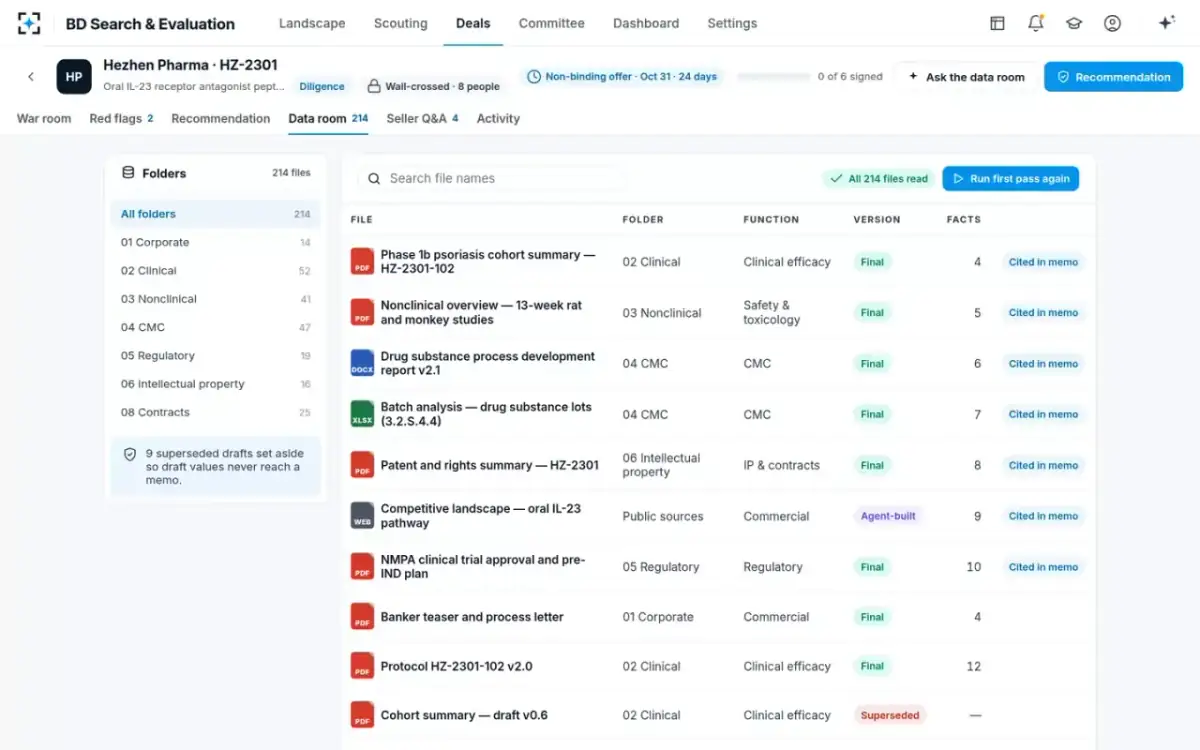
What each rule requires, and what a deal team should be able to produce
| The rule | What it requires | What the deal team keeps as evidence |
|---|---|---|
| 17 CFR 240.10b5-1(a) | No purchase or sale on the basis of MNPI in breach of a duty owed to the issuer or "to any other person who is the source of the material nonpublic information". | The restricted list, with the peer companies named, and the date each name went on and came off. |
| 17 CFR 240.10b5-1(b) | Trading while aware of MNPI is trading "on the basis of" it, subject to the rule's affirmative defences. | The wall-cross log, which fixes the date a person became aware, and pre-clearance records for personal trades. |
| 17 CFR 240.10b5-2(b)(1) | A duty of trust or confidence exists "whenever a person agrees to maintain information in confidence". | The executed confidentiality agreements for every counterparty, adviser and contractor who saw a file. |
| The company's own insider-trading policy | Typically, no dealing in the securities of the company or of "another publicly traded company" that is a collaborator, partner, supplier or competitor. | The signed acknowledgement, plus evidence that the peer clause was read out at the cross and not merely signed years ago. |
| NIST SP 800-53 Rev. 5, AC-3 and AC-4 | Enforce approved authorisations for access to information, and for the flow of information within and between systems. | The access list per deal, the view log, the watermark on every page, and the approval on every export. |
Can software be wall-crossed?
No, and that is the point. A system cannot consent, cannot be restricted and cannot be sanctioned, so it cannot be brought inside a wall the way a person can. The only honest way to put software on a deal is to build the barrier into what the software is allowed to read, and then to show the trail.
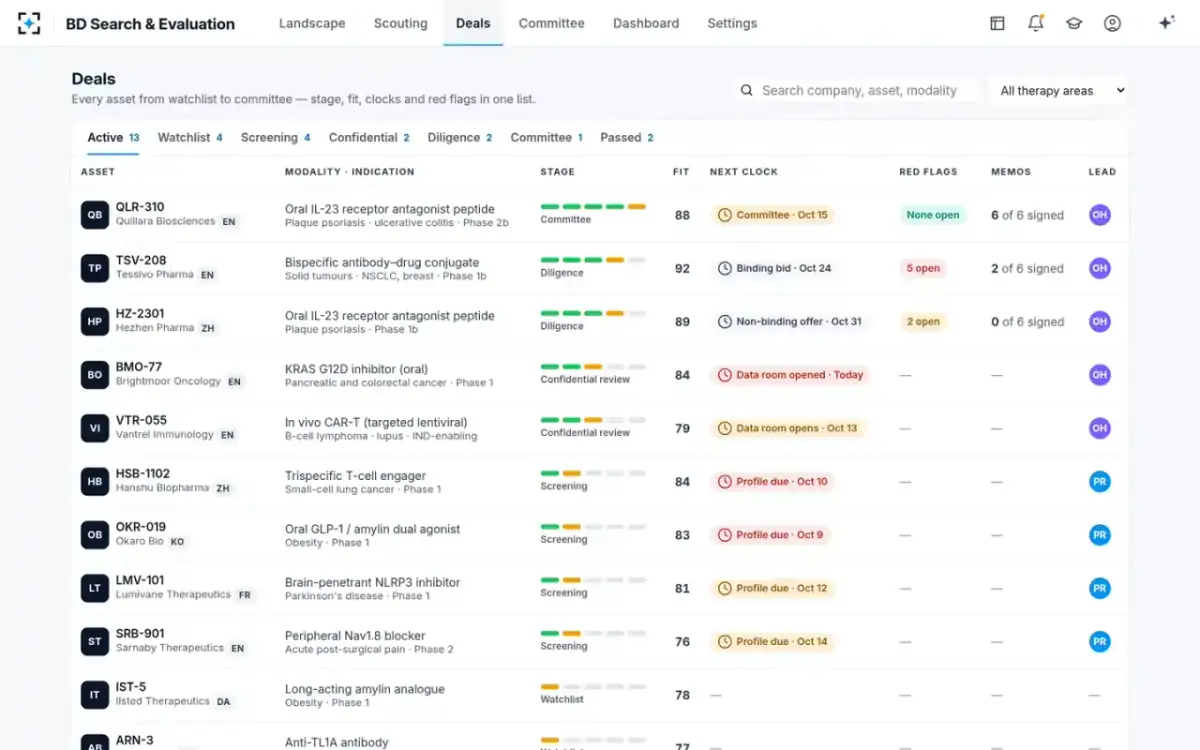
In BD Search & Evaluation that means three constraints with no exceptions. The agents serving a deal read that deal's files and nothing else — no search across rooms, no memory carried from one deal to the next. The scouting agents work from public sources only and never touch deal data, which keeps a landscape that can be shown to a colleague outside the wall genuinely public. And every agent step, signature and approval lands on the deal's activity trail, so the question "which system saw this file, and when?" has an answer. Where the line between drafting and deciding sits is a longer argument, set out in what agents may and may not do in pharma business development.
The temptation an agentic system creates is exactly the one to resist: a model that has read four data rooms would obviously give a better answer about the fifth. It would also be a single process standing on both sides of four walls, and the first question in any investigation would be what it had been asked.
Every deal on one screen, each behind its own wall
When the wall comes down, and what stays confidential afterwards
A restriction ends when the information is no longer material and nonpublic — normally on announcement, sometimes when the information has gone stale, and never simply because time has passed. Two situations catch deal teams out.
The first is the deal that dies. If a licensing discussion ends without an agreement, the fact that your company looked hard at an asset and walked away is still nonpublic, and it is still information about the licensor. Nothing has been announced, so nothing has been cleansed. The list stays live until compliance takes it down, and the people on it are still restricted in the peers.
The second is the information that survives the deal. A confidentiality agreement typically survives termination for a fixed term, and the obligation not to use the counterparty's data for your own programmes usually survives longer than the obligation to keep it secret. A diligence team that has read a competitor's clinical study report cannot unread it, which is why the people who read the room should not be the people designing your competing programme, and why a data room's export and watermark controls matter after the process as much as during it.
The cleansing itself should be a positive act with a date: compliance lifts the restriction, tells each person on the list in writing, and closes the deal's access so the files stop being readable by people who no longer have a reason. On the sample deals, access to the room, the memos and the red-flag register is removed on the same instruction that lifts the trading restriction, and the removal lands on the activity trail with everything else.
Questions people ask
What is a wall cross in finance?
It is the deliberate act of moving someone from outside an information barrier to inside it: a gatekeeper asks whether the person consents to receive confidential deal information, explains that accepting it will restrict their personal trading, obtains the answer, and only then discloses the name. In a licensing deal the people crossed over are the deal lead, the Search & Evaluation head, counsel and the function leads who will read the seller's documents.
Can I trade a competitor's shares on my own company's deal news?
No. A jury found against exactly that in April 2024, after the SEC charged a head of business development who had bought short-term, out-of-the-money call options in a comparable public company rather than in his own employer. The duty that made it unlawful ran to the source of the information — his employer — not to the company whose options he bought.
Who should be on the insider list for a licensing deal?
Everyone who needs the information for a defined task in a defined window, and nobody else: the deal lead, the Search & Evaluation head, counsel and compliance, and each function lead as their part of the data room opens. Write the list as tasks first and names second, record a reason and a date against each name, and treat every addition as a person who must be briefed, restricted and later released.
Does a confidentiality agreement by itself create insider-trading liability?
It creates the duty the rule needs. 17 CFR 240.10b5-2(b)(1) says a duty of trust or confidence exists "whenever a person agrees to maintain information in confidence," which is what every mutual confidentiality agreement in a licensing process says. Liability still requires material nonpublic information and a trade, but the agreement supplies the element that outside advisers and counterparties would otherwise argue about.
How should data room access be logged?
By person, by document, by time, and in a form nobody in the deal team can edit. The useful standard is the federal control catalogue many companies already map their controls to: enforce approved authorisations for access and for information flow, and keep the audit information itself protected. In practice that means a per-deal access list, a view log, the viewer's name rendered on each page, and an approval step on every export.
When can someone who was wall-crossed trade again?
When compliance lifts the restriction, which should follow public announcement or a positive judgement that the information is no longer material and nonpublic — not the passage of time and not the collapse of the deal. A terminated discussion leaves the fact of the discussion nonpublic, so the list stays live until it is formally taken down.