FDA acceptance of foreign clinical data rests on two short passages of regulation and one question that neither of them fully settles. A well-designed and well-conducted foreign study not run under an investigational new drug application is accepted in support of an application if it followed good clinical practice and if the agency can validate its data by inspection; an application resting on foreign data alone needs, in addition, data that are applicable to the US population and US medical practice. For a licensing team the practical consequence is blunt: a single-region dataset is not disqualifying and is not sufficient, and the cost of making it sufficient belongs in the bid rather than in the first year after signing. Botminds' BD Search & Evaluation reads a seller's room into cited memos, quotes agency wording rather than paraphrasing it, and carries what the regulator will ask for into the timing and the conditions on the recommendation.
The worked example is a fictional deal in the solution. Northwind Bio is looking at HZ-2301, an oral IL-23 receptor antagonist peptide for plaque psoriasis, whose patient evidence was generated by its seller, Hezhen Pharma, in a single region and appears only inside the data room. The companies, people and deal figures are sample data; the rules and the advisory record are real and linked where they appear.
What FDA accepts, in the regulation's own words
The acceptance rule is narrow and quotable, and a diligence memo should carry it verbatim rather than in summary. FDA "will accept as support for an IND or application for marketing approval ... a well-designed and well-conducted foreign clinical study not conducted under an IND" where two conditions are met: "the study was conducted in accordance with good clinical practice (GCP)", and "FDA is able to validate the data from the study through an onsite inspection if the agency deems it necessary" (21 CFR 312.120(a)(1)).
The rule then says something that is often missed, and that changes how a buyer should read a weak dataset. "Although FDA will not accept as support for an IND or application for marketing approval a study that does not meet the conditions of paragraph (a)(1) of this section, FDA will examine data from such a study." Supportive examination is not acceptance. A study that cannot meet the conditions may still inform a review, and a seller may honestly describe it as having been reviewed by the agency without it ever having counted as evidence.
The regulation also defines what it means by good clinical practice, which is useful because the phrase is used loosely in data rooms: a standard for the design, conduct, performance, monitoring, auditing, recording, analysis and reporting of trials that gives assurance the data and reported results are credible and accurate and that subjects' rights, safety and well-being are protected, including review by an independent ethics committee before a study starts, continuing review while it runs, and documented informed consent.
The two conditions in 21 CFR 312.120, and the third that only appears in 314.106
It is easy to speak of "three conditions" and cite the wrong rule for one of them. Two of the three — good clinical practice and inspectability — are in 312.120. The third, applicability, appears only where the question is approval on foreign data alone, in 314.106, and 312.120 points there explicitly: "marketing approval of a new drug based solely on foreign clinical data is governed by § 314.106 of this chapter." A memo that cites the wrong section for applicability will be corrected by the buyer's own regulatory function, and that is an avoidable way to lose a committee's confidence.
The three tests a single-region dataset has to pass, and what settles each in the room
- Good clinical practice, under 312.120(a)(1)(i)
Settled by the protocol, the independent ethics committee’s approval and continuing review, the monitoring plan and the informed consent documentation. The regulation requires a description of the actions taken to ensure the research conformed to GCP, including the investigator’s qualifications and a description of the research facilities.
- Inspectability, under 312.120(a)(1)(ii)
Settled by site records, source data and the sponsor’s ability to produce them: FDA must be able to validate the data through an onsite inspection if it deems one necessary. This is the condition a room most often cannot evidence, because it is about what still exists at the site rather than about what was written.
- Applicability, under 314.106(b)
Settled by the population, the comparator, the standard of care and the endpoints, read against US practice. This is a judgement, not a document, which is why it is the test that survives into the bid as a cost.
- And one supporting requirement people forget
A sponsor submitting foreign data must also provide a detailed summary of the protocol and results and, should FDA request, the case records maintained by the investigator. A seller who cannot say where those records are has given the buyer a question, not a dataset.
Can a marketing application rest on foreign data alone?
Yes, and the conditions are strict and explicit. "An application based solely on foreign clinical data meeting U.S. criteria for marketing approval may be approved if: (1) The foreign data are applicable to the U.S. population and U.S. medical practice; (2) the studies have been performed by clinical investigators of recognized competence; and (3) the data may be considered valid without the need for an on-site inspection by FDA or, if FDA considers such an inspection to be necessary, FDA is able to validate the data through an on-site inspection or other appropriate means." The rule then states the consequence without hedging: "failure of an application to meet any of these criteria will result in the application not being approvable based on the foreign data alone" (21 CFR 314.106(b)).
One sentence follows that a seller will quote and a buyer should read carefully: "FDA will apply this policy in a flexible manner according to the nature of the drug and the data being considered." Flexibility is real and it is not a plan. A licensing case that depends on it is a case whose central assumption is that an agency will exercise discretion in the buyer's favour, which is not an assumption a committee should approve without a priced alternative beside it.
What applicable to the U.S. population and U.S. medical practice means in practice
Applicability is not about where the patients lived. It is about whether the trial, as run, describes the decision a US clinician would be making. Four things carry most of the weight.
The population: its disease severity, its prior therapy, its comorbidities and the demographic distribution relative to US patients with the same condition. The comparator: whether the control arm reflects what a US patient would otherwise receive. The standard of care around the trial, including concomitant medications and the monitoring schedule. And the endpoints: whether they were defined and measured the way a US review would expect.
A diligence memo should answer each of those with evidence from the protocol and the study report rather than with reassurance. Where the answer is unfavourable, the memo's job is to say so and to cost the remedy, which is almost always an additional trial that includes US sites — the part that belongs in the timing and cost inputs of the valuation rather than in a footnote.
Does FDA accept data from a China-only trial?
Under the same rules as any other foreign data: it is accepted in support of an application if the study was conducted under good clinical practice and the agency can validate it by inspection, and it can carry an approval by itself only if it also meets the applicability test in 314.106. There is no rule that singles out any country, and there is no rule that promises a single-region dataset will suffice.
What has changed is the volume. A growing share of the assets a licensing team sees were developed outside the United States and Europe, and many are first disclosed in a regional registry or a non-English abstract. A scouting function that cannot read, merge and assess non-English sources is not seeing a growing share of the field — and a diligence function that treats every single-region dataset as a disqualification will decline assets its competitors are licensing.
The honest position for a buyer sits between those two errors. The dataset is evidence. It is usually not, by itself, a US registration package. The question to answer before bidding is what the agency will want in addition, and how long that takes.
Reading the regulatory folder, with the agency's wording kept intact
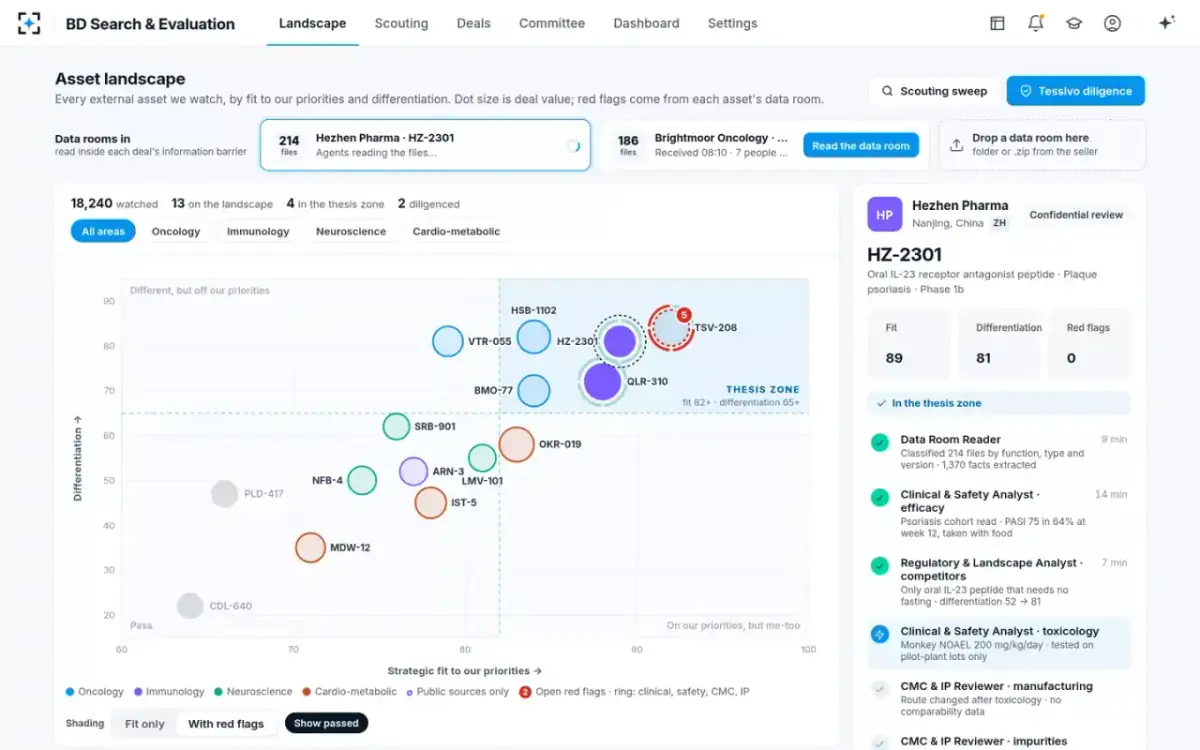
What the February 2022 advisory committee was asked, and why a licensor should read it
The clearest public record of how applicability gets decided is a set of draft questions FDA put to its Oncologic Drugs Advisory Committee on 10 February 2022, about a product whose evidence came from a single-region trial.
DISCUSSION: Discuss the generalizability of ORIENT-11 to a U.S. population and U.S. medical practice. … VOTE: Given that ORIENT-11 may not be applicable to U.S. patients or U.S. medical practice, should additional clinical trial(s) demonstrating applicability be required prior to a final regulatory decision?
FDA (CDER), Oncologic Drugs Advisory Committee draft questions, 10 February 2022
Two things in that wording matter to a licensing team, and neither is about oncology. The first is the premise built into the voting question: having discussed generalizability, the committee was asked to vote not on whether the data were applicable, but on what should happen given that they might not be. The second is the remedy on the table — "additional clinical trial(s) demonstrating applicability", required "prior to a final regulatory decision". That is a sentence about timing, and timing is the input a licensing valuation is most sensitive to.
HZ-2301 is a plaque psoriasis asset, so this is an oncology precedent about method rather than a precedent about this asset's own review. The method is what transfers: applicability is a question a buyer can anticipate, with a remedy a buyer can cost, and the worst time to discover either is after signing. The middle question that day — "Discuss potential clinical trials which may address issues of applicability" — is, read as a diligence instruction, the exact work a bid team should have already done.
What a multiregional trial adds, in months and in money
A multiregional clinical trial "is defined in the present guideline as a clinical trial conducted in more than one region under a single protocol", and such trials "will allow investigation of treatment effects including safety evaluations in the overall population as well as investigations of the potential impact of intrinsic and extrinsic factors ... on the treatment effect" (ICH E17). The reason a licensing team cares is that an MRCT answers the applicability question inside the development plan instead of after it.
The same patients, read two ways
As a single-region study
- One region · 100%
As one region of a multiregional trial
- The original region · 35%
- United States · 40%
- Europe and rest of world · 25%
The cost is the extra study, and the delay is what it does to first launch. A confirmatory multiregional trial is a full study with its own recruitment, so the right way to carry it into a model is as a dated addition to the critical path rather than as a cost line. On this deal the launch date moved for manufacturing reasons alone, from 2031 to the first half of 2032; an applicability requirement arriving later would move it again, and by more.
Where a confirmatory requirement lands if it is discovered after signing
- Diligence and dealnow
- Confirmatory multiregional trial, planned alongsideruns in parallel with other work
- Filing
- Diligence and dealnow
- Development on the seller’s planas bought
- Filing, then the requirement
- Confirmatory trial, from a standing startadded to the critical path
Intrinsic and extrinsic factors: the checklist E17 gives you
E17's practical gift to a diligence team is a short list of the things that make one region's results travel badly, and it is specific enough to check against a protocol. The guideline says these factors "important to the drug development programme, should be identified early", and that information about them "should also be collected during the confirmatory trial for evaluation of their impact on treatment effects".
What to test a single-region dataset against, and where the answer is
| Factor | What E17 says to look at | Where it is settled in the room |
|---|---|---|
| Disease definition and diagnosis | Definitions, methods of diagnosis and the understanding of endpoints may vary between regions; the mitigation is precisely defined inclusion and exclusion criteria and study procedures. | The protocol and the statistical analysis plan |
| Medical practice and treatments | Differences in medical practices and treatments across regions may affect results or their interpretation; standardised protocols and investigator training reduce the variability. | The protocol, the monitoring plan, the investigator training records |
| Diet, environment, culture and access to healthcare | These may affect trial results and also recruitment, compliance and retention. | The study report’s baseline tables and disposition data |
| Genetics, body weight and age | Polymorphisms in drug metabolism or receptor sensitivity, and body weight and age, may affect pharmacokinetics, efficacy and safety — for the investigational drug and for comparators and concomitant medications. | The pharmacokinetic reports and the baseline demographics |
| Concomitant medications | Drugs used alongside the investigational drug should be the same across regions so far as possible; differences may be acceptable if not expected to affect results substantially. | The protocol’s allowed and disallowed medications, and the study report’s usage tables |
| Pooling of regions | Pooling must be justified by the distribution of the factors known to affect the treatment response — for example, pooling Canada and the United States is often justified by similar medical practice and use of concomitant medications. | The statistical analysis plan, if the seller has one that contemplates a filing |
One definition from the same guideline is worth putting into the memo verbatim, because it is the standard the whole question is measured against: consistency of treatment effect is "a lack of clinically relevant differences between treatment effects in different regions or subpopulations" of the trial. That is the thing a multiregional trial is designed to be able to show, and the thing a single-region dataset cannot show at all.
What to ask the seller before the bid, and how the answer is priced
Six questions, each of which has a document behind it, and each of which changes a number if the answer is wrong.
Which ethics committee reviewed each study, and is its approval and continuing review in the room? Where are the source records, and would the sites accept an inspection? What is the full protocol, and does the endpoint definition match what a US review would expect? What prior therapy had the patients received, and how does that compare with US practice? What does any regulatory correspondence actually say about the filing route — in the agency's words, not the seller's summary? And has any confirmatory multiregional trial been designed, costed or started?
The answers are priced the same way every other finding is. A missing ethics approval is an open question until it is answered. An unanswerable inspectability question is a condition to signing. A likely applicability requirement is a dated addition to the critical path and a reduction in the probability of approval on the current plan, which is how a specific asset moves off a published base rate. On this deal the clinical evidence that mattered — PASI 75 in 18 of 28 patients, 64.3%, at week 12 on 50 mg once daily, against 1 of 9 on placebo — existed only inside the room, and the deal was structured as a licence outside Greater China with the US composition-of-matter patent running to 2043.
What the committee sees when the evidence came from one region
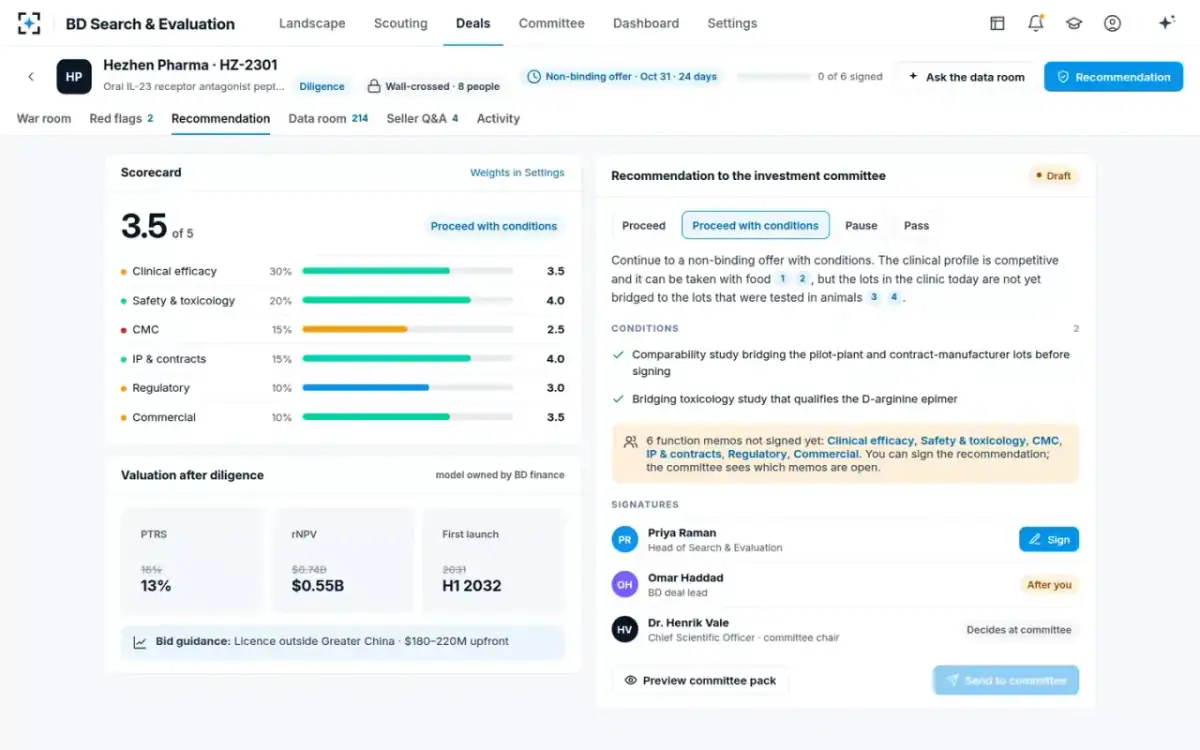
The discipline that makes all of this work is the one the regulatory seat of the six-seat first pass exists to enforce: quote the agency, cost the remedy, and put the date in front of the people who decide. To see it on a room of your own, start from BD Search & Evaluation.
Questions people ask
What is 21 CFR 312.120?
The rule on foreign clinical studies not conducted under an investigational new drug application. It says FDA will accept a well-designed and well-conducted foreign study in support of an application if the study followed good clinical practice and if the agency can validate its data by onsite inspection when it deems one necessary. It also requires the sponsor to describe what it did to ensure the research conformed to GCP, including the investigator's qualifications and the research facilities.
Can a US marketing application be approved on foreign data alone?
Yes, under 21 CFR 314.106(b), if the data are applicable to the US population and US medical practice, the studies were performed by investigators of recognised competence, and the data can be validated — by inspection if the agency considers one necessary. The rule states that failing any of those three criteria makes the application not approvable on the foreign data alone, while adding that the policy is applied flexibly according to the nature of the drug and the data.
Will FDA inspect a foreign clinical site?
It may, and the possibility is itself a condition of acceptance: the regulation requires that FDA be able to validate the data through an onsite inspection if the agency deems it necessary. For a buyer, the practical question is not whether an inspection will happen but whether the sites could survive one — whether source records still exist, are retrievable, and are held by someone who would grant access after the asset changes hands.
What is a multiregional clinical trial?
A clinical trial conducted in more than one region under a single protocol, as ICH E17 defines it. Its purpose is to measure the treatment effect in the overall population while allowing the impact of intrinsic and extrinsic factors — genetics, body weight, diet, medical practice, concomitant medications — to be examined across regions. It is the standard remedy when the applicability of a single-region dataset is in doubt.
What is ICH E17?
The international guideline on the planning and design of multiregional clinical trials, adopted in November 2017. It sets out basic principles for such trials, including that the relevant intrinsic and extrinsic factors should be identified early, that sample size should be allocated strategically across regions, that pooling of regions must be justified by the similarity of those factors, and that a single primary analysis approach should be acceptable to every regulator concerned.
How should a diligence memo handle a regulatory assumption?
By quoting the agency's own wording, stating the assumption as a date and a plan, and naming the alternative if the assumption fails. A memo that says an agency was supportive has recorded a tone; a memo that quotes the minutes and states what the sponsor was asked to do has recorded a fact. The second can be priced into a bid and written into a condition; the first cannot.