Due diligence red flags are findings that change what a buyer will pay or whether it will buy at all, and the useful ones all survive the same test: can this be written as a sentence with a severity, an owner and a route through? A worry cannot. "The manufacturing looks immature" is a feeling; "the drug substance route changed after the toxicology lots were made and the room contains no comparability data" is a finding, and it has exactly one route through, which is a study with a duration and a price. Botminds' BD Search & Evaluation reads a seller's room into cited function memos and lands every finding in a register with its severity, its owner, its sources and its mitigation, so the diligence report arrives already sorted into the three things a deal lead can act on.
Two fictional deals in the solution supply the worked examples: Hezhen Pharma's HZ-2301, an oral peptide for plaque psoriasis, and Tessivo Pharma's TSV-208, a bispecific antibody-drug conjugate in Phase 1b. Both companies, both assets and all the people are sample data; the rules and the published guidance are real and linked where they appear.
What counts as a red flag, and what is just an open question
Most diligence reports mix three kinds of sentence and call them all findings: things that are true and matter, things that are true and do not matter, and things nobody has checked. Only the first kind is a red flag.
A finding has four properties. It is stated as a fact, not an impression. It names the document and page it came from, so a committee can look. It has a consequence a deal lead can price, promise or refuse. And it has an owner, by name, who will say when it is closed. An open question has only the first two at best: it is a hole in the evidence, and the right response to it is a question to the seller, not a line in the register.
The distinction matters because the two decay differently. An open question closes when the seller answers, and the answer either produces a finding or clears the ground. A finding never closes by itself. It becomes a condition, a price adjustment or a reason to walk, and the committee needs to see any that are still open when it votes.
The three kinds of finding, and what each one does to the deal
Deal-breaker
Kills the deal, or must become a condition before anything is signed
The test
If this is true and cannot be fixed, would we still buy?
Who decides
The deal lead, with counsel
On these deals
A change of control that lets a third party terminate the licence on the molecule.
Price item
Costs money or time, and is therefore an adjustment to the offer
The test
What does fixing this cost, and how many months does it add?
Who decides
The function lead who found it, with the analyst who owns the model
On these deals
A bridging toxicology study of about six months to qualify an impurity the animals never saw.
Covenant
Becomes a promise in the agreement: something the seller or the buyer will do
The test
Can we write this as an obligation with a date and a consequence?
Who decides
The function lead, and the lawyer drafting the term sheet
On these deals
A comparability study between the old and new manufacturing routes, as a condition to signing.
The three kinds: deal-breaker, price item, covenant
A deal-breaker is a finding that, if it holds and cannot be fixed, ends the transaction. It is rare, and treating ordinary bad news as a deal-breaker is how a diligence team loses the committee's attention. On the two sample deals there is exactly one: TSV-208 carries a change-of-control clause in the licence on its linker technology, so the transaction itself needs a third party's consent. Either the consent is obtained before signing or the asset can lose the technology it is built from.
A price item is a finding that costs money or months, and therefore moves the offer. The arithmetic is the whole point: a six-month study with a known cost is a number, and a number can be deducted. A price item that nobody has costed is still an open question wearing a finding's clothes.
A covenant is a promise written into the agreement — usually a study, a disclosure or an action with a date and a consequence if it is missed. Covenants are how a buyer takes a risk it can live with without paying for a certainty it cannot get. They also need someone to own them after signing, which is the step deals most often skip.
Why does the investor deck not match the clinical study report?
Because they were written at different times, for different readers, from different cuts of the same data — and because a deck counts things a report will not. It is a contradiction a buyer meets in room after room, and it is usually explained rather than concealed.
One asset's response rate, in two documents from the same room
The June investor deck: 45%
The interim clinical study report: 38.1%
The June investor deck: 18 of 40 patients, confirmed and unconfirmed responses together
The interim clinical study report: 16 of 42 patients, confirmed responses only
The June investor deck: The February cut
The interim clinical study report: A later cut, with two more patients evaluable
The June investor deck: Not used for the model; kept in the register so the difference is on the table
The interim clinical study report: Used. The buyer models confirmed responses on the later cut.
The register keeps both, side by side, with the sources one click away. That is deliberate: a diligence team that silently picks the lower number has made a judgement the committee never saw. Showing both, and saying which the model used and why, is the difference between a finding and an edit.
The data cut-off that explains most contradictions
A data cut-off is the date after which no further patient data were included in a particular analysis. Every summary, deck, brochure and report carries one, and documents in a room routinely carry three or four different ones. Sorting a room by cut-off before reading it removes most apparent contradictions before anyone wastes an hour on them.
The same mechanism explains the safety difference on TSV-208. The deck reports interstitial lung disease in 5.2% of patients — 3 cases, all low grade. The study report has 4 cases, 6.9%, one of them Grade 3. The deck is working from the older February cut; the fourth case, and the grading, arrived afterwards. The number that belongs in the safety memo is the later one, and the finding that belongs in the register is that the seller's circulating material understates a class risk.
Two practical rules follow. Never compare a rate from one document with a rate from another without checking that the cut-offs match. And treat the oldest document in the room with the most suspicion, not the least: an investor deck in circulation for four months has had four months to fall behind the data it summarises.
Unconfirmed responses: a familiar red flag in oncology
A response that has not been confirmed at a second assessment is not yet a response. The agency's own definition is explicit about both halves: objective response rate "is defined as the proportion of patients with tumor size reduction of a predefined amount and for a minimum time period", and "if available, standardized criteria should be used to ascertain response"; the response criteria "should be predefined in the protocol before the start of the study" (FDA, Clinical Trial Endpoints for the Approval of Cancer Drugs and Biologics).
That is why 18 of 40 and 16 of 42 can describe the same cohort without either being a lie. The deck counts every patient who showed tumour shrinkage at any assessment; the report counts those whose shrinkage held to the next one. In early data the two figures can differ by several percentage points, and responses that are never confirmed drop out as the trial matures. A buyer that models the unconfirmed figure is paying for responses some of which will be withdrawn.
The discipline the solution applies is narrow and absolute: the clinical analyst uses confirmed responses for efficacy, cites the sentence it came from, and shows the other number rather than deleting it. Where the two documents cannot be reconciled at all, the contradiction becomes the finding, and the question to the seller writes itself.
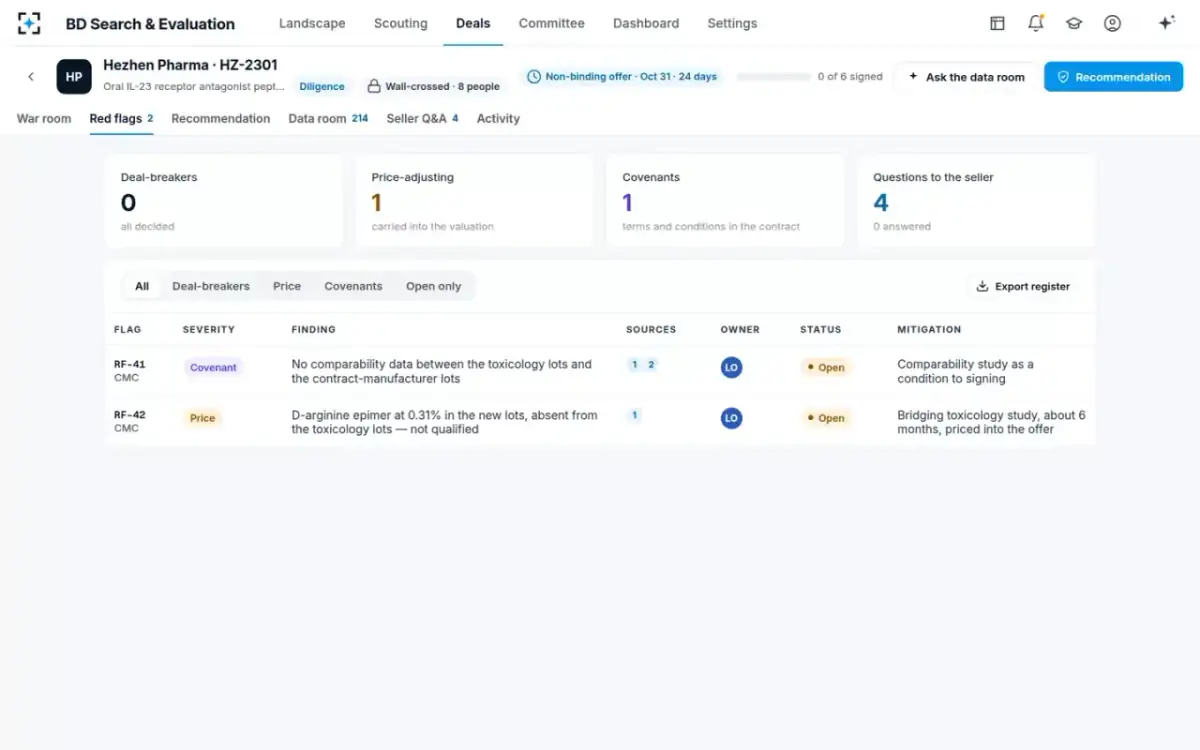
The red-flag register: severity, owner, status and the way through
What happens when the process changed after the toxicology lots?
The programme has, without saying so, split into two drugs: the one the animals received and the one the patients now receive. Bridging them is ordinary work, but it is work, and if the room does not contain it the buyer is inheriting an unfinished job.
On HZ-2301 the sequence is visible in the dates. Toxicology ran on pilot-plant lots HZ-DS-1901 and 1902, and produced a monkey no-observed-adverse-effect level of 200 mg/kg/day, about 30 times the clinical exposure. From lot HZ-DS-2104 the drug substance comes from a hybrid route at a contract manufacturer in Suzhou. The room records a comparability assessment planned for the first quarter of 2027 — planned, not done.
One asset's manufacturing history, and the study that has not happened
- Toxicology lots HZ-DS-1901 and 1902, pilot plantthe safety data
- Route change: hybrid route at a contract manufacturerfrom HZ-DS-2104
- New lots carry a D-arginine epimer up to 0.31%not in the old lots
- Comparability assessment, planned Q1 2027not yet done
- Comparability study as a condition to signing (RF-41)a covenant
- Bridging toxicology study, about six months (RF-42)a price item
The finding is sorted as a covenant, not a price item, because it has a clean route through: the comparability study becomes a condition to signing, and the seller does it. Classifying it as a price item instead would have the buyer paying less for a risk that could simply have been removed.
Has the D-arginine epimer been qualified in any toxicology study?
The seller question drafted from the CMC memo, awaiting the function lead's approval
Impurities the animals never saw, and what qualifying one costs
An impurity present in the clinical material but absent from the material used in the safety studies is a specific, well-described problem with a specific, well-described remedy. ICH Q3A defines the remedy: qualification is "the process of acquiring and evaluating data that establishes the biological safety of an individual impurity or a given impurity profile at the level(s) specified", and its safety section gives guidance for qualifying impurities "that were not present, or were present at substantially lower levels, in batches of a new drug substance used in safety and clinical studies" (ICH Q3A(R2)).
ICH M3(R2) supplies the trigger and the timing. Qualification studies "are not warranted before Phase III, unless there are changes that result in a significant new impurity profile (e.g., a new synthetic pathway, a new degradant formed by interactions between the components of the formulation)"; where there are, "appropriate qualification studies can be warranted to support Phase II or later stages of development" (ICH M3(R2), §16). A new synthetic pathway is exactly what HZ-2301 has, so the work moves forward in the programme rather than waiting for Phase 3.
Now the part a diligence memo must get right, because an off-the-shelf threshold is the obvious thing to reach for and the wrong one here. Q3A's threshold table sets a qualification threshold of 0.15%, or 1.0 mg per day of intake, whichever is lower, for a drug substance at a maximum daily dose of 2 g or less. HZ-2301's epimer at 0.31% sits above that figure — and the figure does not apply to it. Q3A's own scope says so: "the following types of drug substances are not covered in this guideline: biological/biotechnological, peptide, oligonucleotide, radiopharmaceutical, fermentation product and semi-synthetic products derived therefrom, herbal products, and crude products of animal or plant origin." HZ-2301 is a peptide.
So the memo says what is true, which is more useful than a threshold anyway: no off-the-shelf limit covers this impurity, the safety lots never contained it, and the only way to know whether its level is acceptable is to generate the data. That is a bridging toxicology study of about six months, which is a number the model can carry — and a finding of exactly the kind that moves a valuation through timing rather than through cash flow.
The same fact in two documents: what the register records, and what the model uses
| The fact | Where it says one thing | Where it says another | What the memo does |
|---|---|---|---|
| Response rate | June investor deck: 45%, 18 of 40, confirmed and unconfirmed | Interim study report: 38.1% confirmed, 16 of 42 | Models the confirmed figure; keeps the deck line in the register as a finding about the seller’s circulating material |
| Lung disease rate | Deck: 5.2%, 3 cases, all low grade | Study report: 6.9%, 4 cases, one Grade 3 | Uses the later cut; records that the deck understates a class risk |
| Safety margin | Toxicology report: monkey NOAEL 200 mg/kg/day, about 30x clinical exposure | Batch analyses: that study used pilot-plant lots 1901 and 1902 only | States the margin and the lots in the same sentence, every time |
| Impurity profile | Specification: an impurity limit the new lots meet | Batch analyses: a D-arginine epimer up to 0.31%, absent from the toxicology lots | Raises RF-42 as a price item; prices a bridging study of about six months |
| Manufacturing route | Process development report v2.1: hybrid route from lot HZ-DS-2104 | Nothing in the room bridges the old and new material | Raises RF-41 as a covenant: a comparability study as a condition to signing |
Clinical holds: when a safety finding stops the clock
A clinical hold is the most expensive thing that can happen to a development timeline that is otherwise going well, and the grounds for one are worth reading as a diligence checklist in their own right. "A clinical hold is an order issued by FDA to the sponsor to delay a proposed clinical investigation or to suspend an ongoing investigation", and when a proposed study is held, "subjects may not be given the investigational drug" (21 CFR 312.42).
The grounds for holding a Phase 1 study include that "human subjects are or would be exposed to an unreasonable and significant risk of illness or injury", that "the investigator brochure is misleading, erroneous, or materially incomplete", and that the application "does not contain sufficient information required under § 312.23 to assess the risks to subjects of the proposed studies". Two of those three are documentation failures. A buyer looking at a room should read them as a list of the ways an otherwise good asset loses six months.
Any hold in an asset's history is a finding, whether or not it has been lifted, and the memo should carry three things: the written explanation the agency provided, what the sponsor changed, and the date the investigation was allowed to resume. A hold that was lifted quickly after a protocol amendment is a different fact from one that took a year.
Change of control, consent and the clause that can end a licence
The contracts folder is the one most often read last and most likely to contain the deal-breaker. The clause to look for gives a third party rights when the ownership of the counterparty changes — and an in-licensing transaction can be exactly that change.
TSV-208's linker technology is in-licensed, and that licence requires the licensor's consent to a change of control. Without consent, the licence can be terminated, and the asset is a conjugate without its linker. That is why it is classified as the one deal-breaker on either deal: no amount of price covers it, and the only routes through are a consent obtained before signing or a different deal structure. It became one of four conditions, and the offer moved from $720 million upfront to a range of $620-680 million.
Three contract findings belong in every biopharma register alongside it: every third-party royalty on the molecule, its process and any enabling technology, added up into one stack; every territory carve-out, because rights outside one region are a different asset from global rights; and every diligence obligation the seller has already accepted, because the buyer inherits those too. On HZ-2301 the equivalent check came back clean — rights outside Greater China are clear and the US composition-of-matter patent runs to 2043 — which is why that deal was framed as a licence outside Greater China rather than a global one.
Who owns a flag, how it closes, and what the committee must see open
A finding with no owner is a finding nobody will close. Every row in the register carries a named person, which in the sample deals means the function lead who raised it: the CMC findings on HZ-2301 are owned by Lena Ortiz, the CMC diligence lead, and they stay open until she says otherwise.
Closing has exactly three forms. The seller answers and the finding evaporates, in which case the register keeps the answer. The finding becomes a term — a condition, a covenant or a price adjustment — and closes into the term sheet. Or it stands, unresolved, and goes to the committee open, which is the case the register exists for. An open deal-breaker blocks the recommendation signature altogether until it is turned into a condition or the deal is passed, so the one finding that must never be waved through cannot be.
A finding, its memo and the page it came from
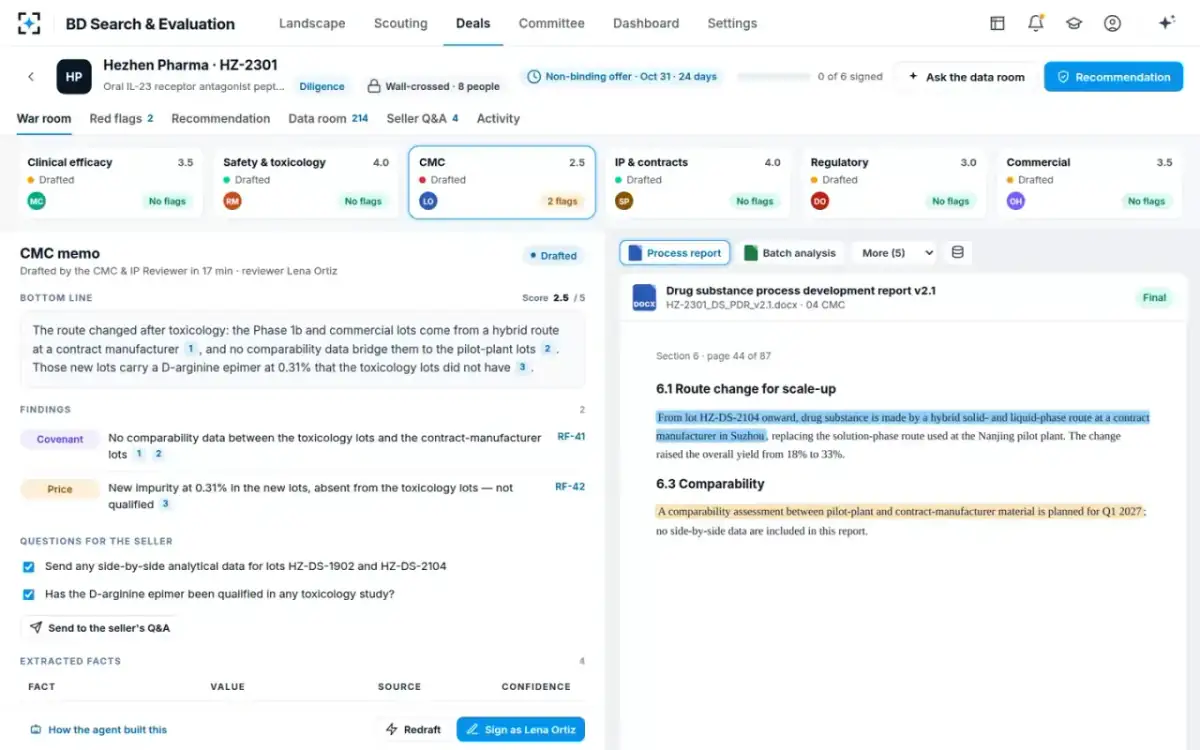
What the committee sees, then, is not a list of worries but a short, sorted set of decisions: one deal-breaker to resolve or refuse, a handful of price items with months and money attached, and a set of promises to write into the agreement. The six function memos behind them follow the six-seat checklist a first pass works through, and the probability each finding moves is set out in what diligence does to an asset's odds. To see the register, the memos and the sources together, start from BD Search & Evaluation.
Questions people ask
What is a red flag report in due diligence?
A short document that lists only the findings that change the transaction, with their severity, sources and owners, rather than everything the team read. It is short, and it sits in front of the longer function memos. Its value is entirely in what it leaves out: a report that lists forty findings has not classified any of them.
What is a deal breaker in due diligence?
A finding that ends the transaction if it holds and cannot be fixed before signing. In licensing, typical examples are a third-party consent the deal itself triggers, a defect in the chain of title to the molecule, and a safety finding that closes the indication. Genuine deal-breakers are rare; on the two deals in the examples above there is exactly one, a change-of-control clause in an in-licensed linker technology.
How do you classify due diligence findings?
By what each one does to the deal rather than by how worrying it feels. Three categories are enough: deal-breaker, price item and covenant. The test for a price item is whether somebody has costed it in money and months; the test for a covenant is whether it can be written as an obligation with a date and a consequence. A finding that fits none of the three is usually an open question waiting for a seller's answer.
What is a data cut-off in a clinical trial?
The date after which no further patient data were included in a given analysis. Every deck, brochure, interim analysis and study report carries one, and documents in the same room routinely carry different ones. Most apparent contradictions in a biopharma data room are explained by comparing two numbers that were never counted on the same day.
Can an impurity stop a licensing deal?
Rarely stop it; frequently price it. An impurity present in the clinical material but absent from the material used in the safety studies has to be qualified, and for a new synthetic pathway that work can be warranted well before Phase 3. The cost is a study with a duration — about six months for the bridging toxicology study on the asset in the examples above — which a buyer deducts from the offer or writes in as a condition.
What is a condition to signing?
Something that must be true or must have happened before the parties sign. It is often how a covenant is enforced: a comparability study between an old and a new manufacturing route, promised by the seller and required before signing, is a typical one; so is a third party's written consent to a change of control. Conditions are how a buyer accepts a risk without paying for certainty it cannot obtain, and each one needs a named owner after signing as well as before.