AI in pharma business development works when it is pointed at the reading and kept away from the deciding. A licensing team's day is scouting external assets across languages it does not read, then taking a handful into diligence where six functions read hundreds of data-room files against a bid deadline — mechanical work at volume, under a clock, where missing one sentence on page 44 of a process report can change the price of a deal. That is what an agent is good for. What an agent is not good for is the judgement at the end: whether a finding is a deal-breaker, a price item or a covenant, and whether to sign. Botminds' BD Search & Evaluation puts seven agents on the reading and leaves the signing with named people — every memo sentence cites the page it came from, every seller question needs a function lead's approval, and the committee decides.
This guide is written for the Search & Evaluation or business development head deciding whether to put agents on this work, and for the function leads whose signatures the output would carry. The deals and figures drawn from the solution are fictional sample data; the regulatory texts are cited where they appear.
What the work is, and which parts an agent can take
Split the work by what fails when it is done badly. Scouting fails by omission: the asset you never saw. Data-room reading fails by volume: the sentence nobody got to. Memo writing fails by inconsistency: two functions quoting different numbers for the same thing. Each of those is a coverage problem, and coverage is what a machine is for.
The rest of the work fails differently. Deciding that an impurity the animals never saw is worth a six-month bridging study rather than a walk-away is a judgement about risk appetite, about the portfolio, and about what your company can live with. It does not fail from missing a document. It fails from being wrong about what matters, and no amount of reading fixes that.
So the division is not "hard tasks to people, easy tasks to machines". It is: anything whose failure mode is "we did not see it" can be automated and checked; anything whose failure mode is "we judged it wrong" stays with the person who will be answerable for the judgement.
The division of labour: draft, cite, flag — never sign
In practice that means each agent has a stated job and a stated limit, and the limits are enforced rather than promised. The table below is the set used on the sample deals; the limits column is the part worth copying into any evaluation you run.
Seven agents in BD Search & Evaluation: what each drafts, and what it may never do
| Agent | What it drafts | What it may never do |
|---|---|---|
| Asset Scout | Sweeps registries, patents, congress abstracts and company disclosures in nine languages, merges code names across languages, and ranks assets by fit with citations. | Touch deal data. Public sources only, every claim cited, and royalty and rights signals flagged rather than dropped. |
| Data Room Reader | Classifies every file by function, document type, version and data cut-off, and extracts its facts with a page reference for each. | Read any room but this deal's, or cite a superseded draft. |
| Clinical & Safety Analyst | The efficacy and safety memos: confirmed responses, adverse events of special interest, class risks, data cut-offs, NOAELs and margins. | Use unconfirmed responses for efficacy, write an uncited sentence, or send a question to the seller without a person's approval. |
| CMC & IP Reviewer | Lots, specifications, suppliers, patents and licences — out-of-spec lots, single sources, change-of-control clauses and royalty stacks. | Reach a legal conclusion. Change-of-control clauses are always flagged and left to counsel. |
| Regulatory & Landscape Analyst | What the agency asked and what it costs in time; the competitive landscape from public sources, and each asset's differentiation score. | Paraphrase agency wording into a commitment, or mix public sources with deal data. |
| Contradiction Checker | Compares the same fact across the investor deck, the study reports and the brochure, and explains why the values differ — an older data cut, unconfirmed responses. | Pick a value. Both sources are shown side by side and a person chooses. |
| Recommendation Assembler | Scores the deal with the agreed weights, carries red flags into conditions and valuation inputs, and assembles the committee materials. | Let an open deal-breaker through. Two signatures are required before the committee sees anything. |
Read the third column as the specification, not the first. Any vendor can list what their agents produce. What distinguishes a system you can put a function lead's signature on is what it refuses to do when the obvious shortcut is available — pick the better of two contradictory numbers, summarise an agency letter into a commitment, or quietly use the draft because the final is missing.
One data room, seven agents, two signatures before the committee
Agent
Data Room ReaderSorts 214 files by function, type, version and data cut-off, and sets nine superseded drafts aside so their values never reach a memo.
Never: reads another deal's room
Agent
Clinical & Safety AnalystDrafts the efficacy and safety memos from the study reports, citing the page behind each sentence.
Never: counts unconfirmed responses as efficacy
Agent
CMC & IP ReviewerReads routes, lots, specifications, patents and licences, and raises the manufacturing and rights flags.
Never: draws a legal conclusion
Agent
Regulatory & Landscape AnalystQuotes what the agency asked, and scores differentiation against the competing assets found in public sources.
Never: paraphrases an agency into a commitment
Agent
Contradiction CheckerPuts the deck, the study report and the brochure side by side where they disagree, and explains the difference.
Never: chooses which number is right
A person decides
Each function lead reviews and signsOpens the cited page beside the drafted memo, approves the questions going to the seller, and signs with the meaning of the signature recorded.
Agent
Recommendation AssemblerScores with the agreed weights, carries each flag into a condition or a valuation input, and assembles the committee materials.
Never: proceeds while a deal-breaker is open
A person decides
Two signatures, then the committeeThe head of Search & Evaluation signs and the deal lead countersigns. The committee decides; the decision is on record.
Can AI read a data room?
Yes, and that part is no longer interesting. A current model can classify a few hundred files by function, type, version and data cut-off, pull the numbers out of a batch analysis table, and find the sentence in a process development report that says the route changed. On the sample deal the reader handles 214 files and extracts 1,370 facts, each with the page reference it came from, and the CMC memo is drafted in 17 minutes.
The interesting question is what happens to a fact after it is extracted. There are two possible designs and only one of them survives a diligence review. In the first, the model reads the documents and then answers questions from what it remembers, which means a wrong answer is indistinguishable from a right one until somebody independently reads the file. In the second, every extracted fact keeps its page reference, and the memo sentence is a link to the page it came from, so a function lead checks in seconds instead of re-reading the room.
Two ways to answer the same diligence question
An assistant answering from what it read: A fluent paragraph summarising the manufacturing position.
A cited sentence in a function memo: A sentence stating the route change, with the process development report opening at section 6, page 44.
An assistant answering from what it read: Re-read the room, or trust it.
A cited sentence in a function memo: Click the sentence. The passage is highlighted where the drafter read it.
An assistant answering from what it read: The error propagates into the valuation and is found at committee, or not at all.
A cited sentence in a function memo: The function lead sees the mismatch between the sentence and the page before signing.
An assistant answering from what it read: Whatever was in the pile, including a draft.
A cited sentence in a function memo: The final version only; superseded drafts are set aside and never cited.
An assistant answering from what it read: That someone read a summary.
A cited sentence in a function memo: That a named person read the cited passages and accepts the memo.
An assistant answering from what it read: The model's output is effectively the only evidence — high influence.
A cited sentence in a function memo: Independent verification sits beside the model output, which lowers its influence.
Model influence and decision consequence: the useful way to size the risk
The best available vocabulary for this comes from FDA's draft guidance on AI used to support regulatory decision-making. It does not govern business development — more on that in a moment — but it supplies the two questions a buyer should be asking, and they are better questions than "how accurate is it?"
Model risk is a combination of two factors: (a) model influence, which is the contribution of the evidence derived from the AI model relative to other contributing evidence used to inform the question of interest and (b) decision consequence, which describes the significance of an adverse outcome resulting from an incorrect decision concerning the question of interest.
FDA (CDER/CBER), draft guidance: Considerations for the Use of Artificial Intelligence to Support Regulatory Decision-Making for Drug and Biological Products, January 2025
The guidance adds the move that makes this practical. In one of its worked examples, an independent check on the model's output "would reduce the AI model influence, and therefore the model influence would be determined to be low" — and because the decision consequence there is high and the model influence low, the example's model risk comes out medium rather than high. Where credibility is not sufficiently established, one of the listed remedies is to "downgrade the model influence by incorporating additional types of evidence in conjunction with the evidence from the AI model".
That is exactly what a page citation and a function lead's signature are: additional evidence beside the model's output, and an independent check that any reviewer can repeat. Applied to the four things agents actually do in diligence, the matrix sorts them cleanly.
The regulator's two factors, applied to four uses in licensing diligence
| What the agent does | Model influence | Decision consequence | Where it lands |
|---|---|---|---|
| Classifies files by function, type, version and data cut-off | Low — a misfiled document is caught by the function lead who opens the folder, and the classification is visible. | Low to moderate — a misfiling costs time, not a decision. | Low. Automate it and spot-check the classification. |
| Extracts a fact and cites the page it came from | Low, by design — the page sits beside the fact and the reviewer reads it. | High — an extracted number can move a price or a condition. | Medium. The citation is what keeps it there; without it the same task is high. |
| Scores differentiation from public sources | Moderate — several sources contribute, and the analyst accepts or rejects each merge and exclusion. | Moderate — it decides what gets pursued, not what gets signed. | Medium. Show the sources behind the score and let the analyst overrule it. |
| Decides whether a finding is a deal-breaker, a price item or a covenant | High if the model decides — nothing else contributes. | High — it is the recommendation. | High, and therefore not a use. The agent proposes a classification; the function lead owns it and signs. |
What FDA says about AI in drug development, and what it does not cover
Being straight about this matters more than claiming regulatory cover. FDA's January 2025 draft guidance is about AI models whose output feeds an agency decision on a drug's safety, effectiveness or quality. Its scope section then carves out two uses it does not cover: drug discovery, and AI used for operational efficiency — its own examples are internal workflows, resource allocation and drafting a submission — where the use does not affect patient safety, drug quality or the reliability of a nonclinical or clinical study's results.
Drafting a diligence memo is an internal workflow. On its own terms, the guidance does not reach it. Anyone telling you their diligence agents are "aligned with FDA guidance" is describing a framework they have chosen to borrow, which is a reasonable thing to do and a different thing to say.
Two other texts are worth holding alongside it. ICH E6(R3), the current good clinical practice guideline, says that "computerised systems used in clinical trials should be fit for purpose (e.g., through risk-based validation, if appropriate), and factors critical to their quality should be addressed in their design or adaptation for clinical trial purposes to ensure the integrity of relevant trial data" (ICH E6(R3), section 9.3). And the NIST AI Risk Management Framework, borrowing the ISO 9000 definition, treats validation as objective evidence that the requirements of one specific intended use have been met, and warns that putting into service a system that is inaccurate, unreliable or poorly generalised beyond its training data raises the risk rather than reducing it (NIST AI 100-1).
Put together, the three say the same thing in three vocabularies: decide what the system is for, size the risk by how much of the decision rests on it, and prove it works for that purpose rather than in general.
How accurate is AI asset scouting, and how should you measure it?
Measure it yourself, on assets you already know, because a scouting tool's headline accuracy usually comes from whoever built it. The useful number is recall: of the assets that a well-run sweep should have found for a given set of criteria, what share did the tool actually surface? Precision — how many of the surfaced assets were genuinely in scope — matters too, but a false positive costs an analyst a minute, and a missed asset can cost a deal.
The test is cheap to build. Take three or four searches your team has already run by hand, such as an indication and a modality in one therapy area, and list every asset you eventually knew about, including the ones found late and the ones found only through a regional registry or a non-English abstract. Run the tool on the same criteria, blind to that list, and count. Then repeat the exercise a quarter later, because a sweep that was complete in one quarter misses whatever was disclosed in the next.
Two caveats belong on any number that comes back. Recall on a discovery task says nothing about a different task — reading a data room — where the relevant measures are coverage of the files, accuracy of the citations and whether the flags a human would raise were raised. How to measure that on a room you have already closed is a separate exercise, and the only one that answers the question for your own documents. And a scouting pipeline presented as a complete count of the field should be challenged with the question of how its recall was measured, on which assets, and by whom.
The limits worth writing into the contract, not the brochure
Most of what distinguishes a serious system from a demonstration is a refusal that costs the vendor something. These are the ones worth making contractual.
Limits to put in the agreement, not in the pitch
- Every sentence in a memo carries a page reference
Not a document name — the page. A system that can only cite a file is asking your function lead to re-read it.
- Superseded and draft documents are never cited
On the sample deal nine superseded drafts are set aside, including a cohort summary at draft v0.6, so their numbers cannot reach a memo by accident.
- Agents serving a deal read that deal only
No cross-deal search, no memory carried between deals. This is a confidentiality control before it is a quality one.
- Public sources and deal data never mix
The scouting side works from public sources only, so the landscape stays shareable outside the wall; the agent-built landscape is labelled when it appears inside a deal.
- No question reaches the seller without a named approval
Questions are drafted from each memo and go out through the room's own channel only after the function lead approves them.
- Contradictions are shown, never resolved
Where the deck and the study report disagree, both are put side by side with the reason — an older data cut, unconfirmed responses — and a person picks.
- An open deal-breaker blocks the signature
The recommendation cannot be signed while a deal-breaker is open; it must become a condition or the deal is passed.
- Agency wording is quoted, never paraphrased
What a regulator asked for is a quotation in the memo. A paraphrase of an agency letter is how a question becomes a commitment nobody made.
- Every step, signature and approval lands on the deal's activity trail
Including the agent steps. If you cannot reconstruct who and what read a file, you cannot answer the only question that will be asked afterwards.
The agents working in view, with their time on each step
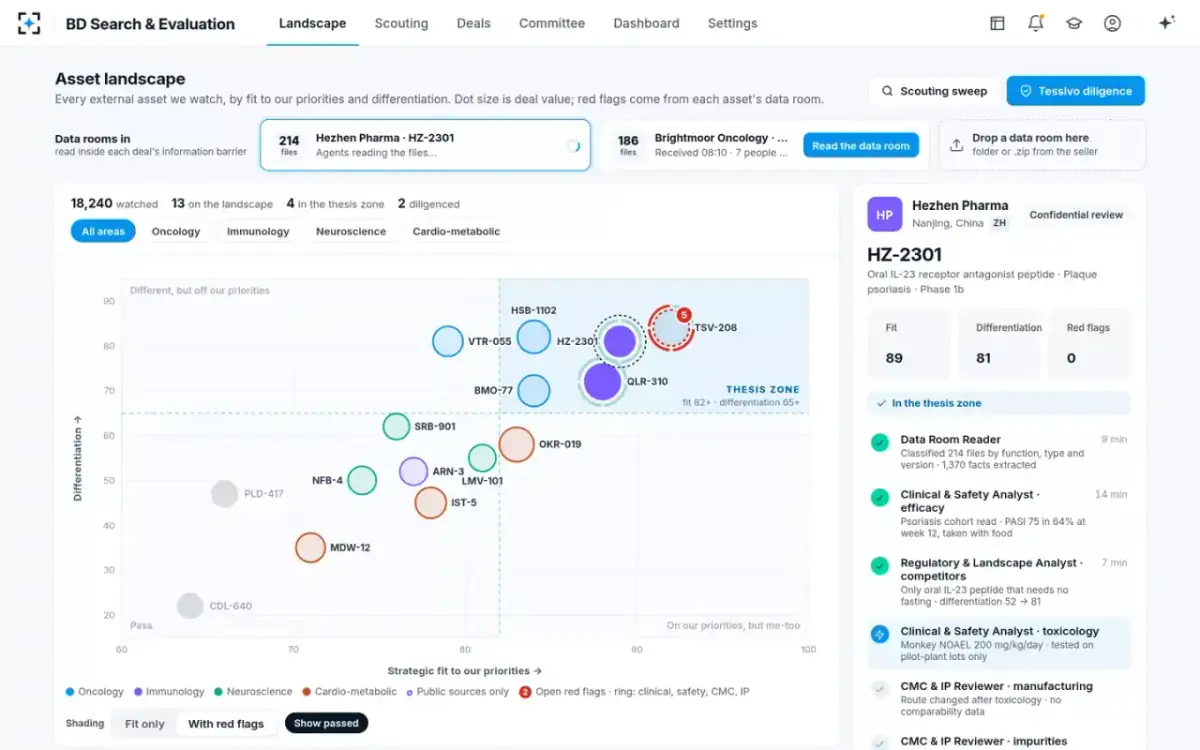
Does an agent search across deals?
It must not, and this is the question that separates a system built for deal work from a general research tool pointed at deal documents. A model that had read four data rooms would plainly give a better answer about the fifth — it would know what a normal impurity profile looks like in this class, what the last three sellers asked for, where the clauses usually hide. It would also be a single process holding confidential information from four counterparties at once, standing on both sides of four information barriers.
The design that follows is strict: each deal's files are kept apart, the agents serving a deal read only that deal's room, and nothing is carried between deals — no search, no memory, no shared index. On the sample deals that means eight people and their agents inside the Hezhen wall, nine inside Tessivo, eleven inside Quillara, and no path between them. Why the duty is stricter than most teams assume, including for people who never touch the target's shares, is set out in the guide to wall crossing and MNPI.
The cost is real and should be stated: the system is less clever on deal five than it could have been. That is the price of being able to tell a counterparty, truthfully, that their study reports were read by a process that could not see anyone else's.
What to ask a vendor, and what to ask of your own function leads
Half the evaluation is about the software and half is about whether your own organisation is ready to sign what it produces. The questions worth asking the vendor are mostly about refusals and evidence: show me a memo sentence and open the page it came from; show me what happens when two documents disagree; show me the system refusing to cite a draft; show me the activity trail for a deal including the agent steps; tell me what it cannot do, in writing.
The questions worth asking your own people are harder. Will the CMC lead sign a memo they did not draft? What will they check before they do, and how long will that take? Who decides whether a flag is a deal-breaker, and is that written down today? If the answer to the last question is "it depends who is in the room", automation will not fix it — it will make the inconsistency faster and more visible. The function-by-function checklist is a reasonable place to start that conversation, because it forces the question of what each seat is actually responsible for.
A drafted memo beside the page it came from
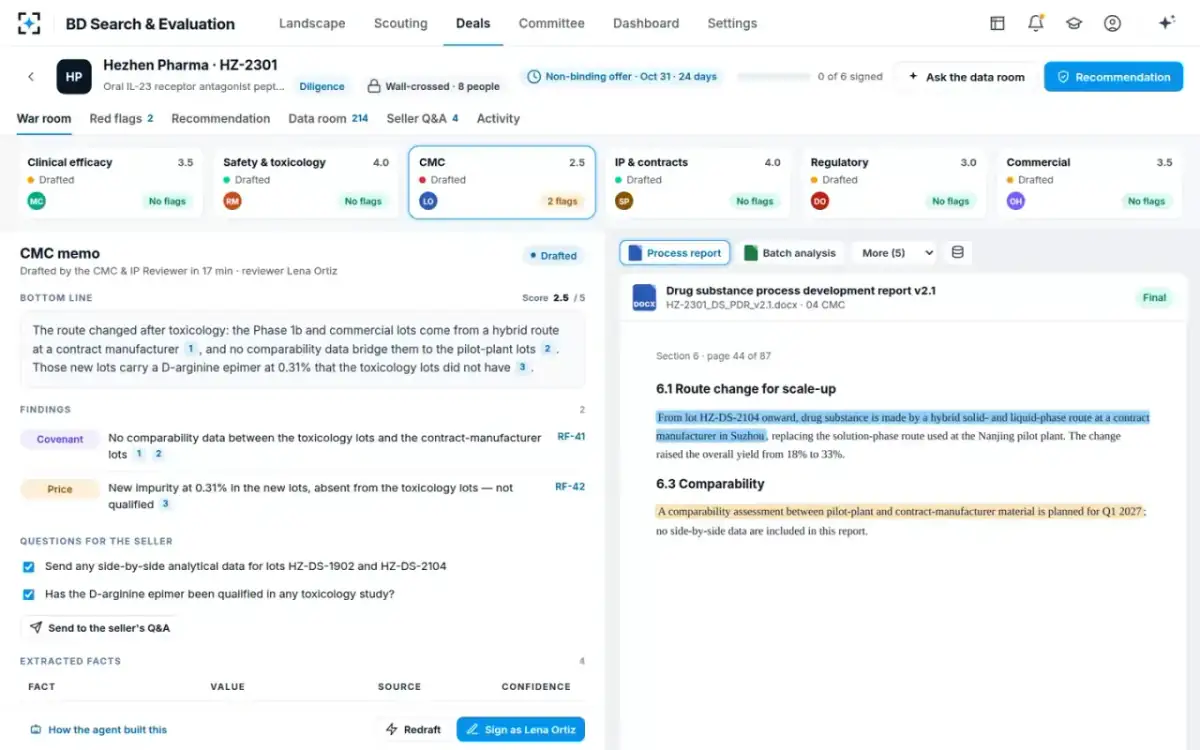
Questions people ask
Can an AI agent do due diligence?
It can do the reading. On a fictional sample deal, seven agents sort 214 data-room files by function, version and data cut-off, extract 1,370 facts each with a page reference, and draft six function memos; the median first pass from the room opening to drafted memos is 6.6 hours as a design target, against about 60 hours by hand as an estimate. What they do not do is decide. Function leads check the cited pages and sign, the head of Search & Evaluation and the deal lead sign the recommendation, and the committee decides.
How do you stop an agent inventing facts in a diligence memo?
By making every sentence cite the page it came from, so the check is a click rather than a re-read, and by refusing to cite anything that is not the final version. The regulator's framing is useful here: independent verification beside a model's output reduces the model's influence, and a use with a high decision consequence but low model influence is a medium risk rather than a high one. A memo you cannot check sentence by sentence is a high-influence use whatever the vendor's accuracy claim.
Does FDA have a view on using AI in business development?
Not directly. Its January 2025 draft guidance covers AI whose output supports agency decisions about a drug's safety, effectiveness or quality, and its scope section leaves out AI used for operational efficiency, such as internal workflows and drafting, where the use does not affect patient safety, drug quality or study results. Diligence memo drafting is an internal workflow. The guidance's risk framing is still the most useful one available — borrow it, but do not describe it as compliance.
How accurate is AI asset scouting?
Accurate enough to widen a sweep, and worth measuring before you rely on it, because most published accuracy figures for scouting tools come from the teams that built them. The test that answers the question for your own criteria is recall on a set of assets your team already knows, including the ones found late or only in a regional registry. Treat the tool as a first sweep that improves coverage, not as a complete count of the field.
Should an agent be allowed to read several deals at once?
No. A process that can see more than one counterparty's confidential documents is a hole in every information barrier it crosses, and the first question in any dispute will be what it was asked. The right design keeps each deal's files apart, scopes each agent to one room, and carries nothing between deals — accepting that the system is less informed as a result.
Who signs an AI-drafted diligence memo?
The function lead whose seat it belongs to, after reading the cited passages — and the signature should record what it means, with the name, date and time, and be unchangeable afterwards. On the sample deals each of the six function memos needs its reviewer's signature, the recommendation needs the head of Search & Evaluation and the deal lead, and an open deal-breaker blocks the signature until it becomes a condition or the deal is passed.