A clinical trial registry search is how a competitive landscape starts: you take a target, a mechanism or an indication, query the public trial registries for every study that touches it, deduplicate the results into assets, and rank what is left. It is the cheapest reliable evidence in business development, and the only evidence you can put in front of a colleague who has not been wall-crossed. It is also incomplete in three specific ways — late results, missing results and the same drug under three names — and a landscape that does not say so will be taken apart at the first strategy review. Botminds' BD Search & Evaluation runs that search as a standing sweep across nine languages, merges the code names into one asset, and places each asset on a landscape of strategic fit against differentiation with every claim cited.
The assets, companies and figures from the solution below are fictional sample data. The research figures come from peer-reviewed studies and from the regulations themselves, linked where they appear.
What a clinical trial registry search can tell you, and what it cannot
A registry entry is a declaration, made by the sponsor, that a study exists. Under the US rule the declaration is due "not later than … 21 calendar days after the first human subject is enrolled" (42 CFR 11.24(a)), and it must carry a defined list of fields: the phase, the study design, the enrolment, the primary and secondary outcome measures, the start date, the primary completion date and the recruitment status, among others (42 CFR 11.28(a)(2)).
That gives you four things a landscape needs and nothing else. You learn that a programme exists, roughly how big it is, what it is measuring and whether it is still running. You do not learn whether it is working, whether the sponsor still believes in it, what the agency has said, or what the deal terms behind it look like. Everything that decides a licensing bid sits outside the registry — which is why a registry landscape is the starting position for diligence rather than a substitute for it, and why the asset that looks best on public sources keeps looking best until someone reads its data room.
The honest way to present one is therefore to publish the method with the gaps attached: here is what we searched, here is what the sources are required to contain, here is what they are known to omit, and here is the confidence we attach to each row. A landscape offered as a complete count of the field is a landscape that one missing Chinese asset will discredit.
The four sources worth searching, and what each one holds
Four sources cover most of what a biopharma team needs. Three are registries; the fourth is a portal over the others and is routinely mistaken for a registry, which matters because it changes what you can trust in it.
Where a competitive landscape's public evidence comes from
| Source | What it covers | What it is required to contain | What it misses |
|---|---|---|---|
| ClinicalTrials.gov | Applicable clinical trials under US law, plus a large voluntary international tail. | Registration within 21 days of first enrolment, the data elements of 42 CFR 11.28, and results information within one year of primary completion. | Trials with no US nexus that the sponsor chooses not to register; everything a sponsor decided before a trial started. |
| The EU Clinical Trials Information System (CTIS) | Clinical trials run in the EU and EEA under the Clinical Trials Regulation. | A public website that anyone can search for EU and EEA trial information; it went live on 31 January 2022. | Trials that began under the earlier Directive sit in a separate, older register, so a single search of CTIS alone misses the legacy tail. |
| National registries in Asia | Chinese, Japanese and Korean trials registered with their own national platforms, often in the local language first. | Each is a WHO primary registry and must meet the platform's minimum data set to feed the portal. | English fields are often thinner than the local-language ones, and the drug is frequently listed under a local code name only. |
| The WHO ICTRP search portal | A single search across the primary registries that feed it. | Nothing of its own. WHO describes its aim as giving everyone involved in health-care decisions a complete view of research. | It is not a registry, and WHO says plainly that a trial cannot be registered with it. Fields are only as fresh as the feed behind them. |
The practical consequence of the fourth row is worth stating plainly, because it is a common error in a landscape built in a hurry. Searching the WHO portal is not searching the registries; it is searching a copy of them with a lag. For anything that matters — a trial you are about to price an asset against — open the primary registry entry and read it there.
When must clinical trial results be posted — and how often are they?
Results are due within a year. For applicable clinical trials, the regulation sets the results deadline at one year after the trial's primary completion date (42 CFR 11.44(a)), and what counts as results is specified rather than left to the sponsor: participant flow, by arm, "including the number who started and completed the clinical trial," then demographic and baseline characteristics, outcome measures and adverse events (42 CFR 11.48).
Compliance is another matter, and it is a useful number for anyone deciding how much weight a landscape can carry. In a cohort study of every trial due to report under the US act, only 1,722 of the 4,209 trials due to report results — 40.9% — met the one-year deadline, and "the median delay from primary completion date to submission date was 424 days … 59 days higher than the legal reporting requirement of 1 year" (DeVito, Bacon and Goldacre, The Lancet, 2020).
What the public evidence behind a landscape is actually worth
40.9%
of trials due to report results under the US act did so within the one-year deadline
424days
median delay from primary completion to results submission — 59 days past the legal requirement
8.1%
of pivotal trials for agents that failed for commercial reasons were published in a peer-reviewed journal
Read those three numbers together and the rule for a landscape falls out. A trial whose primary completion date passed more than a year ago and still shows no results is not by itself evidence of a problem: in the same cohort, 2,686 of the 4,209 trials (63.8%) had submitted results at any time, so roughly two in five of those that missed the deadline reported late rather than never. It is evidence that you do not know, and the landscape should say so in a column rather than leave the row looking clean.
How do I find every trial for one target?
You do not, and the method should be built on that. What you can do is run the same query, over the same sources, on a schedule, with the synonyms written down — so that coverage improves week by week and anything added since the last sweep is visible as an addition rather than buried in a new list.
A clinical trial registry search a team can repeat every week
- Write the target as a synonym set, not a word
The receptor, the gene symbol, the pathway, the antibody class and the common misspellings. A target searched as one string finds the trials whose sponsor used your vocabulary.
- Search intervention fields as well as free text
Registries carry Intervention Name and Other Intervention Name separately. A code name usually lives in the second field, where a free-text search over titles never reaches it.
- Run the query in the local language as well as English
For Chinese, Japanese and Korean registries, the local-language fields are populated first and more fully. Translating the query, not the results, is what finds the asset.
- Pull the primary registry entry for every hit, not the portal copy
Use the portal to discover and the registry to confirm. Status and dates change in the registry first.
- Record the search itself
Query, sources, date, number of hits before and after deduplication. Without it, next week's sweep is a different search and the difference is unreadable.
- Deduplicate to assets, then to sponsors
Several trials become one asset; several assets may become one deal. Both collapses need a human to confirm the first time they happen.
- Mark every row with what it rests on
A row supported by a results posting is not the same as a row supported by a registration with no outcome data. Carry the distinction into the score.
- Sweep on a schedule and diff against last time
A weekly Monday sweep makes "what is new" a one-line answer. An ad-hoc search before each strategy review makes it a week of work.
Code names, synonyms and the same asset in three languages
The hardest part of a registry landscape is not finding trials; it is deciding which trials are the same drug. One asset can appear as an internal code with a company prefix, a second code assigned by a regional partner, a WHO international nonproprietary name once it is far enough along, a trade name after approval, and a transliteration of any of those in a Chinese, Japanese or Korean entry. Each of those strings is a separate row until somebody merges them.
The registries help more than most analysts realise. The required data elements include "Intervention Name(s), for each intervention studied" and, separately, "Other Intervention Name(s), for each intervention studied" (42 CFR 11.28(a)(2)(i)(J)–(K)). The second field is where sponsors put the aliases, and it is often the highest-yield field in a scouting query. A search that looks only at titles and conditions will miss the trial that calls your target's inhibitor by a code you have never seen.
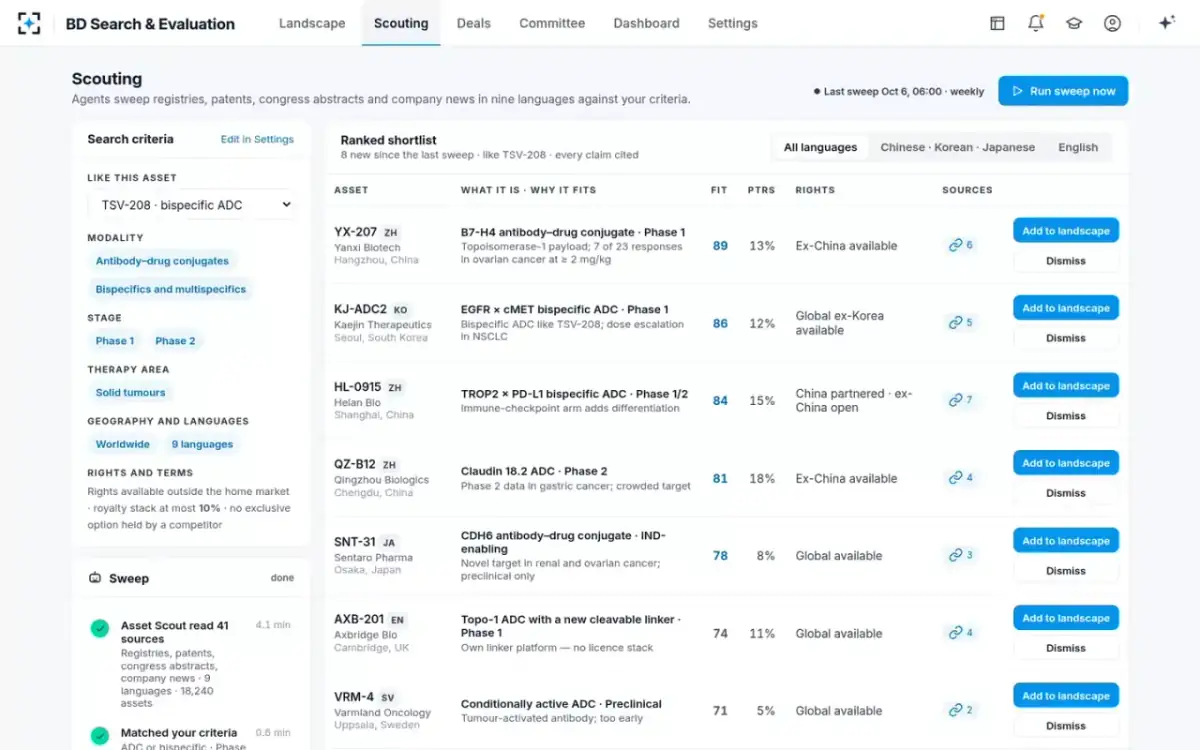
Three merge tests keep the asset list honest: identical sponsor plus identical mechanism plus overlapping dates is usually the same asset; a shared protocol identification number across registries is conclusive; and a local code name that appears in an English abstract next to a known code is a documented alias worth storing permanently rather than rediscovering. On the sample data the sweep merges Chinese, Korean and Japanese code names into one asset, and the merge is shown on the asset rather than hidden, so an analyst can disagree with it.
From one query to a ranked asset list in BD Search & Evaluation
Agent
Expand the queryTurn the target into a synonym set — gene symbol, receptor, class, code-name patterns — and translate it for the local-language registries.
Agent
Sweep the public sourcesQuery the registries, patent families, congress abstracts and company disclosures in nine languages, keeping the citation for every hit.
Never: reads deal data, a seller's data room or any document behind a wall
Agent
Merge to assetsCollapse trials and aliases into one asset per molecule, showing which names were merged and on what evidence.
Agent
Score fit and differentiationRank each asset against the thesis — therapy area, modality, stage, rights, royalty signals — and score differentiation from the competing assets found.
Never: drops an asset for being above the royalty limit; it is flagged instead
A person decides
The analyst confirms the merges and the exclusionsAccepts or rejects each alias merge, each exclusion and each royalty flag. The score is the agents'; the shortlist is the analyst's.
A person decides
The head of Search & Evaluation sets the thesis zoneDecides the fit and differentiation thresholds that make an asset worth pursuing, and signs any recommendation that follows.
Reading a registry entry: arms, endpoints, status and the dates that matter
Once the asset list is right, the value is in reading each entry properly. Four fields decide what a trial means for a landscape, and each of them misleads in a predictable direction.
The four fields that decide what a competitor's trial means
| Field | What it tells you | Where it misleads |
|---|---|---|
| Primary Outcome Measure | What the sponsor committed to measure, and at what timepoint — the closest public statement of what they think the drug does. | It can be amended. An endpoint changed late, or a timepoint moved out, is a signal; it is only visible if you kept the earlier version. |
| Enrolment and Study Design | How serious the programme is, and whether it is randomised against a control that matters. | Enrolment is a target, not a count, until results are posted. A single-arm study with a large target may be recruiting slowly or not at all. |
| Overall Recruitment Status and Why Study Stopped | Whether the programme is alive. The reason field is required when a study stops. | Status is updated by the sponsor, and a stale "recruiting" is common. "Business reasons" in the stop field can mean anything from a portfolio cut to a safety finding nobody wanted to write down. |
| Primary Completion Date | The clock that starts the one-year results obligation, and the date your own timeline should be planned against. | It moves. A primary completion date that has slipped twice says more about a competitor than any press statement, and the slip is only visible if the entry was captured each time. |
The common thread is that a registry is a living document and a landscape is a snapshot. Almost everything interesting is in the difference between two snapshots, which is why a sweep that overwrites last week's answer throws away the most valuable thing it has.
The scouting screen: criteria in, a ranked shortlist out
The silent failures: what never reaches the public at all
The reporting gap is measurable. The failure gap is worse, and it is the reason a landscape built only from registries is systematically optimistic about the field it describes.
In a study of 640 novel therapeutics that entered pivotal trials, pivotal results "were published in peer-reviewed journals for 138 of the 344 (40%) failed agents. Of 74 trials for agents that failed for commercial reasons, only 6 (8.1%) were published" (Hwang et al., JAMA Internal Medicine, 2016). Commercial failure — a programme stopped for business reasons rather than a stated efficacy or safety failure — is the category most relevant to a licensing decision, and it is almost entirely invisible.
This matters in a specific way for in-licensing. The asset in front of you may be the one somebody else walked away from, and the reason they walked away is precisely the kind of reason that was never published. A landscape cannot find that; a data room sometimes can, through the correspondence, the amendment history and the gaps in a study programme. It is one of several reasons that the differentiation score an asset carries before its room opens should be treated as provisional, and that the red flags a room raises often move an asset further than its public data ever did.
From a trial list to a differentiation score you can show
A list of competing trials is not a landscape. The step that makes it useful is turning the list into a comparison on the handful of axes a licensing decision actually turns on: how the asset is dosed, what it is measured against, who else is ahead of it, and what is left to find out.
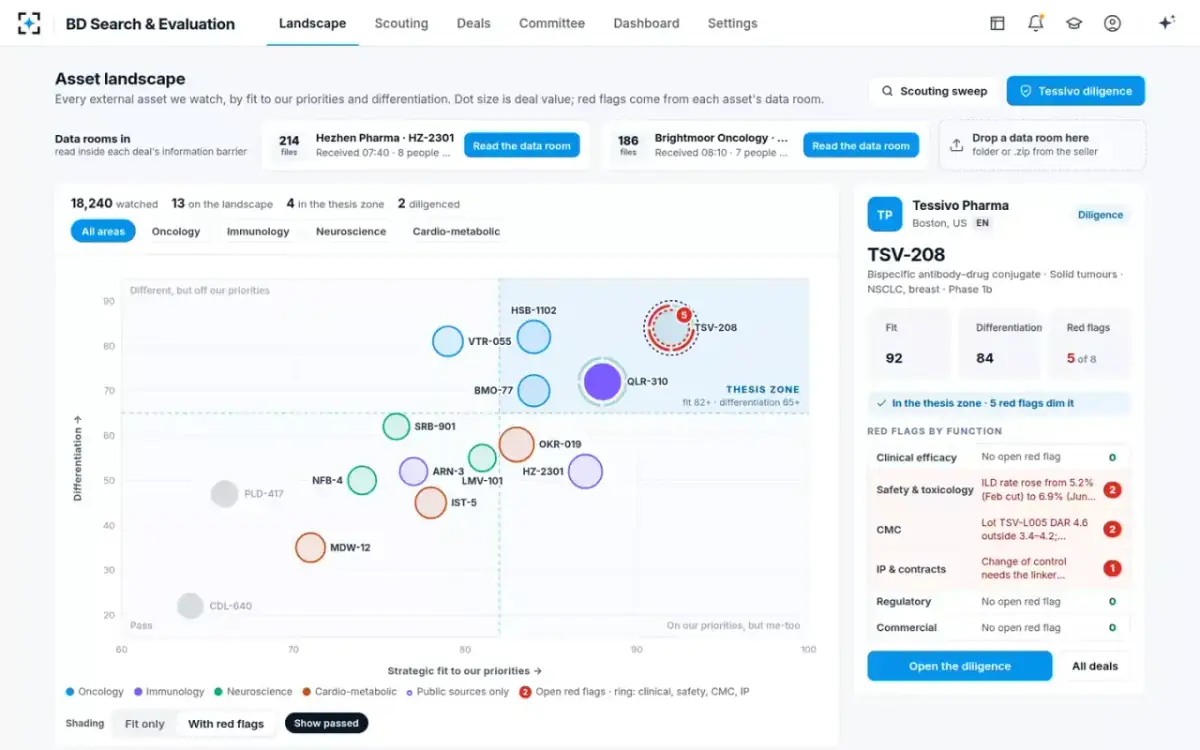
On the sample data this is visible in one number moving. HZ-2301, an oral IL-23 receptor antagonist peptide, sits on public sources at strategic fit 87 and differentiation 52 — outside the thesis zone, because the registry entries show a Phase 1 completed in healthy volunteers and nothing else. The psoriasis cohort exists only inside the seller's room. When it is read, the cohort summary shows the drug was taken with or without food, with a fed/fasted exposure ratio of 0.94; from 19 public sources the two oral agents in the same pathway at Phase 3 or filed are both dosed on an empty stomach. Differentiation moves from 52 to 81, fit from 87 to 89, and the asset crosses into the thesis zone.
The same asset, scored from public sources and after one data room is read
From registries and other public sources: 52 — a completed Phase 1 in healthy volunteers and no comparative evidence.
After the seller's room was read: 81 — dosing with or without food, against two Phase 3 or filed agents in the same pathway that are dosed fasted.
From registries and other public sources: 87 — therapy area, modality and stage all inside the thesis.
After the seller's room was read: 89 — unchanged in substance; the cohort confirms the indication.
From registries and other public sources: Outside the thesis zone, drawn as a hollow dot.
After the seller's room was read: Inside the thesis zone, with a dashed ghost left at its public position.
From registries and other public sources: None visible. Nothing in the public sources suggests a manufacturing or impurity question.
After the seller's room was read: Two CMC red flags — a route change after the toxicology lots, and an impurity the animals never saw — which dim the asset on the landscape.
From registries and other public sources: 19 public sources, each cited, every one of them shareable outside the wall.
After the seller's room was read: The room's own documents, each cited to a page, readable only by wall-crossed people.
From registries and other public sources: Anyone in the team. This is the landscape a strategy review can be run from.
After the seller's room was read: The deal's list only — eight people on this sample deal.
The score is defensible because its parts are. Every claim behind the public half cites a source a sceptical colleague can open, royalty and rights signals are flagged rather than quietly dropped, and the asset that moves is shown moving — the ghost at the old position is the argument. What drives the move from a score to a bid is a separate calculation, worked through in what diligence does to a risk-adjusted NPV.
Keeping public sources apart from a seller's data room
A landscape and a data room must never merge into one pile of evidence, for a reason that has nothing to do with tidiness. The landscape is the artefact you can show to people outside the wall: the scouting team, a strategy review, a colleague being asked a question in the abstract. The moment one line of it comes from a seller's confidential file, it becomes a document only wall-crossed people may see, and nobody can tell by looking which line did it.
So the separation has to be structural. In BD Search & Evaluation the scouting agents work from public sources only and never touch deal data; the agents reading a room read that room and nothing else, with no search or memory across deals; and the agent-built landscape is labelled as such when it appears inside a deal, kept apart from the seller's documents. Who may know what, and why the duty is stricter than most teams assume, is set out in the guide to wall crossing and MNPI.
Every watched asset on one landscape, with each room's red flags drawn on
Questions people ask
What is the WHO ICTRP, and can I register a trial with it?
It is a search portal across the primary national and regional registries, not a registry itself. WHO's own page is explicit that a trial cannot be registered with it, and describes the platform's purpose as making a complete view of research available to everyone involved in health-care decisions. Use it to discover trials across jurisdictions, then open the primary registry entry to confirm anything you intend to rely on.
Is registry data reliable enough to build a landscape on?
Reliable for existence, design and status; unreliable as a complete picture. Registration is compulsory within 21 days of first enrolment for applicable trials and the required fields are specified in the regulation, so what is there is usually accurate. But only 40.9% of trials due to report results under the US act did so within the deadline, and the median delay was 424 days — so an empty results section means "unknown", not "nothing happened".
How do you find Chinese, Japanese or Korean assets?
Search the national registries in the local language, not only the English fields or the aggregated portal, and search the intervention-name fields rather than titles alone. Local entries are often populated first and more fully in the local language, and the drug is frequently listed under a regional code name that no English-language query will surface. Then merge the aliases to one asset and keep the merge on file, so the same name never has to be rediscovered.
How do you tell when two code names are the same drug?
Three tests cover most cases: the same sponsor with the same mechanism and overlapping trial dates; a shared protocol identification number appearing in two registries, which is conclusive; and a local code appearing beside a known code in a congress abstract or a patent family, which documents the alias. Each merge should be shown with its evidence so an analyst can reject it — an over-eager merge collapses two real competitors into one and makes the field look emptier than it is.
What does a trial registry never tell you?
Why a sponsor stopped believing in a programme. Pivotal results were published for only 40% of failed agents in one study of 640 novel therapeutics, and for just 8.1% of the trials whose agents failed for commercial reasons. Some of those are assets that later come up for licensing, so the question "has anyone already walked away from this, and why?" has to be put to the seller rather than to the public sources.
How often should a registry-based landscape be rerun?
On a schedule, and with the previous version kept. Weekly is enough for most therapy areas, because the useful signal is the difference between sweeps — a primary completion date that slipped, a status that changed, an endpoint that was amended, a new entry in a registry you were not watching. A landscape rebuilt from scratch before each review is both more expensive and less informative than one that has been running quietly and can show what moved.