A pharmaceutical due diligence checklist is only useful when every line names the document that settles it and the person who signs for it. A first pass on a seller's data room has six seats — clinical, safety and toxicology, chemistry manufacturing and controls, intellectual property, regulatory and commercial — and each seat owes one short memo, not a row of ticks. The difficulty is rarely knowing what to look for. It is that six functions must read several hundred files against a bid deadline, and the same number appears in three documents with three values. Botminds' BD Search & Evaluation sorts a room by function, document type, version and data cut-off, drafts each of the six memos with every sentence tied to the page it came from, and leaves the judgement, the questions to the seller and the signatures with the people who own them.
The worked examples below follow one deal through the solution. Hezhen Pharma's banker opens a 214-file room on HZ-2301, an oral IL-23 receptor antagonist peptide for plaque psoriasis, and the buyer is Northwind Bio. The companies, the people and the asset are fictional sample data in the solution; the rules and research quoted are real and linked where they appear.
What a pharmaceutical due diligence checklist is actually for
Most circulated checklists are inventories: a list of documents a well-run seller ought to have. They are easy to satisfy and almost impossible to fail. A room can contain every item on the list and still hide the three findings that change a bid, because the problems in a licensing diligence are not usually missing documents. They are documents that disagree with each other, documents that have been superseded, and documents whose scope is narrower than the claim they are being used to support.
A better checklist is written backwards, from the opinion each function has to hold at the end. The clinical lead must be able to say what the asset has shown, in which patients, measured how, at which data cut-off. The toxicology lead must be able to say how much safety margin there is, and in which material. The CMC lead must be able to say that the drug substance in the clinic is the drug substance in the specification. Each of those sentences has one document behind it. Writing the checklist as six claims, each with its proving document and its signatory, is what makes a bid deadline schedulable: the work stops being "read the room" and becomes six parallel, finishable jobs.
The six seats of a first pass, and the document that settles each
- Clinical efficacy
What the asset has shown, in whom, measured against which predefined criterion, at which data cut-off. Settled by the clinical study report or the interim analysis — never the investor deck.
- Safety and toxicology
The no-observed-adverse-effect level, the exposure margin it implies, and the material the studies used. Settled by the study reports and their batch numbers.
- Chemistry, manufacturing and controls
That the lots in the clinic, the lots in the animals and the lots the specification describes are the same substance. Settled by the process development report and the batch analyses.
- Intellectual property
Composition-of-matter cover, remaining term, territory, and every royalty owed to a third party. Settled by the patent families, the licences and the assignment history.
- Regulatory
What each agency has actually asked for, in the agency’s own words. Settled by meeting minutes and written correspondence, not by the seller’s summary of them.
- Commercial
Who else is in the indication, how far ahead, and on what label. Settled by a landscape the buyer builds from public sources, because the seller’s slide was drawn to sell.
The three failure modes are worth naming, because each has a different remedy. A missing document is a question for the seller. A superseded document is a sorting problem: a draft cohort summary at version 0.6 and the final at 1.0 will give different numbers, and a memo that cites the draft is wrong in a way nobody can see later. A contradiction between two current documents is the finding that matters most, and it is almost always explained by a date — which is the subject of how to sort a room's red flags into deal-breakers, price items and covenants.
Each seat's claim, the document that proves it, and the signature it needs
| Seat | The claim it must be able to make | What proves it in the room | Who signs |
|---|---|---|---|
| Clinical | This is the effect size, in this population, on this endpoint, at this cut-off. | Clinical study report; interim analysis; the statistical analysis plan that predefined the endpoint | Clinical diligence lead |
| Safety and toxicology | This is the margin between the animal no-effect dose and the clinical exposure. | Toxicology study reports with batch numbers; the integrated safety summary | Safety diligence lead |
| CMC | The material in the clinic, in the animals and in the specification is the same. | Process development report; batch analyses; specifications and analytical methods | CMC diligence lead |
| IP | We would own, or be licensed to, what we are paying for, until this date, in this territory. | Patent families and term calculations; in-licences; assignment chain | Head of IP, with outside counsel |
| Regulatory | This is what the agency asked for, and this is what it costs in months. | Meeting minutes; written responses; the agency’s own correspondence | Regulatory diligence lead |
| Commercial | This is the field the asset would enter, and this is where it differs. | A landscape built from public sources, kept apart from the seller’s files | BD deal lead |
The clinical seat: what the efficacy memo has to prove, and from which document
The clinical memo has one job: to state the effect size in a form the committee can argue with. That means a number, a denominator, an endpoint with a predefined definition, and a date on which the data were cut. Any one of those missing turns the claim into marketing.
On HZ-2301 the useful evidence was not in the public record at all. The asset had completed Phase 1 in healthy volunteers, and the psoriasis cohort existed only in the room: PASI 75 in 18 of 28 patients, 64.3%, at week 12 on 50 mg once daily, against 1 of 9 on placebo. That is a small cohort and the memo says so. It is also the single fact that moved the asset, because nothing in the public sources showed any patient data at all. An asset judged on what a registry publishes and an asset judged on what its room contains are not the same asset, which is the argument of what published phase success rates can and cannot tell you about one asset.
Three questions do most of the work in a clinical first pass. Which cut-off does this number come from? The investor deck and the study report are often both honest and still disagree, because the deck was built on an earlier cut. How was the response defined, and was that definition written before the study or chosen after it? And what is the denominator — patients randomised, patients dosed, or patients who reached week 12? A response rate quoted on completers is a different claim from the same rate quoted on everyone enrolled, and sellers do not always say which they mean.
The regulation is blunt about what happens when the summarising document misleads. An agency may stop a trial if it finds that the investigator brochure is "misleading, erroneous, or materially incomplete" (21 CFR 312.42(b)(1)(iii)). A buyer reading a room has no such power, but it has the same interest: the brochure is a summary, and a diligence memo built on a summary inherits whatever the summary smoothed over.
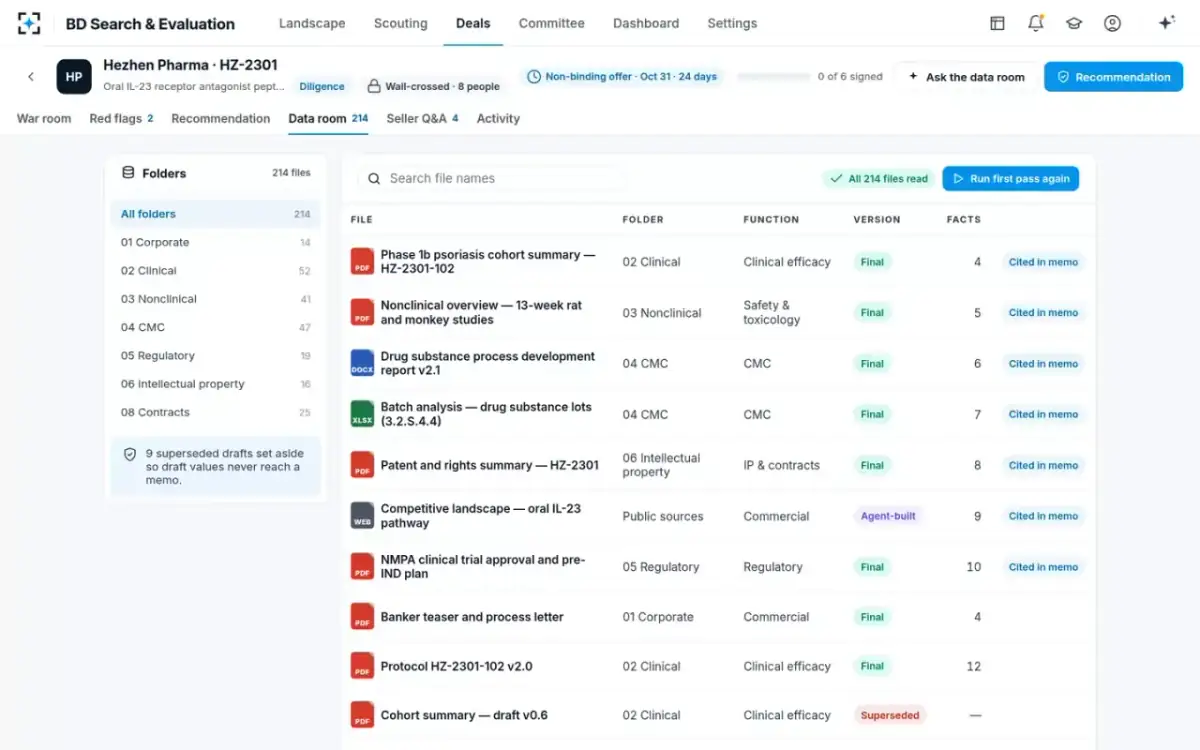
The room, sorted before anyone reads it
The safety and toxicology seat: NOAELs, margins, and the lots they came from
The safety memo answers two questions at once: how large the margin is, and where it was measured. The margin is the ratio between the highest animal dose that produced no adverse effect and the exposure a patient would see. The second question — which material the animals actually received — is the one that gets skipped.
ICH M3(R2) sets out what the nonclinical package is for: it characterises toxic effects — which organs, how they depend on dose and exposure, and whether they reverse — and the information "is used to estimate an initial safe starting dose and dose range for the human trials and to identify parameters for clinical monitoring" (ICH M3(R2), §1.4). Read as a diligence instruction, that sentence says the package has to connect a dose to an exposure to a clinical monitoring plan. If any link is missing, the margin is arithmetic without a subject.
What the room must contain is also written down. An application's nonclinical section has to carry an integrated summary of the drug's toxic effects in animals and in vitro and, for each study meant mainly to support the safety of the proposed clinical investigation, the full data in tabulated form, detailed enough for review (21 CFR 312.23(a)(8)). A seller who offers the integrated summary but not the tabulations has given the buyer the conclusion without the evidence, and that is a question, not a finding.
On HZ-2301 the monkey no-observed-adverse-effect level was 200 mg/kg/day, about 30 times the clinical exposure — a comfortable margin, and the kind of line that goes into the committee papers unqualified. The qualification is that the studies used pilot-plant lots HZ-DS-1901 and 1902. Everything made from lot HZ-DS-2104 onwards came from a different route at a different site. The margin is real; it was measured on material the programme no longer makes.
If the lots in the clinic aren't the lots in the animals, I need it in writing.
Lena Ortiz · CMC diligence lead, a character in the solution
The CMC seat: route, lots, specifications and impurities
That line is the CMC seat's whole brief. Three documents settle it: the process development report, which says how the substance was made and when that changed; the batch analyses, which say what each lot actually contained; and the specification with its analytical methods, which says what the programme promises every future lot will contain. A CMC memo is the comparison of those three against the clinical and toxicology batch lists.
ICH Q11 describes the two ways a programme can get there. "In a traditional approach, set points and operating ranges for process parameters are defined and the drug substance control strategy is typically based on demonstration of process reproducibility and testing to meet established acceptance criteria"; the enhanced approach uses risk management and process understanding to build a control strategy "applicable over the lifecycle of the drug substance" (ICH Q11, §1). Which approach a seller took tells the buyer how much of the control strategy is knowledge and how much is testing — and therefore how much work a route change creates. Q11 also defines the thing a buyer is really assessing: a control strategy is "a planned set of controls, derived from current product and process understanding, that assures process performance and product quality".
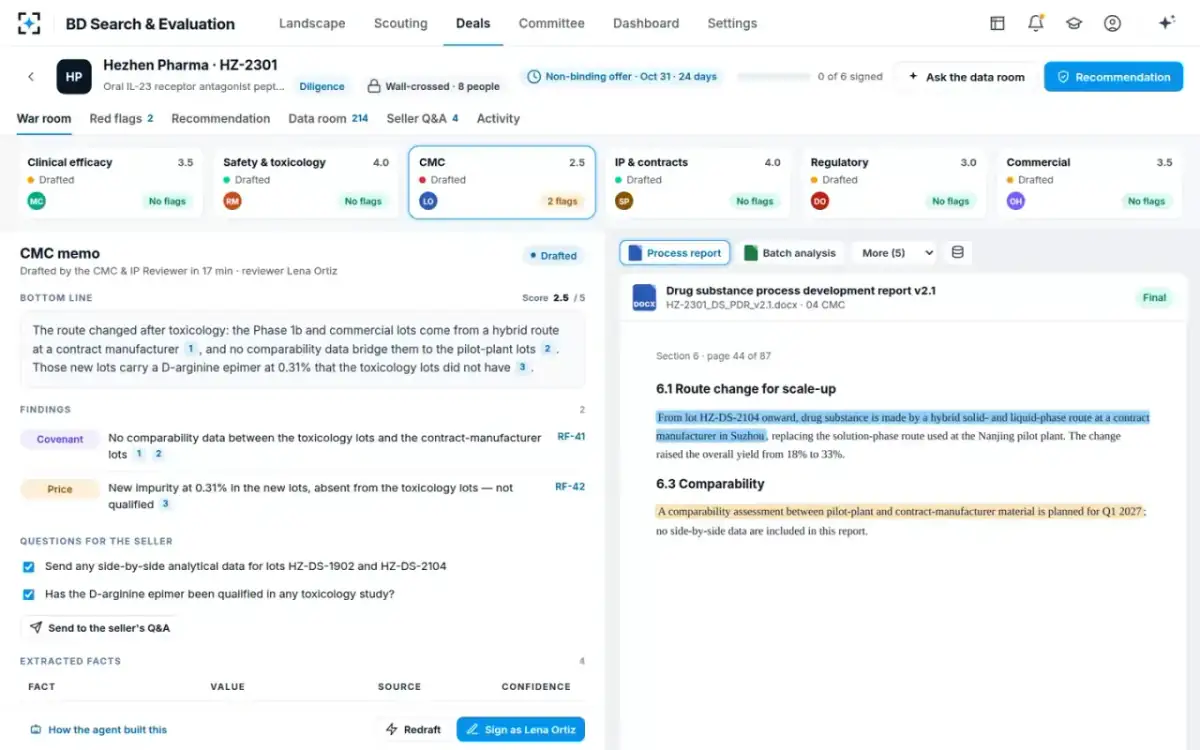
On this asset the route changed. From lot HZ-DS-2104 the drug substance comes from a hybrid route at a contract manufacturer in Suzhou, and the room contains no comparability data between the old and new material; a comparability assessment is planned for the first quarter of 2027. The new lots also carry a D-arginine epimer at up to 0.31% that the toxicology lots never contained. Neither finding is a reason to walk away, and neither is free: the CMC memo scored 2.5 of 5 with two flags, and both flags left the room as terms in the offer.
What is CMC due diligence, and what does it cover?
CMC due diligence is the review of how a drug substance and drug product are made, tested and controlled, and of whether that chain supports the clinical and regulatory claims being sold. It covers eight things, and a first pass can reach all eight from a well-indexed room.
The route and its starting materials, including who owns the know-how. The batch genealogy: every lot made, where, by which route, and which study used it. The specification and the analytical methods that enforce it. The impurity profile, including anything the safety lots did not contain. The supply chain, with single sources named. Stability, and whether it covers the intended presentation. Scale-up and comparability, which is where most late surprises live. And the manufacturing quality status of each site in the chain, including whose inspection history it is.
The reason CMC is the seat that most often moves a price is that its findings are remediable and therefore quantifiable. A missing comparability study is a known study with a known duration. On HZ-2301, the bridging toxicology study needed to qualify the new impurity is about six months. Those are numbers a deal lead can put into a model, which is what a risk-adjusted valuation does with a diligence finding is about.
A function memo beside the page it came from
The IP seat: composition of matter, term, and the royalty stack
The IP memo answers three questions in order: would we own the molecule, for how long, and what do we owe other people. The first is narrower than it sounds. The categories the regulation uses are a good checklist in themselves: patents that must be declared for a new drug application "consist of drug substance (active ingredient) patents, drug product (formulation and composition) patents, and method-of-use patents", and the test for declaring one is whether "a claim of patent infringement could reasonably be asserted if a person not licensed by the owner of the patent engaged in the manufacture, use, or sale of the drug product" (21 CFR 314.53(b)(1)). An asset whose only cover is a formulation patent and a method-of-use patent is a different asset from one with composition-of-matter cover, whatever the data show.
Term is arithmetic plus territory. On HZ-2301 the US composition-of-matter patent runs to 2043 and rights outside Greater China are clear, which is why the recommendation was framed as a licence outside Greater China rather than a global deal. The royalty stack is the third question and the one most often deferred: every third-party royalty on the molecule, the process and any enabling technology, added up. Northwind's stated limit is 10%, and an asset above it is flagged rather than dropped — a limit that silently discards assets is a limit nobody will ever revisit.
The regulatory seat: what the agency asked, in the agency's words
The regulatory memo is the easiest to write badly, because the temptation is to summarise. "The agency was supportive of the development plan" is not a finding. What the minutes say, quoted, is. A diligence memo should carry the agency's wording and let the reader judge the distance between a comment and a commitment, which is why the solution quotes agency language and never paraphrases it into an agreement.
Three things belong in the memo. The regulatory history: every meeting, every written question, every response, with dates. The open asks: what the agency has said it will want, and when. And the pathway assumption the valuation rests on, stated plainly enough to be wrong. Where the asset's evidence comes from a single region, that assumption carries most of the risk in the deal, and it is handled in what FDA acceptance of foreign clinical data requires a buyer to check.
The reason to quote rather than paraphrase is that the agency's own remedies are specific. A trial can be stopped if the application "does not contain sufficient information required under § 312.23 to assess the risks to subjects of the proposed studies" (21 CFR 312.42(b)(1)(iv)). That is a sentence about completeness, not about science, and it is exactly the kind of risk a summary hides.
The commercial seat: the landscape the seller did not draw
Every seller's deck contains a competitive landscape, and every one of them was drawn to make the asset look unoccupied. The commercial seat's first job is to redraw it from public sources, with citations, and keep it apart from the seller's files so nobody later mistakes one for the other.
On HZ-2301 the redrawn landscape changed the deal. The cohort summary recorded that the drug was taken with or without food, with a fed-to-fasted exposure ratio of 0.94. Two oral agents in the same pathway were in Phase 3 or filed, and both are dosed on an empty stomach. On public sources the asset scored 52 for differentiation; read against the field, with that one pharmacokinetic fact, it scored 81, and strategic fit rose from 87 to 89. A differentiator that mundane is also the most durable kind, because it survives a label.
The commercial memo should also say what it cannot see. Pricing assumptions, payer behaviour and a competitor's unpublished readouts are not in any room, and a memo that pretends otherwise invites a committee to argue with the weakest page in the committee papers.
How long does a first pass take, and where do the hours go?
A first pass on a mid-sized room — 200 to 300 files — takes six functions somewhere around 60 hours of expert time by hand, spread over the days a bid deadline usually allows. That estimate is ours, and the split below is the one the solution's own dashboard shows for this deal. The important part is not the total but its shape: roughly a seventh of it is sorting, and the sorting has to finish before any of the reading can start.
Where a first pass's expert hours go, by hand and in BD Search & Evaluation
The with-agents column is a design target rather than a measured outcome, and it is worth reading for what it does to the sequence rather than the total. When sorting takes minutes, the six seats start at the same time instead of queueing behind one person's weekend. When the memos arrive drafted and cited, the expert hours move to the two things only experts can do: deciding whether a finding is a problem, and deciding what to ask the seller.
Who signs each memo, and what the signature means
A diligence memo without a named signatory is a document nobody will defend at committee. Northwind's settings name a reviewer for each of the six functions, and each memo needs that reviewer's signature, recorded with name, date and time, and not editable afterwards. The signature means one thing: this person has read the cited pages and holds this opinion.
Above the memos sit two more signatures and one decision. The head of Search & Evaluation signs the recommendation, the BD deal lead countersigns it, and the investment committee decides. An open deal-breaker blocks the recommendation signature until it is turned into a condition or the deal is passed, so the one finding that should never be waved through cannot be.
What BD Search & Evaluation drafts, and what each person still signs
Today
Learns from a memo, days later, which of her favourites has a problem.
With agents
Watches the room redraw the landscape — where each asset really sits, and which flags dim it — before she signs.
Still theirs: The signature on every recommendation
Today
Runs three seller processes at once and asks each function what changes the price and what changes the deal.
With agents
Reads each flag already sorted into deal-breaker, covenant or price item, with bid guidance on one page.
Still theirs: The countersignature, and what goes to the seller
Today
Reads routes, lots and impurities in every room from the first page.
With agents
Opens a drafted memo with the batch analyses and process report beside it, and approves or rewrites the seller questions.
Still theirs: The CMC memo’s signature
Today
Hears a favourite’s manufacturing or IP problem for the first time in the meeting.
With agents
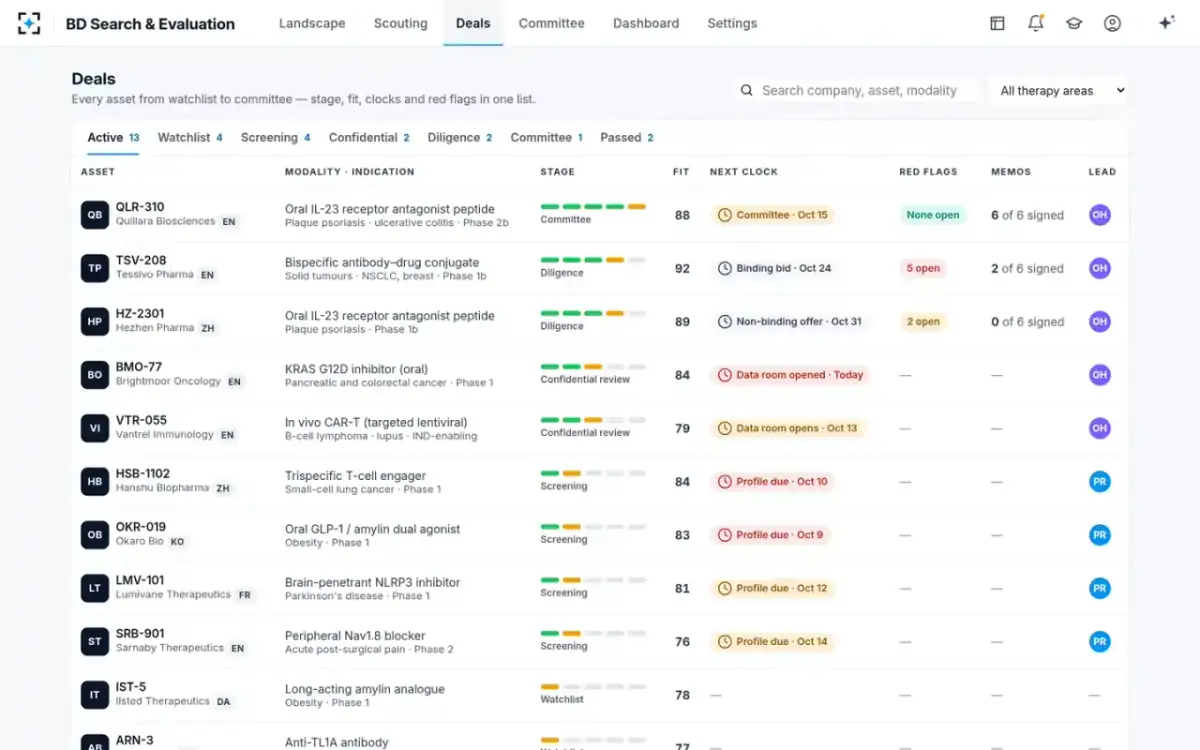
Gets score, conditions and signatures on one page per deal, and which memos are still open.
Still theirs: The committee’s decision
Every deal, and which memos are still unsigned
That is the whole method. Six claims, six proving documents, six signatures, and a register of everything that did not reconcile. To see it run on a room of your own, start from BD Search & Evaluation.
Questions people ask
What is included in pharmaceutical due diligence?
Six function reviews and one register of findings. Clinical efficacy, safety and toxicology, chemistry manufacturing and controls, intellectual property, regulatory and commercial each produce a short memo with a score and its open questions, and every finding is sorted by what it does to the deal. Corporate, financial and tax diligence usually run in parallel, on a different team and a different timetable.
What is regulatory due diligence in pharma?
It is the reconstruction of what every agency has actually said about the asset, from the minutes and correspondence rather than the seller's summary, plus a view of what the agency will ask for next and what that costs in months. The discipline is to quote the agency's wording: the distance between a supportive comment and an agreement is where most regulatory risk in a licensing deal sits.
What documents are in a pharma data room?
Often eight folders, as in the sample room: corporate and ownership, nonclinical, clinical, CMC, regulatory, intellectual property, commercial, and contracts. The Hezhen room in the examples above holds 214 files across folders numbered 01 Corporate to 08 Contracts. Expect several versions of the same document; nine of those 214 were superseded drafts, and citing one of them is how a memo ends up quoting a number the seller abandoned.
How long does pharma due diligence take?
A first pass that produces six drafted memos is a few days of elapsed time and roughly 60 hours of expert time on a 200-to-300-file room, by our estimate. Confirmatory diligence — site visits, counsel's patent opinion, independent statistical review — runs for weeks after that. The first pass is the part a bid deadline compresses, which is why the sorting step is worth automating before the reading step.
What is a data room index?
The seller's own list of the files in the room, by folder. It is useful and never sufficient: it names documents, not versions, data cut-offs or the function that needs each one. A buyer's working index adds those four columns, and marks which files a memo has actually cited — which is also how you notice that a whole folder was never opened.
Who signs a due diligence memo?
The function's own diligence lead, by name, with the date and time recorded and the text locked afterwards. The signature means that person has read the cited pages and holds the opinion. The recommendation that carries the six memos to the investment committee takes two more signatures, the head of Search and Evaluation and the BD deal lead, and the committee itself decides.