Virtual data room due diligence has two layers that buyers routinely price as one. The room is custody: it holds the seller's files, versions them, decides who may open which folder, stamps each page with the viewer's name, logs every view and carries the question channel. The review is reading: six functions working through hundreds of documents against a bid deadline, deciding what each one means, and writing memos somebody will sign. A better room does not shorten the review, because the review is not a storage problem — and the hours a first pass costs are all on the second layer. Botminds' BD Search & Evaluation is a reading layer: it takes the room as a folder or a .zip, sorts every file by function, version and data cut-off, and drafts cited memos the function leads check and sign.
This guide is for the deal lead choosing what to buy around a seller's room, and for the legal or compliance partner who has to approve how the files are handled. The deal figures below are fictional sample data from the solution; the regulatory texts are cited where they appear.
What a virtual data room is for, and what it is good at
A virtual data room exists to let a seller show confidential documents to several competing buyers at once without losing control of them. That is a genuinely hard problem, and good rooms solve it well. They keep one authoritative copy of each document with its version history, so a buyer and a seller can argue about the same file. They enforce access by person and by folder, so the bidder who is out of the process stops seeing new material the same hour. They render the viewer's name across each page, which deters the forwarding that watermarks cannot technically prevent. They keep an index the seller can publish. And they log everything, which is as much protection for the seller as for the buyer.
None of that is marketing. A deal team that has run a process on shared drives and email will recognise every one of those as a problem they have had. The mistake is not buying a room; it is assuming that because the room is good, the diligence is handled.
The room's job and the review's job, line by line
What the data room does: Holds one authoritative copy of each file with its version history and upload dates.
What still has to be done above it: Works out which version is current, which are superseded, and which data cut-off each number belongs to.
What the data room does: Presents the seller's folder tree and index, as the seller chose to build it.
What still has to be done above it: Re-sorts the same files by the function that must read them, which is rarely the seller's structure.
What the data room does: Enforces who may open what, stamps the viewer's name on each page, logs every view.
What still has to be done above it: Decides who should be on the list at all, and keeps that decision aligned with the trading restriction.
What the data room does: Full-text search across the documents, returning files.
What still has to be done above it: Returns facts with the page they came from, so a memo sentence can be checked in seconds.
What the data room does: Nothing. Two documents that disagree sit quietly in different folders.
What still has to be done above it: Puts the deck, the study report and the brochure side by side where they differ, and explains why.
What the data room does: Nothing, correctly — a room that interpreted the files would be the seller interpreting them.
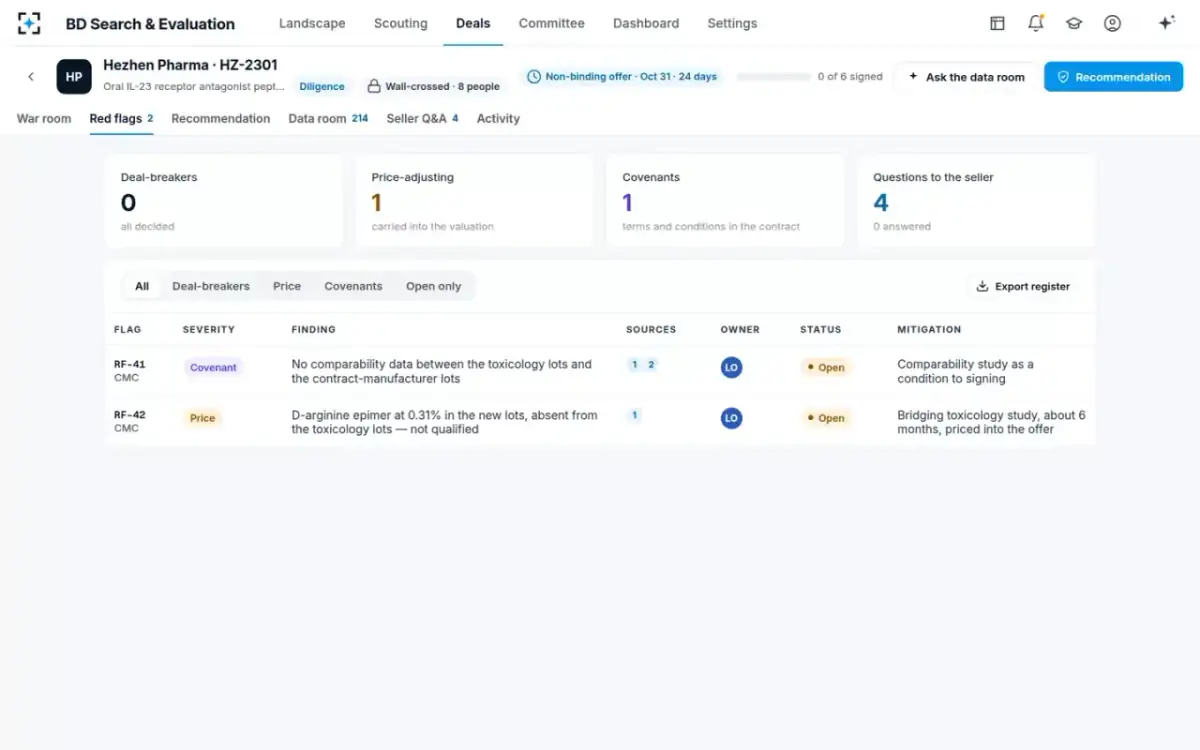
What still has to be done above it: Classifies each finding as a deal-breaker, a price item or a covenant, and carries it into the valuation.
What the data room does: Records that a person opened a file.
What still has to be done above it: Records that a named function lead accepted a memo, with the meaning of the signature, the date and the time.
What the room gives you, and what it leaves on your desk
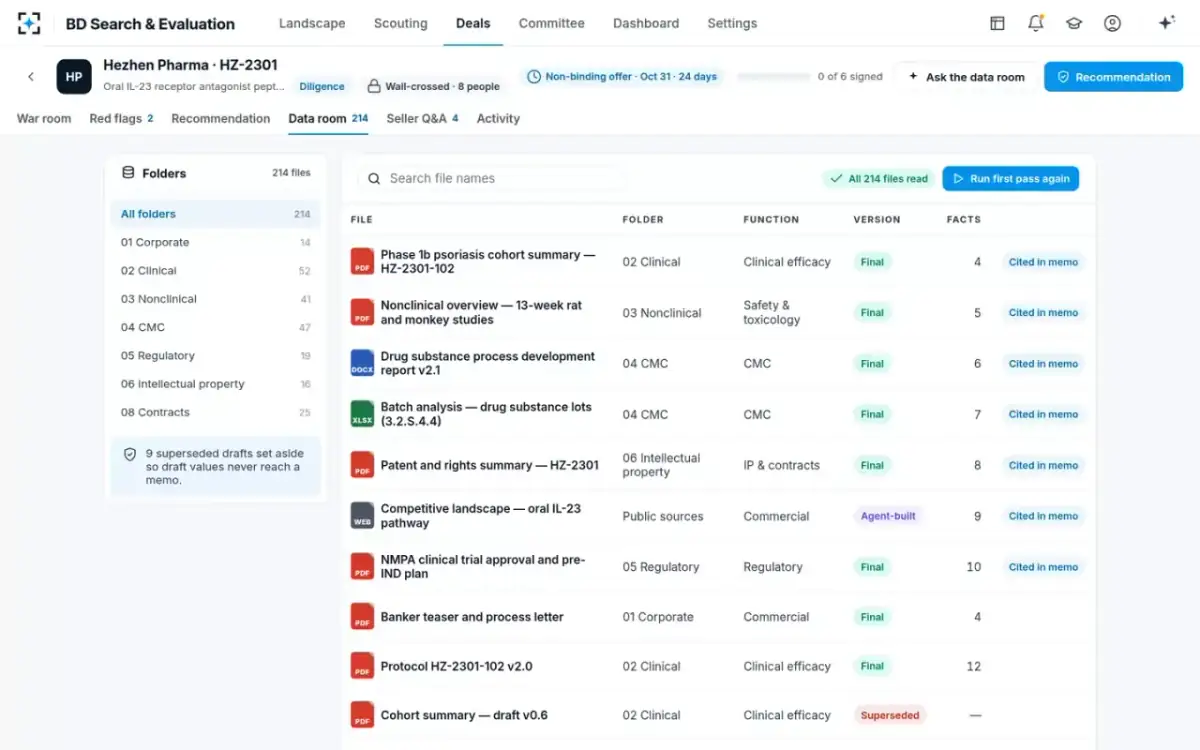
The numbers make the point faster than the argument. On the sample deal the seller's room contains 214 files across eight folders. Everything the room does with those files — index, version, log, watermark — is done the moment they are uploaded. Everything that costs a buyer money starts afterwards.
One seller's room, and what reading it produces
214files
in the seller's room, across folders 01 Corporate to 08 Contracts
1,370facts
extracted, each kept with the page reference it came from
9drafts
superseded documents set aside so their values can never reach a memo
That third number is the one a room cannot help with. A seller's room will happily contain a draft and a final of the same study summary, correctly versioned, both openable. Nothing about the room stops an analyst under time pressure from quoting the draft, and nothing about the room notices when they do. Catching it is a reading job: classify every file by version and data cut-off first, set the superseded ones aside, and refuse to cite them afterwards.
Is a virtual data room enough for due diligence?
No — and the clearest way to see why is to ask what a room would have to become to be enough. It would have to decide which of two conflicting numbers is right, which means taking a position against the seller who is paying for it. It would have to tell a buyer that an impurity in the clinical lots was never qualified in an animal study, which means reading across a toxicology report, a batch analysis and a process development report that sit in three different folders. It would have to know your thesis, your scoring weights and your risk appetite. A room that did any of those things would not be a neutral custodian, and sellers would stop using it.
So the division is structural, not a gap somebody will close. Judge the room on custody, access and logging. Judge everything above it on whether it produces memos a function lead will sign, with citations they can check. The two are bought from different people for different reasons, and a buying process that compares them on one feature list will choose badly.
How a pharma room is structured, and why version and data cut-off matter most
Pharma rooms converge on a familiar shape because the functions that read them are the same everywhere. The folder numbering varies; the seats do not.
A licensing data room, folder by folder, and who reads each
| Folder | What it is meant to prove | Who reads it first | Where it goes wrong |
|---|---|---|---|
| 01 Corporate | That the counterparty exists, owns what it is selling, and can sign. | Legal and the deal lead. | Cap table and subsidiary structure that do not match the entity named on the licence. |
| 02 Clinical | That the drug does something, in people, measured against something. | The clinical lead, then safety. | A cohort summary circulated in draft, and a deck that counts unconfirmed responses as confirmed. |
| 03 Nonclinical | That the toxicology supports the clinical dose and duration, with margins. | The safety and toxicology lead. | NOAELs quoted without saying which lots the animals received. |
| 04 CMC | That the drug can be made to a specification, repeatably, at scale. | The CMC lead. | A route change after the toxicology lots were made, with comparability only planned. |
| 05 Regulatory | What the agencies have asked, and what remains open. | The regulatory lead. | Minutes paraphrased into a company summary instead of quoted. |
| 06 Intellectual property | That the rights are owned, run long enough, and are free in your territory. | IP counsel, with the CMC lead on process patents. | A royalty stack assembled from three licences that nobody has added up. |
| 07 Commercial | That someone will pay for it, against the alternatives. | The commercial lead. | A landscape drawn by the seller, with the inconvenient competitor absent. |
| 08 Contracts | That nothing in the existing agreements breaks on a change of control. | Legal, with the deal lead. | A consent requirement buried in a linker or platform licence. |
Two attributes decide more than the folder does. The first is version: a room can hold three generations of the same document, and only one of them is the number you should price. The second is data cut-off — the date to which a dataset was current. Most contradictions inside a room are not errors; they are two documents written against different cut-offs, and the cheap way to resolve them is to read the cut-off rather than argue about the number. Which is why the register of red flags should always record which cut-off a figure belongs to before anyone calls it a discrepancy.
The same 214 files, re-sorted for the people who have to read them
The Q&A channel: who may ask, who answers, what is on the file
The question channel is the part of a room buyers use worst. It is the only written exchange with the seller during diligence, it is visible to the seller's advisers and often to their counsel, and every question in it tells the seller something about where you are looking. Three disciplines pay for themselves.
Ask through the channel, not around it. A question asked on a call leaves no file and produces an answer nobody can rely on later; the same question in the room produces a dated answer from a named person that a memo can cite. Review before sending. A question that reveals the buyer's internal view, or that asks for something the buyer is not entitled to under the confidentiality agreement, is cheaper to catch before it is sent than after. And batch by function, so the seller's clinical people answer clinical questions in one pass instead of five.
How a question reaches the seller in BD Search & Evaluation
Agent
The function agent drafts the questionEach memo produces the questions its own gaps require — a missing qualification study, an unexplained difference between two documents — with the page that prompted it attached.
Never: sends anything to the seller
A person decides
The function lead approves or rewrites itReads the drafted question beside the page, decides whether it should be asked at all, and edits the wording that will be seen by the seller.
A person decides
The deal lead sees the batchKeeps the questions consistent across functions and decides the order they go out in, because the sequence itself signals where the buyer is concerned.
Agent
The question goes out through the room's own channelSubmitted in the seller's question channel so the exchange stays on the deal file, dated and attributable.
Never: uses a side channel, email or a call to ask the same thing
Agent
The answer is attached to the finding it came fromThe seller's reply is linked to the memo sentence and the flag that prompted it, so the register shows what has been answered and what has not.
A person decides
The function lead decides whether the answer closes itAn answer is not a closure. The lead decides whether the flag is closed, downgraded, or carried into a condition.
Access, watermarks and audit trails: the standard your company already runs
Many life-sciences companies already operate to a documented standard for electronic systems, and a data room should be judged against it rather than against a feature list. The two obligations that matter most are in the same regulation. Systems must limit "system access to authorized individuals", and must keep secure, computer-generated, time-stamped audit trails that independently capture when anyone creates, modifies or deletes an electronic record — and a change may never hide what was recorded before it (21 CFR 11.10(d) and (e)).
Two further standards fill the gaps. The NIST control catalogue requires that organisations "protect audit information and audit logging tools from unauthorized access, modification, and deletion" (NIST SP 800-53 Rev. 5, AU-9) — a log the deal team can edit is not evidence. And ICH E6(R3) states the principle in the clinical vocabulary: trials "should incorporate efficient and robust processes for managing records (including data) to help ensure that record integrity and traceability are maintained and that personal information is protected" (ICH E6(R3), section 9.4).
Four controls a data room must have, and what each one proves afterwards
| Control | What it does during the deal | What it proves afterwards |
|---|---|---|
| Access by person and folder | Only the people on this deal's list open this deal's files, folder by folder. | That the information went where it was authorised to go — the question asked first in any dispute. |
| The viewer's name on the page | Deters the screenshot and the forward, because the copy carries the person who made it. | Where a leaked page came from, which is the only forensic answer a watermark gives. |
| A time-stamped view log the deal team cannot edit | Shows who read what and when, including the agent steps. | That a buyer saw, or did not see, a document before a decision — and that the log itself was not adjusted. |
| Approval on every export | Nothing leaves the room without the deal lead agreeing that it should. | That the buyer's own copies are accounted for, which matters most when the deal does not close. |
One point is easy to miss when the reading is done by software. Every agent step belongs on the same trail as the human views, because "which process opened this file, and when" is the same question as "who opened this file, and when". On the sample deals each agent step, signature and approval lands on the deal's activity trail alongside the people.
Can you share data room files before closing?
Carefully, and with advice, because this is where a diligence process stops being a document problem and becomes an antitrust one. The FTC's Bureau of Competition has put the position on pre-merger conduct bluntly: "Right up until consummation, the merger parties are still independent businesses and they must continue to operate independently — including safeguarding their competitively sensitive information" (FTC Bureau of Competition, March 2018).
The same guidance explains both the mechanism and the usual mitigation. Exchanging information "about competitive plans, strategies, and crucial data such as prices and costs can facilitate coordination between firms"; and where competitively sensitive information must be exchanged for diligence and integration planning, "parties should employ third-party consultants, clean teams, and other safeguards that limit the dissemination and use of that information". Pre-merger information sharing "may contribute to unlawful 'gun jumping' in violation of the HSR Act and Rules if it results in the buyer effectively gaining beneficial ownership of the seller prior to the close of the transaction."
For a licensing deal the practical consequences are narrow but real. Keep pricing, customer and detailed commercial-strategy material out of the room, or behind a clean team that does not include the people who set your own prices. Do not take operational control of anything — scheduling a competitor's trial, directing their manufacturing — before the deal closes. And keep the diligence reading scoped to the deal: a process that could compare this seller's confidential commercial data with another counterparty's is exactly the dissemination the guidance is about. None of this is legal advice; it is the reason your counsel will ask who is on the list and what is in folder 07.
An exclusive licence can be a reportable acquisition: the filing nobody expects
The rule most likely to surprise a biopharma business development team has nothing to do with buying a company. For patents covering products whose manufacture and sale would generate revenues in the pharmaceutical manufacturing industry group, the premerger notification rules say plainly that "the transfer of patent rights covered by this paragraph constitutes an asset acquisition", and that rights are transferred "if and only if all commercially significant rights to a patent … for any therapeutic area (or specific indication within a therapeutic area) are transferred to another entity" (16 CFR 801.2(g)).
The rule goes on to say that the licensor keeping limited manufacturing rights or co-rights does not change the answer, and the worked examples in the regulation are all licences: an exclusive licence to all rights in one therapeutic area, an exclusive licence for veterinary indications only, an exclusive licence alongside a co-development and co-commercialisation agreement. Each is treated as an asset acquisition.
What follows from that for a deal team is a timetable question, not a legal one: an exclusive in-licence above the relevant thresholds may carry a notification and a waiting period, which can add months to a transaction that everyone involved has been calling "just a licence". Whether a particular deal is reportable is counsel's call and nobody else's — the solution's own limit is that legal conclusions are left to counsel, and change-of-control and consent clauses are flagged rather than interpreted. The point for the deal lead is to ask the question early enough that the answer is still free.
What the reading produced: every finding with its source and its owner
What to ask a room vendor, and what to ask of a reading layer
Two different conversations, and they should be run separately.
Room hygiene a buyer should insist on before the clock starts
- A complete index, with versions and upload dates
Ask for the index as a file, not a screen. A buyer who cannot see what arrived when cannot tell whether the room was still being filled while they were reading it.
- Explicit data cut-off on every clinical and safety dataset
Most contradictions in a room resolve to two cut-offs. Getting them stated at the start saves a week of argument and several unnecessary questions.
- Superseded documents marked, not deleted
A buyer needs to know a draft existed and that it was superseded. Deleting it looks worse than keeping it and is less useful.
- Export permitted for your own notes, with approval
A review that cannot be taken out of the room in any form cannot be signed off properly. Agree the mechanism before the deadline, not during it.
- The question channel open from day one, with named responders
A channel that routes everything through one banker is a bottleneck that will cost you the last week of the process.
- Access that can be narrowed as well as widened
Folder 07 may need a clean team. A room that can only grant everything to everyone on the list forces a legal problem into a technical one.
- A log you can request
Ask whether the seller will share the access log for your own team. If a page leaks, you will want to show where it did not come from.
For the reading layer the questions are different in kind, and all of them are about evidence. Show me a memo sentence and open the page it came from. Show me what happens when two documents disagree. Show me the system declining to cite a draft. Show me the activity trail including the agent steps. Tell me, in writing, what it will not do. Where to draw that line, and why it belongs where regulators already put it, is argued in what agents may and may not do in pharma business development; what the whole first pass should cover, seat by seat, is in the pharmaceutical due diligence checklist.
Questions people ask
What does a virtual data room actually do?
It takes custody of the seller's documents and controls how buyers see them: one authoritative copy of each file with its version history, access granted by person and folder, the viewer's name rendered on each page, a time-stamped log of every view, and a question channel that keeps the exchange with the seller on the file. What it does not do is read, compare, classify or judge — those stay with the buyer's functions.
How should a pharma data room be structured?
By the seats that must read it: corporate, clinical, nonclinical, CMC, regulatory, intellectual property, commercial and contracts. The numbering matters less than two attributes carried on every document — the version, so superseded drafts can be set aside, and the data cut-off, so two documents that disagree can be reconciled by date instead of argument. A buyer re-sorting the seller's tree by function is doing normal work, not complaining.
What should be logged in a data room?
Every view, by person, document and time, on a secure, computer-generated, time-stamped trail on which no change can hide what was there before — the standard 21 CFR 11.10(e) sets for electronic systems generally. The log itself must be protected from editing — NIST's control catalogue requires that audit information and logging tools be protected "from unauthorized access, modification, and deletion". If software reads the room, its steps belong on the same trail as the people.
What is gun jumping, and how does diligence cause it?
It is pre-closing conduct that gives the buyer effective control or lets competitors coordinate before they are allowed to. The FTC's published guidance is that "right up until consummation, the merger parties are still independent businesses and they must continue to operate independently — including safeguarding their competitively sensitive information", and that pre-merger information sharing "may contribute to unlawful 'gun jumping' … if it results in the buyer effectively gaining beneficial ownership of the seller prior to the close of the transaction." In diligence the risk sits in commercial folders; clean teams and third-party consultants are the usual mitigation.
Does an exclusive licence need a premerger filing?
It can. Under 16 CFR 801.2(g), transferring all commercially significant rights to a pharmaceutical patent for a therapeutic area, or a specific indication within one, "constitutes an asset acquisition" — and the licensor keeping limited manufacturing rights or co-rights does not change that. Whether a particular licence is reportable depends on the thresholds and the structure, and is a question for counsel; the point for a deal lead is to ask it early, because the waiting period is a schedule item.
Will a better data room shorten our first pass?
Only at the margin. A well-indexed, properly versioned room removes the sorting and the chasing — on the sample deal that step takes 0.2 hours with a reading layer against an estimated 8 by hand — but the reading, the comparing and the memo drafting are the bulk of the work and sit above the room entirely. Judge rooms on custody and access; judge the time saved on whatever reads them.