When a goods line in a trade finance transaction raises a dual-use question, the usual result is a hold, and the exporter pays for it in days: under a letter of credit subject to UCP 600 the bank has at most five banking days after presentation to decide, and every day the goods question waits is a day the exporter's money does not arrive. The cost is the price of those days, plus the risk that the clock runs out before the answer does. Botminds' Trade Sanctions & Dual-Use Screening is built so that a hit holding a presentation is decided the same day, with the question to the exporter asked once, in writing, with the evidence attached.
The worked example uses a fictional sample: Corvane National Bank advising and negotiating an export credit of $1,284,600 for an Ohio machine-parts maker shipping spindles to Türkiye, presented on a Tuesday. Rates and rules come from the Federal Reserve, the ICC and the courts, linked where they are used.
Why the days matter to an exporter
5banking days
at most for each bank to decide whether a presentation complies under UCP 600
ICC, UCP 600 article 14(b)
9.6%
of U.S. goods exports were settled by letter of credit, about $33.8 billion, in 2010–2012
Federal Reserve IFDP 1151
7.00%
bank prime loan rate, October 19 to 23, 2026, a reference for what waiting costs
Federal Reserve H.15
How long can a bank hold a trade payment for screening?
Under a credit subject to UCP 600, not longer than the five banking days the rules give for examination, unless sanctions or export-control law itself forbids paying. Article 14(b) gives the nominated bank, any confirming bank and the issuing bank five banking days each, from the day after presentation, to decide whether a presentation complies (UCP 600, ICC Digital Library; UCP 600's five banking days quotes the rule and counts the days). A refusal must be sent as a single notice listing every discrepancy no later than the close of the fifth banking day, and a bank that misses that is precluded from saying the documents do not comply (articles 16(c), 16(d) and 16(f)).
UCP 600 applies because the credit says so: it governs a documentary credit only when the credit's text states that it is subject to the rules. Most do. For a payment outside a credit, such as an open account wire, the timing comes from the bank's own procedures and from sanctions rules, and a payment that is blocked or rejected must be reported to OFAC within ten business days; the OFAC reporting clock is set out on our sanctions reporting pages.
The same goods question against the five banking days
- PresentedTue
- Hit waits in a queuedays 1–2
- Specialist and exporter, by emaildays 3–4
- Decide or refuseday 5
- PresentedTue
- Hold and one questiondays 1–2
- Room for the answerdays 3–5
What a dual-use hold costs the exporter, line by line
Four costs fall on the exporter, and only the first is easy to price. The exporter, not the bank, carries most of them, which is why the speed and clarity of the bank's hold is a service, not an internal metric.
The time value of the payment. Every day the proceeds of a credit are not paid is a day the exporter finances the goods itself, at its own cost of funds. That is the term the formula below prices.
The days lost from the clock. A hold that takes four of five banking days leaves no room to answer a question or cure a discrepancy. If the bank must refuse, the documents are returned or held, and the exporter starts again, sometimes after the goods have arrived.
The knock-on in the supply chain. Suppliers, freight and insurance are paid on the exporter's schedule, not the bank's. We found no independent study that measures these costs across exporters; they belong in the formula as the exporter's own figures.
The relationship. A buyer who hears that its order is stuck on an unexplained compliance question starts to ask what else is wrong. A precise question, asked once, is cheaper than a vague delay.
The cost of a hold to the exporter, term by term
Payment held
value × rate × days ÷ 360
The credit amount, the exporter’s cost of funds and the calendar days the payment arrives late. On the sample: $1,284,600 × 7.00% ÷ 360 ≈ $250 a day.
The exporter’s treasurer
Days that cannot be recovered
× probability of refusal
If the hold leaves no time to answer, the presentation may be refused and re-presented. Price it from your own refusal history.
The bank’s trade operations
Supply-chain costs
+ the exporter’s figures
Storage, demurrage, supplier terms, penalties under the sale contract. No public source measures these; only the exporter knows them.
The exporter
What a faster hold costs the bank
− the bank’s cost
Specialist time, a same-day service level and the system that supports it.
The bank
Pricing the days: a worked example
On the sample credit, $1,284,600 at a 7.00% cost of funds is about $250 for each calendar day the payment is late, on a 360-day year. A hold decided on the second banking day and paid within the five costs the exporter little. A hold that runs to the fifth banking day, a week of calendar time across a weekend, costs about $1,750. A hold that becomes a licence question can run for months.
What waiting costs on a $1.28 million credit, at a 7.00% cost of funds
The last bar is not hypothetical in kind. In Celestial Aviation Services v UniCredit, conforming demands were made on twelve standby letters of credit in March 2022; the principal, about $45.8 million and $23.5 million on the two claims, was paid in October and November 2022, after EU and UK licences were obtained ([2024] EWCA Civ 628). The dispute that reached the Court of Appeal was about the interest and costs for those months.
Does the five-day UCP clock stop during screening?
No. UCP 600 has no screening pause. An expiry date falling during the article 14(b) period does not shorten it, and asking the applicant for a waiver does not lengthen it either (article 16(b)). Nothing in the rules stops the clock while a goods line waits for a specialist.
Article 36, on force majeure, covers the interruption of a bank's business by "Acts of God, riots, civil commotions, insurrections, wars, acts of terrorism, or by any strikes or lockouts or any other causes beyond its control". It is written for a bank that cannot open its doors, not for a bank that has not yet decided a screening question. The ICC is clear that sanctions are a matter of law, outside the rules: their enforceability "is a question to be decided by courts, national regulators or administrative agencies; it is not an issue that can be addressed by rules of banking practice such as ICC rules" (ICC, consolidated guidance on sanctions clauses, 2022).
When sanctions law stops the clock
It stops when the law forbids payment, and only then. The ICC's guidance says that, where they apply, sanctions laws "are generally considered as being mandatory and thus may override the ICC rules applicable to that instrument". In Celestial, it was common ground that if the UK regulation applied, the bank's "payment obligation under the LCs was suspended until the UK licence process was completed" (para. 68). The Court of Appeal held that it did apply.
Most dual-use questions on a goods line never reach that point. A spindle bound for Türkiye with a mismatched end-user statement is a red flag to resolve, not a legal prohibition. The bank needs an answer from the exporter, inside the five days, and the exporter needs a precise question. If a payment is blocked under OFAC rules, the money goes into a segregated account that must earn interest at a commercially reasonable rate (OFAC FAQ 33, updated October 26, 2026), but that is a different and rarer case; see blocking and rejecting on our sanctions pages.
Two ways to hold a goods line, and the one Trade Sanctions & Dual-Use Screening is built for
Hold that drifts: “Please provide more information on the goods”, sent on day 3
Hold decided the same day: The missing detail named on day 2: the ultimate consignee and the end use, or the run-out figure on the datasheet
Hold that drifts: Whoever answers the email
Hold decided the same day: The beneficiary, through the document examiner, once
Hold that drifts: One, or none
Hold decided the same day: Three
Hold that drifts: A rushed refusal, or a missed deadline and preclusion
Hold decided the same day: A refusal notice prepared in time, listing every discrepancy
Hold that drifts: A hold and a note
Hold decided the same day: The hold, its reason code, the evidence, the maker and a different checker
What exporters need to provide, and when
The exporter's classification, its licence position and enough technical detail to check them, ideally with the documents rather than after a hold. BIS asks banks to seek licence confirmation from their customers, "including by obtaining a copy" of any BIS licence, because BIS does not confirm licences to third parties (BIS guidance to financial institutions, 2024). For highly structured trade finance, the Wolfsberg principles say it may be appropriate to obtain "appropriate assurances that export licencing requirements have been satisfied" (Trade Finance Principles, Control Mechanisms 5.3).
What an exporter can send to keep a dual-use goods line moving
- The ECCN or EAR99 designation
Per line, as the exporter has classified it, with the basis: the maker’s classification, a self-classification or a BIS ruling.
- The licence position
The licence number and a copy if one applies, or the licence exception relied on.
- The technical datasheet
For machine tools, parts and electronics: the parameters the control list turns on.
- The end user and end use
Named, consistent across the invoice, the transport document and any end-user statement.
- The route
Ports of call and transshipment, matching the bill of lading.
- A contact who can answer
Someone at the exporter who can reply within hours, not days, while the credit’s clock runs.
Can the bank refuse the documents?
Only for discrepancies under the credit, unless the law forbids payment. UCP 600 lets a bank refuse when "a presentation does not comply", and requires a single notice stating each discrepancy (article 16). A screening concern is not a discrepancy in itself; an end-user statement that conflicts with the other documents may well be, which is for the document examiner to decide. The ICC adds that sanctions clauses in a credit are "non-documentary conditions" for the purpose of the UCP, which is one reason it discourages them; what a sanctions clause in a letter of credit can and cannot do covers that question.
If the bank holds the presentation past the fifth banking day without a valid refusal notice, UCP 600 article 16(f) precludes it from claiming the documents do not comply. A slow screening decision can therefore turn into a payment obligation the bank did not intend.
The service the exporter is buying
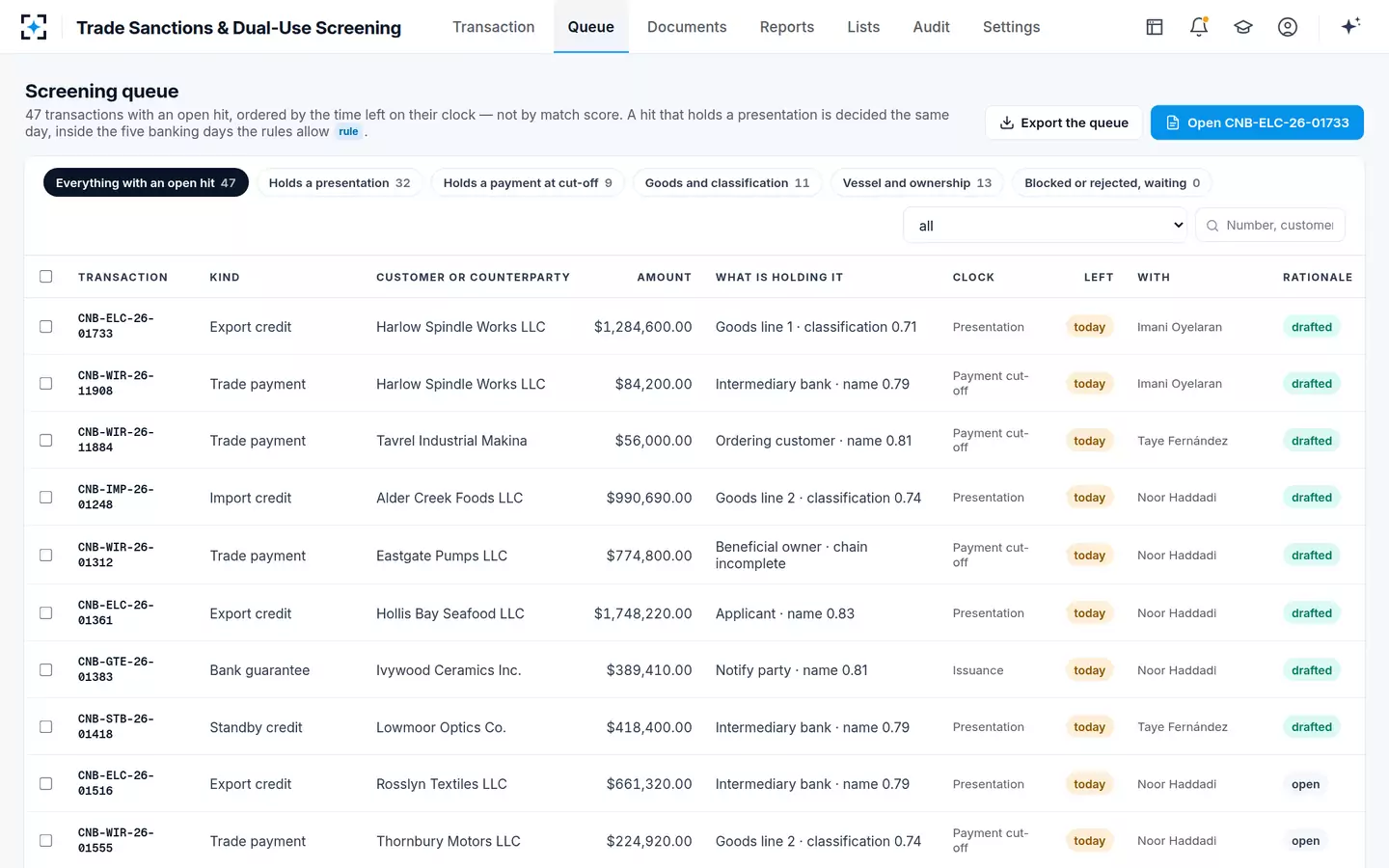
An exporter cannot buy a faster law, but it can choose a bank whose hold is fast, specific and explained. In Botminds' Trade Sanctions & Dual-Use Screening the screening queue is ordered by the clock each hit is on, not by match score, and a hit that holds a presentation is a same-day decision by a set cut-off. On the sample desk the export credit is presented on a Tuesday, the goods line is decided and held on Thursday, the second banking day, and the beneficiary is asked for the ultimate consignee and the end use with three banking days still to run.
Trade Sanctions & Dual-Use Screening orders the queue by the clock, not by match score
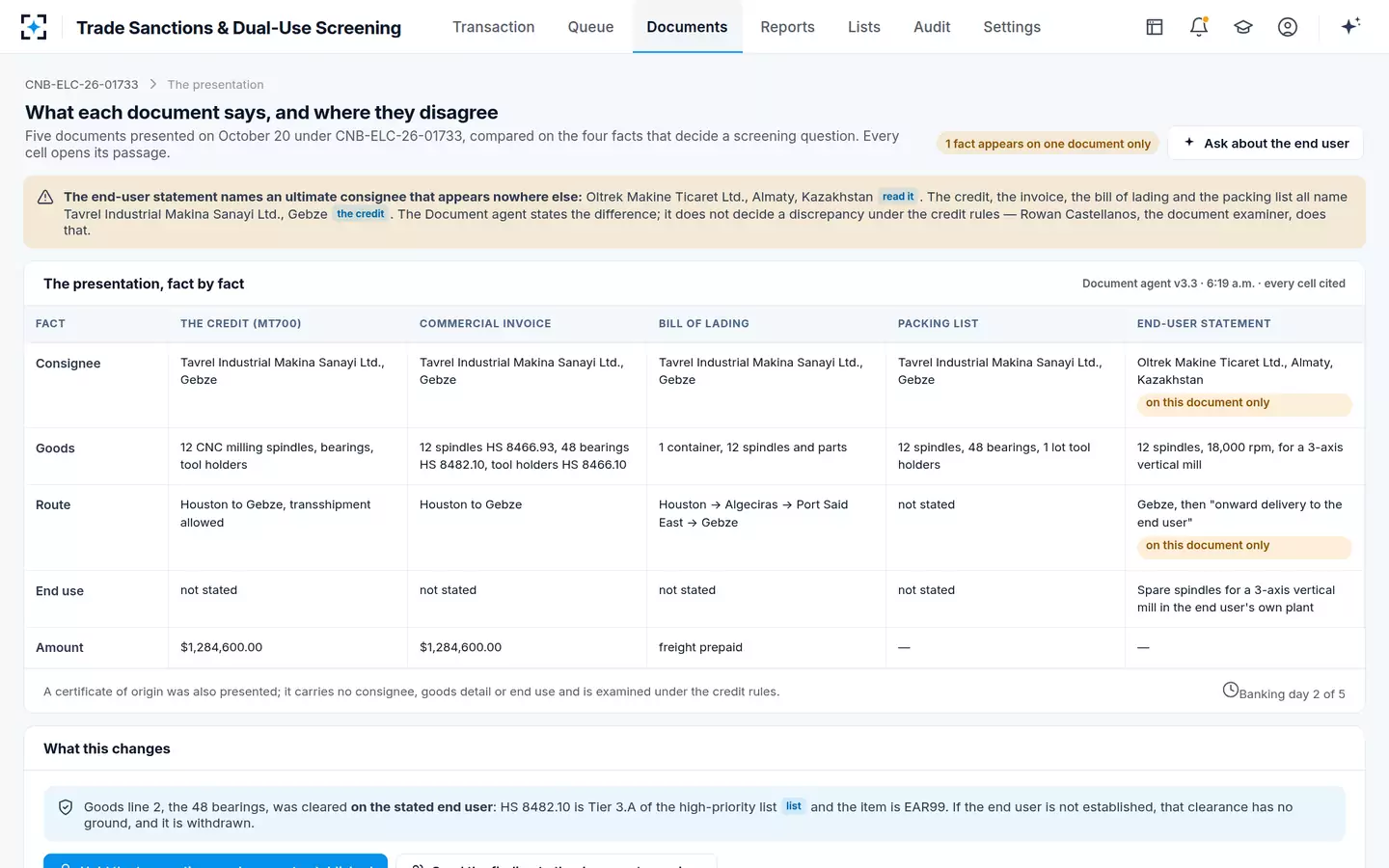
The question goes out with its evidence. The document comparison shows the one name that appears only on the end-user statement, so the request to the beneficiary is specific: who is the ultimate consignee, and what is the end use. That is the difference between a hold the exporter can answer in an afternoon and one it has to guess at.Reading a presentation for export control red flags shows the same mismatch from the analyst's side, and the full solution is on the Trade Sanctions & Dual-Use Screening page.
The question to the exporter, built from the documents
Questions people ask
How quickly should a trade screening hit be decided?
Fast enough to leave the exporter time to answer inside the credit's five banking days. On the sample desk a hit that holds a presentation is a same-day decision, with escalation at half and three quarters of the clock; a hit that holds a payment gets a first touch within four hours and always before the payment cut-off.
How long does a bank have to examine documents?
Under UCP 600, at most five banking days after the day of presentation, for each of the nominated, confirming and issuing banks. Any refusal notice must go by the close of the fifth banking day.
Who pays for a screening delay?
Mostly the exporter, through payment arriving later than planned and the knock-on in its supply chain. If a bank misses the five days without a valid refusal, UCP 600 article 16(f) can leave the bank bound to pay a presentation it meant to refuse.
Is a sanctions or export-control hold a discrepancy?
Not in itself. A discrepancy is a failure of the documents to comply with the credit. A hold is the bank's own compliance step; it may lead to a refusal if the documents conflict, or to non-payment if law forbids paying.
What happens to blocked funds?
Under OFAC rules, blocked funds go into a segregated, interest-bearing account from which only OFAC-authorized debits can be made, and the block is reported within ten business days. That is the rare case: most dual-use questions end with an answer from the exporter, not a block.