A sanctions clause in a letter of credit is a term saying that the issuing or confirming bank will comply with the sanctions laws that apply to it, and will not be liable for delay or non-payment that those laws compel. The ICC's Banking Commission recommends against using them routinely, and against any clause that reaches beyond what the law requires, because a clause that gives a bank discretion to refuse undermines the irrevocable, documentary nature of the credit. When it is used, the ICC offers a narrow sample disclaimer. What actually stops a payment is the law, as the English Court of Appeal showed in Celestial Aviation v UniCredit. Botminds' Trade Sanctions & Dual-Use Screening is built for the part that clauses cannot do: screening every party, bank and goods line in the credit and keeping the evidence for each decision.
Four numbers behind the sanctions clause question
2014
year of ICC’s guidance paper recommending against clauses that go beyond the law
Addendum 2020, consolidated 2022
3
example clauses ICC analyses: one informative, two problematic
ICC guidance, section 3
12
standby letters of credit in Celestial v UniCredit, confirmed by a London branch for Russian aircraft leases
[2024] EWCA Civ 628
$8.57M
OFAC settlement with a French trade finance bank whose violations included back-to-back letters of credit
OFAC, January 4, 2021
What is a sanctions clause in a letter of credit?
It is any term in a credit, or in an instruction to advise or confirm one, that refers to sanctions and the bank's intention to comply with them. The ICC notes that banks add them "concerned about the implications of sanctions for their own obligations" and to notify correspondents and beneficiaries, and that "there is no standard for these clauses and they vary considerably in their scope" (ICC guidance, 2.1–2.2).
The variety is the problem. At one end is a clause that simply informs: the ICC's first example says documents not complying with "applicable anti-boycott, anti-money laundering, anti-terrorism, anti-drug trafficking and economic sanctions laws and regulations" are not acceptable, and that applicable laws "may include United Nations, United States and/or local laws". At the other end are clauses that let the issuer decide, in its discretion, not to pay, or that refer to internal policies "which in some cases go beyond the requirements of applicable laws and regulations".
A credit is meant to be the opposite of discretionary. UCP 600 article 4(a) begins: "A credit by its nature is a separate transaction from the sale or other contract on which it may be based" (UCP 600, ICC Digital Library). A clause that lets the bank look past the documents to its own policy changes what the beneficiary was promised.
Does ICC allow sanctions clauses?
The ICC does not forbid them, because it cannot: they are terms the parties agree. It recommends against them in strong terms. The 2014 guidance paper's first recommendation reads: "It is recommended that banks should refrain from issuing trade finance-related instruments that include sanctions clauses that purport to impose restrictions beyond, or conflict with, the applicable statutory or regulatory requirements" (ICC guidance, 4.1).
The 2020 addendum hardened the position after the ICC "noted a resurgence in the use of sanctions clauses in documentary credits and in demand guarantees, particularly in the form of non-specific clauses that create uncertainty". It states that "the ICC confirms its guidance that sanctions clauses should not be used generally", and that they "ought only to be considered in specific transactions, and only after consulting with the customer and counterparties in the relevant transaction". It also classifies them for the rules: sanctions clauses are "non-documentary conditions for the purpose of the UCP and the URDG".
What wording does ICC suggest?
One restrictive sample, offered reluctantly. The addendum says that if a bank decides, after consulting its customer and the counterparty, that a clause is needed, it "should be drafted in clear terms, restrictively, to limit the reference only to mandatory law applicable to the bank". It then gives the sample clause below, with two warnings that matter as much as the words: "Operators must not consider that the sample clause drafted in this Paper is in any way recommended practice", and the clause "is a sample only and not to be used without seeking advice from legal and compliance advisors".
ICC's sample sanctions clause, part by part
“[notwithstanding anything to the contrary in the applicable ICC Rules or in this undertaking,]”
Optional and bracketed: it states that the clause prevails over the rules, which is what makes it a departure the counterparties must agree to.
“We disclaim liability for delay, non-return of documents, non-payment, or other action or inaction”
A disclaimer of liability, not a right to refuse. It covers the consequences of complying, not a discretion to decide.
“compelled by restrictive measures, counter-measures or sanctions laws or regulations”
“Compelled”: only conduct the law requires is covered. A bank’s own policy is not.
“mandatorily applicable to us”
The test the 2020 addendum turns on: laws that apply to the bank as a matter of law, not a list of regimes the bank prefers to follow.
“or to [our correspondent banks in] the relevant transaction.”
Bracketed: to be used only where a correspondent in another location would be stopped by sanctions that do not bind the issuing bank, such as a U.S. bank clearing dollars.
The guidance around the sample is as useful as the sample. Clauses "should refrain from including unparticularised references to laws generally", and "reference to 'bank policy and procedure' should be avoided at all times". A specific regime may be named only where it "directly and mandatorily" applies, and the ICC lists the usual ways it can: the law of the issuing bank or branch, the law of the currency of payment, the law governing the undertaking, or international public policy as a court or tribunal characterises it.
Why broad clauses damage the credit
Because they move the decision to pay from the documents to the issuer's discretion. The ICC says that if a clause allows the issuer "a level of discretion as to whether or not to honour beyond the statutory or regulatory requirements applicable to that issuer", it brings "into question the irrevocable and documentary nature of the letter of credit or guarantee", and that if a bank's internal policy lets it decide whether to pay, "one could even question if that bank has in fact assumed a legally binding obligation" (ICC guidance, 2.4).
The cost falls on the other banks in the chain. A nominated bank that pays a complying presentation, as Corvane National Bank does when it negotiates an export credit in the fictional sample used in this series, "would face uncertainty as to whether it will be reimbursed", and so prices in the issuer's internal policy as a risk: "This may result in increased costs, delays and potential disputes" (2.5). The ICC singles out clauses that try to alter UCP 600's reimbursement provisions or shift sanctions risk onto nominated banks.
Two kinds of sanctions clause, judged by ICC's guidance
A clause ICC warns against: The bank’s own policies, “which in some cases go beyond” the law
A clause ICC can live with: Sanctions laws mandatorily applicable to the bank or its correspondent
A clause ICC warns against: Decline “in its discretion” to perform
A clause ICC can live with: Nothing new: it disclaims liability for what the law compels
A clause ICC warns against: Lists of countries and programmes, or “any applicable local and foreign laws”
A clause ICC can live with: Named only where they directly and mandatorily apply
A clause ICC warns against: Questions its irrevocable, documentary nature
A clause ICC can live with: Leaves the undertaking intact
A clause ICC warns against: Reimbursement uncertain, so higher costs and disputes
A clause ICC can live with: Risk limited to the law that already applies
A clause ICC warns against: On every credit, as standard wording
A clause ICC can live with: Only in specific transactions, after consulting the customer and counterparties
Can a bank refuse to pay a letter of credit because of sanctions?
Only where the law prevents payment; the clause does not create that right. The ICC is explicit that sanctions sit outside its rules: whether they apply and how is for courts and regulators, and where they do apply they override the rules and the instrument's terms. A clause that merely repeats the law adds nothing; a clause that goes further is the kind the ICC tells banks to avoid.
The Celestial case shows both halves. The Court of Appeal held that UK sanctions did prevent UniCredit from paying, so its obligation was suspended until UK licences came. It also held that U.S. sanctions did not help the bank, because "UniCredit has not established that it made reasonable efforts to obtain a licence from OFAC" ([2024] EWCA Civ 628, para. 131). A bank relying on sanctions to withhold payment must show both that the law applies and that it tried to obtain any licence available.
Where U.S. sanctions require a bank to block or reject, OFAC expects a report within ten business days, and its FAQ, updated on October 26, 2026, lists "letters of credit, bills of lading, invoices" among the supporting documents the report must include (OFAC FAQ 49). Blocking versus rejecting is covered on our sanctions reporting pages.
What did Celestial v UniCredit decide?
That paying a letter of credit can be the provision of funds "in connection with" a sanctioned arrangement, even though the credit is legally independent of it. UniCredit's London branch had confirmed twelve standby letters of credit issued by a Russian bank in connection with aircraft leases to Russian airlines; each was in U.S. dollars, governed by English law and incorporated UCP 600. When the lessors demanded payment in March 2022, UniCredit said sanctions prevented it.
The court read the UK regulation broadly. "The words 'in connection with' do not require any form of legal dependence, for example by reference to principles of causation. Rather, the question is one of factual connection" (para. 55). It accepted that letters of credit are autonomous, but added: "that does not mean that the factual reality of a connection with the leases can be ignored" (para. 61). The credits were issued because of the leases and paid on an asserted lease default; that was connection enough.
Celestial v UniCredit: from demand to Court of Appeal
- Demands to paymentMar–Nov 2022
- High Courtto Mar 2023
- Court of Appealto Jun 2024
The case was about UK sanctions on aircraft, but its reasoning travels. A bank asked to pay under a credit whose underlying trade involves restricted goods cannot rely on the credit's independence to ignore that trade. That is the same question an export-controls review asks of a goods line, and it is why the screening of goods, routes and end users belongs next to the screening of names. General Prohibition 10 asks the U.S. version of it.
Are sanctions clauses enforceable?
That depends on the governing law and the court, not on the ICC rules, and in some places a clause can itself be unlawful. The ICC warns that "some countries have legislation that prohibits, on grounds of discrimination, any reference to 'exclusion' or 'boycott' regulation or language in any transaction unless such exclusion or boycott is required under the laws of those countries", so a bank receiving such a clause may have to reject the instrument (2.3). A clause that names a foreign regime can therefore cost a bank the business it was meant to protect.
Where a clause is enforceable, it still cannot do more than the law allows a bank to do. A disclaimer of liability for compliance is coherent. A reserved discretion not to pay sits badly with the bank's undertaking, and the ICC suggests it may call into question whether a binding obligation was given at all.
What a sanctions clause cannot do for you
It cannot screen. A clause tells the counterparty what the bank will do if sanctions apply; it does nothing to find out whether they do. OFAC's enforcement history in trade finance is about that second question. In January 2021 a French bank settled for $8,572,500; 13 of its 127 apparent violations were "either 'back-to-back' letter of credit transactions or other trade finance transactions involving sanctioned Syrian parties, all of which were processed through a U.S. bank" (OFAC, UBAF). In 2023 Wells Fargo paid $30,000,000 over trade finance software its predecessor provided to a European bank, which used it to process trade finance with sanctioned jurisdictions and persons for years (OFAC, Wells Fargo).
Nor can a clause stop the UCP 600 clock, protect a bank that knew of an export-control violation, or replace the evidence of what was screened and decided. In Botminds' Trade Sanctions & Dual-Use Screening every bank in the chain, every party and every goods line is screened against a named list version, and each decision carries a reason code, a maker and a different checker. What a hold costs the exporter shows why that decision has to be fast as well as right.
Trade Sanctions & Dual-Use Screening screens every bank in the chain, not only the parties
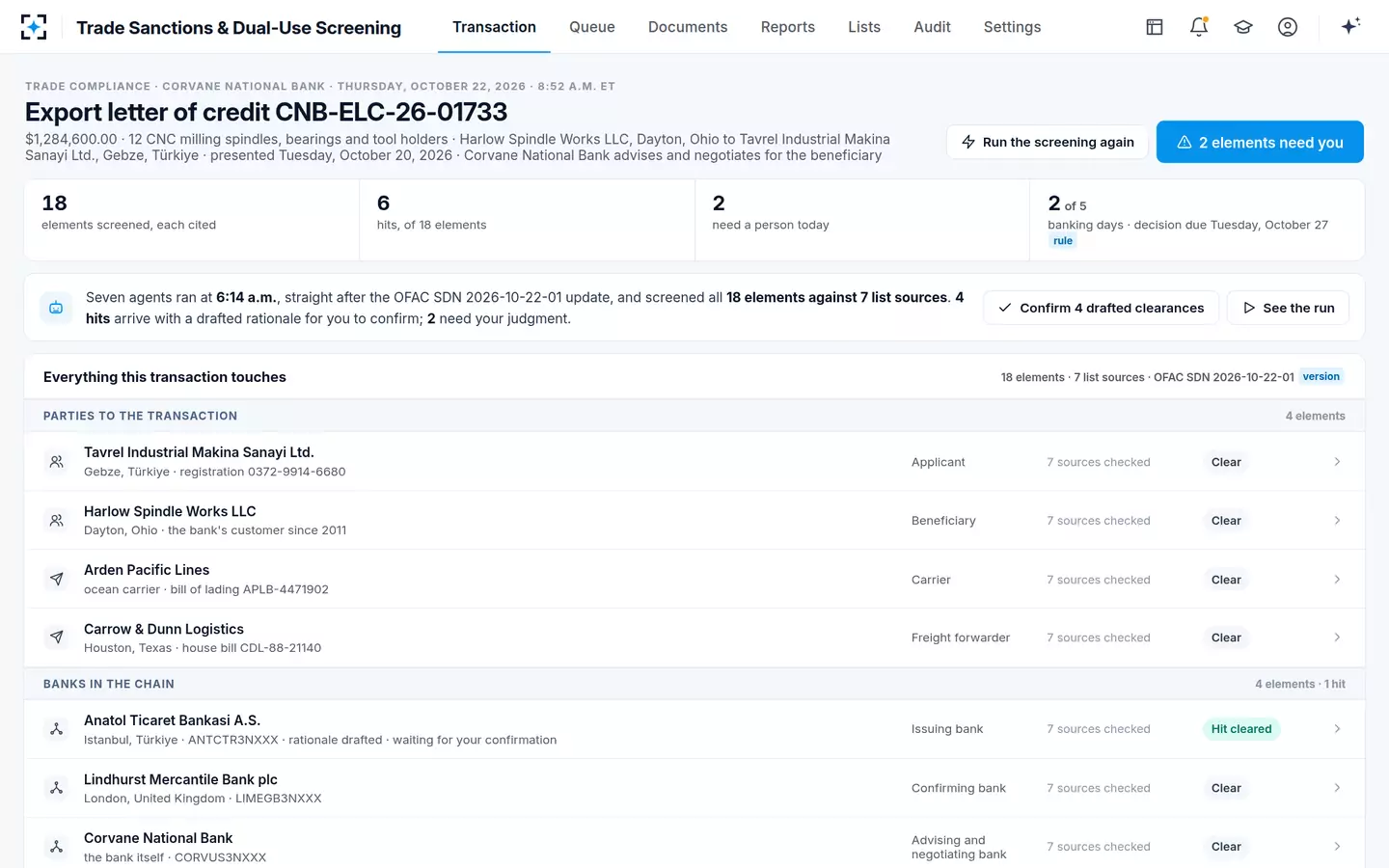
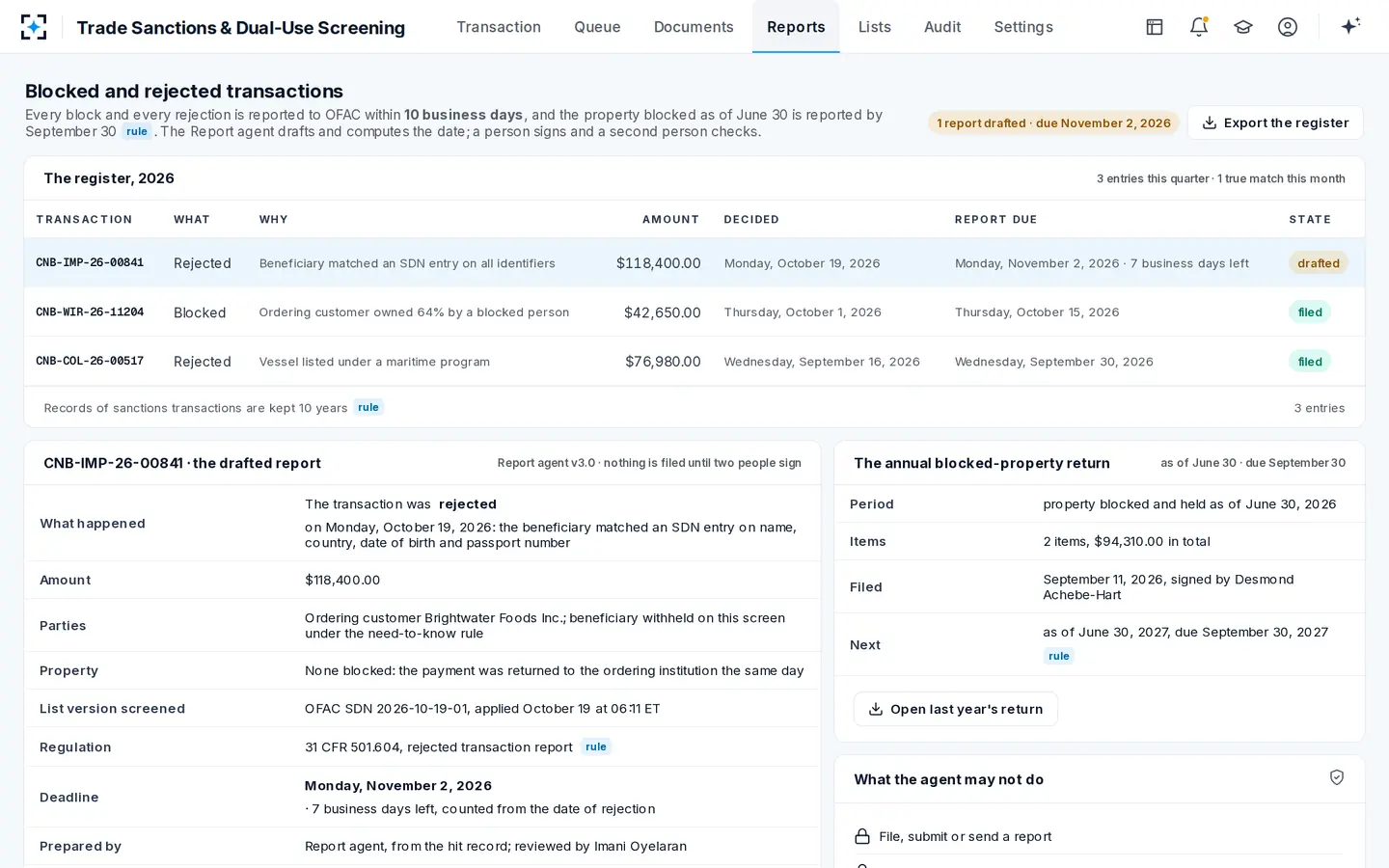
When the law does stop a payment, the evidence has to be ready the same day. On the sample desk an import credit beneficiary matched a listed entry on name, country, date of birth and passport number, the payment was rejected and returned, and the report to OFAC was drafted with its deadline computed from the rule.
When law, not a clause, stops a payment: a rejected credit and its report
A drafting checklist for sanctions clauses
If a clause is needed at all, these are the ICC's conditions, in order. The full solution behind the screening side is on the Trade Sanctions & Dual-Use Screening page.
Before a sanctions clause goes into a credit
- Ask whether it is needed
If the only sanctions involved apply by law anyway, ICC says a clause may be unnecessary and confusing.
- Use it in specific transactions only
Never as standard wording; consult the customer and the counterparties first.
- Refer only to mandatory law
Law that applies to the bank, its branch, the currency or the governing law of the undertaking.
- Never refer to bank policy
“Bank policy and procedure” should be avoided at all times.
- Avoid general references
No “any applicable local and foreign laws”; name a regime only if it directly and mandatorily applies.
- Add correspondents only where needed
Only when a correspondent elsewhere, such as a U.S. bank clearing dollars, is bound by sanctions the issuer is not.
- Check the counterparty’s law
Some jurisdictions prohibit references to foreign boycotts; the clause may force a rejection.
- Do not touch reimbursement
Clauses that alter UCP 600 reimbursement or shift sanctions risk to nominated banks are of particular concern.
- Take legal advice on the wording
The ICC sample is a sample only, and not recommended practice.
Questions people ask
Is a sanctions clause a non-documentary condition?
Yes, according to the ICC's 2020 addendum: sanctions clauses "are non-documentary conditions for the purpose of the UCP and the URDG". That is one reason the ICC treats them as a source of uncertainty in an instrument meant to turn on documents alone.
Should an advising or confirming bank accept a credit with a broad sanctions clause?
The ICC advises practitioners to be aware of the risks of clauses that other banks include. A confirming or nominated bank faces uncertainty about reimbursement if the issuer's clause refers to internal policy, and should price or decline that risk rather than assume it away.
What is a back-to-back letter of credit, and why did it matter to OFAC?
It is a second credit issued on the strength of a first, usually by an intermediary buying and reselling the same goods. In the UBAF case, sanctioned Syrian parties were on the first credits, which did not clear in dollars, while the matching dollar credits were processed through a U.S. bank.
Does a sanctions clause protect a bank against U.S. sanctions?
No. U.S. sanctions apply to U.S. persons and dollar clearing by law, with or without a clause. In Celestial the bank could not rely on U.S. sanctions in court because it had not made reasonable efforts to obtain a licence from OFAC.
What documents go into an OFAC report about a letter of credit?
OFAC's FAQ 49, updated October 26, 2026, says reports must include copies of supporting documents such as payment or transfer instructions, checks, letters of credit, bills of lading and invoices, and must be filed within ten business days of the action.