General Prohibition 10 is the rule in the Export Administration Regulations that forbids anyone, financial institutions included, to finance or otherwise service an item subject to the EAR with knowledge that an export-control violation has occurred, is about to occur or is intended to occur in connection with it. BIS's guidance of October 9, 2024, its first written for financial institutions, says the rule applies to them "regardless of location, country in which they are headquartered or registered, or nationality", and that knowledge includes an awareness of a high probability. That makes what a bank reads in a trade transaction, and what it does about it, the centre of its exposure. Botminds' Trade Sanctions & Dual-Use Screening is built to put that reading, and the decision on it, in the file of every trade transaction.
Nevertheless, an FI may learn of information that constitutes a red flag after it has processed payment for a transaction, which may give rise to “knowledge” for purposes of GP 10 for future transactions involving the same customer or counterparties.
BIS, guidance to financial institutions on the EAR, October 9, 2024
What is General Prohibition 10?
It is the last of the EAR's ten general prohibitions, titled "Proceeding with transactions with knowledge that a violation has occurred or is about to occur", and it is written for everyone who touches a transaction, not only the exporter. The verb list is deliberately long: sell, transfer, export, reexport, finance, order, buy, remove, conceal, store, use, loan, dispose of, transport, forward or "otherwise service". A bank that pays a letter of credit, discounts a draft or processes a payment for an export is doing one of those things. The regulation's operative words are quoted on our sanctions page about the BIS Affiliates rule, stayed until November 9, 2026.
Two features make it hard to manage. There are no license exceptions to it: the text says "There are no license exceptions to this General Prohibition Ten in part 740 of the EAR" (15 CFR 736.2(b)(10)). And it turns on what the bank knew, which a bank proves or disproves only through what it read, asked and wrote down at the time.
The same idea appears in the EAR's list of violations. Section 764.2(e), "Acting with knowledge of a violation", repeats the verbs, finance included, and adds "conduct negotiations to facilitate such activities" (15 CFR 764.2(e)). For U.S. persons there is a further layer: section 744.6 restricts support for certain weapons of mass destruction and military-intelligence end uses, and its examples include "servicing, financing, transporting, freight forwarding" (15 CFR 744.6).
Does General Prohibition 10 apply to banks?
Yes, wherever they are. BIS put it plainly in 2024: "Under GP 10, FIs and other persons (regardless of location, country in which they are headquartered or registered, or nationality) may not finance or otherwise service, in whole or in part, any item subject to the EAR with knowledge that a violation of the EAR has occurred, is about to occur, or is intended to occur in connection with the item" (BIS guidance to financial institutions). It also reminded banks that "items shipped from the United States are generally subject to the EAR, with narrow exceptions", and that BIS's authority reaches transactions "even when no U.S. person or U.S. financial institution is involved".
The guidance is equally clear about the limits. BIS "recognizes that exporters generally have more information than FIs about whether an item may be subject to the EAR", and lets banks rely on their customers' representations "unless such reliance would be unreasonable – for example, when the FI has reason to know that such representations may be false". A bank is not expected to classify goods. It is expected not to look away.
What counts as knowledge under the EAR?
More than certainty. The EAR defines knowledge of a circumstance to include "not only positive knowledge that the circumstance exists or is substantially certain to occur, but also an awareness of a high probability of its existence or future occurrence", and says such awareness "is inferred from evidence of the conscious disregard of facts known to a person and is also inferred from a person's willful avoidance of facts" (15 CFR 772.1).
BIS's Know Your Customer guidance, which sits in the regulations as a supplement, turns that into behaviour. Its third rule is "Do not self-blind". It warns that "an affirmative policy of steps to avoid 'bad' information would not insulate a company from liability, and it would usually be considered an aggravating factor in an enforcement proceeding", and that "knowledge possessed by an employee of a company can be imputed to a firm" (15 CFR Part 732, Supplement No. 3). For a bank, the last sentence is the operational one: what a document examiner noticed on an end-user statement is, in law, what the bank knew.
What a General Prohibition 10 violation can cost, under the Export Control Reform Act
$374,474
maximum civil penalty per violation as adjusted for inflation, or twice the transaction value if greater
15 CFR 6.3; 50 U.S.C. 4819
$1M
maximum criminal fine for a wilful violation
50 U.S.C. 4819(b)
20years
maximum prison term for an individual, for a wilful violation
50 U.S.C. 4819(b)
What BIS's 2024 guidance asks of financial institutions
Three practices, each with a different clock. Due diligence before onboarding and periodically: review customers against BIS's restricted-party lists, the Unverified List, the Entity List, the Military End-User List and the Denied Persons List, and weigh a listing heavily in the customer's risk profile. Ongoing review of transactions for red flags, after processing where necessary, with risk-based procedures to investigate what is found before dealing with the same parties again. Real-time screening only against three narrow list groups for transactions likely tied to U.S. exports, declining to proceed on a match until the export is shown to be authorized or not subject to the EAR.
BIS's three practices for financial institutions, and where each one ends
Agent
Due diligenceCustomers screened against BIS restricted-party lists at onboarding and periodically; customers, and where appropriate their customers, against lists of high-priority shippers.
Agent
Real-time screeningEvery known party to a transaction likely tied to U.S. exports, against the Denied Persons List, named military-intelligence end users and certain Entity List parties.
Agent
Ongoing reviewProcessed and pending transactions read for red flags, including after payment.
A person decides
Resolve or refrainA named person decides: resolve the flag with the customer, decline until authorized, or refrain from further transactions with the parties.
A person decides
ReportA suspicious activity report with the right key term, and a voluntary self-disclosure to BIS where the bank may itself have violated the EAR.
Must banks check customers' customers?
BIS recommends it, "where appropriate", for one specific list: entities that have shipped high-priority items to Russia since 2023, according to public trade data. The guidance calls it "an EAR-related due diligence best practice", notes that such lists can be obtained from commercial providers or free of charge from the Trade Integrity Project, and asks banks to "closely scrutinize" the entities and addresses that appear (BIS, 2024). The high-priority items are the fifty HS codes of the Common High Priority Items List (BIS, CHPL).
Where a customer is on a restricted-party list or a high-priority shipper list and exports items subject to the EAR, BIS recommends asking it to certify that it has export controls in place: screening its own counterparties, heightened due diligence for embargoed or restricted destinations, and enhanced diligence for items on the control list or the high-priority list. For a trade finance bank, the customer's customer is often the applicant or the beneficiary on the other side of the credit, and its name is already in the documents.
The four red flags BIS says may amount to knowledge
BIS warns that "the presence of certain individual red flags may be sufficient to constitute 'knowledge' under the EAR", and names four that demonstrate "a high probability of evasion". If a bank finds one in a post-transaction review and "cannot resolve it to its satisfaction", BIS recommends refraining "from future transactions with the relevant transaction parties".
The four red flags in BIS's 2024 guidance, and what each looks like on a trade desk
| Red flag, in BIS’s words | Where a trade desk sees it |
|---|---|
| A customer refuses to provide details to banks, shippers, or third parties, including details about end-users, intended end-use(s), or company ownership | An unanswered request for the ultimate consignee, the end use or the owners of a party |
| The name of one of the parties to the transaction is a “match” or similar to one of the parties on a restricted-party list | A screening hit on any party or bank in the credit, not cleared on identifiers |
| Transactions involving companies that are physically co-located with a party on the Entity List or the SDN List or involve an address BIS has identified as an address with high diversion risk | A consignee or notify-party address shared with a listed party |
| Transactions involving a last-minute change in payment routing that was previously scheduled from a country of concern but is now routed through a different country or company | An amended credit, a new reimbursing bank or a payment from an unrelated third country |
BIS adds a sharper case. After a bank files a suspicious activity report, BIS "may provide the FI with additional information that would establish knowledge", and then expects the bank to make sure it does not finance or service the items in future, "including, if appropriate, by terminating a customer relationship". From that day, the bank knows. The red flags method for a trade desk sets out how to read a presentation for these signals and the FinCEN–BIS ones.
What is the penalty for a General Prohibition 10 violation?
Under the Export Control Reform Act, a civil penalty of up to $300,000 per violation or twice the value of the transaction, whichever is greater, plus revocation of licences and denial of export privileges; Commerce's inflation adjustment now puts the dollar maximum at $374,474 (50 U.S.C. 4819; 15 CFR 6.3). A wilful violation can bring a criminal fine of up to $1,000,000 and, for an individual, up to 20 years in prison.
Intent changes the forum, not the exposure. FinCEN and BIS pointed out in 2023 that "administrative penalties may also be imposed even in cases where there is no willful intent, which means that administrative cases can be brought in a much wider variety of circumstances than criminal cases" (FIN-2023-NTC2). BIS encourages voluntary self-disclosure from parties who suspect they may have violated the EAR.
What changed for financial institutions between 2022 and 2026
The rule itself did not change; the expectations around it did. Each step below moved goods-level reading closer to the bank's desk.
General Prohibition 10 for financial institutions: four years of guidance
| Date | What was published | What it asked of banks |
|---|---|---|
| June 28, 2022 | FinCEN–BIS joint alert, FIN-2022-Alert003 | Watch trade finance documents and end-use certificates; key term FIN-2022-RUSSIABIS |
| May 19, 2023 | FinCEN–BIS supplemental alert, FIN-2023-Alert004 | Due diligence on nine high-priority HS codes found on trade documents |
| November 6, 2023 | FinCEN–BIS notice, FIN-2023-NTC2 | A global key term, FIN-2023-GLOBALEXPORT, and the letter-of-credit red flag |
| February 23, 2024 | BIS Common High Priority Items List | Fifty HS codes in four tiers, CNC machine tools included |
| October 9, 2024 | BIS guidance to financial institutions | Due diligence, ongoing review and narrow real-time screening under GP10 |
| September 8, 2026 | FinCEN alert on Iranian aviation procurement, FIN-2026-Alert006 | Red flags for aircraft parts and dual-use items routed through transshipment points; issued by FinCEN alone |
One change in the related rules is on a timer. BIS's rule extending Entity List restrictions to companies 50% or more owned by listed parties was stayed in November 2025 until November 9, 2026, together with the Know Your Customer red flag that goes with it; our sanctions ownership pages track what returns on November 10. A bank that applies General Prohibition 10 to ownership chains will need that answer in two weeks.
What a bank should have in place now, and where Trade Sanctions & Dual-Use Screening helps
A written procedure that a regulator can follow from list to decision, and evidence that it was followed on each transaction. The checklist below turns BIS's guidance into controls; the screens show how Botminds' Trade Sanctions & Dual-Use Screening holds the evidence for them.
General Prohibition 10 controls for a trade finance bank
- Restricted-party lists in due diligence
Unverified, Entity, Military End-User and Denied Persons Lists at onboarding and periodically, weighed in the risk rating.
- High-priority shipper lists
Customers and, where appropriate, their customers, with a certification request when one appears.
- Real-time screening where BIS asks
The three list groups, on every party known in the ordinary course, for transactions likely tied to U.S. exports.
- Goods lines read, not just names
HS codes against the high-priority list, and consignee, route and end use compared across documents.
- A post-transaction review
Closed transactions read for BIS’s four red flags, with a rule to refrain from the parties if unresolved.
- Licence confirmation from the customer
A copy of any BIS licence, since BIS does not confirm licences to third parties.
- Reporting
SARs with FIN-2022-RUSSIABIS or FIN-2023-GLOBALEXPORT, and a route to voluntary self-disclosure.
- Evidence on every decision
Who decided, on what evidence, against which list version, with a second person on every hold.
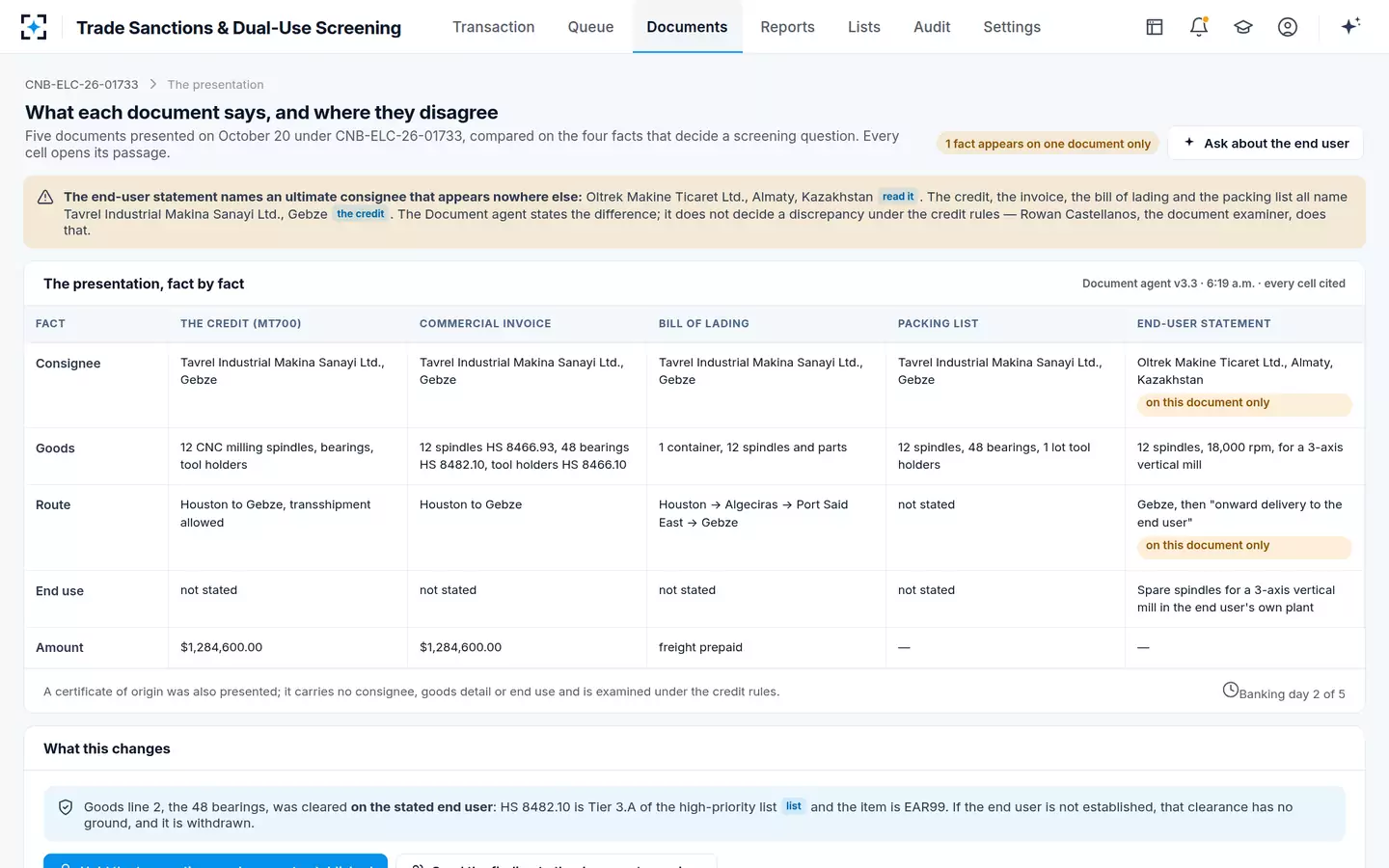
The evidence point is where most banks are weakest and where the knowledge standard bites hardest. If a document examiner noticed a second consignee and the analyst cleared the line anyway, the file needs to show why. In Botminds' Trade Sanctions & Dual-Use Screening, the document agent lays the documents side by side, the analyst decides with a reason code, a different person checks any hold, and every row carries its evidence and the list version screened against. Who reads the goods line in a bank and the Trade Sanctions & Dual-Use Screening page show how that works seat by seat.
Where knowledge shows up: one name on one document, in Trade Sanctions & Dual-Use Screening
Questions people ask
Does General Prohibition 10 apply to non-U.S. banks?
BIS says it applies to financial institutions "regardless of location, country in which they are headquartered or registered, or nationality", whenever the item is subject to the EAR. Items shipped from the United States generally are, and so are certain foreign-made items with U.S. content or made with U.S. technology.
Is General Prohibition 10 strict liability?
No: it requires knowledge. But knowledge includes awareness of a high probability, inferred from conscious disregard or wilful avoidance, and BIS can pursue administrative penalties without proving wilful intent. In practice the bank's evidence of what it read and asked is its defence.
Can a bank rely on its customer's word that a licence exists?
Generally yes, unless reliance would be unreasonable, for example when the bank has reason to know the statement may be false. BIS does not confirm licences to third parties, so it recommends asking the customer for a copy of the licence.
Which SAR key term applies to export-control evasion?
FIN-2022-RUSSIABIS for suspected Russia-related evasion, and FIN-2023-GLOBALEXPORT for evasion elsewhere; FinCEN suggests using both when unsure. The November 2023 notice also asks filers to check box 38(z) and note "Export Evasion".
Did BIS change General Prohibition 10 in 2026?
No. The text in the eCFR, current to October 23, 2026, is unchanged, and none of BIS's 2026 rules in the Federal Register amends it. The related ownership rule for the Entity List remains stayed until November 9, 2026.