Dual-use goods screening in a bank is the check of every goods line in a trade transaction (its description, its HS code, its route and its stated end user) for signs that the goods are export-controlled or headed somewhere they should not go. It is hard because a bank sees documents, not products, and the industry's own trade finance standard says banks are generally not in a position to determine whether an export licence is required. Since 2022 the job has landed anyway, on an analyst, a specialist and a document examiner who were never designed as one team. Botminds' Trade Sanctions & Dual-Use Screening exists to give that work one seat: agents read and flag each goods line with its evidence, and a named person decides.
The examples below come from a fictional bank, Corvane National Bank, and one export letter of credit it advises and negotiates: twelve CNC milling spindles, forty-eight bearings and a lot of tool holders, shipped from Houston to a buyer in Gebze, Türkiye. The rules and figures around it come from regulators and the Wolfsberg Group, linked where they appear.
Why the goods line became a bank's question
50HS codes
on the Common High Priority Items List, agreed by the US, the EU, Japan and the UK
BIS, February 23, 2024
333
suspicious activity reports that cited the FinCEN–BIS export-control alerts in their first year
June 2022 to July 2023
96%
of those reports were filed by U.S. depository institutions, not by exporters
FinCEN Financial Trend Analysis
What is dual-use goods screening in a bank?
It is the part of trade screening that looks at the goods rather than the names. A name screen asks whether a party, a bank or a vessel matches a sanctions or restricted-party list. Dual-use screening asks what is being financed: whether the goods described on the invoice could have a military or proliferation use, whether their HS code sits on a list regulators have published, and whether the route and the end user make sense for that product.
The definitions are short. FinCEN and BIS describe dual-use items as "commodities, software, or technology that have both commercial and military or proliferation applications" (FIN-2023-NTC2), and the EU's Regulation 2021/821 uses nearly the same words (Regulation (EU) 2021/821, article 2). What makes screening hard is that the same spindle, bearing or oscilloscope is sold to car plants and to arms factories, and nothing on a commercial invoice says which.
For a bank the question is narrower than an exporter's. The exporter must classify the item and decide whether a licence is needed. The bank must avoid financing or servicing a transaction it knows, or has strong reason to believe, breaks those rules. General Prohibition 10 and BIS's 2024 guidance to financial institutions set out exactly where that line sits.
Why the goods line became a bank's problem in 2022
Before 2022, export controls were mostly an exporter's compliance question; banks screened names. The Bureau of Industry and Security says so directly: "While EAR compliance has traditionally been of greatest concern to exporters, FIs' responsibilities under the EAR have increased significantly following Russia's further invasion of Ukraine in 2022" (BIS guidance to financial institutions, October 9, 2024).
Three things moved the goods onto the bank's desk. FinCEN and BIS issued joint alerts in June 2022 and May 2023, and a notice in November 2023, telling banks which red flags to watch in trade finance. The May 2023 alert named nine HS codes and pointed out that banks would find them printed on the invoices, packing lists and transport documents they already handle. In February 2024 the list grew to the fifty codes of the Common High Priority Items List, in four tiers, including five codes for CNC machine tools and their parts (BIS, CHPL).
The June 2022 alert also explained why banks in particular were asked to look: those "directly involved in providing trade finance for exporters" may see "their customers' end-use certificates, export documents, or other more extensive documentation associated with letters of credit-based trade financing" (FIN-2022-Alert003). A letter of credit puts the goods description, the HS code, the consignee and sometimes an end-user statement in front of the bank. Once a regulator has said that, a bank that never reads them has a hard time explaining why.
Who in a bank checks export controls?
No single person, and that is the problem this page is about. In most trade operations the check is shared between three seats that report to different managers: the sanctions analyst who clears screening hits, the document examiner who checks the presentation against the credit, and an export controls specialist, if the bank has one, who is asked when a goods line looks technical.
The Wolfsberg Group, the ICC and BAFT, in their joint Trade Finance Principles, expect front and middle office staff to be trained on "the common types of goods which have a dual use" and to "attempt to identify dual use goods in transactions wherever possible" (Trade Finance Principles, 2019, Core 5.5). The same paragraph says that while banks "may be in a position to identify obvious dual use goods", corporates, customs and export licensing agencies "are better able to make this determination". So the bank's job is to notice and escalate, not to classify, and someone has to own the noticing.
Five seats carry one goods line, and only one of them is called 'export controls'
Today
Opens each hit in its own system, compares identifiers by eye and closes it with a free-text note that says nothing about which list version was used.
With agents
Opens one transaction with every element on it, sees which goods lines are flagged and why, and spends the morning on the two that need judgment.
Still theirs: Clearing, holding or escalating each hit, with a reason code
Today
Is asked about a goods line by email, with the invoice pasted into the thread and nothing kept of what was considered.
With agents
Is asked with the invoice line, the datasheet passage and the proposed entry attached; the advice lands on the goods line with a name and a time.
Still theirs: The technical reading of the goods, and the classification library
Today
Reads five documents in sequence and carries in his head what each said about the consignee, the route and the end use.
With agents
Sees the documents compared on those four points, with any name that appears on one document only marked.
Still theirs: Deciding discrepancies under the credit, inside its five banking days
Today
Checks decisions reconstructed afterwards from several systems and an inbox.
With agents
Checks a hold with its memo, its evidence and its maker on one screen, and cannot check work he prepared.
Still theirs: Every hold, block, reject and release as the second signature
Today
Requests evidence from four teams and rebuilds what was screened against what.
With agents
Reads every decision with its evidence and exports a sealed evidence file; has no decide button.
Still theirs: Testing the control, independently
The seat no occupation code describes
The person who reads the goods line has no official job category. A keyword search for "export compliance" in the U.S. Department of Labor's O*NET database returns customs brokers first; compliance managers and compliance officers appear further down the list (O*NET OnLine). There is no occupation for a trade sanctions analyst or a bank-side export controls specialist.
The nearest statistical proxy is the Bureau of Labor Statistics' compliance officer group: 417,070 people across all industries in May 2025, at a mean annual wage of $88,400 and a median of $80,730 (BLS Occupational Employment and Wage Statistics, 13-1041). It is a broad group, which O*NET uses even for customs brokers, and that is the point: the trade desk's goods reader is invisible in the data, and usually in the organization chart too.
That invisibility has a cost. A seat with no name has no written procedure, no training plan and no backup when the one person who understands machine-tool parts is on leave. It is why a goods-line question can sit in an inbox while a presentation's five banking days run.
Can a bank tell whether an export licence is needed?
Generally not, and the industry standard says so. "FIs are generally not in a position to determine, at any stage in a trade transaction, whether an export licence is required, or whether the commercial counterparties to the trade have obtained a valid export licence" (Trade Finance Principles, Control Mechanisms 5.1). The next paragraph gives the reason: trade finance documents rarely carry a detailed description of the product.
BIS accepts the premise and builds on it. It acknowledges that exporters usually know more than banks about whether an item is subject to the EAR, lets banks rely on customers' representations unless that reliance would be unreasonable, and adds a practical point: because BIS will not confirm a licence to a third party, banks should ask the customer, including for a copy of the licence (BIS, 2024).
So the goods reader's real question is not "is a licence needed?" but "is there anything here that a reasonable bank would have to ask about?" That is a question about red flags, consistency and evidence, and it can be answered on the documents.
Interpretation of “dual use” requires a degree of technical knowledge that DC, SBLC, and Guarantee FI staff cannot be expected to possess.
The Wolfsberg Group, ICC and BAFT, Trade Finance Principles (2019), Control Mechanisms 6.2
What the goods-line reader decides in a morning
Take the sample credit as it runs through Botminds' Trade Sanctions & Dual-Use Screening on the morning it is screened. The transaction touches eighteen screenable elements; six are hits; four arrive with a drafted rationale and two need a person. One of the two is a goods line, and a second goods line comes back to the desk later that morning.
The first is twelve CNC milling spindles, HS 8466.93, which sits in Tier 4.B of the high-priority list. The classification agent proposes an entry with a confidence of 0.71, below the bank's 0.80 threshold, and says where its doubt lies: the invoice does not state whether the spindles are specially designed for a machine tool with two or more simultaneously coordinated contouring axes. That is a technical question, so the line goes to the bank's export controls specialist with the invoice line and the datasheet passage attached.
The second, forty-eight ball bearings under HS 8482.10, is on the same list in Tier 3.B. It was among the four hits that arrived with a drafted clearance, resting on the stated end user. Then the document comparison found that the end-user statement names a different ultimate consignee, in Almaty, from every other document, which names the buyer in Gebze. Both Türkiye and Kazakhstan appear on FinCEN and BIS's 2022 list of common transshipment points, and the bearings clearance no longer has a ground to stand on. Reading a presentation for export control red flags walks through that mismatch step by step.
In Trade Sanctions & Dual-Use Screening, the goods line that needs a person opens where it is
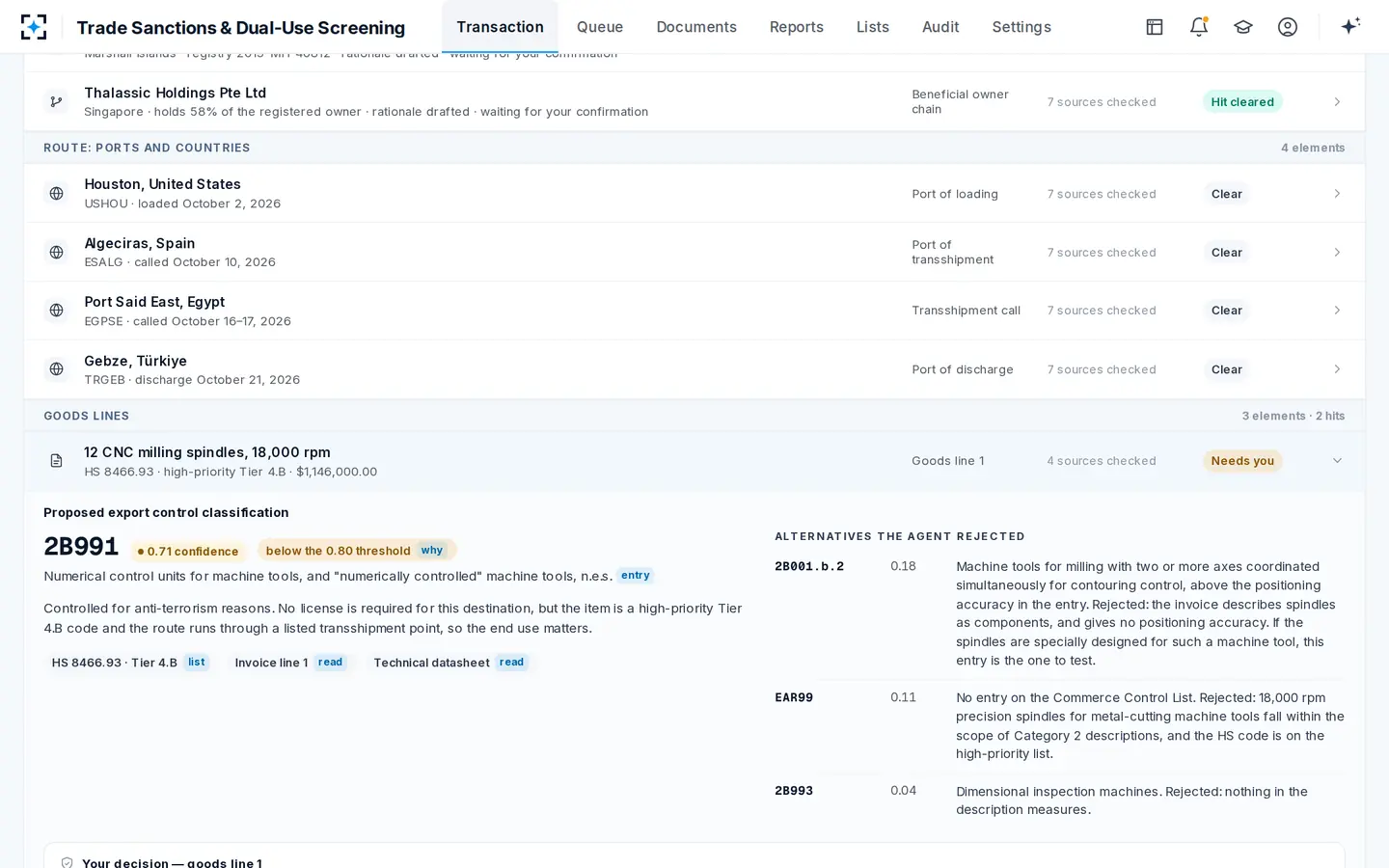
The route lines above are clear; the goods line is the one that holds the transaction.
Most of a goods-line hit is spent finding and reading, not deciding
- Documents1.5 h
- Name hits2.5 h
- Goods lines, by email3 h
- Vessel and owners2 h
- Memo and report1.5 h
- Deciding1.5 h
Five hand-offs where dual-use screening breaks
Dual-use screening rarely fails because someone made a bad call on a clear case. It fails in the hand-offs between seats, where context drops out. Five recur.
The description is too thin to judge. Wolfsberg notes that trade finance documentation "rarely contains a detailed description of the product". An invoice line that says "spindles, 18,000 rpm" tells a reader nothing about the accuracy figures the Commerce Control List turns on. The fix is to ask for the datasheet early, not after the hold.
The HS code is mistaken for a classification. BIS states that an export control classification number has nothing to do with an HS or tariff code (BIS, Classify your item). An HS code on the high-priority list says "look closer"; it does not say "controlled".The difference between an ECCN and an HS code is worth a page of its own.
The specialist's advice lives in email. When the export controls specialist answers in a thread, the transaction file keeps the decision but not the reasoning, and an examiner a year later sees a clearance with no ground.
The documents are read one at a time. A consignee that differs on one document of five is easy to miss when each is read in sequence. FinCEN and BIS flag letters of credit whose documents never name the actual end user for exactly this reason.
The clearance does not say what it was screened against. A free-text "false positive, different entity" note does not show which list version or which identifiers were compared, so the decision cannot be re-tested when the list changes.
Who decides what on a goods line, and what each seat never decides
| Seat | Decides | Never decides |
|---|---|---|
| Trade Sanctions Analyst | Whether a hit is cleared, held or escalated, with a reason code | A technical classification without the specialist when the proposal is below threshold |
| Export Controls Specialist | The technical reading of the goods and the classification advice | Whether a sanctions hit is cleared |
| Document Examiner | Discrepancies under the credit, inside its five banking days | Whether the goods are controlled |
| Sanctions Compliance Officer | Whether a hold, block, reject or release stands, as second signature | Anything he prepared himself |
| The agents | Nothing: they read, compare, propose and draft | Clearing, holding, licensing, filing |
What changes when Trade Sanctions & Dual-Use Screening reads the goods line first
In Botminds' Trade Sanctions & Dual-Use Screening, seven agents do the reading the five seats used to do separately. A manifest agent breaks the credit and its documents into every screenable element, each tied to the document and line it came from. A classification agent proposes an entry for each goods line with a confidence, quotes the control-list text it relied on, flags the HS code against the high-priority list and lists the entries it rejected. A document agent compares what each document says about consignee, goods, route and end use.What a trade compliance AI agent should and should not do covers that classification agent in depth.
The seats do not disappear; their mornings change. The analyst starts from a transaction with the evidence assembled instead of from a list of hits. The specialist answers a question that already contains the invoice line, the datasheet passage and the agent's doubt. The examiner sees the one name that appears on a single document. Each decision carries the person, the reason code and the list version it was screened against, and the second signature is a different person.
Five documents compared on the four points that decide a screening question
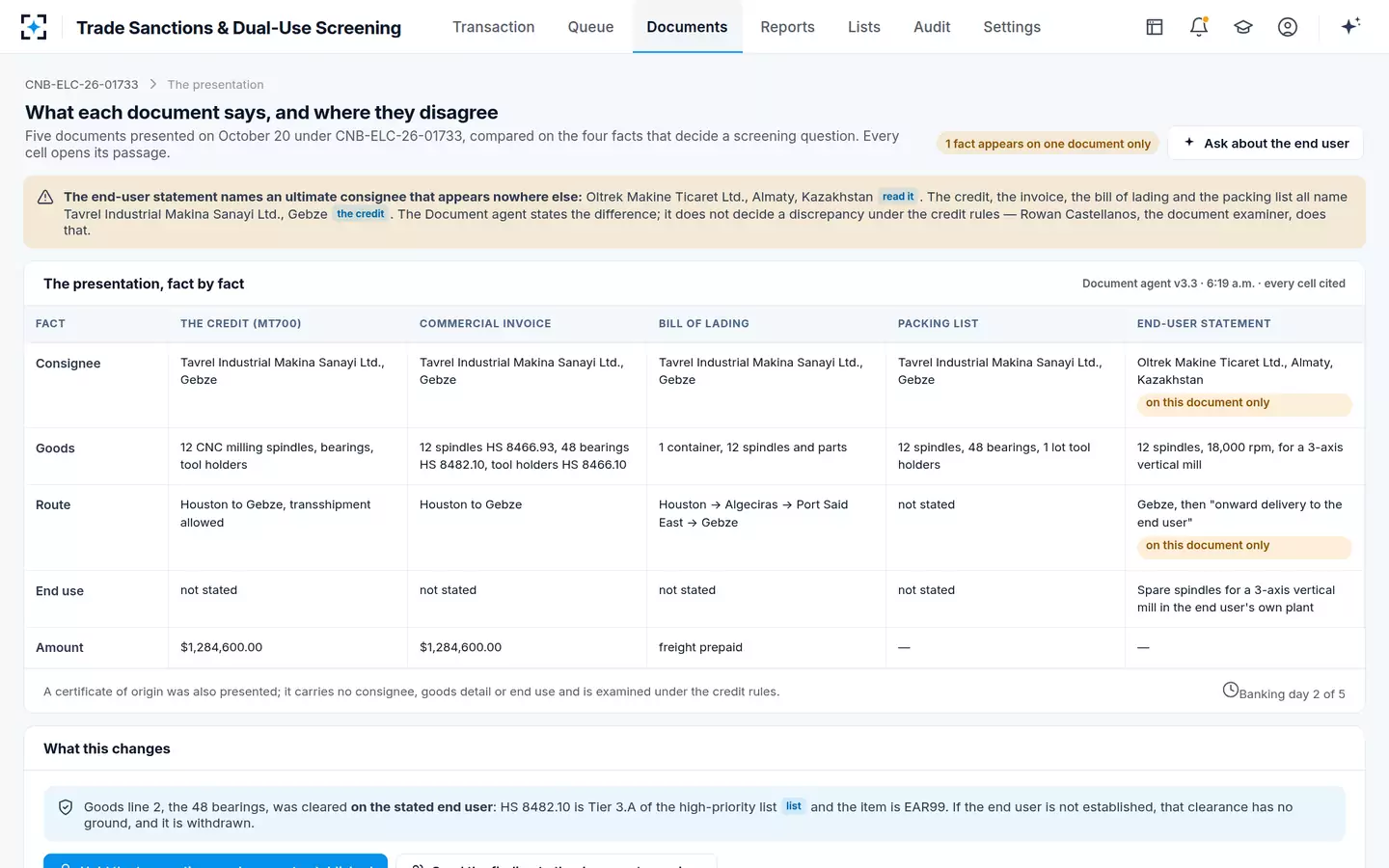
What the agents never do is equally deliberate. No agent clears a hit, decides whether a licence is required, holds a payment or files a report, and any classification proposal below the bank's confidence threshold goes to a named specialist. That matches the Wolfsberg position that it would be impracticable for banks to employ departments of specialists for this, and the tool's job is to make the bank's limited technical judgment go further, not to pretend it has more. The full solution, with every agent and its limits, is on the Trade Sanctions & Dual-Use Screening page.
Questions people ask
Do banks screen for dual-use goods?
Banks that finance or process trade increasingly do, though not by classifying goods themselves. BIS's 2024 guidance recommends that financial institutions review customers against lists of entities that have shipped high-priority items to Russia since 2023, and the FinCEN–BIS alerts ask them to act on goods-related red flags they can see in trade documents.
What is a dual-use good in relation to sanctions?
It is an item with both commercial and military or proliferation uses, which export controls restrict by destination, end user or end use. Sanctions programmes then add restrictions by party and by country. A bank's trade screening meets both: the names against sanctions lists, and the goods against export-control signals.
Is dual-use screening a sanctions job or an AML job?
In practice it sits with trade sanctions teams, while the reporting runs through the AML suspicious activity process. FinCEN asks banks to use the key terms FIN-2022-RUSSIABIS or FIN-2023-GLOBALEXPORT in suspicious activity reports about export-control evasion, so the two functions need the same evidence.
How do you identify dual-use goods in a trade transaction?
Start with the goods description and HS code on the invoice and packing list, check the code against the Common High Priority Items List, then test the route, the consignee and the end user for consistency across documents. Where the description is technical, ask for the datasheet and the exporter's export control classification number rather than guessing.
What changed for banks after 2022?
Three joint FinCEN–BIS documents in 2022 and 2023, the 50-code high-priority list in February 2024 and BIS's first guidance written for financial institutions on October 9, 2024. FinCEN's index lists no joint FinCEN–BIS alert after November 2023.
What does a trade sanctions analyst do?
A trade sanctions analyst clears or escalates screening hits on trade transactions: parties, banks in the chain, vessels, ports and goods. On a goods line the analyst decides whether the evidence supports clearing it, and sends technical questions to an export controls specialist rather than answering them alone.