Export control red flags for banks are the signs, listed by the Bureau of Industry and Security and by FinCEN and BIS together, that a transaction may be financing goods bound for a prohibited end user, end use or destination: a buyer whose business does not fit the product, a freight forwarder named as the final customer, an odd route, a consignee who appears on one document only. One red flag rarely proves anything, but BIS's rule is that once a flag appears there is a duty to inquire, and an unresolved flag can amount to knowledge. The method below turns the published flags into steps a letter of credit desk can follow, and Botminds' Trade Sanctions & Dual-Use Screening runs the reading steps on every presentation so that people spend their time on the inquiry and the decision.
The red flag landscape a trade desk works in
29
numbered red flags in BIS’s Know Your Customer supplement, one stayed until November 9, 2026
15 CFR Part 732, Supplement No. 3
18
common transshipment points FinCEN and BIS named in 2022, from Armenia to Uzbekistan
FIN-2022-Alert003
3
joint FinCEN–BIS alerts and notices, the last on November 6, 2023
FinCEN index, October 27, 2026
333
suspicious activity reports citing the first two alerts in their first year
FinCEN Financial Trend Analysis
What are export control red flags for banks?
They are circumstances that should make a reasonable person suspect that an export breaks the rules, and for a bank they come from two sets of documents. BIS's Know Your Customer guidance, in the regulations as Supplement No. 3 to Part 732, defines red flags as "abnormal circumstances in a transaction that indicate that the export may be destined for an inappropriate end-use, end-user, or destination" (15 CFR 732, Supplement No. 3). The FinCEN–BIS alerts of 2022 and 2023 translate the same idea into what banks see: payments, trade finance documents, customer profiles.
The two sets differ in audience. BIS's list was written for exporters, and most of its numbered flags since number 13 concern specialised fields: "600 series" military parts, advanced-node chips, supercomputers, AI model weights. The first twelve are general and read straight onto a trade desk. The FinCEN–BIS flags were written for financial institutions from the start, and some come from suspicious activity reports banks had already filed.
What does BIS's Know Your Customer guidance require?
A sequence, not a list. Decide whether there are red flags; if there are, inquire; make sure employees know how to handle them; reevaluate after the inquiry; and if concern remains, "Refrain from the transaction or advise BIS and wait". The inquiry step is the heart of it.
However, when “red flags” are raised in information that comes to your firm, you have a duty to check out the suspicious circumstances and inquire about the end-use, end-user, or ultimate country of destination.
BIS, Know Your Customer guidance, 15 CFR 732 Supplement No. 3
The guidance also sets the outcome. "If the 'red flags' cannot be explained or justified and you proceed, you run the risk of having had 'knowledge' that would make your action a violation of the EAR." For a bank, BIS's 2024 guidance applies the same logic to financial institutions directly, naming four flags that may by themselves amount to knowledge if a post-transaction review cannot resolve them (BIS, 2024);General Prohibition 10 for financial institutions sets those out in full.
The FinCEN–BIS alerts, read for a trade desk
Each alert added flags a trade finance bank can see. The June 2022 alert, written after Russia's invasion of Ukraine, named eighteen common transshipment points, warned that illicit buyers often seek low-technology EAR99 items, and flagged "freight-forwarding firms that are also listed as the product's final end customer, especially items going to traditional Russian transshipment hubs", as well as "atypical shipping routes for a product and destination" (FIN-2022-Alert003).
The May 2023 supplemental alert added nine high-priority HS codes and a profile of risky customers: companies incorporated after February 24, 2022 in countries outside the export control coalition, customers who started buying the nine codes only after that date, and parties listed as ultimate consignees that "do not typically engage in business consistent with consuming or otherwise using commodities (e.g., other financial institutions, mail centers, or logistics companies)" (FIN-2023-Alert004). The November 2023 notice extended the approach beyond Russia under the key term FIN-2023-GLOBALEXPORT and added flags such as a purported civil end user whose address "is a military facility or co-located with military facilities in a country of concern" (FIN-2023-NTC2).
FinCEN's index lists no joint FinCEN–BIS alert after that notice. The newest export-related alert is FinCEN's own, of September 8, 2026, on Iranian procurement for commercial aviation. Its flags will look familiar to a trade desk: front companies that "purchase aircraft components and related dual-use items" for onward export, orders placed "from firms in one country for delivery to freight forwarding or logistics firms in a second country", and customers who claim OFAC or BIS authorization "without providing copies" (FIN-2026-Alert006).
What is the letter of credit red flag?
It is the one FinCEN and BIS wrote specifically about documentary credits, in the November 2023 notice, and it is about the end user going missing from the documents.
Purchases under a letter of credit that are consigned to the issuing bank, not to the actual end-user. In addition, supporting documents, such as a commercial invoice, do not list the actual end-user.
FinCEN and BIS, FIN-2023-NTC2, November 6, 2023
Read it carefully, because half of it describes normal practice. A bank in the consignee field is not suspicious in itself: the EAR's own definitions say an intermediate consignee "may be a bank, forwarding agent, or other person who acts as an agent" (15 CFR 772.1). The flag is the combination: goods consigned to the bank and no document anywhere naming who will use them. The same notice says banks financing exports may hold "end-use certificates, export documents, contracts, or other documentation, such as those associated with letters of credit-based trade financing". If those exist, read them; if they are missing where they should be, that absence is the signal.
Ultimate consignee, end user and intermediate consignee: what is the difference?
The ultimate consignee receives the goods abroad; the end user receives and uses them; the intermediate consignee only helps deliver them. Each can be the same party, and the red flags turn on when they are not. The EAR defines all three.
Three parties a red flag review must name, as the EAR defines them
| Party | EAR definition | Where a trade desk finds it |
|---|---|---|
| Ultimate consignee | “The principal party in interest located abroad who receives the exported or reexported items. The ultimate consignee is not a forwarding agent or other intermediary, but may be the end-user.” | The consignee on the bill of lading or air waybill, the buyer on the invoice, the party named in an end-user statement |
| End user | “The person abroad that receives and ultimately uses the exported or reexported items. The end-user is not a forwarding agent or intermediary, but may be the purchaser or ultimate consignee.” | An end-user statement or certificate, a contract, sometimes nowhere: that is the letter-of-credit red flag |
| Intermediate consignee | “The person that acts as an agent for a principal party in interest for the purpose of effecting delivery of items to the ultimate consignee. The intermediate consignee may be a bank, forwarding agent, or other person who acts as an agent for a principal party in interest.” | A bank or forwarder in the consignee or notify field |
The method, step by step
Seven steps take a presentation from documents to a defensible decision. The first three are reading, which is where agents help; the last four are judgment, which is where the bank's people and signatures belong.
A red flag method for a letter of credit desk, and where Trade Sanctions & Dual-Use Screening does the reading
Agent
Read four points from every documentConsignee, goods, route and end use, from the credit, invoice, transport document, packing list and any end-user statement, each tied to its page.
Agent
Compare and placeMark any party that appears on one document only; place the route against published transshipment points and the HS codes against the high-priority list.
Agent
Test against the published flagsThe general Know Your Customer flags and the FinCEN–BIS indicators, each hit cited to its source.
Never: Decides that a flag is resolved
A person decides
InquireOne specific question to the beneficiary or applicant through the right channel: who is the end user, what is the end use, which licence.
A person decides
ReevaluateIs the flag explained or justified by the answer? The analyst decides, with a reason code.
A person decides
Refrain, hold or proceedA hold or refusal needs a second person; proceeding over an unresolved flag is the knowledge risk BIS describes.
A person decides
ReportA suspicious activity report with the right key term where warranted, and the evidence kept.
Red flags a letter of credit desk can see in the documents
- The product does not fit the buyer’s business
BIS Know Your Customer flag 2; FinCEN–BIS 2023 notice.
- A freight forwarder is the final destination or end customer
BIS flag 9; FinCEN–BIS 2022 alert.
- The route is abnormal for the product and destination
BIS flag 10; FinCEN–BIS 2022 alert, “atypical shipping routes”.
- Goods consigned to the bank and no document names the end user
FinCEN–BIS 2023 notice, the letter-of-credit flag.
- The ultimate consignee is a bank, mail centre or logistics firm
FinCEN–BIS 2023 alert.
- The customer will not give end-use, end-user or ownership details
BIS flag 1; FinCEN–BIS 2023 alert; one of BIS’s four 2024 flags.
- Delivery dates are vague, or delivery is to out-of-the-way places
BIS flag 8.
- The buyer is unclear whether the goods are for domestic use or re-export
BIS flag 12; an end-user statement that mentions “onward delivery” is one form of it.
- The customer pays far above market price
FinCEN–BIS 2023 alert and notice.
- A party was incorporated after February 24, 2022 in a non-coalition country
FinCEN–BIS 2023 alert, for the nine high-priority codes.
What the SAR must say
The key term, the right box and the trade documents. FinCEN asks for FIN-2022-RUSSIABIS for Russia-related export control evasion and FIN-2023-GLOBALEXPORT for evasion elsewhere, in field 2 and the narrative, and suggests both when unsure. The 2023 notice also asks filers to check box 38(z) and note "Export Evasion", and to include "all available transportation and trade financing documentation" (FIN-2023-NTC2). For a letter of credit, that means the credit, the presentation and the evidence of what the desk compared and asked.
The reports are read. FinCEN found that the reports filed in the first year of the alerts "detailed almost one billion dollars in suspicious activity", and said that "when financial activity is combined with BIS enforcement data, it has directly enabled export enforcement actions" (FinCEN Financial Trend Analysis). Besides a report, the 2023 notice points to BIS's own enforcement tip channels for suspected evasion.
One presentation, read for red flags in Trade Sanctions & Dual-Use Screening
Take the fictional sample credit used across this series: twelve CNC milling spindles, forty-eight bearings and tool holders, shipped from Houston to a buyer in Gebze, Türkiye, under an export credit Corvane National Bank advises and negotiates. The goods fit the buyer, an industrial machinery company. The bill of lading routes them via Algeciras and Port Said East. Every document but one names the Gebze buyer as consignee.
The exception is the end-user statement. It names a different company, in Almaty, Kazakhstan, as ultimate consignee, and says onward delivery from Gebze is arranged by the buyer. That name appears on no other document and nowhere on the credit. Three published flags meet in that one page: an end user the other documents do not name, a buyer who has in effect said the goods are for re-export, and two countries, Türkiye and Kazakhstan, on FinCEN and BIS's 2022 list of transshipment points.
Trade Sanctions & Dual-Use Screening lays five documents side by side
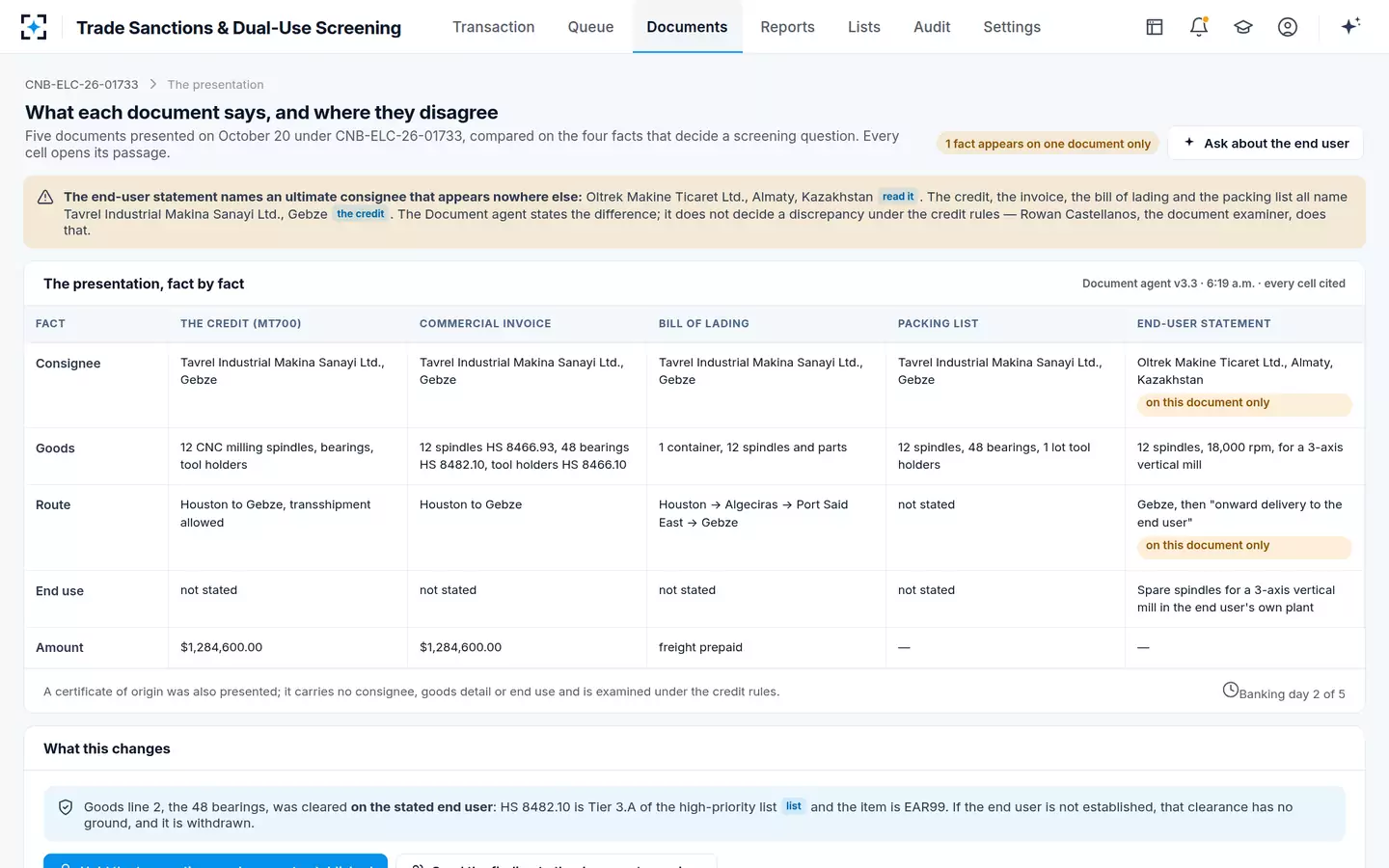
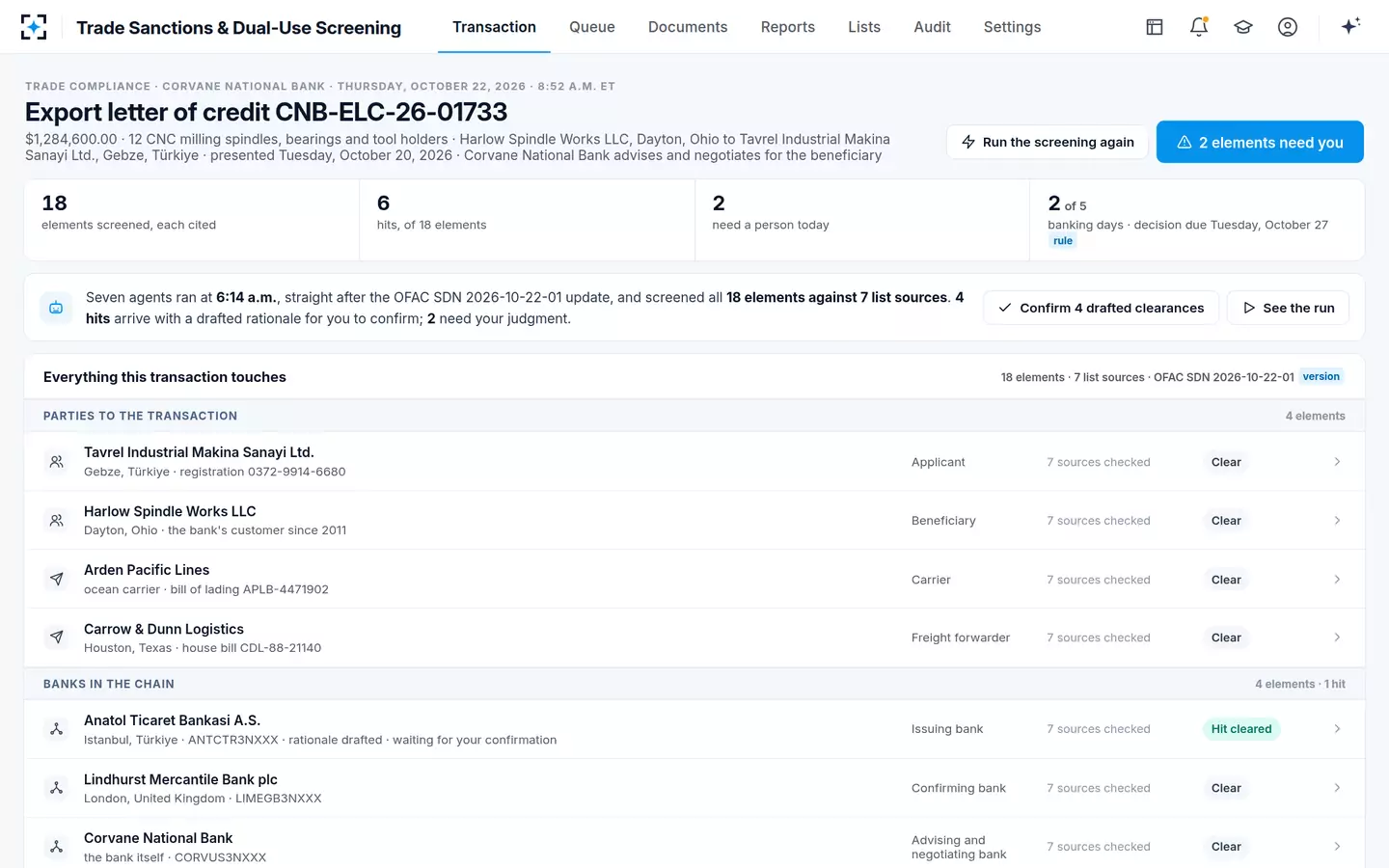
The method then hands over to people. The analyst holds the presentation with the reason "end user not established", and cannot approve her own hold: a sanctions compliance officer checks it. Nothing is blocked and nothing is rejected. The beneficiary is asked, through the document examiner, for the ultimate consignee and the end use, on the second of five banking days. The bearings line, cleared earlier on the stated end user, has its clearance withdrawn because its ground has gone. What that hold costs the exporter depends on how fast the answer comes, and the Trade Sanctions & Dual-Use Screening page shows the whole transaction.
The same transaction, on one manifest with every element cited
Questions people ask
How many SARs cited the FinCEN–BIS export control alerts?
FinCEN identified 333 reports that mentioned the two Russia-related joint alerts, filed between June 28, 2022 and July 12, 2023 and covering almost one billion dollars of suspicious activity. U.S. depository institutions filed 96% of them.
What key term goes in the SAR?
FIN-2022-RUSSIABIS for suspected Russia-related export control evasion and FIN-2023-GLOBALEXPORT for evasion involving other parts of the world, in field 2 and the narrative. FinCEN suggests using both if it is unclear whether Russia is involved.
Is a freight forwarder as consignee a red flag?
As an intermediate consignee, no: the EAR expects forwarders, and banks, in that role. As the final destination or the end customer, yes. BIS's Know Your Customer guidance lists it, and the 2022 alert flags it especially for goods going to known transshipment hubs.
Does one red flag mean the bank must refuse the transaction?
No. It means the bank must inquire and reevaluate. If the flag is explained, the bank may proceed; if not, BIS's guidance is to refrain or seek BIS's view, and its 2024 guidance names four flags that may amount to knowledge on their own if left unresolved.
Have FinCEN and BIS issued new joint alerts since 2023?
Not as of October 27, 2026: FinCEN's index shows three joint documents, the last dated November 6, 2023. FinCEN has since issued export-related alerts of its own, including one on September 8, 2026 on Iranian aviation procurement.