A trade compliance AI agent is software that takes one defined piece of trade compliance work and does it end to end on the documents: for a goods line, it reads the description and HS code, proposes an export control classification with a stated confidence, checks the code against published high-priority lists and hands anything doubtful to a named specialist. The good ones show their reasoning and stop at a proposal, because the decision on export controls belongs to the exporter and, in a bank, to a person. Botminds' Trade Sanctions & Dual-Use Screening runs seven such agents on every trade transaction a bank advises, pays or issues; this page opens the one that reads the goods.
The screens come from a fictional bank, Corvane National Bank, screening an export credit for twelve CNC milling spindles bound for Türkiye. The rules come from the Bureau of Industry and Security, the Commerce Control List and the Wolfsberg Group's trade finance principles, each linked where it is used.
Classification is a technical act, and BIS says who does it
3
ways BIS lists to find an export control classification: ask the maker, self-classify, or ask BIS
BIS, Classify your item
14days
for BIS to answer a formal classification request, in calendar days
15 CFR 750.2(a)
5characters
in an export control classification number, unrelated to the HS code on the invoice
BIS
What is a trade compliance AI agent?
It is a narrow worker with a written job, not a general assistant. The distinction matters when buying. A chat assistant answers whatever it is asked and leaves no trail; an agent in a compliance process takes a defined input, produces a defined output, cites where each part came from and is forbidden, by design, from certain actions. In trade compliance the useful jobs are reading-heavy: splitting a presentation into parties, banks, vessels, ports and goods lines; comparing what five documents say about the consignee; proposing a classification for a goods description; drafting the rationale for a cleared hit.
The goods-line job is the hardest of these, and the one where an agent can do the most damage if it is allowed to sound certain. An export control classification number has five characters, a category from 0 to 9, a product group from A to E and a three-digit entry, and BIS points out that it bears no relation to a Schedule B or tariff code (BIS, Classify your item). The invoice gives the agent a tariff code. Everything else it has to read. Why an HS code cannot settle the question is a page of its own.
What the goods-line agent reads, and what it writes
It reads the invoice line, the packing list, any technical datasheet in the presentation and the HS code, and it writes a proposal, never a verdict. In Botminds' Trade Sanctions & Dual-Use Screening the classification agent produces five things for every goods line: a proposed entry, a confidence, the quoted control-list text it relied on, the HS code's position on the Common High Priority Items List, and the entries it considered and rejected, each with a reason. Below the bank's confidence threshold, 0.80 on the sample desk, it must hand the line to a named export controls specialist.
One goods line through the agent, and where people take over
Agent
Read the lineTakes the invoice description, quantity, value and HS code, and any datasheet passage, each tied to its page.
Never: Infers specifications the documents do not state
Agent
Check the listsPlaces the HS code on the high-priority list and its tier, and the destination against published transshipment points.
Never: Treats a listed HS code as a classification
Agent
Propose and doubtProposes an entry with a confidence, quotes the control-list text, names the missing detail and lists the rejected entries.
Never: Acts below the confidence threshold
A person decides
Export Controls SpecialistReads the datasheet against the control-list parameters and gives advice, with a name and a time.
A person decides
Trade Sanctions AnalystDecides the line with a reason code; the agent’s original output stays beside the decision.
Why the agent stops at a proposal
It stops because the law puts the classification and the licence with the exporter, and because the documents a bank sees are rarely enough to finish the job. BIS accepts that exporters usually know more than banks about whether an item is subject to the EAR, and asks banks to get licence confirmation from their customers, since BIS itself "does not confirm the existence of a license to third parties" (BIS guidance to financial institutions, 2024). The Wolfsberg principles add that trade finance documents rarely describe the product in detail (Trade Finance Principles, Control Mechanisms 5.2).
The sample spindle line shows why. The agent's proposal is held at 0.71, and the doubt it names is real. On the Commerce Control List, entry 2B991 covers numerical control units and numerically controlled machine tools, while spindle assemblies are described elsewhere: under 2B998.a, for spindle and bearing assemblies specially designed for 2B991 machine tools with run-out or camming better than 0.0006 mm total indicator reading, and under 2B008.d for tilting spindles designed for contouring control (15 CFR Part 774, Supplement No. 1). A cartridge that meets none of those parameters may be EAR99. Which applies turns on figures the invoice does not give.
An agent that resolved that line on its own, at whatever confidence, would be guessing at the very facts the control list turns on. An agent that says "these are the three or four entries in play, this is the parameter that decides between them, and this is the document that should state it" has done the useful part and left the decision where it belongs.
A Trade Sanctions & Dual-Use Screening proposal that shows its own doubt
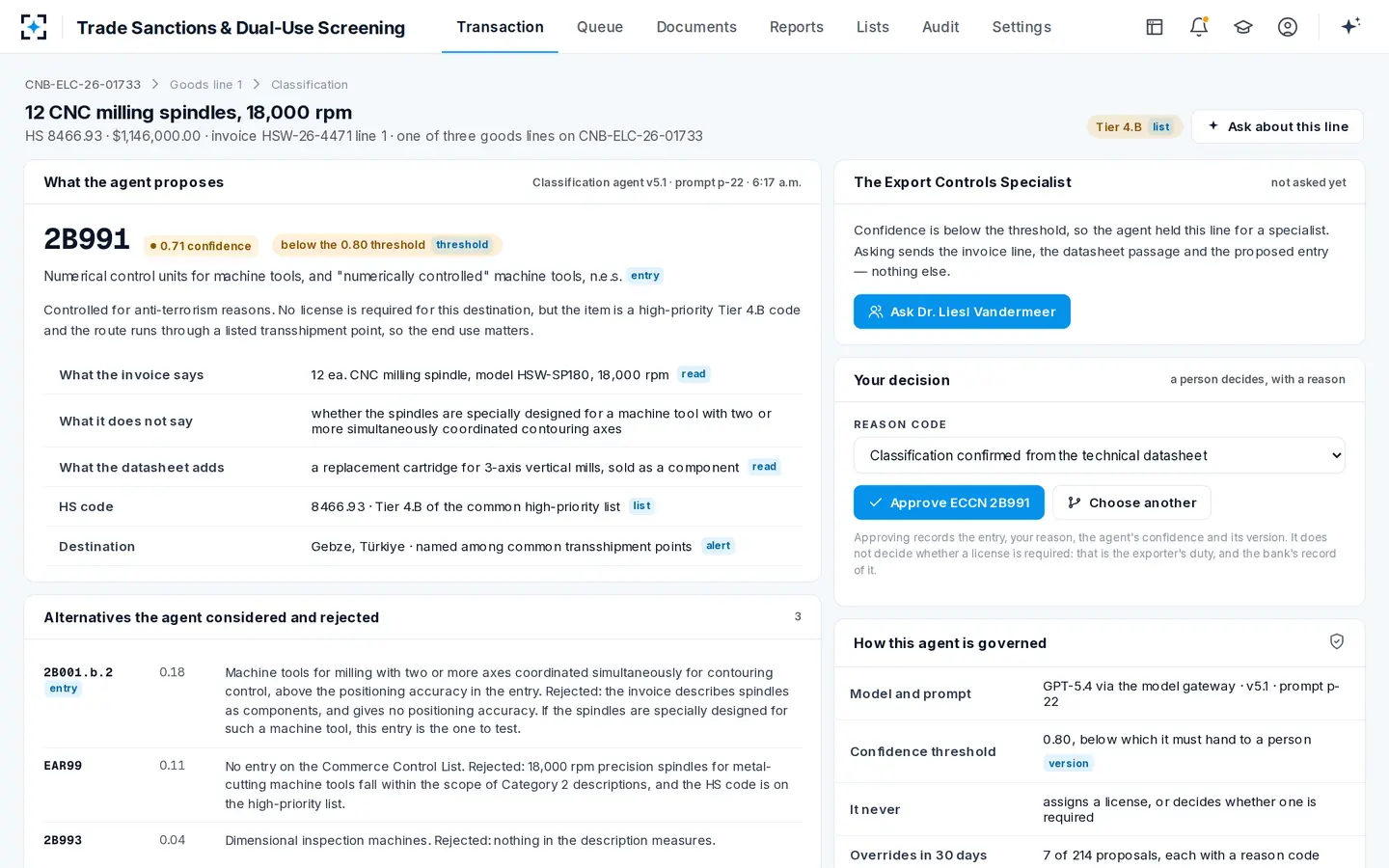
What the invoice does not say is printed as plainly as what it does.
Can AI identify dual-use goods?
It can spot candidates and assemble the evidence; it cannot determine the answer from trade documents alone. We found no regulator or peer-reviewed benchmark for AI accuracy on export control classification in banks, so any accuracy figure a vendor quotes is its own. Testing ECCN classification software on lines you planted is the way to get a number that means something on your goods.
The industry asked for this kind of help years ago. In 2019 the Wolfsberg Group, ICC and BAFT recommended that governments describe dual-use products "in a manner that can be understood by non-experts" and that "these details should ideally be capable of being integrated into electronic processing systems" (Trade Finance Principles, Core 6.b). The Common High Priority Items List, written in six-digit HS codes that also print on invoices, is one answer to it: a product list a system can apply (BIS, CHPL). An agent can apply it to every line, every time; a person cannot.
What an agent can identify reliably is inconsistency: a goods description that does not match the buyer's business, a consignee that differs between documents, a route through a known transshipment point, a technical product sold as a component with no datasheet. Those are the red flags BIS and FinCEN ask banks to act on, and they need reading, not engineering.
The line between agent and desk in Trade Sanctions & Dual-Use Screening
What the agent does: Every goods description, HS code, quantity and datasheet passage, each tied to its page.
What stays with people: Asking the beneficiary for the datasheet or the end use when the documents are silent.
What the agent does: A proposed entry, a confidence, the quoted control-list text and the rejected alternatives.
What stays with people: The technical reading of the parameters, by the export controls specialist.
What the agent does: The HS code against the high-priority list and its tier; the route against published transshipment points.
What stays with people: What a listed code means for this customer and this destination.
What the agent does: Nothing. Below the threshold it must hand the line to a named specialist.
What stays with people: Clear, hold or escalate, with a reason code and a second signature on any hold.
What the agent does: Never assigns one or decides whether one is required.
What stays with people: Confirmation from the exporter, including a copy of any BIS licence.
Where a trade compliance AI agent fits, and where it does not
It fits where documents exist and someone must read them under a clock: letters of credit, documentary collections and guarantees, where the presentation carries invoices, packing lists and transport documents. It fits less well where the bank sees only a payment. Wolfsberg notes that payments for open account trade, about 80% of international trade by its estimate, "can only be screened by reference to the disclosed name data" (Trade Finance Principles, Control Mechanisms 6.1(a)). No agent can read an invoice the bank was never sent.
Where the goods-line agent earns its place, and where it should not be sold
| Work | Fit | Why |
|---|---|---|
| Goods lines on letters of credit and collections | Strong | The documents are in the presentation, and the five banking days reward reading them once, properly |
| Consistency across five documents | Strong | Comparing consignee, route and end use is reading, not engineering |
| High-priority list and transshipment checks | Strong | Published lists, applied to every line rather than a sample |
| Final export control classification | Proposal only | The parameters that decide it are often not in the bank’s documents |
| Whether a licence is required | No | The exporter’s duty; BIS does not confirm licences to third parties |
| Customs tariff classification for duty | No | A different question for a different authority |
| Open account payments with no documents | Weak | Only names and payment details are visible |
| Replacing the sanctions screening engine | No | The agents send elements to the bank’s engine and work its hits |
What to ask before you buy a trade compliance AI agent
Ask what it refuses to do before you ask what it does. The questions below are the ones that separate an agent you can defend to an examiner from one you will have to explain. Ask for each to be shown on a transaction of yours, not on the vendor's sample.
Eight questions for any trade compliance AI agent
- What does it never do?
Clearing a hit, assigning a licence, filing a report. The limits should be in the job, not in a setting someone can change.
- Does it show its doubt?
A confidence, the missing detail, and the entries it rejected. A single answer with no alternatives cannot be checked.
- Does every output cite its page?
Each extracted value tied to the document and line it came from, so a specialist can check it in seconds.
- What happens below the threshold?
A named person, not a queue. Who sets the threshold, and who approves a change?
- Which list version did it use?
Screening and list checks against a named version, so the decision can be re-tested when the list changes.
- Is the original output kept after an override?
The agent’s proposal, its confidence and the person’s reason, side by side, for audit and for tuning.
- Which model and prompt version produced it?
Version-controlled, with an approver for every change, so an examiner can see what ran on the day.
- How was it tested on goods like ours?
A seeded test on lines with known answers, run by your specialist, not a vendor accuracy figure.
How a bank governs an agent no guidance yet covers
By treating it as a controlled process with versions, approvals and outcome testing, because the model risk guidance itself steps aside. The Federal Reserve, the OCC and the FDIC replaced SR 11-7 with revised model risk guidance on April 17, 2026, and placed generative and agentic AI models outside its scope, while asking banks to apply their own risk management and governance to tools the guidance does not cover (SR 26-2).
In practice that means the controls a bank already uses for any decision-support tool, applied to each agent. In Botminds' Trade Sanctions & Dual-Use Screening every agent runs a named model and prompt version; a change is a new version with an approver, and the old one stays readable. The classification threshold is a setting the systems administrator proposes and the Sanctions Compliance Officer approves. Every override keeps the agent's original output beside the person's reason: on the sample desk, 7 of 214 classification proposals were overridden in thirty days, each with a reason code.
Every element of one transaction on one manifest, with the list version screened against
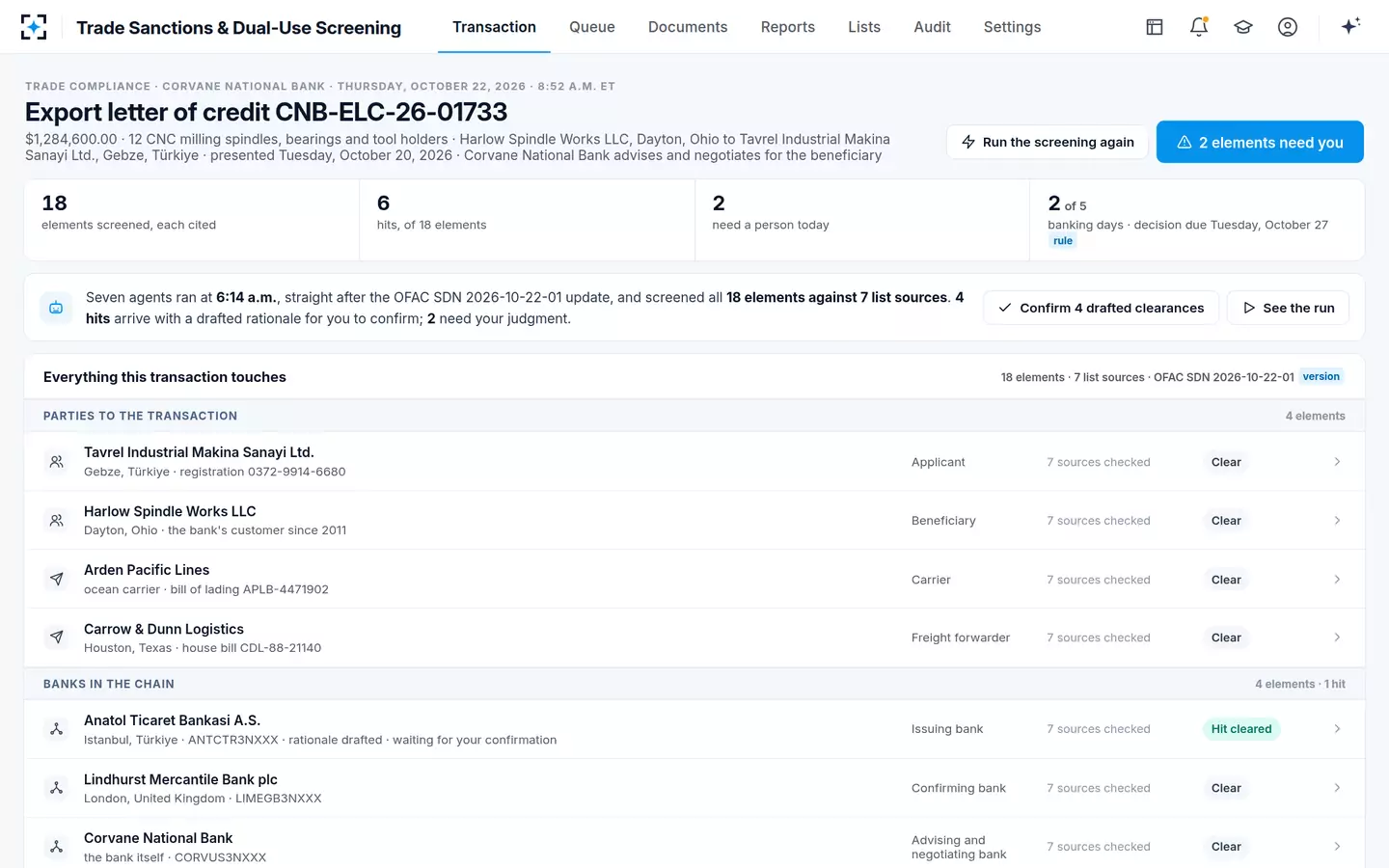
The honest limit: no agent reviews a trade transaction as a whole
The Wolfsberg Group, ICC and BAFT wrote in 2019 that list screening can be automated but that reviewing trade documents, taken as a whole, cannot be, and that banks need automated and manual controls together. Seven years and a generation of language models later, that is still the right design rule, and the goods-line agent is built on it. It does not review the transaction; it does the reading that makes a person's review possible in the time the credit allows.
The same paper explains why the reading matters. It says interpreting dual use takes technical knowledge that documentary credit and guarantee staff cannot be expected to have, and that building departments of specialists to supply it would be impracticable (Control Mechanisms 6.2). Where a bank has an export controls specialist at all, the specialist is a scarce resource. An agent that arrives at the specialist's desk with the invoice line, the datasheet passage, the candidate entries and the deciding parameter already laid out is how one specialist covers a trade book. The people who carry a goods line describes those seats in turn. For how the agents compare with list-only tools, see export control screening software for banks; for the whole solution, the Trade Sanctions & Dual-Use Screening page.
Questions people ask
What is the best AI for trade compliance?
The best one for a bank is the one whose limits you can show an examiner: it cites every page, shows its confidence and alternatives, never decides below a threshold and keeps its original output after an override. Ask for a test on your own past transactions; no regulator publishes a ranking or an accuracy benchmark.
Can AI classify an ECCN?
It can propose one and explain the parameters that decide it. BIS lists three ways to classify an item: ask the manufacturer, self-classify with technical understanding, or ask BIS, which answers formal requests within 14 calendar days. An AI proposal is an input to the second, checked by a person.
Does a trade compliance AI agent replace the sanctions screening engine?
No. In Botminds' design the agents send every element to the bank's screening system and work the hits that come back, gathering the identifiers that prove or disprove each match. The engine matches names; the agents read documents.
How do you know when the agent is wrong?
By keeping its original output beside every human override and counting the overrides by reason. A rising override rate on one goods category, or a correct-looking proposal later reversed by BIS or the exporter, is the signal to retune the threshold or the prompt.
What documents does a goods-line agent need?
At minimum the commercial invoice and packing list, which carry the description and HS code. A technical datasheet, an end-user statement and the exporter's own export control classification number, where available, are what turn a low-confidence proposal into a decision a specialist can make quickly.