The Common High Priority Items List is a list of fifty six-digit Harmonized System codes, in four tiers, that BIS developed with the European Union, Japan and the United Kingdom to mark the goods Russia seeks for its weapons programmes. For a bank it is the most direct goods-level signal regulators have published: the codes are the same ones printed on commercial invoices and packing lists, and BIS's 2024 guidance builds customer due diligence around the firms that ship them. It is also easy to misuse, because a listed code says "look closer", not "controlled". Botminds' Trade Sanctions & Dual-Use Screening flags every goods line whose code is on the list, with its tier, and puts the evidence for a decision beside it.
The Common High Priority Items List in four numbers
50
HS codes, each identified by its six-digit Harmonized System number
BIS, February 23, 2024
4
partners: the United States, the European Union, Japan and the United Kingdom
BIS
9
codes in Tiers 1 and 2, which BIS prioritizes within the list
integrated circuits, RF modules, capacitors
5
codes in Tier 4.B, CNC machine tools and their parts, added in 2024
EU, February 2024 version
What is the Common High Priority Items List?
It is a published list of goods, by HS code, that the four partners found in Russian weapons or judged critical to making them. BIS describes it as "50 items identified by six-digit Harmonized System (HS) Codes that Russia seeks to procure for its weapons programs", published "to highlight for industry that these items pose a heightened risk of being diverted illegally to Russia because of their importance to Russia's war efforts" (BIS, CHPL). The European Commission's version says the items were drawn from Russian military systems "found on the battlefield in Ukraine or critical to the development, production or use of those Russian military systems" (European Commission, February 2024).
It is not, by itself, a list of controlled goods. BIS says plainly what the codes contain.
The items in these 50 HS codes include both lower technology items designated EAR99, as well as more sensitive items on the Commerce Control List.
BIS, Common High Priority Items List
That sentence is the key to using the list well. A bearing or a connector under a listed code may need no licence to most destinations. What the list tells a bank is that this kind of good is what procurement networks look for, so the route, the consignee and the end user deserve a closer read.
How many HS codes are on the CHPL, and in which tiers?
Fifty, in four tiers, with Tiers 3 and 4 each split in two. Tier 1 is the highest concern: four codes for integrated circuits. Tier 2 adds five electronics codes. Tier 3.A holds sixteen codes for discrete electronic components, connectors, cameras and navigation parts; Tier 3.B nine for mechanical and optical components, including bearings. Tier 4.A lists eleven codes for equipment to make and test electronics, and Tier 4.B five for CNC machine tools and their parts.
Where the fifty codes sit: electronics dominate, machine tools are the newest tier
Share of the 50 HS codes, by tier
- Tier 1 · 4 · 8%
- Tier 2 · 5 · 10%
- Tier 3.A · 16 · 32%
- Tier 3.B · 9 · 18%
- Tier 4.A · 11 · 22%
- Tier 4.B · 5 · 10%
Within the list, BIS has prioritized the nine HS codes in Tiers 1 and 2, covering items "such as integrated circuits and radio frequency (RF) transceiver modules" that "have extensive commercial applications but have also been found in Russian missiles and drones". Those nine were the first to reach banks: they are the codes FinCEN and BIS named in their May 2023 alert, which says they are listed in Supplement No. 7 to Part 746 of the EAR, so a licence is required for items under them "destined to Russia, Belarus, the Crimea region of Ukraine, or Iran" (FIN-2023-Alert004).
When were CNC machine tools added to the list?
In February 2024. The European Commission's September 2023 version had 45 codes, with a single Tier 4 of eleven codes for manufacturing equipment. The February 2024 version, which "replaces the previous September 2023 version", split Tier 4 and added Tier 4.B: "5 HS codes concerning Computer Numerical Control (CNC) machine tools for working metal, and related components" (European Commission, February 2024). BIS published the same fifty codes on February 23, 2024.
How the high-priority list grew from nine codes to fifty
Tier 4.B, code by code
Tier 4.B deserves a trade finance desk's attention because its goods are capital equipment and parts, described on invoices in words that rarely settle their control status. Each code is broad; each takes in controlled and uncontrolled goods.
The five Tier 4.B codes, and what they reach
| HS code | BIS description | What a bank sees on an invoice |
|---|---|---|
| 8457.10 | Machining centers for working metal | Whole machines, often with a model number and an axis count |
| 8458.11 | Horizontal lathes for removing metal, numerically controlled | Whole machines |
| 8458.91 | Lathes, excluding horizontal, for removing metal, numerically controlled | Whole machines |
| 8459.61 | Milling machines, not knee type, for removing metal, numerically controlled | Whole machines |
| 8466.93 | Parts and accessories for machine tools, for laser operation, metalworking machining centers, lathes and drilling machines, etc., not specified or included elsewhere | Spindles, heads, tables, controllers: the parts line, and the hardest to judge |
The parts code is where the work is. A machine sold whole usually arrives with a model number a specialist can look up. A spindle, a rotary table or a control unit sold as a replacement under 8466.93 often arrives with a one-line description, and the export control answer depends on figures the invoice does not give.Why the HS code cannot settle that question explains the gap between the two codes.
Is the CHPL the same in the EU and the UK?
The fifty codes are common by design: the list was built by the four partners together, which is what "common" means. The European Commission publishes the same fifty codes, in the same tiers, as a tool for exporters' due diligence and for "targeted anti-circumvention actions by customs and enforcement agencies of partner countries", and calls the list "not static", to be "periodically adjusted in the light of what is found in Russian military systems on the battlefield" (European Commission).
What differs is the law each partner attaches to it. In the EU the items are "sanctioned under the Russia Sanctions Regulation"; in the United States, the EAR sets licence requirements by HS code for Russia, Belarus, Iran and the occupied Crimea region through Supplement No. 7 to Part 746, which lists 846693 among its codes (15 CFR 746, Supplement No. 7). A bank that operates in more than one jurisdiction should screen against one list and apply each jurisdiction's rules to the result.
Is there a 2026 Common High Priority Items List?
Not as of October 27, 2026. BIS's page is still dated February 23, 2024, and the Commission's document is still the "Version of February 2024". People search for a 2026 list, and both partners say the list will be updated, so a bank's screening should carry the version it used, and a change should trigger a re-screen of open transactions rather than a quiet swap.
How should banks use the CHPL?
In three ways, two of which BIS and FinCEN spelled out. First, for customer due diligence: BIS recommends reviewing customers, and where appropriate their customers, against lists of entities that have shipped CHPL items to Russia since 2023, built from public trade data, and closely scrutinizing those that appear (BIS, 2024). Second, on transactions: FinCEN and BIS strongly encouraged due diligence whenever one of the nine Tier 1 and 2 codes appears, including checking whether a customer was incorporated after February 24, 2022 or started receiving those goods only after that date (FIN-2023-Alert004). Third, by extension, on every goods line under any of the fifty codes, as a reason to read the rest of the presentation carefully.
The 2023 alert also described the importers BIS was worried about, from its review of U.S. export data for the nine codes. Three patterns raised diversion concerns for importers outside the coalition of countries imposing similar controls: a company that "never received exports prior to February 24, 2022"; one that received exports before that date but none under the nine codes; and one that did receive them before, then "saw a significant spike in exports thereafter". Each is visible to a bank that finances or pays for its customer's shipments over time, and none needs a classification to spot.
Using the high-priority list on a trade finance desk
- Flag every listed code, with its tier
On every goods line, from the invoice and packing list, not a sample.
- Treat Tiers 1 and 2 as the sharpest signal
The nine codes BIS prioritizes and FinCEN–BIS named in 2023.
- Check the destination against HS-coded licence rules
Russia, Belarus, Iran and occupied Crimea under Part 746; elsewhere the code alone decides nothing.
- Read the route and the consignee
Transshipment points, a consignee who differs between documents, an end user named once.
- Ask for the classification, do not infer it
The exporter’s ECCN or EAR99 designation, with the datasheet for parts under 8466.93.
- Screen customers against shipper lists
Entities that shipped listed items to Russia since 2023, including customers’ customers where appropriate.
- Keep the list version
Each flag with the version used; re-screen open transactions when the list changes.
What the high-priority list does not tell you
Three things. It does not say whether a given item is controlled, since each code mixes EAR99 and controlled goods. It does not say whether a destination is lawful: a listed code bound for Türkiye needs no licence by HS code, yet BIS warns that Russia "routinely relies on evasive or deceptive tactics, such as the use of third-party intermediaries or transshipment points" (BIS, CHPL). And it does not say who the end user is, which is the question most diversion cases turn on.
The reporting data show why the list still matters to banks. In the first year of the FinCEN–BIS alerts, 333 suspicious activity reports cited them, and U.S. depository institutions filed 96% of those reports (FinCEN Financial Trend Analysis). Banks were finding the activity in the documents and payments they handle, not in the exporters' classification files.
Which lines of an export credit hit the list: a sample, in Trade Sanctions & Dual-Use Screening
On the fictional sample credit in this series, Corvane National Bank's export credit for spindles, bearings and tool holders bound for Gebze, two of three goods lines are on the list. Twelve CNC milling spindles under 8466.93 sit in Tier 4.B, and forty-eight ball bearings under 8482.10 sit in Tier 3.B. The tool holders, under 8466.10, are not.
A listed goods line in Trade Sanctions & Dual-Use Screening, flagged with its tier
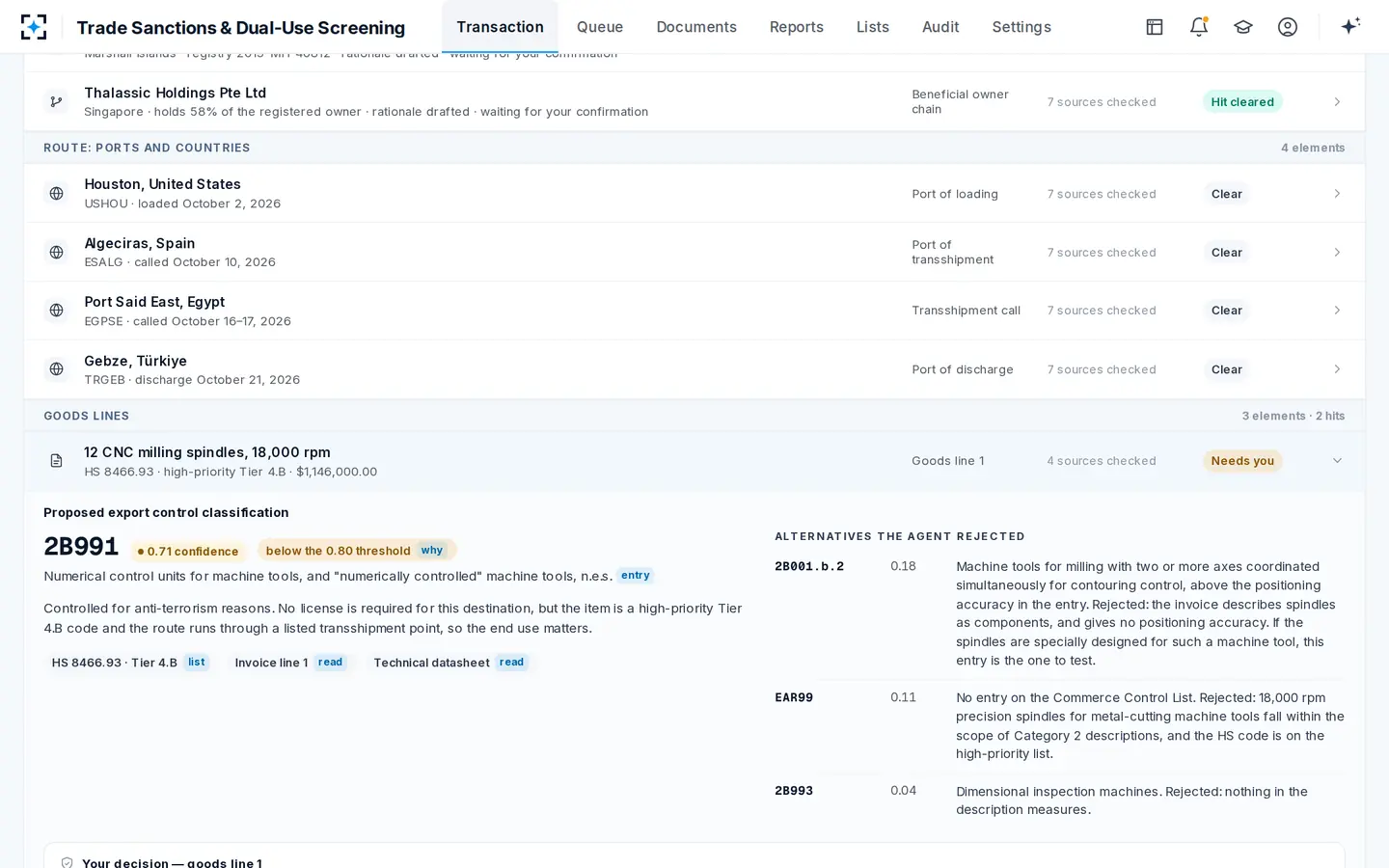
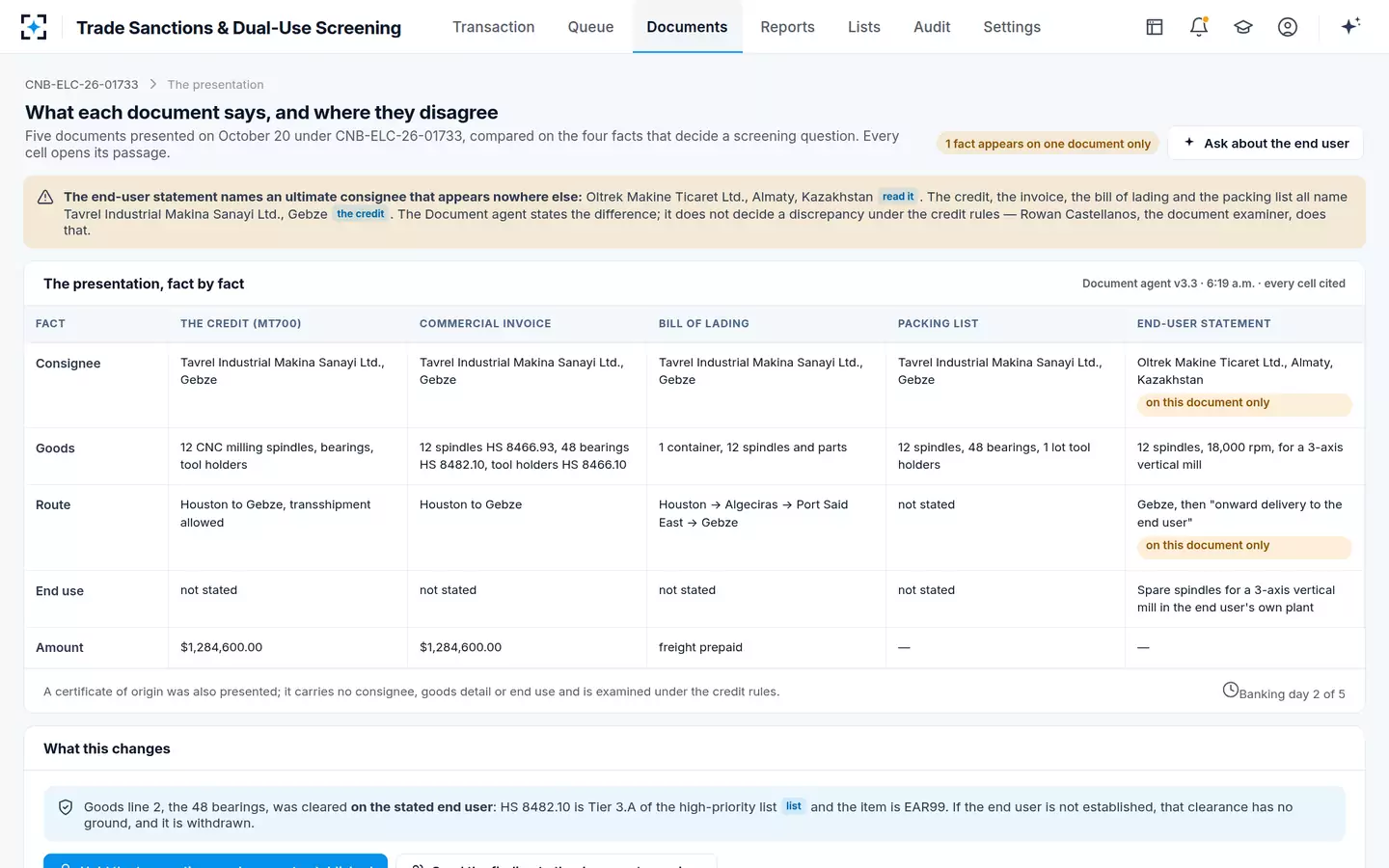
The two listed lines end differently, and neither because of the list. The spindles go to the bank's export controls specialist, because their classification turns on figures the invoice omits. The bearings, cleared at first on the stated end user, come back when the end-user statement names an ultimate consignee in Almaty that no other document mentions. The list told the analyst where to look; the documents decided. Reading that mismatch as a red flag is the next step, and the Trade Sanctions & Dual-Use Screening page shows the whole transaction.
The bearings line loses its ground when the documents disagree
Questions people ask
What does CHPL stand for?
Common High Priority List, or Common High Priority Items List: the fifty HS codes agreed by the United States, the European Union, Japan and the United Kingdom as the items Russia most seeks for its weapons programmes.
Are items on the Common High Priority Items List banned?
Not generally. They are restricted for Russia and Belarus, and under U.S. rules the HS-coded licence requirements also reach Iran and the occupied Crimea region. To other destinations, a listed code is a diversion risk to examine, not a prohibition.
Which CHPL tier is the highest priority?
Tier 1, four codes for integrated circuits, followed by Tier 2. BIS prioritizes those nine codes within the list, and they are the codes FinCEN and BIS asked banks to watch for in May 2023.
Is the CHPL only about Russia?
It was built around Russia's weapons programmes, but BIS also applies the same nine Tier 1 and 2 codes to Belarus, Iran and occupied Crimea through Supplement No. 7 to Part 746. FinCEN's separate global key term covers export evasion elsewhere.
Where can I find the official list?
On BIS's website under country guidance, and in the European Commission's document "List of Common High Priority Items (Version of February 2024)". Both give the codes by tier with their descriptions.