Searching for a technology transfer protocol template often means one thing: a quality procedure has named the document and not said what goes in it, and somebody has three weeks. The useful answer is that the contents are already prescribed. Section 7.1 of the World Health Organization's technology transfer guideline lists twelve elements an authorised transfer document has to include, and the hard part is not finding a layout but filling two of those elements honestly — the acceptance criteria for a successful transfer, and the parallel comparison of the two sites. Botminds' Technology Transfer Package drafts the protocol and the package behind it straight out of the development records, every statement carrying the passage it came from, so the elements that are often written from memory are written from evidence.
The worked example running through this page is the solution's own sample data: a monoclonal antibody drug substance moving from a development site to a commercial plant, with invented people, products, companies and sites. Everything attributed to a regulator is real and linked where it appears.
What goes in a technology transfer protocol?
The guideline's own framing is loose about the document's name and strict about its contents: "An authorized technology transfer document – for example, a master plan or technology transfer protocol – should list the intended sequential phases and activities of the transfer, where appropriate." It then gives the list below. Whether your procedure calls it a transfer protocol, a transfer plan or a master plan does not matter; whether it carries these twelve elements does.
Two things the guideline adds here often get lost. Standard operating procedures "should be followed, describing the actions to be taken during the technology transfer process" — so the protocol sits under a procedure rather than replacing it. And records of the activities performed have to be maintained, which is what makes the report a requirement and not a courtesy. The four phases those activities belong to are walked through in technology transfer in the pharmaceutical industry, end to end.
The elements the protocol has to carry, one by one
Read the list once and a pattern appears. Four elements are identity — title, objective, scope, the two sites. Three are the project — the team, the phases with their accountabilities, the timing including the trial and validation batches. Three are pointers — to other transfer plans, to the validation master plans, to the gap analysis and risk assessments. And two are the substance: the acceptance criteria, and the parallel comparison. The first ten can be filled in an afternoon. The last two are the protocol.
The twelve elements of an authorised transfer document, and a mistake to avoid in each
| Element | What it has to carry | A mistake to avoid |
|---|---|---|
| Title | Enough to identify the product, the two sites and the version. | A title that cannot be cited from a batch record, so the executed record points nowhere. |
| Objective | What this transfer is for, in a sentence a reviewer can test the conclusion against. | Restating the scope. The objective is the thing the report later says was or was not achieved. |
| Scope | Which unit operations, which procedures, which batch sizes — and what is out. | Silence on what is excluded, so packaging or a second strength is argued about in Phase III. |
| Names and addresses of both units | The legal entities and the sites, not the project nicknames. | A site named by its city when the company runs two plants in it. |
| The transfer team and responsibilities | Key personnel at both units, with what each is responsible for. | Roles without names. "Quality" does not sign anything; a person does. |
| Phases with activities, deliverables and accountabilities | Each phase, what it produces and who is accountable for producing it. | Deliverables listed without an owner, which is how a method transfer becomes nobody's. |
| Approximate timing, including trial and validation batches | When each key activity and deliverable falls, with the trial production and validation batches dated. | Dating the validation batches and not the engineering run that has to precede them. |
| Reference to other transfer plan documents | Pointers to the other plans relevant to the process being transferred. | Copying their content in, so the protocol and the plan drift apart at the first revision. |
| Reference to the validation master plans | Equipment, facilities and utilities qualification plans; the process validation master plan, site-independent or site-dependent; the method validation master plan. | Omitting the method validation master plan, which is where the analytical schedule actually lives. |
| Reference to the gap analysis and risk assessments | A pointer to the live gap list and the risk assessment, by document number and revision. | A summary of the gaps as they stood on the day of drafting, which is wrong by the time it is signed. |
| Acceptance criteria for a successful transfer | What result, on what batches, measured how, counts as the transfer having succeeded. | Writing them last, or writing "meets specification", which tests the product and not the transfer. |
| A parallel comparison of the two sites | Premises, equipment, instruments, materials, procedures and methods, side by side. | A narrative paragraph instead of a comparison, which hides the differences it exists to expose. |
The pattern has a consequence for the drafting order. Elements that only point at other documents should point at the live revision and nothing more; elements that carry substance need the gap analysis to exist first. A protocol drafted top to bottom in a single sitting will have its twelfth element written by a tired person at five o'clock, which is the opposite of how much it matters.
Acceptance criteria for a successful transfer, written first
This is the element that decides whether the transfer ever closes, and it is an easy one to leave until after the batches are planned. The guideline pairs it with the parallel comparison as the last two of the twelve: "acceptance criteria for a successful transfer; … a parallel comparison of premises, equipment, instruments, materials, procedures, and methods for the transfer under consideration."
The reason they have to be written first is structural. A report can only conclude against what its protocol asked for. If the criteria arrive after the engineering run, they will be written by people who have seen the result, and no reviewer can tell whether the bar was set or found. The guideline's definition of success is explicit that the specifications are agreed in advance: documented evidence that the receiving unit can routinely reproduce the process "against a predefined set of specifications, as agreed between the SU and RU".
Three properties separate a criterion that works from one that does not. It names the measurement, not the outcome: a yield range, a purity profile, an equivalence interval on a potency result, a number of consecutive batches. It names the population: which batches count, and what happens if one of them deviates. And it is achievable on the equipment the receiving site actually has — which is why the parallel comparison belongs in the same document, and why the criteria cannot sensibly be finalised before the gap analysis has run. "Meets the release specification" is not an acceptance criterion for a transfer; it is an acceptance criterion for a batch, and a batch can meet specification while the process behaves nothing like it did at the sending site.
EU GMP Annex 15 adds the discipline behind the criticality that the criteria rest on, requiring that the basis on which parameters and attributes were identified as critical or non-critical be clearly documented, taking the risk assessment results into account. A criterion written against a parameter whose criticality nobody can source is a criterion that will be argued about in review. How each value and each class gets back to the study that set it is the subject of critical process parameters in pharma.
The parallel comparison: premises, equipment, materials, procedures, methods
The second substantive element is a comparison, and the word is doing work: not a description of the receiving site, but the two sites set against each other, aspect by aspect, in a form where a difference cannot hide. Premises. Equipment. Instruments. Materials. Procedures. Methods.
In practice this is the element that turns a transfer protocol from a plan into a risk document, because it is where a reviewer learns that the receiving vessel has a different sparger, that the centrifuge has a lower maximum, that the control strategy depends on an in-line probe the receiving suite has no port for. Teams skip it for an understandable reason: assembling it means holding two equipment lists, the validated ranges and the development reports open at once, and the comparison has to be redone every time one of those documents is revised.
The parameter table the comparison is drawn against
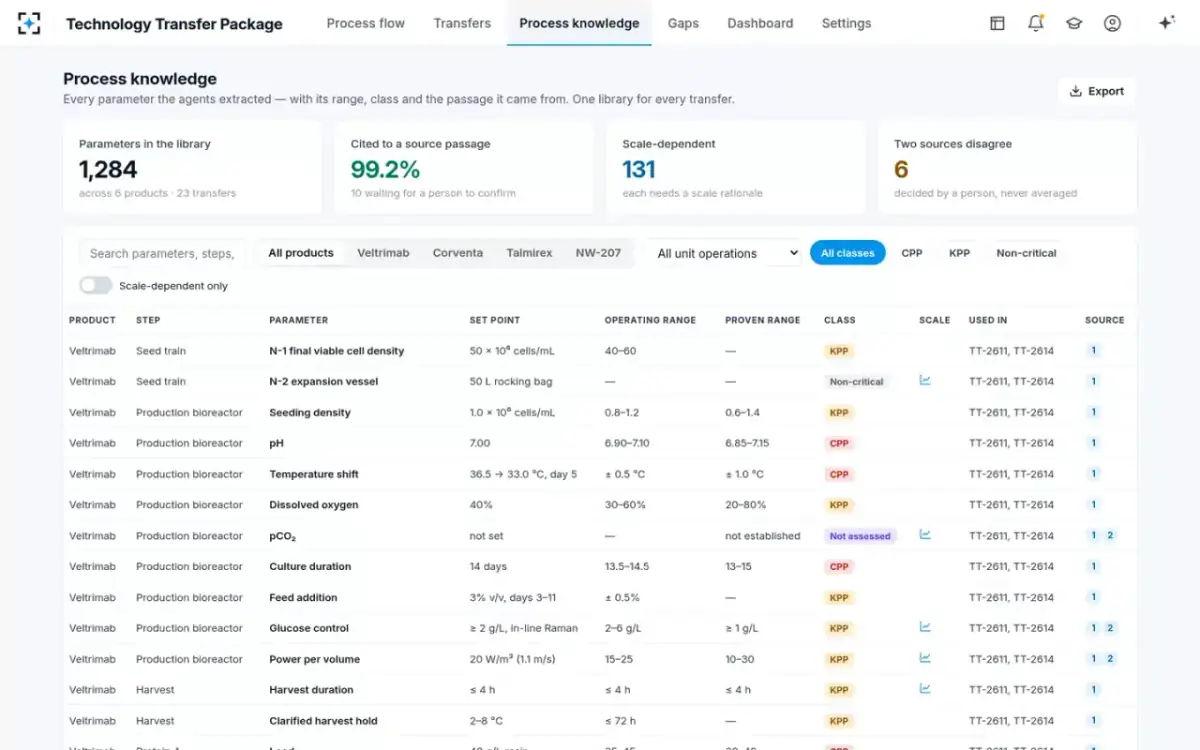
Done properly, the comparison carries its arithmetic. A row that says "the receiving vessel is larger" is not a comparison; a row that says what matching the sending site's power per volume would mean for tip speed on that vessel, with the inputs shown, is. On the worked transfer the equipment comparison runs to eleven aspects, and the three steps whose validated ranges the receiving site cannot hold — the production bioreactor, viral filtration, and harvest and clarification — each carry a drafted risk line and a gap. The arithmetic itself, and the choice of which scale-up criterion to hold, is worked through in bioreactor scale-up parameters.
What the transfer report has to say, and who authorises it
The protocol and the report are different documents with different jobs, and a common fault in a transfer file is a report that reads like a second protocol. Section 7.3 fixes the report's job in one sentence: "The report should summarize the scope of the transfer, the critical parameters as obtained in the SU and RU, and the final conclusions of the transfer." As obtained at both units — the report's distinctive content is the comparison of what actually happened against what the sending site saw, which is the thing no protocol can contain.
Protocol against report: what belongs in each
The transfer protocol, before: What will be done, by whom, when, and what will count as success.
The transfer report, after: What was done, what was obtained, and whether it counted.
The transfer protocol, before: The parameter table as transferred: set point, ranges, class, and the source of each.
The transfer report, after: The critical parameters as obtained at both units — the sending site's values and the receiving site's, side by side.
The transfer protocol, before: The parallel comparison of premises, equipment, instruments, materials, procedures and methods, with the gaps and their actions.
The transfer report, after: Which differences were closed, which were accepted with a rationale, and what each one did to the result.
The transfer protocol, before: The procedure for handling them, and who may approve one.
The transfer report, after: Every deviation and change from the master plan, assessed and evaluated before close-out.
The transfer protocol, before: None. A protocol that concludes has been written after the fact.
The transfer report, after: An assessment of the data and information, a conclusion, and a statement of whether the team has achieved completion of the transfer.
The transfer protocol, before: Authorised before execution begins, by both units and quality.
The transfer report, after: Authorised by "the appropriate responsible person or persons" — named in the company's procedure, not chosen at the end.
"The document, which should include an assessment of the data and information and a conclusion, should be authorized by the appropriate responsible person or persons."
WHO guidelines on technology transfer in pharmaceutical manufacturing, §12.46
The documents behind the protocol, aspect by aspect
The protocol references documents; it does not contain them. That distinction is the difference between a file that stays true and one that is wrong within a month. The guideline makes two of the twelve elements explicit pointers — to other transfer plans, and to the validation master plans — and a third, to the gap analysis and risk assessments, which is the most live document in the project. A protocol that summarises the gap list instead of pointing at it is out of date the next time a document arrives, and it is out of date in the most dangerous way: plausibly.
Appendix 1's final row is the one worth reading before drafting, because it is easy to overlook and likely to hold a contradiction: under "other documents", the guideline lists recalls and complaint reports, bio-batch and pilot batch information, the history of changes and change management, and hold time protocols and reports. Hold time protocols and reports sit in the same row as the change history, and the pairing is apt — a hold time is the kind of limit that gets revised by a later study while the batch record keeps the older number. On the worked transfer that is exactly what happened: the master batch record holds the neutralised pool at 2–8 °C for not more than 48 h, and a newer study supports 72 h. Two documents, one limit. What a conflict like that becomes, and why it goes to a person rather than being resolved by a rule, is set out in the tech transfer gap analysis.
The receiving site's own documentation chain starts where the protocol stops. In the US, 21 CFR 211.186(a) requires that "To assure uniformity from batch to batch, master production and control records for each drug product, including each batch size thereof, shall be prepared, dated, and signed (full signature, handwritten) by one person and independently checked, dated, and signed by a second person." Two people, per batch size. A transfer that changes the batch size changes the master record, and the second signature is a real piece of the receiving site's schedule rather than an afterthought.
The analytical procedure transfer protocol, and its six parts
Analytical procedures travel under their own protocol, and §12.25 prescribes its contents as firmly as §7.1 prescribes the main one. It is a short list, and every item on it is something teams are tempted to agree verbally and then argue about once results exist.
The six parts an analytical procedure transfer protocol must have
- Objective, scope and responsibilities of both units
Which procedures, for which materials, and who at each laboratory owns the execution and the review.
- A specification of materials and methods
Including reference standards, columns and reagents — the items whose lot-to-lot variability is the usual explanation for a laboratory-to-laboratory difference.
- The experimental design and acceptance criteria
The deliverable, not the pass. How many analysts, how many replicates, on which samples, and what interval counts as equivalent.
- Documentation, including the report forms to be used
Agreed in advance so the two laboratories report comparable things; "information to be supplied with the results" is the guideline's phrase.
- A procedure for handling deviations
Written before the first out-of-trend result, by people who do not yet know whose result it will be.
- Details of test samples
Starting materials, intermediates and finished products — including which lots, and whether the receiving laboratory gets material the sending laboratory has already tested.
Who approves a technology transfer report?
The guideline names the authority by function rather than title: the report "should be authorized by the appropriate responsible person or persons", and it "should further state whether or not the team has achieved the completion of the technical transfer". Which persons those are is fixed by the company's own quality procedure, and the useful discipline is to fix it in the protocol — before anyone knows how the batches went.
On the worked transfer the protocol carries four signatures, and they mean four different things. The sending site signs that the process description, parameters and ranges are technically accurate — it is attesting to its own knowledge. The receiving site signs that it can execute what is described on the equipment it has, which is the signature the parallel comparison exists to make possible. Quality approves that the document meets the procedure and that the risks are assessed. And the transfer lead signs that the project is ready to proceed, with every gap that blocks the next step carrying an agreed action.
Four signatures, and the meaning each one records
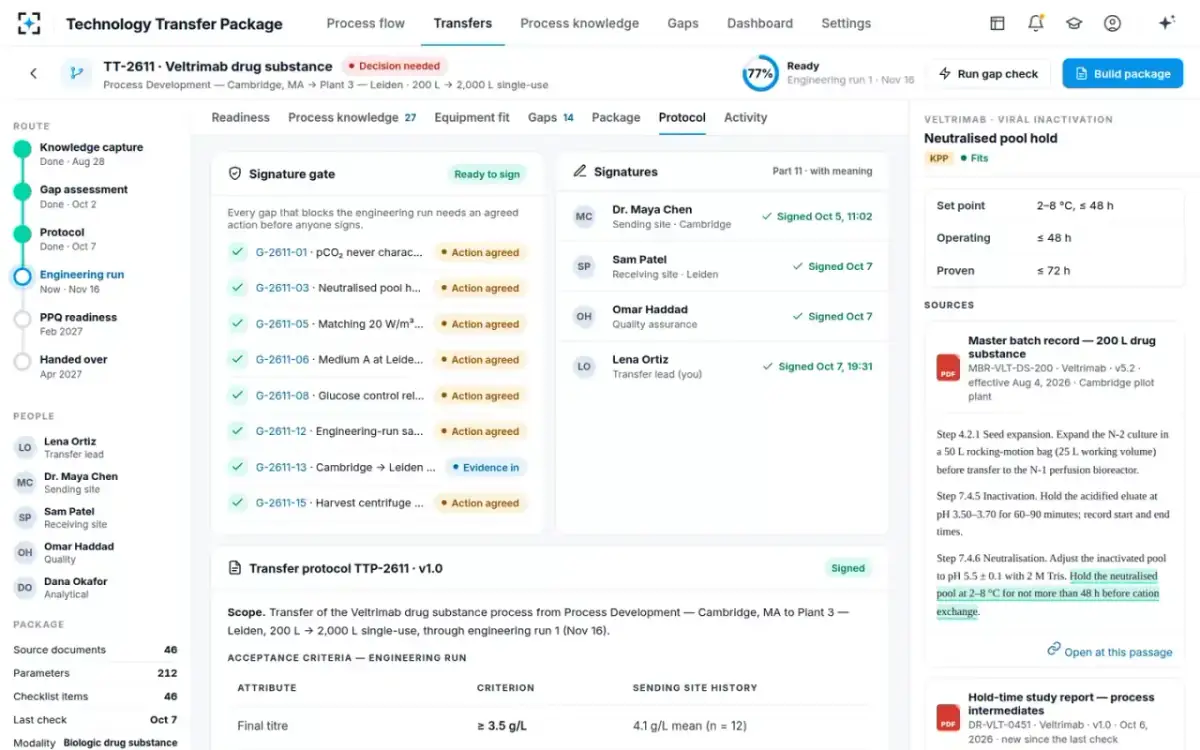
That ordering matters more than it looks. A protocol signed while a blocking gap has no agreed action transfers the problem to the engineering run, where it costs a batch instead of a meeting. Making the agreed action a precondition of the signature is a cheap control and an unpopular one, because it means the project's dates are set by the gap list rather than the other way round.
Where a downloaded template stops helping you
A template gives you headings. It cannot give you the twelve elements' contents, and the two that matter — the acceptance criteria and the parallel comparison — are the two no template can pre-fill, because they are statements about your process and your two sites. What a downloaded file does supply is the illusion of completeness: every heading present, half of them filled with text that is true of any transfer.
The worked package in the solution is structured as ten sections in the company's own template, and the test it is held to is not whether a section exists but whether each statement in it points at the document it came from.
Ten sections, and what each one has to be able to prove
- Purpose and scope
Which product, which two sites, which unit operations and which analytical procedures are in the transfer — and what is explicitly out.
- Product and process overview
The molecule, the dosage form or drug-substance presentation, the batch size at each site, the quality attributes the process is controlled against.
- Process description
Every unit operation in order, with the equipment class each needs and the scaling factors for the steps that are scale dependent.
- Parameters and control strategy
The parameter table: set point, operating range, proven range, class, scale dependence and the passage each value was read from.
- Materials
Raw, starting and packaging materials with their attributes, suppliers and qualification status at the receiving site.
- Equipment fit and scale-up
The parallel comparison the guideline asks for, aspect by aspect, with each calculation shown with its inputs.
- Analytical methods
Each procedure, the transfer route chosen for it, its protocol reference and who owns it at both laboratories.
- Risk assessment
The risk lines, including those drafted from equipment differences, and the risk priorities that oblige an action.
- Holds and stability
Hold times with their studies, the sampling points, and the site-specific stability the receiving site will generate.
- Open gaps with their agreed actions
Every gap still open, what it blocks, its agreed action, owner and due date — the section a reviewer reads first.
A drafted package where every statement carries its source
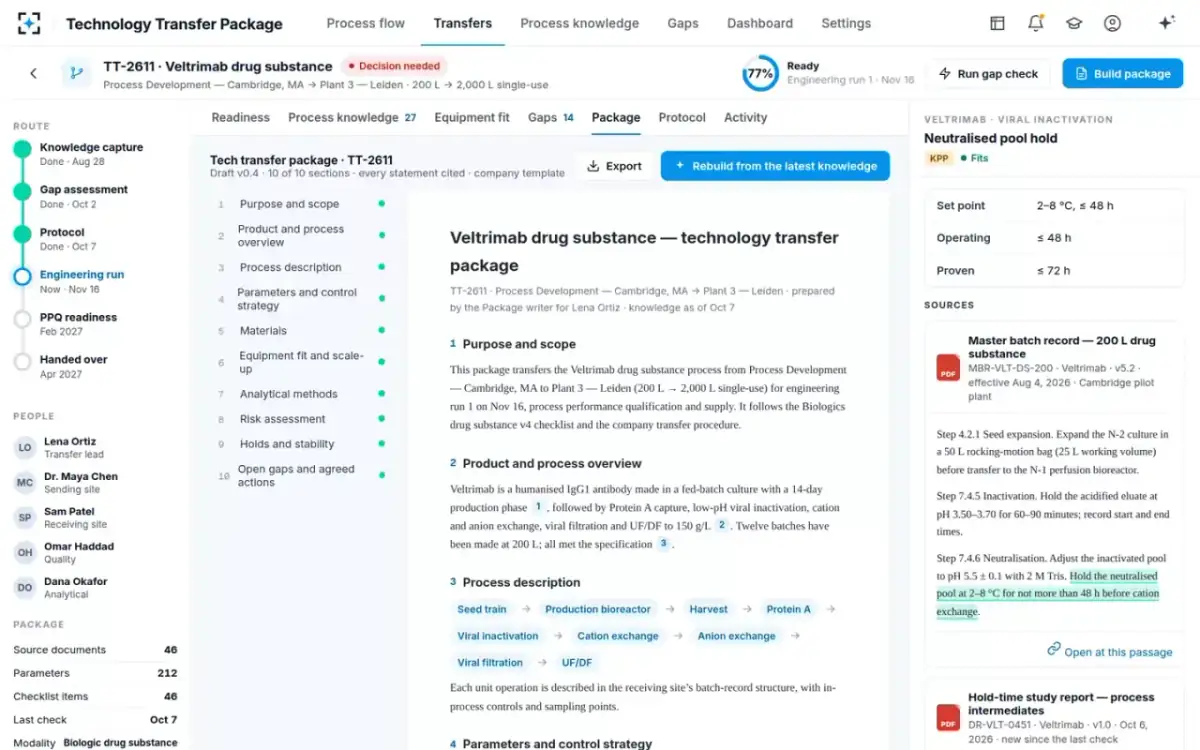
Where a template is genuinely useful is as a contract between the author and the reviewer about what the document will contain. Where it stops helping is the moment it is treated as the work. The protocol's value is in the two elements that take a week each and cannot be downloaded — and the rest of the transfer, phase by phase, is in the end-to-end guide. To see a protocol drafted from the records themselves, start from Technology Transfer Package.
Questions people ask
What is a technology transfer protocol?
An authorised document — the guideline allows it to be called a master plan or a transfer protocol — that lists the intended sequential phases and activities of a transfer and carries twelve prescribed elements, from the title and the two units through the team, the phases with their accountabilities and the timing of the trial and validation batches, to the acceptance criteria for a successful transfer and a parallel comparison of the two sites. It is authorised before execution begins, and the transfer report is later written against it.
What is the difference between a technology transfer protocol and a report?
The protocol says what will be done and what will count as success; the report says what was obtained and whether it counted. Three things belong only in the report: the critical parameters as obtained at both the sending and the receiving unit, the deviations and changes from the plan assessed before close-out, and a conclusion stating whether the team achieved completion of the transfer. A report that only restates the protocol has not done its job.
What are the acceptance criteria for a successful technology transfer?
They are whatever the two units agreed in advance, and the guideline's test of success is documented evidence that the receiving unit can routinely reproduce the process against a predefined set of specifications as agreed between them. A workable criterion names a measurement rather than an outcome, names which batches count, and is achievable on the equipment the receiving site actually has — which is why it cannot sensibly be finalised before the gap analysis and the parallel comparison are done.
Who approves a technology transfer report?
"The appropriate responsible person or persons", in the guideline's wording, with the company's own quality procedure deciding who that is. On the worked transfer it is four signatures with four different meanings: the sending site attesting that the technical content is accurate, the receiving site that it can execute it on its equipment, quality that the document meets the procedure and the risks are assessed, and the transfer lead that the project may proceed.
Is there a standard technology transfer protocol template?
There is no official template, but there is an official contents list — §7.1 of WHO TRS 1044 Annex 4 — and a company's own quality procedure usually turns it into a house format. A downloaded template can give you the headings; it cannot give you the acceptance criteria or the parallel comparison of your two sites, which are the two elements that carry the work and the two a reviewer will read most closely.
What goes in a technology transfer package?
The set of documents the sending site hands over so the receiving site can make the same product. On the worked example here it is ten sections: purpose and scope; product and process overview; process description; parameters and control strategy; materials; equipment fit and scale-up; analytical methods; risk assessment; holds and stability; and the open gaps with their agreed actions. The guideline's Appendix 1 gives the underlying documentation by aspect, from regulatory and starting materials through to hold time protocols and reports.