Digital tech transfer is a phrase that covers four quite different purchases, and the reason buyers struggle to choose between vendors is that the vendors are not all selling the same thing. One sells a better spreadsheet. One sells a document store you can search. One sells structured authoring, where the parameters live as data instead of as prose. And one reads the records and compares what they say with what the receiving site's equipment can actually do. Only the fourth changes which gaps you find before a batch is at stake; the first three change how fast you type. Botminds' Technology Transfer Package is built for the fourth job, and this guide runs one transfer through all four so the difference is visible rather than asserted.
The worked transfer is sample data — the people, companies, products and sites are fictional. The obligations quoted are the European and US rules a computerised system brings with it, whichever of the four you buy.
One parameter library in Technology Transfer Package, across six products
1,284parameters
held as values with their ranges and class, across six products and twenty-three transfers
99.2%
cited to the passage they came from; ten are waiting for a person to confirm
131scale-dependent
parameters flagged as needing a rationale for the new scale
6
where two sources disagree — shown to a person, never averaged
What does digital tech transfer actually mean?
Strip the marketing away and the underlying obligation is a decade old and one sentence long. EU GMP Annex 15 requires that "For all products irrespective of the approach used, process knowledge from development studies or other sources should be accessible to the manufacturing site, unless otherwise justified, and be the basis for validation activities" (Annex 15, §5.10). Accessible to the manufacturing site. Not archived, not retrievable on request, not held by the three people who ran the process.
"Process knowledge from development studies or other sources should be accessible to the manufacturing site … and be the basis for validation activities."
EU GMP Annex 15, §5.10
ICH Q10 names the discipline that is supposed to deliver that: knowledge management, "a systematic approach to acquiring, analysing, storing and disseminating information related to products, manufacturing processes and components", with technology transfer named among its own sources of knowledge (ICH Q10, §1.6.1). Note the four verbs. Acquiring and storing are what a document store does. Analysing and disseminating are what it does not, and they are where every argument about digital tech transfer actually lives.
So the honest definition is this: digital tech transfer is whatever moves process knowledge from the form a development scientist wrote it in to the form a receiving plant can act on. That is a transformation, not a filing exercise, and it is why two tools that both claim to digitise a transfer can produce completely different outcomes on the same set of documents.
Four ways to run a transfer, side by side
Here are the four, in the order companies usually meet them. Each one is a genuine improvement on the one before it, and each one solves a different problem, which is why a team can adopt three of them and still find a centrifuge limit in the engineering run.
Four ways to run a transfer, and what each one can and cannot find
| Approach | What it is | What it finds | What it cannot find |
|---|---|---|---|
| A better spreadsheet | A shared workbook with a template, named tabs and a review column. Often the honest state of the art. | Items the template asks for and nobody filled in. Arithmetic you wrote a formula for. | Anything the template did not anticipate. A value that contradicts another workbook. Which version of a report a number came from. |
| A findable document store | A validated document system with versioning, metadata and full-text search across reports, batch records and methods. | The document, fast. Which version is current. Who approved it and when. | A conflict between two documents it holds, because it compares documents to queries, not to each other. |
| Structured authoring | Parameters authored as data — set point, ranges, class, units, source — in a library rather than typed into a document. | Missing fields, unit mismatches, parameters with no source, and the same parameter stated twice. | Whether the receiving site’s machine can hold the range, because the equipment is not in the library. |
| Reading the records and comparing the equipment | Agents that read the existing documents, extract each parameter with its source passage, and compare every range against the receiving equipment list. | All of the above, plus the steps whose validated range the receiving equipment cannot reach, with the calculation shown. | Which of two conflicting values should transfer, whether a risk is acceptable, and whether a gap blocks a batch. Those are decisions. |
Is a spreadsheet good enough for a transfer package?
For a second transfer of a product you already make, to a site you already run, a spreadsheet is often good enough, and saying otherwise is how software is oversold. What makes it fail is not size but divergence: the moment two people hold two copies, or the moment a value in the workbook and a value in a batch record disagree, the spreadsheet has no way to tell you, because it has no idea the batch record exists.
A spreadsheet also faces a specific regulatory test that teams tend to meet late. Annex 11 requires that risk management "should be applied throughout the lifecycle of the computerised system taking into account patient safety, data integrity and product quality" (Annex 11, §1), and the same annex asks that, based on a risk assessment, consideration be given to a system generated record of GMP-relevant changes and deletions. A workbook on a shared drive that holds parameters a batch record will be written from is a computerised system doing GMP work, and the question of what validation and what change record it needs does not go away because the file ends in .xlsx.
The practical test is cheap. Take last year's transfer workbook and pick three parameters at random. For each, can you say which document the number came from, which version of it, and whether any other document in the project says something different? If the answer to the third question is "we would have to read them", the workbook is a container, not a knowledge system.
A document system: findable, and still not comparable
A validated document management system fixes the version problem, which is the problem most worth fixing first. It makes the current report findable, it keeps the superseded one without letting it be cited by accident, and it tells you who approved what. On the worked transfer it is one of six sources the software reads, alongside an electronic lab notebook, a laboratory information system export, equipment lists held by revision, a portal for contract sites and data rooms from an acquired company.
What it cannot do is compare. A search engine answers a question you ask; it has no opinion about two documents that answer the same question differently. On the worked transfer the neutralised pool hold is 48 hours in the master batch record and 72 hours in a newer hold-time study. Both documents are correctly filed, correctly versioned and instantly findable. Nothing in the document system notices that they disagree, because noticing requires holding the parameter, not the paper.
The four things a comparison needs, which a document store does not hold
1A value
10,000–12,000 × g
A document store holds the sentence that contains it. A comparison needs the number itself, separated from the prose around it.
2Its range
operating ≤ 4 h · proven ≤ 72 h
Set point, operating range and proven range are three different claims. A step fits or does not fit against a range, never against a set point.
3Its class
critical · key · non-critical
Class decides what a difference means. The same 5% shift is a note on one parameter and a blocking gap on another.
4The receiving limit
DSC-LDN-02 · max 8,000 × g, rev 2
Held by equipment and by revision, so a new revision moves the comparison rather than sitting unread in a folder.
Structured authoring and a parameter library
Structured authoring is the step where parameters stop being prose. Instead of a sentence in a report saying the harvest was performed at ten to twelve thousand times gravity, the library holds a row: the parameter, its set point, its operating range, its proven range, its class, its units, which transfers use it and which passage it came from. Once values are rows, a great deal becomes mechanical — unit normalisation, missing-field checks, duplicate detection, and a usable answer to "what do we actually know about this step".
On the worked library that is 1,284 parameters across six products and twenty-three transfers, with 99.2% carrying a citation to the passage they came from and ten waiting for a person to confirm. A hundred and thirty-one are marked scale-dependent, which is the flag that says a number cannot simply be carried across to a new scale without a study or a calculation behind it. What makes a parameter critical, and where each class comes from is the discipline that makes those rows worth holding.
Parameters as rows, each with its range, its class and its source
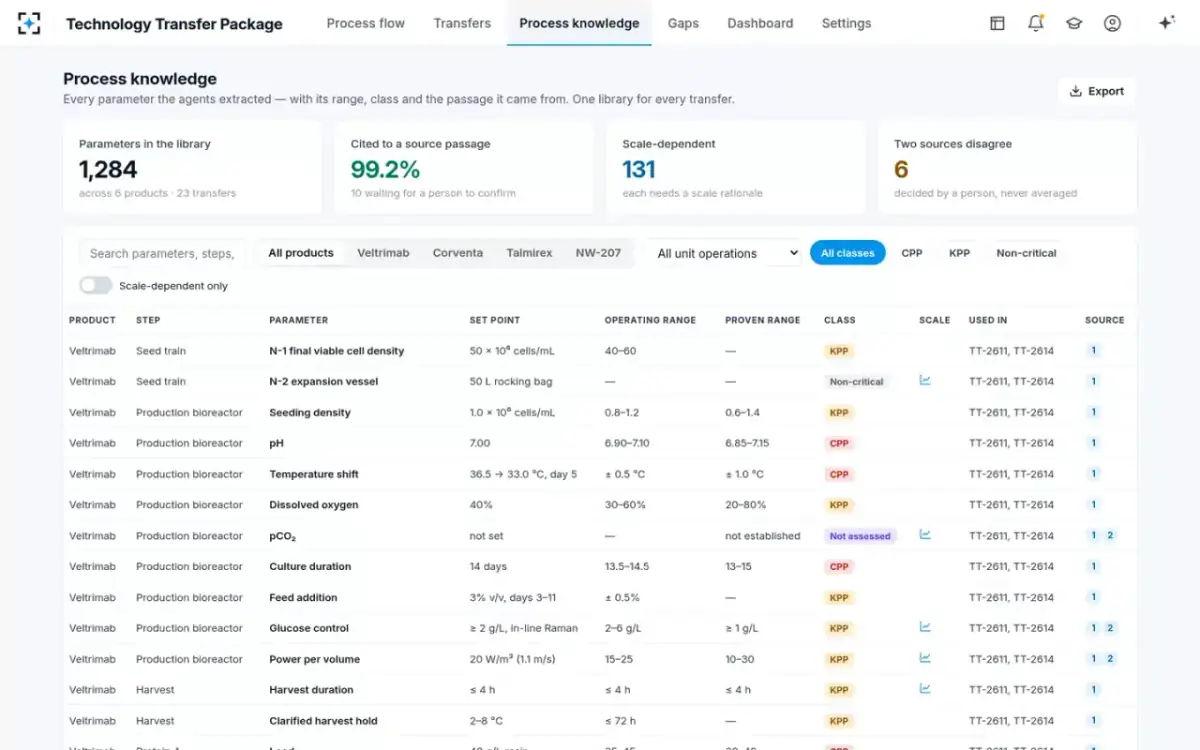
Structured authoring has a real limit, and it is one buyers can miss. A parameter library knows everything about the process and nothing about the plant. It can tell you that the harvest was validated between 10,000 and 12,000 × g. It cannot tell you that the receiving site's centrifuge tops out at 8,000, because the receiving site's equipment list is not a parameter.
Agents that read the records and compare the equipment
The fourth approach closes that loop by holding both sides and comparing them. In the worked software the reading is done by agents with written limits: the document reader never drops a page — every page is indexed or reported — and superseded versions are kept but never cited; the parameter extractor cites every value to its source passage, and where two sources disagree it raises a conflict rather than averaging or choosing; the equipment fit analyst never changes a validated range and shows every calculation with its inputs.
What that produces is not a search result but a comparison with arithmetic attached. On the worked transfer, three new documents arrived since the previous check — a hold-time study, a new revision of the receiving equipment list and a buffer hold study — and re-running the check took the agents between 1.5 and 4.3 seconds a step. The output was one new gap for a person to decide and a harvest step that had moved from fitting to not fitting, because an equipment limit had changed under it.
A re-check over three new documents, with each step and its limit in view
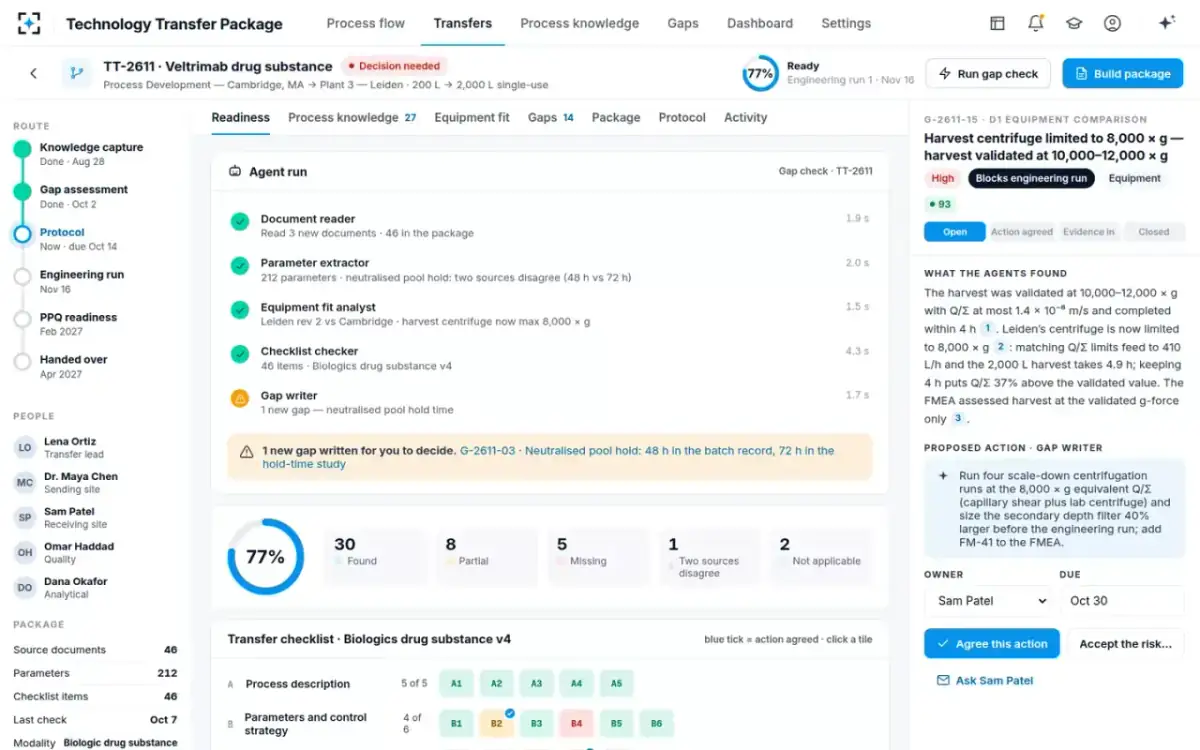
One transfer, run four ways: what each one found
The matrix below is the buying question reduced to capabilities rather than adjectives. Take it to a demonstration and ask for each row to be shown on your own documents, not on the vendor's.
A capability matrix for one transfer, with Technology Transfer Package in the last column
| Capability | Spreadsheet | Document store | Structured authoring | Reading and comparing |
|---|---|---|---|---|
| Holds a parameter with the passage it came from | By hand, if someone types a reference | Holds the document, not the parameter | Yes, where an author entered it | Yes, cited automatically as the record is read |
| Normalises units across sources | Only where a formula does it | No | Yes, if the library enforces units | Yes, as part of extraction |
| Compares a validated range with an equipment limit | No — the equipment list is elsewhere | No | No — the plant is not in the library | Yes, step by step, against the current revision |
| Shows the calculation behind a verdict | The formula is visible, the inputs may not be | Not applicable | Not applicable | Yes, inputs and result together |
| Raises a conflict between two sources | No | No | Only if both were authored into it | Yes, and never resolves it itself |
| Keeps an audit record of changes and deletions | Depends entirely on where the file lives | Yes, for documents | Yes, for values | Yes, for values, rules and decisions |
| Carries your own transfer procedure as a setting | The template is the procedure | No | Partly, through the schema | Yes — checklists, fit rule, risk threshold and approval rules |
Run that matrix honestly and many tools will land in columns two and three. That is not a scandal — a validated document store is a genuinely good thing to own, and structured authoring pays for itself on the second product. It is only a problem when a tool from column two is bought to solve a column-four problem, and the gap it was supposed to find turns up in the suite. What a failed engineering run costs is the arithmetic that makes that distinction expensive.
What does a computerised system have to prove under GMP?
Whichever of the four you buy, the obligations arrive with it, and they are a part of a business case that is often written last and can cost most. The European rules set the frame: risk management applied across the system's whole lifecycle, with the extent of validation and data integrity controls based on "a justified and documented risk assessment" (Annex 11, §1). Two specific clauses bite hardest on a transfer tool, because a transfer tool is, by definition, something you pour existing records into.
What a transfer system brings with it, whichever approach you choose
- A documented, risk-based validation
Annex 11 §1: how much validation and how many data integrity controls is a judgement you have to justify and write down, not a package the supplier ships.
- Migration checks on every load
Annex 11 §4.8: "If data are transferred to another data format or system, validation should include checks that data are not altered in value and/or meaning during this migration process." Meaning, not only value — a range flattened to a set point passes a value check and fails this one.
- A second check on critical data keyed by hand
Annex 11 §6 requires an additional accuracy check on critical data entered manually, by a second operator or by validated electronic means. Every parameter typed rather than read is in scope.
- A system generated record of changes and deletions
Annex 11 §9: "Consideration should be given, based on a risk assessment, to building into the system the creation of a record of all GMP-relevant changes and deletions", with the reason documented for each.
- Time-stamped audit trails under US rules
21 CFR 11.10(e) requires audit trails that are secure, generated by the computer and time-stamped, recording independently when an operator entered, changed or deleted an electronic record.
- A supplier assessment proportionate to the risk
Annex 11 §3.2 makes the competence and reliability of the supplier a key factor in selection, with the need for an audit based on a risk assessment.
The migration clause is worth reading twice, because it is the one that catches structured authoring projects. "Not altered in value and/or meaning" is a high bar when the source is a paragraph of prose and the destination is a typed field. A proven range of up to 72 hours loaded into a column called "hold time" has lost its meaning even though no digit changed, and a transfer package built on that column will be wrong in a way no reconciliation report will catch. The defence is to carry the citation with the value, so the sentence it came from is always one click away.
Where going digital does not help: the decisions
The last section is the one easiest to leave out of a sales pitch. On the worked transfer, when two sources disagree about the pool hold — 48 hours in the executed batch record, 72 in the new study, with high molecular weight species up 0.1% at 72 hours and 0.4% at 96 — none of the four approaches can tell you which one transfers. That is a judgement about how much margin to carry into a plant that has never run the step, and it belongs to the transfer lead, who records her choice and her reason.
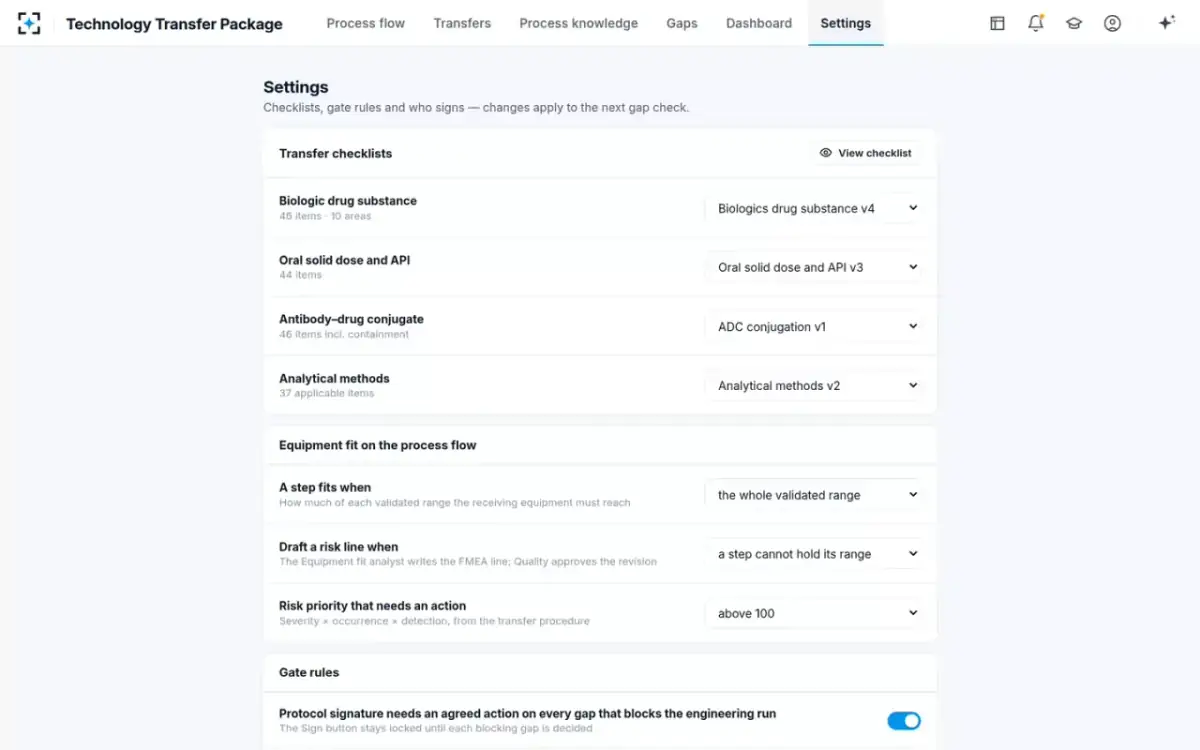
The same is true of the three decisions that actually determine a transfer's outcome: whether a gap blocks the first engineering run or only the qualification batches; whether a scale-down study is enough evidence to proceed; and whether a risk is accepted rather than actioned. In the worked software one setting cannot be switched off at all — two sources that disagree always go to a person — and the rest of the procedure is configuration: the checklists by modality, when a step counts as fitting, when a risk line is drafted, the risk priority that needs an action, and the approval rules. Changes apply to the next check and are recorded.
The transfer procedure as configuration, not as a change request
Regulators are already saying something similar about the direction of travel. The European Medicines Agency's reflection paper notes that "The use of AI/ML in the manufacturing of medicinal products including process design and scale up, process optimisation, in-process quality control and batch release is expected to increase in the coming years" (EMA reflection paper on AI in the medicinal product lifecycle, §2.3.6). Expected to increase is not the same as permitted without conditions, and the conditions are where the useful questions are; which transfer tasks can move to a machine and which cannot works through them task by task.
Questions people ask
What is process knowledge management?
ICH Q10 defines knowledge management as "a systematic approach to acquiring, analysing, storing and disseminating information related to products, manufacturing processes and components", and names technology transfer activities among its sources. In practice the useful test of whether a company has it is not whether a system exists but whether a receiving site can get at the development evidence behind a range without asking the person who generated it — which is what Annex 15 §5.10 asks for.
What does ALCOA mean for transfer data?
ALCOA is industry shorthand for data that is attributable, legible, contemporaneous, original and accurate; Annex 11 and 21 CFR Part 11 do not use the acronym, so argue from their clauses rather than the initials. For a transfer the ones that bite are Annex 11 §9, a system generated record of GMP-relevant changes and deletions with the reason documented, and 21 CFR 11.10(e), time-stamped audit trails that independently record entries and actions. Attributable, for transfer data, means a value you can trace to the passage and the person.
Does a transfer tool have to be validated?
If it holds or produces GMP-relevant data, yes, and the extent is a risk-based judgement you have to document: Annex 11 §1 requires risk management across the system's lifecycle "taking into account patient safety, data integrity and product quality", with decisions on the extent of validation based on a justified and documented risk assessment. A tool that drafts a transfer package from which a batch record will be written is very likely in scope; the argument is usually about how much, not whether.
What is the difference between a document management system and a knowledge system?
A document management system holds documents and answers questions about them: which version, who approved it, where is it. A knowledge system holds the facts inside the documents — a value, its ranges, its class, its units, its source — and can therefore answer questions the documents never anticipated, including whether two of them disagree. Many companies need both, and a common mistake is buying the first and expecting the second.
What should a team digitise first?
The parameters, not the documents, if the goal is to find gaps earlier. Version control on reports is the more urgent fix if your current problem is people citing superseded studies — but it will not change what you find before a batch. A useful sequencing test: write down the last three expensive surprises in your transfers and ask which approach would have surfaced each one. If two of the three were equipment that could not hold a range, no amount of document search would have helped.
What can digital tools not do in a technology transfer?
Decide. Which of two conflicting values transfers, whether a scale-down study is sufficient evidence, whether a gap blocks the engineering run or only the qualification batches, and whether a residual risk is accepted — all four are judgements a named person has to make and sign for, and none of them becomes safer by being automated. A tool earns its place by making those four decisions arrive earlier, with the evidence attached.