MS&T in pharma stands for Manufacturing Science and Technology: the group that owns a product's process in the years between the laboratory that invented it and the plant that will make it for the rest of its commercial life. On a technology transfer, MS&T holds the parameter table, argues the scale-up, writes the gap list and carries the protocol to signature. The hard part is not the project plan. It is that a transfer is held together by four signatures whose meanings the rules prescribe, and an MS&T organisation is only as real as whether each of those four people has something concrete to sign for. Botminds' Technology Transfer Package assembles the package they sign: every parameter cited to the development report it came from, every step compared with the receiving site's equipment list before anyone signs.
The worked example throughout is sample data — the people, companies, products and sites are fictional. It is one transfer inside the software, TT-2611, moving a biologic drug substance from a 200 L pilot suite in Cambridge, Massachusetts to a 2,000 L single-use suite at Plant 3 in Leiden. The rules quoted beside it are the regulators' own, linked where they appear.
One transfer in Technology Transfer Package, counted in seats and signatures
10transfers
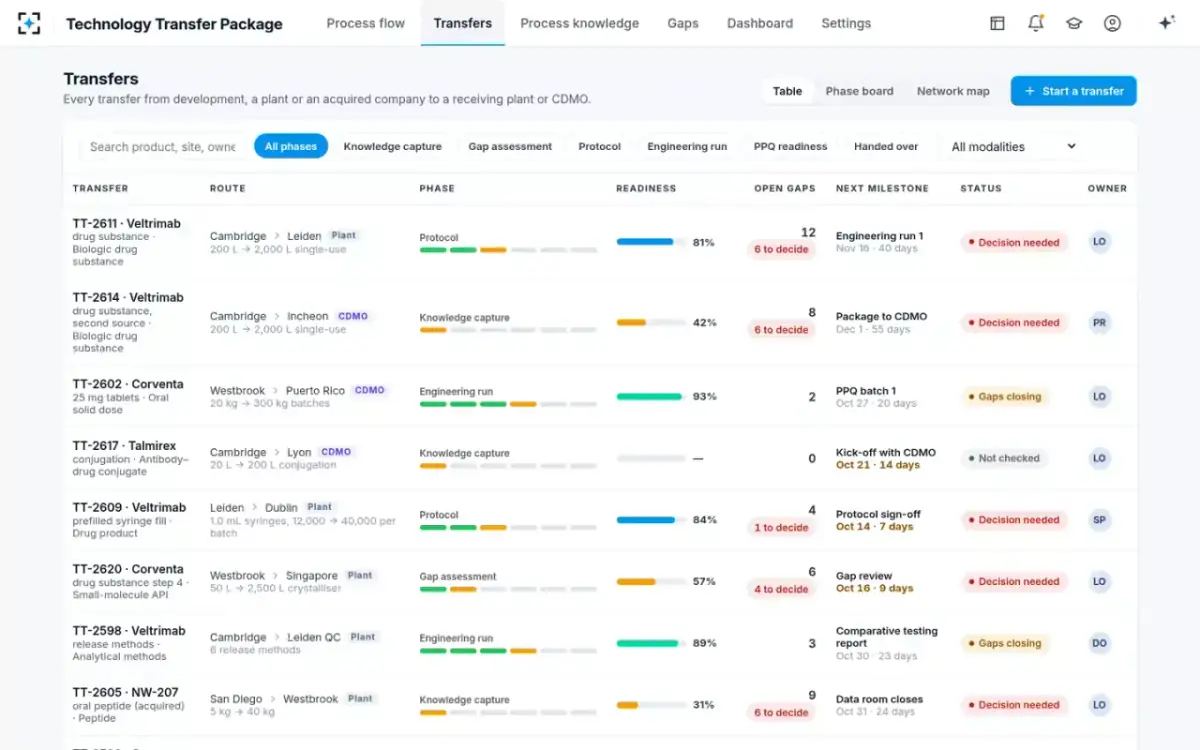
in the worked network, from development, a plant or an acquired company to a receiving plant or contract manufacturer
5seats
named on one of them, each owning a different part of the package
4signatures
on its transfer protocol: sending site, receiving site, quality and the transfer lead
46items
in the transfer checklist those four signatures rest on
What does MS&T do in pharma?
MS&T owns the process, not the project. Development invents a process and proves it works at the scale it was invented at; the plant runs a process it has been handed. MS&T is the seat in between, and it has four standing duties: custody of what is known about the process and where each number came from; moving that process to a new site and defending it there; supporting it after it is running, through deviations, trends and continued verification; and assessing every change anyone proposes to it. A transfer is the loudest of the four, but the other three are why the group exists at all.
The regulations never use the abbreviation. What they name is the duty. The World Health Organization's guideline on technology transfer says a transfer "should be managed by responsible persons from each site (the SU and RU) and any other units with the appropriate technical and quality oversight", and that a transfer team "may be appointed with identified and documented responsibilities" (WHO TRS 1044, Annex 4, §5.6; SU is the sending unit, RU the receiving unit). Every word of that is a staffing decision: a responsible person at each end, not one at the sending end and a mailbox at the other, and technical oversight sitting beside quality oversight rather than inside it.
The second thing the rules settle is what MS&T does not displace. EU GMP Annex 15 is blunt about who should be in the suite when the validation batches run: "It is expected that production personnel are involved in the manufacture of validation batches to facilitate product understanding" (Annex 15, §5.11). An MS&T group that writes a beautiful protocol and then runs the batch itself has moved the knowledge into its own heads rather than into the plant's. The transfer is finished when the receiving site can run the process without the people who brought it.
The five seats on a transfer, and what each one owns
On the sample transfer, five people are named, and the useful way to tell them apart is not by title but by what each one is the last word on. The transfer lead decides; the sending site explains; the receiving site accepts or refuses; quality approves or rejects; analytical development owns the methods. Where two of those blur into one person, the transfer loses a check rather than a headcount.
Five seats on sample transfer TT-2611, and what each one is the last word on
| Seat | What it owns | What it signs | The rule behind it |
|---|---|---|---|
| Transfer lead, MS&T | The transfer as a whole: the parameter table, the gap list, and which value transfers when two documents disagree. | The protocol, with the meaning "approved — transfer lead", after agreeing the action on every gap that blocks the first run. | WHO TRS 1044 Annex 4 §5.6: responsible persons from each site, with technical and quality oversight. |
| Process development scientist, sending site | The characterisation reports the ranges come from, and what each number actually means. | The protocol as technically accurate — that the process it describes is the process the development work found. | WHO §5.8: the sending unit should make available in relevant documents all the necessary information and knowledge. |
| MS&T lead, receiving site | The suite, the equipment list and its revisions, and the actions on his own machines. | The protocol for the receiving site, and a co-signature on every gap closure. | WHO §9.1: the sending unit provides a list of equipment and instruments with makes and models, to be evaluated against the receiving site’s. |
| Quality assurance | Approval or rejection of the procedures and specifications the transfer creates, and the revision of the risk assessment. | The protocol, the reports, and the revised risk assessment carrying the new equipment lines. | 21 CFR 211.22(c): the quality control unit approves or rejects all procedures or specifications impacting identity, strength, quality and purity. |
| Analytical development | The release methods and their transfer to the receiving site’s quality control laboratory; method gaps by default. | The method-transfer protocols and their reports, separately from the process protocol. | WHO §5.3: responsibilities of the sending and receiving units, sponsor and marketing authorization holder defined in writing. |
Two of those lines are worth arguing with. The first is the analytical seat. Method transfer runs on its own clock, with its own protocols and its own acceptance criteria, and on the sample network it is a transfer of its own — six release methods going to the receiving site's quality control laboratory, tracked beside the process transfer rather than inside it. Teams that fold it into the process protocol discover late that the potency assay, not the bioreactor, is the long pole; how a pharmaceutical technology transfer runs end to end follows both clocks.
The second is the transfer lead's. Deciding is a job, and it is the one that does not scale by hiring. On the sample transfer the lead has twelve open gaps, six of them waiting on her decision, and the decisions are not interchangeable: which of two hold times transfers, whether a scale-down study is enough evidence, whether a risk is accepted or actioned. What a tech transfer gap analysis actually produces is the list she works from.
The same five seats, before and after the reading is done for them
Today
Assembles each package by hand from reports and spreadsheets, and learns in the engineering run that a receiving machine cannot hold a range.
With agents
Picks a receiving site on the process flow and sees each step fit, adjust or gap, with the risk line already drafted.
Still theirs: every decision, and the reason recorded against it
Today
Wrote the characterisation reports — everything is in them, if you know which page — and answers the same questions on every transfer.
With agents
Every parameter in the library points at the passage in her reports it came from, so the question is asked of the document, not of her.
Still theirs: whether the protocol is technically accurate
Today
Owns the suite and its equipment list, and needs the range, not just the set point, to know whether his machines can run it.
With agents
Sees sending against receiving aspect by aspect, with the scale factors computed and shown.
Still theirs: what his site can deliver, and a co-signature on every gap closure
Today
Approves protocols and risk assessments, and needs every equipment risk assessed before the engineering run, not after.
With agents
Approves a protocol whose blocking gaps each carry an agreed action, with the drafted risk lines and their sources attached.
Still theirs: approval or rejection, and the authority behind it
Today
Transfers the release methods, where the potency assay is the long pole, and finds out late that it is on the critical path.
With agents
Owns method gaps by default and tracks each method transfer on the same list as the process transfer.
Still theirs: the acceptance criteria for every method
Who signs a technology transfer protocol?
No rule fixes the list, but the rules point to it: the WHO guideline asks for responsible persons at each site with technical and quality oversight, and US rules give the quality unit approval authority. On the sample transfer, four people sign: the sending site, the receiving site, quality assurance, and the transfer lead who owns the transfer. The order matters as much as the list. The sending site signs for what the process is; the receiving site signs for what its equipment can do; quality signs for whether the whole thing may proceed; and the transfer lead signs last, because the lead's signature is the one that says every open action has an owner and a date.
On the sample transfer that chain ran over three days. The sending site's scientist signed on 5 October at 11:02, two days before the rest, because her signature is against the process description and nothing in the equipment argument changes it. The other three signed on 7 October, after the lead had worked through the five actions still open and agreed each one.
The signature chain on sample protocol TTP-2611: five steps, none of them automatic
A person decides
Process development scientist, sending siteSigns that the process description, the parameters and the validated ranges in the protocol are what the development work actually found. Signed 5 October, 11:02.
Never: signs for whether the receiving plant can hold those ranges — that is not her evidence
A person decides
Transfer lead, MS&TWorks through every gap that blocks the first engineering run and agrees the action, its owner and its due date, one at a time. Five were still open on the morning of 7 October.
Never: closes a gap alone — a closure needs the receiving site’s co-signature
A person decides
MS&T lead, receiving siteSigns for the site that will run the process: the equipment list is the current revision, and the actions on his machines are ones he can deliver by their dates. Signed 7 October.
Never: signs for a step whose validated range his equipment cannot reach without an agreed action
A person decides
Quality assuranceApproves the protocol and the revision of the risk assessment that carries the newly drafted equipment lines. Signed 7 October.
Never: approves while a gap that blocks the engineering run has no agreed action
A person decides
Transfer lead, MS&T — lastSigns the protocol with the meaning "approved — transfer lead", which is the signature that says the other three had what they needed. Signed 7 October, 19:31.
Never: signs before the other three, which is why the lead signs last
Eight blocking gaps, each with its agreed action, and four signatures with their meanings
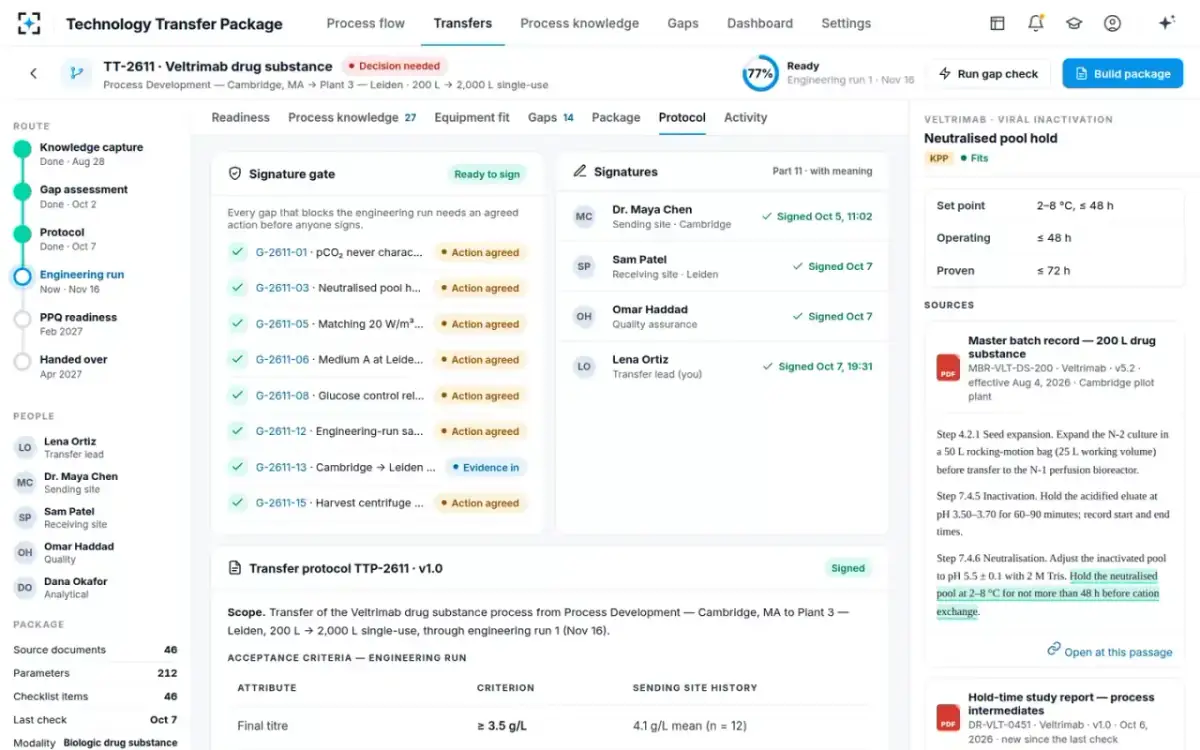
What a signature has to mean, in writing
A signature on a regulated record has to say what it is for. The US electronic records rule requires every signed electronic record to carry the signer's printed name, the date and time, and what the signature means — review, approval, responsibility or authorship, for example (21 CFR 11.50(a)(3)). That short clause does more work than any transfer procedure. It means a page with four names on it and no meanings is not four signatures; it is four people who looked at something.
"The technology transfer should be managed by responsible persons from each site (the SU and RU) and any other units with the appropriate technical and quality oversight."
WHO TRS 1044, Annex 4, §5.6
Write the meanings out and the seats stop overlapping. On the sample protocol they read: technically accurate, for the sending site; accepted for the receiving site; approved for quality; approved, transfer lead. Four different claims about one document. The sending scientist is not claiming the plant can run it. The receiving lead is not claiming the development work was sound. Quality is not claiming either, only that the procedures and specifications are approvable. And the lead is claiming that the three before her had what they needed and every open action is owned.
The same rule tells you what to do when the meanings cannot be written. If nobody can say what the second quality signature is for, it is a review, not an approval, and calling it an approval in the procedure is how a transfer ends up with four names and one decision. The test is cheap to run on your own template: take last year's signed protocol and write beside each signature the sentence that signature asserts. Any line you cannot finish is a seat that does not exist.
The quality unit's authority, and where it starts
Quality's signature on a transfer protocol is not a courtesy at the end of a technical argument. The US regulation gives the quality control unit standing authority over exactly the artefacts a transfer produces: it "shall have the responsibility for approving or rejecting all procedures or specifications impacting on the identity, strength, quality, and purity of the drug product" (21 CFR 211.22(c)). A transfer protocol is a set of procedures and specifications; so is a revised master batch record, a new hold time and a changed in-process limit. The authority is there whether or not the transfer procedure mentions it.
The same section adds the part a transfer procedure can easily skip: "The responsibilities and procedures applicable to the quality control unit shall be in writing; such written procedures shall be followed" (211.22(d)). So "quality reviews the protocol" is not a procedure. What quality approves, what it may reject, at which point, and on what evidence — those are the words that have to exist before the first transfer, not after the first argument.
In the software, quality's authority has a concrete surface. A risk line that the equipment comparison drafts — on the sample transfer, a harvest step the receiving centrifuge cannot reach, scored severity 7, occurrence 5, detection 4 for a risk priority of 140 against an action threshold of 100 — stays a draft until quality approves the revision of the risk assessment. The analyst proposes a number; it is not in the risk assessment until the unit with the authority puts it there.
The receiving site's seat: why the range matters more than the set point
The receiving site's lead owns one artefact above all others, and it is the one most likely to go out of date: the equipment list. The WHO guideline asks the sending unit for a list of equipment and instruments including "the makes and models of the relevant equipment and instruments, including automated systems and those of single use" (§9.1), and then, among the factors to review, names "minimum and maximum capacity", "critical operating parameters" and "range of intended use" (§9.5). Capacity and range, not set point. That distinction is the whole seat.
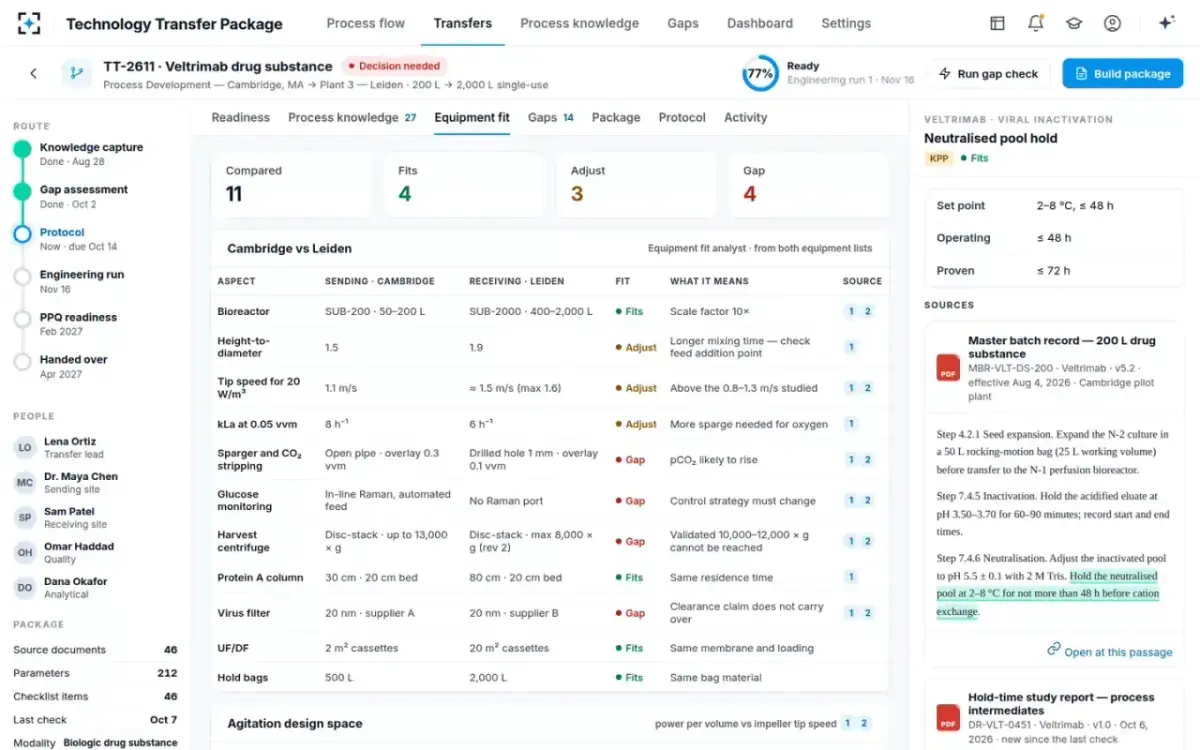
Here is why it bites. On the sample transfer the agitation set point at the sending scale is 20 W per cubic metre of power input. Matching it on the receiving site's 2,000 L single-use bioreactor needs an impeller tip speed of about 1.5 metres per second, against a machine maximum of 1.6 and a studied range of 0.8 to 1.3. Compare set points and the step passes. Compare ranges and the step is an adjustment with a study behind it, raised as a gap owned by the receiving lead, due before the engineering run.
The receiving site's revision history matters as much as the list. On the sample transfer the Leiden list went to revision 2 on 5 October and the harvest centrifuge came back limited to 8,000 × g, against a harvest validated at 10,000–12,000 × g. The last full gap check was three days old; the protocol was due in nine days. Without a re-check against the new revision, that transfer signs a protocol for a machine that no longer exists as described.
Sending against receiving, aspect by aspect, with what each difference means
The written agreement between two sites, and what it must cover
Seats are allocated inside a company by an org chart. Between two legal entities — a sponsor and a contract manufacturer, or two companies after an acquisition — they are allocated by a written agreement, and the WHO guideline says what it is for: "There should be formal written agreements, signed between the parties involved in technology transfer, that specify the responsibilities of each party before, during and after transfer. The agreements should cover, for example, data management, data integrity, documentation and validation" (§5.2). The guideline adds that responsibilities of the sending and receiving units, the sponsor and the marketing authorization holder "should be defined in writing" (§5.3).
Read that list against a typical transfer kick-off deck and the omission is easy to spot. Scope, timeline and deliverables are covered. Data management and data integrity — who holds the raw development data, in what form, for how long, and what the receiving site is entitled to see of it — are not. That is the clause that decides, eighteen months later, whether the receiving site can defend a range it did not generate.
What a transfer agreement has to settle before the first document moves
- Responsibilities before, during and after the transfer
Three periods, not one. After is the one that is forgotten: who answers a question about a range two years into commercial supply.
- Data management
Which records move, in what form, and which stay. A summary report is not the data a receiving site needs to defend a parameter.
- Data integrity
Whose system of record the transferred values live in, and how a value is traced back to the study that produced it.
- Documentation
Which document controls when the sending site’s batch record and the receiving site’s differ, and who revises which.
- Validation
Who writes, executes and approves each qualification and validation protocol, and whose acceptance criteria apply.
- The named responsible person at each end
One at the sending unit, one at the receiving unit, with technical and quality oversight beside them, as §5.6 asks.
- What the receiving site may refuse
The clause that makes the receiving signature mean something: the grounds on which the site can decline to accept a step.
- Who sees what, where two customers share a site
A contract manufacturer running three sponsors’ transfers needs each to be invisible to the others; on the sample network each contract site sees only its own transfer.
What the work pays, and what it asks of you
There is no published wage series for MS&T, because it is not an occupation any statistical agency counts. The nearest published figure is for chemical engineers, an occupation many MS&T engineers fall under. The US Bureau of Labor Statistics reports that "The median annual wage for chemical engineers was $125,040 in May 2025", with employment "projected to grow 5 percent from 2025 to 2035, faster than the average for all occupations" and "About 1,100 openings for chemical engineers are projected each year, on average, over the decade" (BLS Occupational Outlook Handbook). The federal occupational database gives the same median, $125,040 a year or $60.12 an hour for 2025, under a definition updated in 2026: "Design chemical plant equipment and devise processes for manufacturing chemicals and products" (O*NET OnLine, 17-2041.00).
Treat those as the floor of the range rather than the number. They cover an occupation far wider than biologics process transfer, they are a median across all seniorities, and a transfer lead in a biologics network is likely to be at the senior end of it. The honest use of the figure is directional: the pay is engineering pay, not project-management pay, and the market for it is growing modestly rather than explosively.
What the work asks is written down more precisely than what it pays. The US regulation requires that "Each person responsible for supervising the manufacture, processing, packing, or holding of a drug product shall have the education, training, and experience, or any combination thereof, to perform assigned functions" (21 CFR 211.25(b)), and the WHO guideline asks that transfer team members "have the necessary qualifications and experience to manage the particular aspects of the transfer" (§5.7). In practice that means three things a job advertisement rarely says plainly: you must be able to read a characterisation report and tell a proven range from a studied one; you must be able to do the scale arithmetic yourself rather than accept it; and you must be willing to be the person who says a gap blocks a batch when a date is already booked.
One week on a transfer, hour by hour
The week below is the sample transfer's, from the last full gap check on 2 October to the evening of 7 October, when the protocol was signed. It is included because the abstract answer to "what does MS&T do" is useless, and because the shape of the week — long stretches of reading, then a cluster of decisions nobody else can take — is the thing an MS&T job actually is.
One week on sample transfer TT-2611, and who each decision belonged to
| When | What happens | Whose seat | What changes |
|---|---|---|---|
| 2 Oct | The last full gap check. The checklist stands at 46 items, the package at 212 parameters from 43 development records. | Transfer lead | A baseline: the open gaps, and the equipment comparison against revision 1 of the receiving list. |
| 5 Oct, 11:02 | The sending site’s scientist signs the protocol as technically accurate. | Process development | The process description is fixed. Nothing in the week that follows reopens it. |
| 5 Oct | The receiving site issues revision 2 of its equipment list. The harvest centrifuge is now limited to 8,000 × g. | Receiving site | The equipment comparison is stale, and nobody knows it yet. |
| 7 Oct, morning | The gap check runs again over three new documents — a hold-time study, the new equipment list, a buffer hold study. The checklist reads 30 found, 8 partial, 5 missing, 1 where two sources disagree, 2 not applicable. | The agents | A new gap is written for a decision, and the harvest step turns red. |
| 7 Oct, morning | The harvest step is re-compared: matching the validated flow ratio limits the feed to 410 L/h, so 2,000 L takes 4.9 hours against a 4 hour window; keeping 4 hours would push the ratio above the validated value. A risk line is drafted at 140 against a threshold of 100. | Receiving site, with quality | Gap G-2611-15 is raised as high and blocking, with a proposed action and an owner. |
| 7 Oct, midday | Two sources disagree on the neutralised pool hold: 48 hours in the batch record, 72 hours in the new study. Both are shown; neither is picked. | Transfer lead | She records 48 hours as the operating limit and 72 as the proven limit, with her reason. |
| 7 Oct, afternoon | The five actions still open are reviewed one by one, each given an owner and a date. | Transfer lead | Every gap that blocks the engineering run now carries an agreed action. |
| 7 Oct, 19:31 | The receiving site signs, quality approves, the lead signs last. The transfer moves to engineering run, 40 days out. | All four | Protocol TTP-2611 v1.0 is signed, with each signature’s meaning stored beside it. |
Two things in that week are worth naming. The first is that most of its rows are reading and checking, and most of the decisions in it fall to one person, the transfer lead. The second is that the most consequential event — a receiving site issuing a new equipment list two days before the signatures — could easily have passed unnoticed in a transfer run on a shared folder, and it is the event that changed what was signed on 7 October. What each section of a transfer protocol contains sets out the document those signatures land on.
Ten transfers, each with an owner and the decisions waiting on them
Questions people ask
What does MS&T stand for?
Manufacturing Science and Technology. Some companies call the same group Technical Operations, Technical Services, Process Sciences or Manufacturing Technical Support; the regulations use none of these names and instead require "responsible persons from each site" with technical and quality oversight (WHO TRS 1044 Annex 4, §5.6). If you are comparing job titles across two employers, compare what the seat signs rather than what it is called.
What is the difference between MS&T and process development?
Process development invents and characterises the process and owns the evidence for its ranges; MS&T owns the process from the point it has to run somewhere else, and for the rest of its commercial life. On a transfer the practical split is that development signs the protocol as technically accurate and MS&T signs as approved, having agreed the action on every gap. One answers "is this what we found"; the other answers "can this run there, and what is still open".
Who owns the equipment list at the receiving site?
The receiving site does, and it owns its revisions. The WHO guideline asks the sending unit to supply its own list with makes and models (§9.1), the two to be compared side by side by working principle, capacity, make and model (§9.2), and factors such as capacity and range of intended use to be reviewed (§9.5). The risk is a revision, not a list: on the sample transfer a new revision issued two days before the signatures limited the harvest centrifuge to 8,000 × g, below the 10,000–12,000 × g the harvest was validated at, and turned a step that fitted into a gap that blocked a batch.
Does quality have to sign the transfer protocol?
Where the protocol sets or changes procedures or specifications that affect identity, strength, quality or purity, the quality unit's approval is not optional under 21 CFR 211.22(c), and 211.22(d) requires its responsibilities and procedures to be in writing and followed. What varies between companies is when quality signs — at the protocol, at each gap closure, at the report — and that is exactly the thing the written procedure has to settle before the first transfer rather than during it.
What does a tech transfer role in pharma pay?
No agency publishes a wage for MS&T as such. The closest published figure is for chemical engineers: a median of $125,040 a year in May 2025, with employment projected to grow 5 percent from 2025 to 2035 and about 1,100 openings a year (US Bureau of Labor Statistics). A biologics transfer lead is likely to sit above that median, because the role is senior by construction — it is the seat that decides — but treat the published number as the floor of a wide range, not an estimate of the job.
How many people does a tech transfer team need?
Five named seats is what the sample transfer carries, and it is a reasonable floor rather than a target: a responsible person at each site, quality, the development author, and analytical development for the methods. What matters is not the headcount but that no two of the five collapse into one person, because each of the four signatures asserts something different, and a signature nobody else can contradict is a review in disguise.