Tech transfer software is a crowded label: much of what is sold under it is a document store, a project tracker, or a document store with a project tracker bolted to it. Both are useful. Neither answers the question that decides what a transfer costs, which is whether the receiving site's equipment can hold the range the process was validated in. That is a comparison, it needs four facts a document store does not keep, and it has to show its arithmetic. Botminds' Technology Transfer Package is built around that comparison, and this guide is written so you can test it, or any competitor, on evidence rather than on a demonstration.
The worked examples use sample data — the people, companies, products and sites are fictional, and the two performance figures quoted are the solution's stated design targets rather than a measured customer result. The rules cited are the European and US obligations that arrive with any computerised system doing this job.
The numbers to score a trial on, and what Technology Transfer Package targets
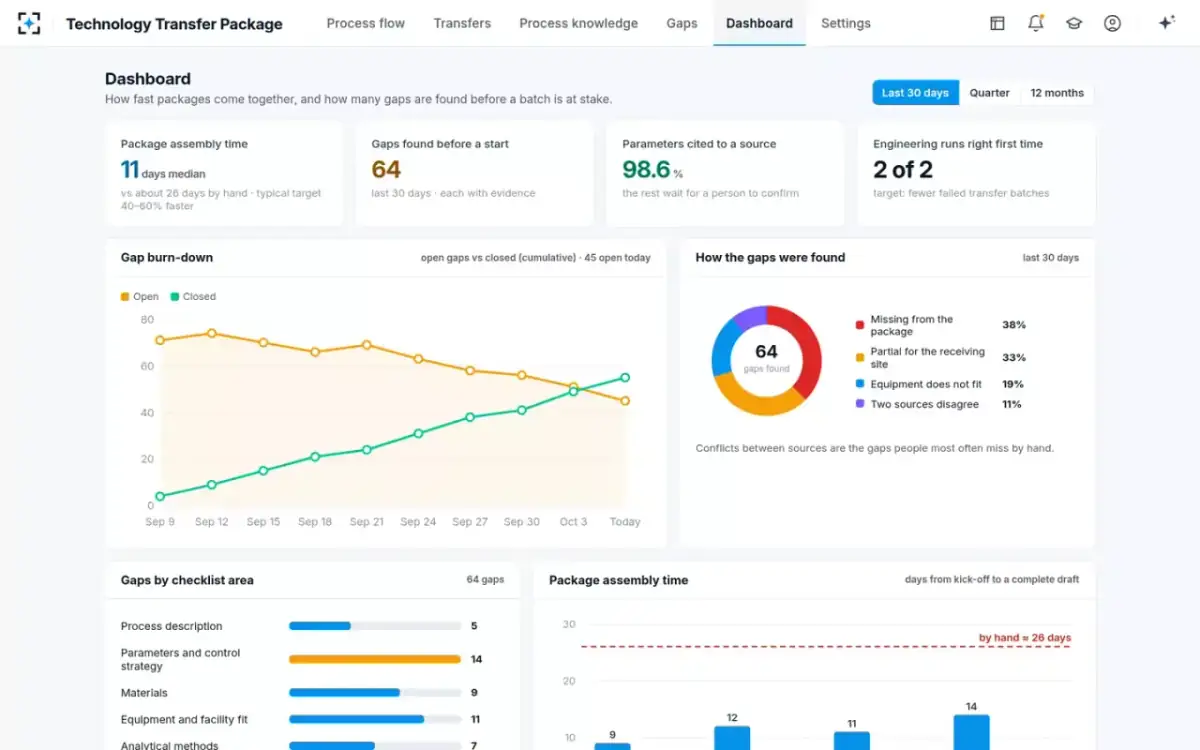
64gaps
found before a start, over thirty days on the sample network — the measure that actually pays for a tool
98.6%
of parameters cited to a source passage, a stated design target; a person confirms the rest
11days
median to a complete package draft against about 26 by hand — an estimate and a design target
2 of 2
engineering runs right first time on the sample network, against a target of fewer failed transfer batches
What should tech transfer software do?
It should hold every process parameter as a value with its ranges, its class, its units and the passage it came from; hold the receiving site's equipment by revision; compare the two step by step; show the arithmetic behind every verdict; raise a conflict when two documents disagree and refuse to resolve it; write a gap with its evidence, a proposed action and an owner; carry your own transfer procedure as configuration; and keep a record of who changed what, when and why. Everything else on a feature list — templates, dashboards, notifications, a timeline view — is convenience, and convenience is not what the engineering run bills you for.
The core of that specification is not an opinion. It is the comparison the WHO guideline on technology transfer asks for, restated as software: "A review and side-by-side comparison of the equipment and instruments, as well as process steps and parameters of the SU and RU, should be carried out in terms of their working principle, capacity, make and model to ensure that they are capable of appropriately performing the required processes and methods" (WHO TRS 1044, Annex 4, §9.2). Side by side, in terms of capacity. Any tool that cannot hold both sides cannot do the sentence.
The guideline adds a precondition people forget to ask about: "Equipment and instruments should be qualified and calibrated before using them to support the technology transfer activities" (§10.2). A comparison against an equipment list is only as good as the list, which is why the revision date of the receiving site's list matters more than almost anything in a product demonstration.
Twelve questions for a vendor, and the answers that should worry you
Ask these in this order, on your own documents, with your own equipment list. The worrying answers are not lies; they are the honest answers of a product built for a different job, which is exactly what you need to find out before a procurement process acquires momentum.
Twelve questions, with the answer that should worry you
- Show me a parameter and the passage it came from, in one click
Worrying: "it links to the document". A document is not a passage, and a reviewer who has to find the sentence will stop checking by the third parameter.
- Show me the same parameter where two sources disagree
Worrying: anything that produces a single value. The correct behaviour is to show both, name both sources and stop.
- Compare this validated range against this equipment limit, now
Worrying: "that is a services engagement" or "we would configure that". This is the capability; it cannot be a project.
- Show me the calculation, with its inputs
Worrying: a verdict with no arithmetic. If an engineer cannot re-do it on paper, it is not evidence.
- What happens when the receiving site issues a new equipment revision?
Worrying: "you re-upload it". The useful answer is that the comparison moves and the steps that changed are listed.
- Which of your rules are settings, and who can change them?
Worrying: "we can customise that for you", which means a change request, a release and a revalidation every time your procedure changes.
- Which setting cannot be switched off?
Worrying: "all of them are configurable". At least one control — a disagreement between sources goes to a person — should be beyond an administrator.
- Show me a page the reader could not read
Worrying: "that does not happen". A tool that cannot report what it failed to read cannot tell you what it does not know.
- Show me the audit record for a rule change
Worrying: an audit record that covers documents but not settings. The rule in force when a check ran is part of the result.
- What is the validation package, and what is left for us?
Worrying: "it is validated". Annex 11 makes the extent of validation your risk-based judgement; what you want is their evidence plus a clear boundary.
- How does a contract site see its own transfer and nothing else?
Worrying: "we would set up a separate instance", which is how two customers end up on two different versions of your procedure.
- Run this on the transfer we closed last year, and score it against what we actually found
Worrying: reluctance. This is the only question on the list whose answer cannot be prepared in advance.
Document store, project tracker, or comparison engine?
Three kinds of system get sold into this budget, and the fastest way to tell them apart is to ask each one a question from a real transfer and see which can answer it at all.
One question, asked of three kinds of system
| The question | Document store | Project tracker | Comparison engine |
|---|---|---|---|
| Where is the current hold-time study? | Answers instantly, with the version and the approver. | Links to it, if someone attached it. | Answers, and also names the passage the hold time came from. |
| Is the transfer on schedule? | No view of it. | Answers instantly, which is what it is for. | Answers in gaps and milestones rather than tasks. |
| What is the validated range for the harvest? | Returns the document that contains it. | No view of it. | Returns the value, the operating and proven ranges, the class and the source. |
| Can the receiving centrifuge hold that range? | Cannot answer — the equipment list is a different document. | Cannot answer. | Answers with the arithmetic: matching the ratio means 410 L/h and a 4.9 h harvest against a 4 h window. |
| Do any two of our documents disagree? | Cannot answer — it compares documents to queries, not to each other. | Cannot answer. | Lists them, with both values and both sources, unresolved. |
| What did we know, and when? | Version history of each document. | Task history. | The value, the rule in force when it was checked, and who decided what. |
A buying process can go wrong between rows two and four. A project tracker demonstrates beautifully, because schedule is legible and comparison is not, and the thing on screen in a demonstration is a Gantt chart rather than a centrifuge limit. The four approaches to running a transfer, set side by side works through the same distinction from the practitioner's end.
Can your own procedure be a setting rather than a change request?
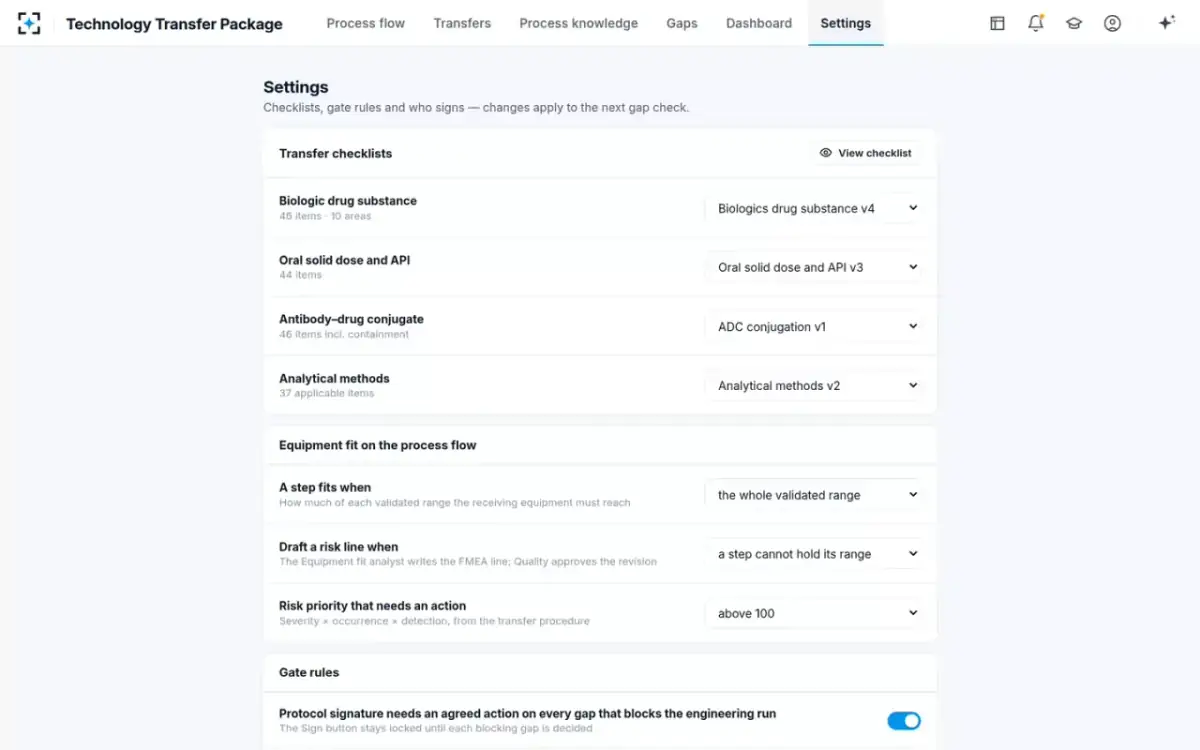
This is the question that decides the five years after purchase. Transfer procedures tend to differ in the same handful of places, and each of them is either a setting you control or a conversation with a vendor's roadmap. The ones to check by name: which checklist applies to which modality and at which version; whether a step counts as fitting when the equipment covers the whole validated range or only the normal operating range; when a risk line is drafted; the risk priority above which an action is required; whether a signature requires an agreed action on every gap that blocks the engineering run; whether closing a gap needs both sites; and whether every scale-dependent parameter needs a scale rationale.
In the worked software all seven are settings, with the thresholds offered as explicit alternatives — above 80, above 100 or above 120 for the risk priority, for instance — and changes apply to the next check and are recorded. One rule is deliberately not a setting at all: two sources that disagree always go to a person. That asymmetry is the thing to look for. A product where everything is configurable has no opinion, and a product with no opinion will let an administrator quietly switch off the control the whole argument rests on.
Seven rules a company should own, as configuration
What evidence to ask for: show me the calculation
A verdict is a claim; a calculation is evidence. The practical form of that distinction, on a transfer, is whether the tool will put its inputs on the screen beside its conclusion. When the worked software says the harvest step cannot hold its range at the receiving site, it shows the validated values, the two ways of matching them and what each one costs: match the flow-to-settling-area ratio and the feed drops to 410 L/h so 2,000 L takes 4.9 hours against a four-hour window; keep the four hours and the ratio runs above the validated value.
An engineer can argue with every number in that sentence. That is the test. A receiving-site lead who disagrees with a conclusion has nothing to do but escalate; one who disagrees with an input has something to check. Demand the same of every claimed capability: not the answer, the working.
The same applies to the counting. When a tool reports that it found sixty-four gaps before a start, ask how a gap is defined, whether a conflict between two sources counts as one, and what proportion were equipment that does not fit rather than a missing document. On the sample network the breakdown is 38% missing from the package, 33% partial for the receiving site, 19% equipment that does not fit and 11% two sources that disagree — and the last two categories are the ones most likely to surface late, in the engineering run or after it.
The computerised-system obligations the buyer inherits
Whatever you buy, a set of obligations arrives with it and lands on you rather than on the vendor. Three are worth settling in the contract rather than after go-live.
The first is the agreement itself. Annex 11 is explicit: "When third parties (e.g. suppliers, service providers) are used e.g. to provide, install, configure, integrate, validate, maintain (e.g. via remote access), modify or retain a computerised system or related service or for data processing, formal agreements must exist between the manufacturer and any third parties" (Annex 11, §3.1), with clear statements of the third party's responsibilities. ICH Q10 says the same thing about outsourced activities generally: responsibilities and communication processes for quality-related activities should be defined, and "For outsourced activities, this should be included in a written agreement between the contract giver and contract acceptor" (ICH Q10, §2.7(b)).
The second is validation. The US rule requires systems to be validated so that they are accurate and reliable, perform consistently as intended, and can tell when a record is invalid or has been altered (21 CFR 11.10(a)), and the European annex makes the extent of it your documented, risk-based judgement. A vendor's package is an input to that judgement, never a substitute for it. Agree in writing which test evidence you may rely on, which you must repeat in your own environment, and what happens at each release.
The third is the audit record, and it carries a requirement people read past: "Audit trails need to be available and convertible to a generally intelligible form and regularly reviewed" (Annex 11, §9). Available, intelligible and reviewed — three separate obligations, the last of which implies somebody's standing job. Ask to see an exported audit record during the trial, not a screenshot of one.
How do you pilot technology transfer software on a closed transfer?
A demonstration shows you a product working on data chosen to make it work. A trial on a transfer you have already closed shows you the product working on your documents, and — because you already know what the transfer found and when — it gives you a scoring key no vendor can prepare for. Pick a transfer that finished in the last two years, that had at least one difference discovered late, and whose gap list and meeting minutes you can still get at.
A three-week trial on a transfer you have already closed
- Prepare the documents3 d
- Load and check2 d
- Check1 d
- Score it2 d
- A second transfer4 d
- Score and decide3 d
Two details decide whether the trial is honest. First, load the documents as they were at the start of the transfer, not as they are now, and use the receiving site's equipment list at the revision that was current then. A tool handed the final, corrected record will find the gaps because they have already been fixed. Second, have someone who was not on the original transfer do the scoring, because the person who ran it knows which gaps mattered and will unconsciously grade on a curve.
The scoring sheet: four columns, and only one of them pays
Found earlier
A gap the trial raised from the documents that the real transfer raised later — in a review, a meeting or the run. The only column that pays for the tool.
For each one, how many weeks earlier, and what was at stake at the later date?
Found the same
A gap the trial raised at about the point the transfer did. Useful as evidence the reading is sound; worth nothing on its own.
Did it arrive with better evidence attached than it had the first time?
Missed
A gap the real transfer raised and the trial did not. The most informative column, and the one a demonstration never shows you.
Was it missed because the evidence was not in the documents, or because the tool could not read it?
New
Something the trial raised that the transfer never did. Some of these are noise; the rest are the ones that keep programme managers awake.
Is it real? If it is, why did nobody catch it the first time?
The column to argue about afterwards is "missed". A tool that misses a gap because the evidence was never in the documents has told you something about your records, not about itself — and that finding is worth the trial on its own. A tool that misses a gap the documents plainly contained has told you something about itself. Keep the two apart in the write-up, because they lead to completely different decisions.
How do you measure whether a transfer tool worked?
Three measures, and only three, because a longer list lets a weak result hide behind a strong one. How many gaps were found before a start — before an engineering run, a qualification campaign or a filing — and how much earlier than the real transfer found them. What share of parameters carry a citation to a source passage, and what happens to the rest. And how many working days it took to reach a complete package draft, measured from the same starting point as your own transfers.
On the sample network those are exactly the measures the dashboard keeps, with the honest labels attached: 11 days median to a draft and 98.6% of parameters cited are stated design targets, while the gap counts and the burn-down are sample data. Hold any vendor to the same distinction. A number that cannot be described as measured, estimated or targeted is a number that has not been thought about.
The three measures, with targets and sample counts separated
Going live: what to bring, and in what order
The honest answer to how long a transfer system takes to go live is that it depends almost entirely on what you bring, and anyone who quotes a duration before seeing your documents is quoting a sales cycle rather than a project. What is predictable is the order, because each item unblocks the next.
What you bring, and what the software brings
Yours, and nobody can supply it for you: Your transfer procedure, written: what a gap is, what blocks what, who signs and when. If it is not written, this is the project, and the software is the easy part.
The system's side of the line: Carries it as settings rather than code, so a revision is a configuration change recorded on the audit record.
Yours, and nobody can supply it for you: Your transfer checklist per modality, at the version you actually use, with the areas you organise it by.
The system's side of the line: Runs them item by item and marks each one found, partial, missing or in conflict, with cited evidence required for found.
Yours, and nobody can supply it for you: Your package and protocol template, with the sections your quality unit expects in the order it expects them.
The system's side of the line: Drafts into it section by section, with every statement cited and open gaps listed.
Yours, and nobody can supply it for you: A set of past development reports, batch records, risk assessments, methods and equipment lists — and access to the systems they live in.
The system's side of the line: Reads them, records each one’s code, version and effective date, and reports any page it could not read.
Yours, and nobody can supply it for you: Sending and receiving equipment, by revision, with capacities and limits rather than just makes and models.
The system's side of the line: Holds both sides by revision and re-compares when either moves.
Yours, and nobody can supply it for you: A named transfer lead, a named receiving-site lead and a quality approver — the seats that will do the deciding.
The system's side of the line: Proposes, and stops. Every decision is recorded against a person with a reason.
The sequencing that works is: procedure, then checklists, then one past transfer loaded end to end, then a second transfer of a different modality, then a live one. The second transfer matters more than it looks, because it is where you find out which of your conventions were really conventions and which were that one team's habits.
What a live network looks like once more than one transfer is on it
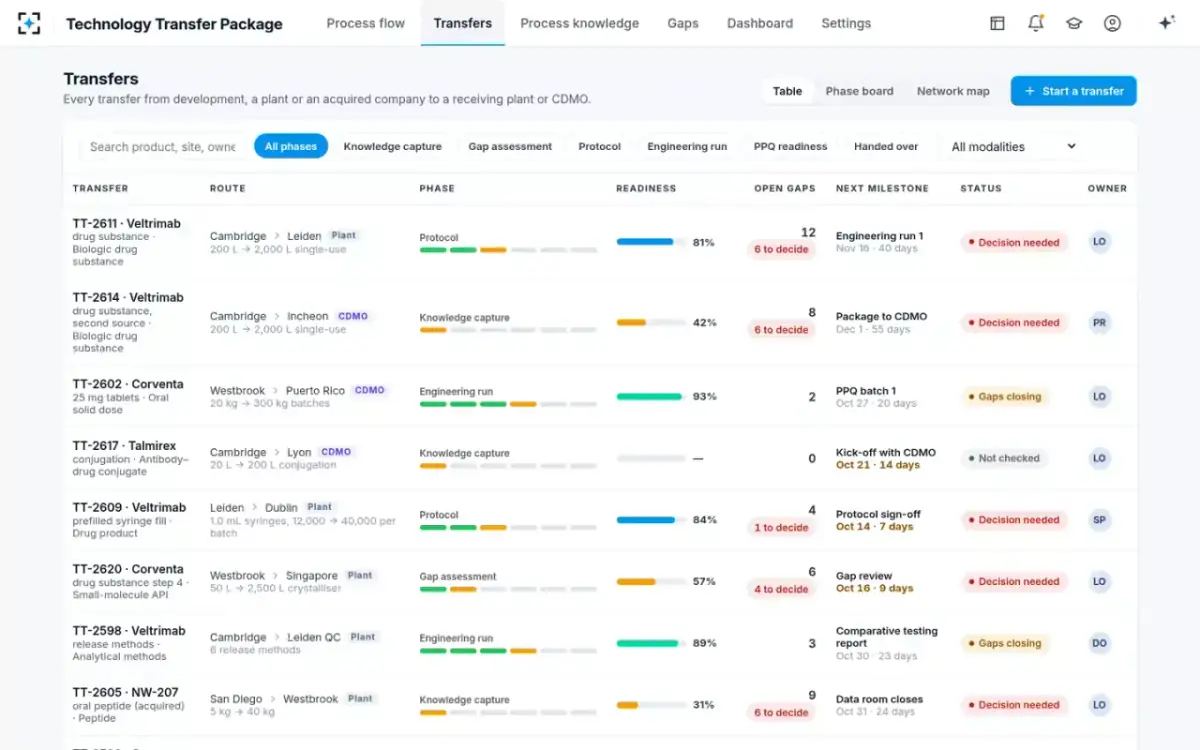
One row on that list is worth a question of its own at a demonstration. A transfer out of an acquired company's data room has a deadline attached to the documents themselves, and what matters is how much of the room has been read and what was found in it before access ends. That is a reading problem at a volume no team solves by hand, and it is the clearest case where the choice between the approaches is not a preference. Which of those reading tasks a machine may take, and which it may not sets out where the line falls, and how a gap analysis produces something decidable is what the trial is ultimately scored on.
Questions people ask
Is a document management system enough for technology transfer?
It is necessary and not sufficient. A validated document system solves the version problem, which is the first problem worth solving, and it is one of the sources a comparison reads from. What it cannot do is notice that two of the documents it holds give different values for the same parameter, because it compares documents to queries rather than to each other. If your late surprises are usually "we were working from the old report", a document system fixes them; if they are usually "the equipment cannot hold that range", it will not.
How does a contract manufacturer get access without seeing other transfers?
Through a portal scoped to its own transfer, which is how the worked software handles it: each contract site sees only the transfer it is party to. Ask to see that boundary demonstrated with two sites rather than described, and settle the responsibilities in the written agreement Annex 11 §3.1 requires for any third party providing, configuring, maintaining or processing data in a computerised system — including what happens to the data when the relationship ends.
What do you need to bring to start?
Your transfer procedure, your checklists at the version you use, your package and protocol template, a set of past development records, and sending and receiving equipment lists held by revision with capacities and limits rather than just makes and models. The equipment lists are often the item missing in usable form, and they are the one the entire comparison depends on — which is why the WHO guideline asks for makes, models, minimum and maximum capacity and range of intended use.
How long does tech transfer software take to go live?
There is no honest general answer, and the worked software publishes none. The duration is set by how much of the left-hand column you already have: a company with a written procedure, current checklists and accessible development records moves quickly, and one whose procedure exists mainly in people's heads is really running a procedure-writing project with software attached. Ask vendors what determines the range rather than what the average is.
Should you write the procedure before you buy?
Write enough of it to buy well. You do not need a finished procedure, but you do need to know what you call a gap, what blocks an engineering run as opposed to the qualification batches, which risk threshold requires an action, and who signs for each site — because those are precisely the settings you will be evaluating, and you cannot judge whether a product carries your procedure if you cannot state it.
What should a quality agreement say about a transfer system?
Who does what, in writing, as both Annex 11 §3.1 and ICH Q10 §2.7(b) require: who validates and what evidence you may rely on, who maintains and with what access, what happens at each release, how the audit record is exported and reviewed, where the data lives and what becomes of it at the end. The review obligation is easy to miss — Annex 11 §9 asks that audit trails be available, convertible to a generally intelligible form and regularly reviewed, and "regularly" means somebody has that as a standing job.