AI in tech transfer is usually argued at the wrong altitude. The question is not whether a machine can run a technology transfer — nobody is proposing that — but which of a transfer's many tasks are reading and arithmetic, which are judgements, and what evidence each kind of output has to carry. Split the work that way and both regulators' frameworks point to the same answer: the judgement tasks are precisely the ones whose model influence has to stay low, which in practice means an agent proposes and a named person decides. Botminds' Technology Transfer Package is built on that split, with the limit written against each agent rather than described in a brochure.
The worked transfer on this page is sample data — the people, companies, products and sites are fictional. The US guidance quoted is a January 2025 draft, which means it is non-binding and may change; the European paper is a final reflection paper adopted in September 2024. Both are frameworks for thinking, not approvals.
Can AI be used in technology transfer?
Yes, and the US regulator has already named a transfer-shaped use among its examples. Listing what AI is being used for in information intended to support regulatory decisions about drug safety, effectiveness or quality, the FDA's draft guidance includes "(6) facilitating the selection of manufacturing conditions" (FDA, Considerations for the Use of Artificial Intelligence To Support Regulatory Decision-Making for Drug and Biological Products, §III). Selecting manufacturing conditions is most of what a transfer argues about.
What neither regulator does is bless a tool. Both describe a way of deciding how much assurance a particular use needs, which is a far more useful thing to have, because it lets you answer the question task by task instead of product by product. The European paper puts the accountability where it was always going to sit. As a key principle, it is for the sponsor of a clinical trial, the applicant for or holder of a marketing authorisation, or the manufacturer to make sure that every algorithm, model, dataset and data-processing pipeline it relies on is fit for purpose and meets legal, ethical, technical, scientific and regulatory standards (EMA reflection paper, §2.2).
"To build trust in the effectiveness, reliability, and fairness of AI/ML tools, a human-centric approach should guide all development and deployment of AI and ML."
EMA, Reflection paper on the use of AI in the medicinal product lifecycle, §2.8
So "the vendor validated it" is not an answer, and neither is "the model is accurate". The obligation is yours, it attaches to a specific use, and it is discharged by evidence about that use.
The tasks of a transfer, re-divided
Write out what a transfer actually consists of and the division stops being ideological. Some tasks are reading: find every parameter in forty-three development records and note which page it was on. Some are arithmetic: given two vessel geometries and a power input, compute the tip speed. Some are classification against a written rule: does this checklist item have cited evidence or not. And some are judgements about risk, margin and consequence, which is a different kind of work entirely.
Eight tasks of one transfer, and what each one's output has to carry
| Task | What kind of work it is | Can a machine do it? | What the output must carry |
|---|---|---|---|
| Index every page of forty-three development records | Reading | Yes, and without tiring at this volume. | A complete account: every page indexed or reported as unread. Superseded versions kept and never cited. |
| Extract each parameter with its set point, ranges, class and units | Reading and typing | Yes. | The passage each value came from, so the extraction can be checked against the source rather than trusted. |
| Normalise units across sources | Arithmetic | Yes. | The original value as written, alongside the normalised one. |
| Compute a scale factor between two vessels | Arithmetic | Yes. | Every input to the calculation, shown, so an engineer can re-do it. |
| Mark a checklist item found, partial or missing | Classification against a written rule | Yes, where the rule is written down. | The cited evidence for a found item, and a stated reason for anything marked not applicable. |
| Notice that two documents give different values | Comparison | Yes, and it is the class that is easiest to miss by hand. | Both values, both sources, and no resolution. |
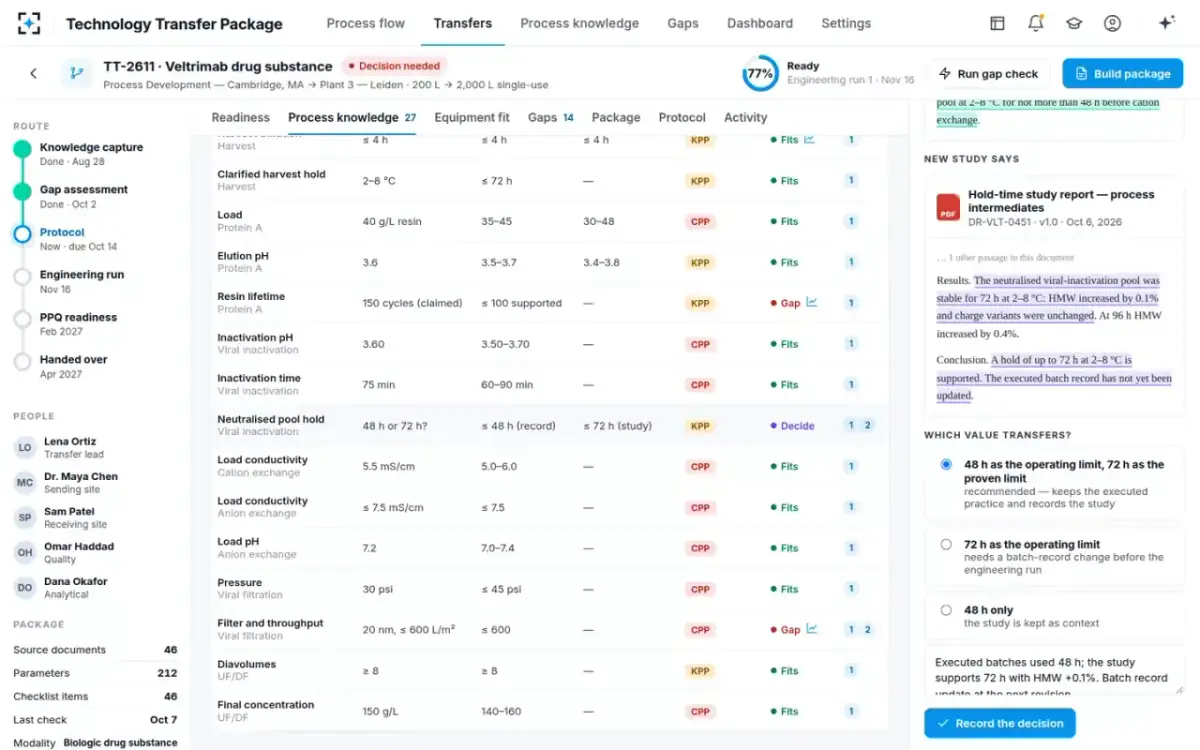
| Decide which of the two values transfers | Judgement about margin | No. | A named person, a recorded reason, and a date. |
| Decide whether a gap blocks the engineering run | Judgement about consequence | No. | A named person, the action agreed, its owner and its due date. |
The reading and arithmetic tasks that move first
The tasks at the top of that table move first because they are high volume, low judgement and completely checkable. On the worked transfer, forty-three development records yield 212 parameters, and the design target is that 98.6% of them carry a citation to the passage they came from, with a person confirming the rest. That last clause is what makes the first number safe: an extraction that cites its source is an assertion you can falsify in ten seconds, which is a different thing from an answer you have to believe.
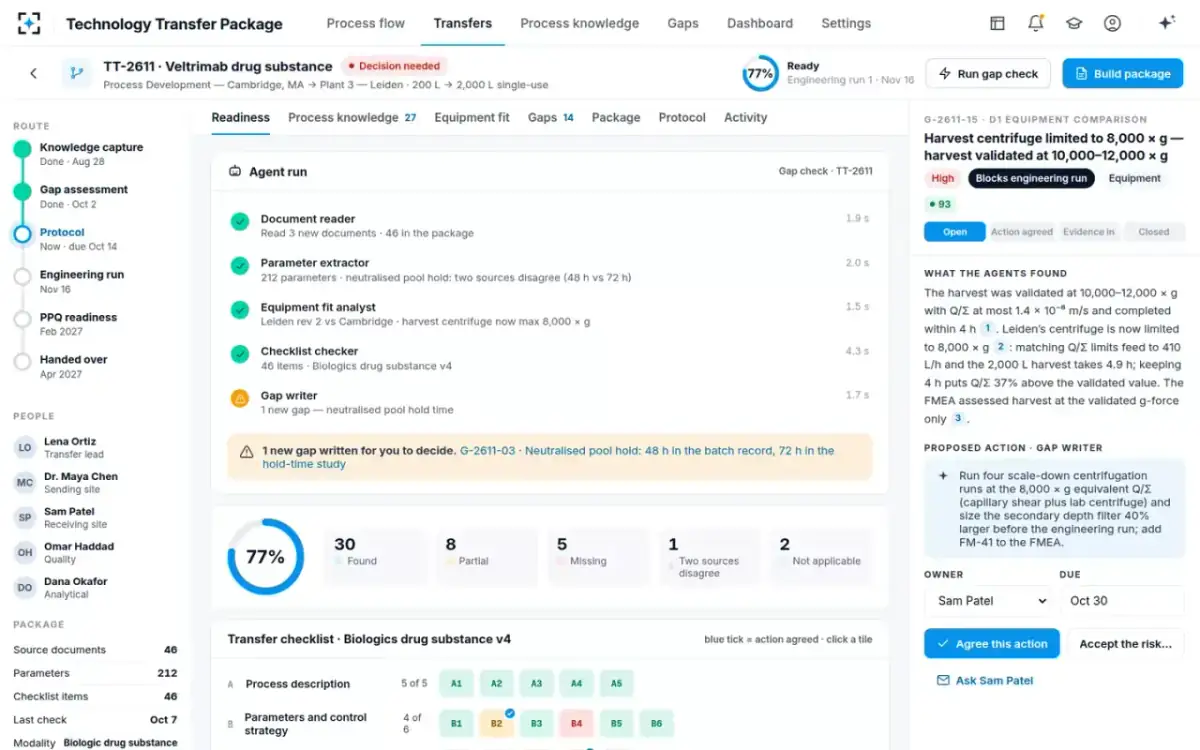
Arithmetic moves for the same reason. When the worked transfer compares the sending site's harvest with the receiving site's centrifuge, it does not report a verdict; it reports that matching the validated flow-to-settling-area ratio limits the feed to 410 L/h, so 2,000 L takes 4.9 hours against a four-hour window, and that keeping four hours would push the ratio above the validated value. Both calculations are on the screen with their inputs. The receiving site's lead can disagree with the inputs, which is the only kind of disagreement worth having.
Five agent steps, each with what it read, and the point where it stops
The judgements that do not move, and why
The bottom two rows of the table are where an honest argument has to be made, because a machine could plainly produce an answer to both. It could pick 48 hours. It could say the gap blocks the run. The reason it must not is not that the answer would be wrong; it is that the question is not a question about the documents.
Take the hold time. The batch record allows the neutralised pool to be held for not more than 48 hours at 2–8 °C. A new study finds it stable for 72, with high molecular weight species up 0.1% and charge variants unchanged, and 0.4% at 96 hours. Nothing in those two documents answers the real question, which is how much margin to carry into a plant that has never run this step. The transfer lead's answer on the worked transfer — 48 hours as the operating limit and 72 as the proven limit, with her reason recorded — is a risk posture, not a reading.
Two values, both shown, and three ways a person can decide
Model influence and decision consequence: a regulator's two axes
The FDA's draft guidance gives a clean vocabulary for this argument. It treats model risk as a combination of two factors (§IV.A.3): model influence, meaning how much the evidence from the AI model contributes to answering the question of interest compared with the other evidence used; and decision consequence, meaning how serious the adverse outcome would be if the decision on that question turned out to be wrong. The two ratings are determined independently, and risk rises as either rises.
Two things follow that matter more than the definition. First, model risk is about the decision, not the model: the guidance is explicit that it means the chance that the model's output leads to a wrong decision with an adverse outcome, rather than any risk built into the model itself. Second, influence is something you can deliberately lower. Where credibility is not sufficiently established for the risk, one of the options the guidance lists is that the sponsor "may downgrade the model influence by incorporating additional types of evidence in conjunction with the evidence from the AI model to answer the question of interest".
Read that sentence as a design instruction and the architecture writes itself. Cite every extraction to its source passage and the document, not the model, becomes the evidence. Show every calculation with its inputs and the arithmetic, not the model, becomes the evidence. Send every conflict to a person and the model contributes no evidence at all to that question. In each case the decision consequence stays exactly as high as it was — this is medicine — and the influence falls.
The regulator's two axes, applied to four tasks on one transfer
Extracting a validated range from a development report
High
A wrong range reaches a parameter table, then a protocol, then a batch record.
Low
Every value carries the passage it came from, and a person confirms the ones that do not.
Medium
Computing a scale factor between two vessels
High
The result decides whether a step is called fitting or not.
Low
The calculation is shown with its inputs, so an engineer re-does it in a minute.
Medium
Scoring severity, occurrence and detection on a risk line
High
The score decides whether an action is required before a batch.
High if it stands alone
Nothing else answers the question unless the score is a draft that quality has to approve.
High, unless the score stays a draft
Choosing which of two conflicting hold times transfers
High
It changes what the plant is allowed to do with real material.
Not permitted
The question is how much margin to carry into a plant that has never run the step. It is given to a person, not mitigated.
Not a task for a model
The fourth row is the one buyers should press a vendor on. A tool that offers to resolve conflicting values is not offering a better model; it is offering to take a task whose influence cannot be lowered, because there is no other evidence to put beside it. The documents disagree. That is the whole point.
What the EU expects of AI in manufacturing
The European Medicines Agency's reflection paper covers the whole product lifecycle and devotes a short section to manufacturing. It expects use to grow, and then sets the condition: "Model development, performance assessment and life-cycle management should follow the quality risk management principles, taking patient safety, data integrity and product quality into account", with the principles of ICH Q8, Q9 and Q10 to be considered for human medicines while current regulatory requirements and GMP standards await revision (EMA reflection paper, §2.3.6).
Life-cycle management is the phrase doing the quiet work there. A model that extracts parameters is not finished when it is accurate on the documents it was tested against; it has to stay accurate as document templates change, as a new modality arrives, as a company that was acquired brings a different house style. That is a change-control obligation, not a procurement one, and it is the question to ask a vendor that is hardest to answer with a demonstration.
The paper's section on ethics and trustworthy AI adds the posture: "To build trust in the effectiveness, reliability, and fairness of AI/ML tools, a human-centric approach should guide all development and deployment of AI and ML" (§2.8). Human-centric is not a slogan if you can point at the places a human is structurally required rather than merely invited.
Where an extraction may be wrong, and where it may not
A useful discipline is to say in advance what kinds of error you are willing to tolerate from a reading step, because "it must never be wrong" is not a specification anyone can build to. On the worked transfer the tolerances are written as limits against each agent, and they are asymmetric on purpose.
Six steps, and the point at which each one stops
Agent
Document readerReads development reports, batch records, risk assessments, methods and equipment lists; records each one’s code, version and effective date and splits it into passages by unit operation.
Never: drops a page — every page is indexed or reported, and superseded versions are kept but never cited
Agent
Parameter extractorExtracts each parameter with its set point, operating and proven ranges, class and scale-dependence, and normalises the units.
Never: averages or picks between two sources that disagree — the disagreement becomes a conflict for a person
Agent
Equipment fit analystCompares the receiving site’s equipment against every validated range, computes the scale factors and drafts the risk line for a step that cannot hold its range.
Never: changes a validated range, and never promotes its drafted line into the risk assessment itself
Agent
Checklist checkerRuns the transfer checklist for the modality and marks each item found, partial, missing or in conflict.
Never: marks an item found without cited evidence, or not applicable without a stated reason
Agent
Gap writerWrites one gap per missing, partial or conflicting item, with the evidence, a severity, what it blocks, a proposed action and a suggested owner.
Never: decides or closes a gap
A person decides
The transfer lead, quality, and the receiving siteDecide which value transfers, whether the proposed action is the right one, whether a risk is accepted, and whether the protocol may be signed.
Never: inherit a decision already taken — the run ends at a proposal
Notice which way each limit points. The reader is allowed to fail to read a page, but not to fail silently — an unread page is reported. The extractor is allowed to be uncertain, but not to resolve uncertainty — a disagreement is raised, never averaged. The fit analyst is allowed to be wrong about a calculation, because the calculation is on the screen, but not to alter a validated range. In every case the permitted error is one a reader can catch, and the forbidden one is an error that would be invisible.
The subjectivity a risk score hides
Risk scoring is where the argument about AI in transfers gets genuinely difficult, because the scores look like arithmetic and are not. A severity of 7, an occurrence of 5 and a detection of 4 multiply to a risk priority of 140 against an action threshold of 100, and the multiplication is the only part of that which is objective. ICH Q9(R1) is unusually direct about it: "All participants involved with quality risk management activities should acknowledge, anticipate, and address the potential for subjectivity" (ICH Q9(R1), §5.3), noting that subjectivity enters through how risks are perceived, through inadequately defined risk questions and through poorly designed scoring scales.
A machine does not remove that subjectivity; it industrialises whichever version of it the scale encodes. The defensible arrangement is therefore the one the worked transfer uses: the analyst drafts the line with its inputs visible, the line stays a draft, and it enters the risk assessment only when quality approves the revision. The threshold above which a score needs an action is a setting the company chooses — above 80, above 100 or above 120 — not a property of the tool. How a gap is written so that a person can decide it is where that draft becomes a decision.
The same gap, as the agents propose it and as a person records it
Proposed, by the gap writer: Harvest validated at 10,000–12,000 × g; the receiving centrifuge is limited to 8,000 × g at revision 2 of its equipment list.
Decided, by the transfer lead: Unchanged. The finding is a reading, and readings are not re-decided.
Proposed, by the gap writer: Proposed as blocking the engineering run, from the severity rules in the transfer procedure.
Decided, by the transfer lead: Confirmed as blocking, which is a judgement about consequence and sits with a person.
Proposed, by the gap writer: Four scale-down runs at the equivalent ratio for 8,000 × g, plus 40% more secondary depth-filter area, before the run.
Decided, by the transfer lead: Agreed as proposed, or replaced, or sent back for more evidence. On the worked transfer it was agreed.
Proposed, by the gap writer: Suggested: the receiving site’s lead, by 30 October.
Decided, by the transfer lead: Accepted, with the date confirmed against the engineering-run date and the receiving site’s own plan.
Proposed, by the gap writer: Drafted at severity 7, occurrence 5, detection 4 — a risk priority of 140.
Decided, by the transfer lead: Stays a draft until quality approves the revision of the risk assessment.
Proposed, by the gap writer: The evidence, cited to the passage and the equipment revision it came from.
Decided, by the transfer lead: Who decided, what they decided, when, and why — beside the evidence, not instead of it.
What to ask before an agent touches a parameter table
The checklist below is the one to run before any tool — this one included — is allowed near the values a batch record will be written from. Each item is a question with a demonstrable answer, not a policy statement.
Nine questions to settle before an agent touches your parameters
- What is the context of use, written down?
The FDA framework assesses risk for a specific use, not for a product. "Extracts parameters from development reports for a transfer package" is a context of use; "helps with tech transfer" is not.
- Does every extracted value carry the passage it came from?
This is one of the most direct ways to lower model influence, because it puts the document back in the evidence chain.
- What happens when two sources disagree?
If the answer is anything other than "both are shown and a person decides", the tool has taken a judgement task. Ask to see it happen on your own documents.
- Are calculations shown with their inputs?
A scale factor you cannot re-do by hand is a number you have to believe. One you can re-do is evidence.
- Can a drafted risk line enter the risk assessment without a quality approval?
If it can, the scoring step’s model influence is high and the decision consequence is high, which is the corner of the matrix nobody wants to defend.
- Who is recorded as having decided, and is the reason stored with it?
21 CFR 211.22(a) gives the quality control unit responsibility and authority to approve or reject; an audit record that shows a tool deciding is a finding waiting to happen.
- What is the life-cycle plan when the documents change?
The EMA paper asks for model development, performance assessment and life-cycle management under quality risk management principles. New templates and new modalities are the normal case, not the exception.
- Can a page be skipped silently?
Ask for the report of what was not read. A tool that cannot produce one cannot tell you what it does not know.
- Which settings cannot be switched off?
Configurability is good until it reaches the controls the argument rests on. At least one rule — disagreements go to a person — should be beyond the administrator’s reach.
Where the chain ends: four names, four meanings, one protocol
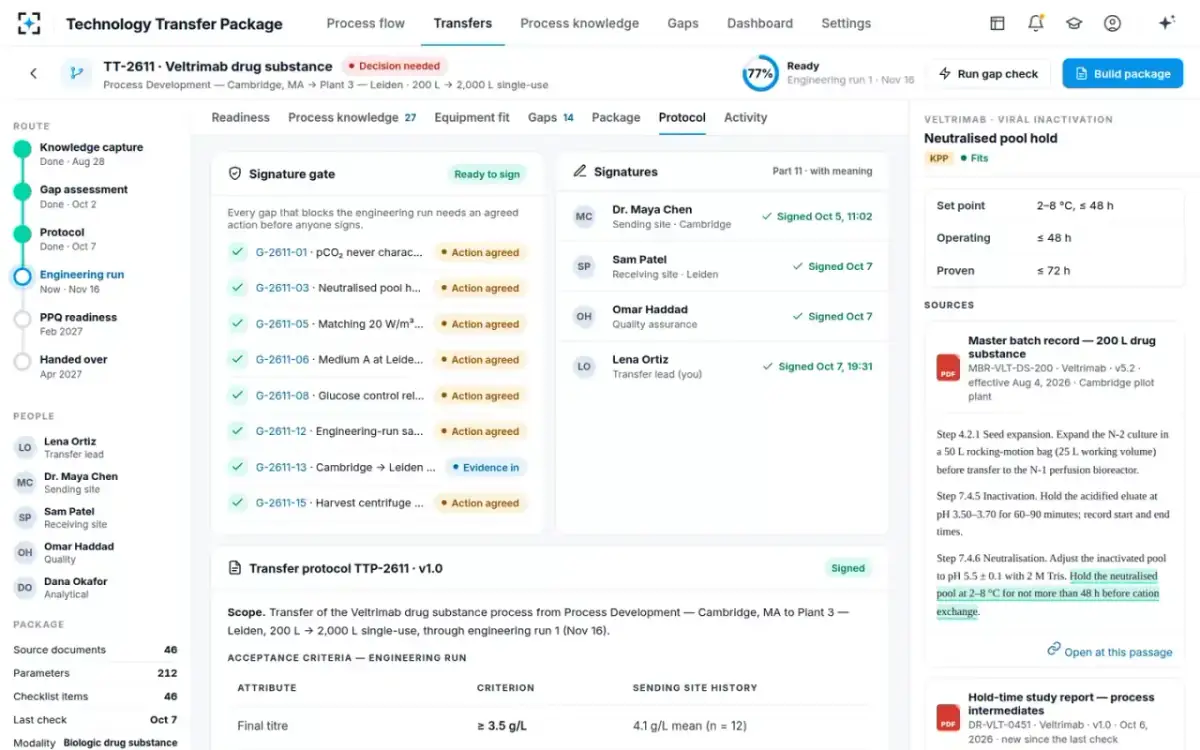
That last screen is the test of whether a task split is real. If the names on the protocol belong to people, and each name carries a meaning the rules recognise, then whatever read the documents was a tool. If a tool's output can reach a signature without a person in between, the split was a description rather than a design. What to ask a vendor, and how to test it on a transfer you have already closed turns the same questions into a trial.
Questions people ask
Is AI allowed in pharmaceutical manufacturing under GMP?
No rule forbids it, and both regulators have published frameworks rather than prohibitions. The EMA expects use in process design, scale-up, optimisation, in-process control and batch release to increase, subject to quality risk management principles. The FDA's January 2025 draft guidance sets out a seven-step framework for establishing a model's credibility for a specific context of use. Neither approves a product, and both leave the responsibility with the manufacturer.
Can AI decide whether a process parameter is critical?
It can propose a classification from the evidence, and it should not be the thing that settles it. Criticality is a judgement about the link between a parameter and a quality attribute, and EU GMP Annex 15 §5.7 requires the basis for identifying parameters as critical or non-critical to be clearly documented, taking risk assessment results into account. A proposal with its evidence shortens that work; a classification nobody can trace back to a study is a liability in an inspection.
How do you stop an agent inventing a number in a transfer package?
By making a number without a source unusable rather than merely unlikely. In the worked software every value cites the passage it came from, the package writer never states anything that is not cited, and the small share of parameters that arrive without a citation wait for a person to confirm them. The control is structural: the question is not how accurate the model is but whether an uncited value can reach a document, and the answer should be no.
Who is responsible when AI gets a transfer value wrong?
The manufacturer. The EMA paper states that it is the responsibility of the sponsor, applicant, holder or manufacturer to ensure that all algorithms, models, datasets and pipelines are fit for purpose. Inside the company, 21 CFR 211.22(a) puts the responsibility and authority to approve or reject with the quality control unit, and nothing about a tool changes that. In practice this is why the audit record has to show a person deciding, not a system.
What is a context of use, and why does it matter so much?
It is the specific description of what the model is being used for and what question it helps answer — the unit the FDA framework assesses risk against. It matters because it is the difference between a tractable question and an impossible one. "Is this AI reliable" cannot be answered; "does this extraction of validated ranges from our development reports, confirmed against cited passages, carry enough credibility for the decision it informs" can be, and the answer may differ between two uses of the same model.
Does an agent's output belong in a regulatory submission?
What belongs in a submission is the process description, the parameters and the justification, not the tool that assembled them. The FDA framework applies where AI output is used to produce information supporting a regulatory decision, and it asks for a credibility assessment proportionate to the model risk, with the report either submitted or held for inspection as discussed with the agency. The practical consequence is to keep the citation chain intact, so that every number in the submission can be traced to the study behind it regardless of what read it.