An engineering batch in pharma is a full-scale rehearsal: a batch run on the commercial equipment, with the commercial process and the commercial people, before the qualification batches that the site needs in order to sell anything. No regulation defines the term, which is why it means slightly different things in different companies, but its purpose is constant. It exists because scale effects cannot be settled on paper — and that is also its problem, because it is the most expensive place in a technology transfer to discover a difference that two equipment lists would have shown in an afternoon. Botminds' Technology Transfer Package exists to move that discovery earlier: it reads the development records, compares every validated range against the receiving site's equipment and writes the gap while the suite is still weeks away.
The worked transfer on this page is sample data — the people, companies, products and sites are fictional. The money comes from a peer-reviewed benchmarking study of biopharmaceutical development costs, and every piece of arithmetic built on it is shown so you can substitute your own numbers.
One transfer in Technology Transfer Package, forty days before its first engineering run
40days
from the signed protocol to the first engineering run on the worked transfer
12open gaps
on it at that point, six of them waiting on a person to decide
140risk priority
on the harvest step the receiving centrifuge cannot reach — an action is needed above 100
10.5days
to a complete package draft, against about 26 by hand (an estimated split and a design target)
What is an engineering batch in pharma?
An engineering batch — most people say engineering run — is a batch made at the intended commercial scale, on the qualified commercial equipment, to prove the process can actually be executed there before anyone commits a qualification batch to it. It is a dress rehearsal with real material. It checks that the batch record is executable as written, that the equipment holds the parameters the process needs, that the in-process samples can be taken when the plan says, that the hold times fit the shift pattern, and that the people who will run the process for the next decade can run it.
What it is not is a regulatory requirement. Neither the US process validation guidance nor EU GMP Annex 15 mentions engineering batches. What they require is process performance qualification, and the US guidance is unambiguous about the consequence: "A manufacturer must successfully complete PPQ before commencing commercial distribution of the drug product" (FDA, Process Validation: General Principles and Practices, §IV.B.2). The engineering run is what sites do voluntarily so that the qualification batches, which are expensive and are watched, are not the first time the process meets the plant.
The same guidance explains why a paper argument is never enough on its own: "To understand the commercial process sufficiently, the manufacturer will need to consider the effects of scale. However, it is not typically necessary to explore the entire operating range at commercial scale if assurance can be provided by process design data."
"To understand the commercial process sufficiently, the manufacturer will need to consider the effects of scale."
FDA, Process Validation: General Principles and Practices, §IV.B.2
Read the second sentence as carefully as the first. The guidance does not say run everything at scale; it says that design data can carry the assurance where it is good enough. That is the whole economics of the engineering run. Every question the development data can answer is a question the suite does not have to.
Engineering run, demonstration batch, PPQ: what each one is for
Four kinds of full-scale batch get confused with one another, and the confusion is expensive because only one of them lets a site sell. The table separates them by what each one is evidence of, what it is not evidence of, and whether the product can be released.
Four full-scale batches, and what each one is actually evidence of
| Batch | What it proves | What it does not prove | Can the product be sold? |
|---|---|---|---|
| Engineering run | That the process is executable on this equipment, by these people, with this batch record: parameters held, samples taken, holds survivable, shifts workable. | Consistency. One batch is an existence proof, not a demonstration of a state of control. | Normally no. It is run before the qualification protocol is executed, and its disposition should be decided in advance. |
| Demonstration or technical batch | Much the same thing under a different internal name, often at an intermediate scale or with a reduced sampling plan. | Anything the qualification protocol is meant to prove. The term is a company’s, not a regulator’s. | Only if the site decided so beforehand and the batch was made fully to GMP. |
| PPQ or process validation batch | That the commercial process performs as expected at commercial scale, under the acceptance criteria written in a protocol beforehand. | That the process will stay in control, which is what the continued verification stage exists for. | Yes, where release was pre-defined. Annex 15 §5.14 requires that to be settled in advance, with full GMP compliance and the marketing authorisation met. |
| Routine commercial batch | Nothing by itself; it is the output the whole exercise was for. | That a change is safe. A change takes the process back through assessment and, where the filing requires it, a supplement. | Yes. |
One line in Annex 15 quietly settles a question that costs sites a lot of argument: "Normally batches manufactured for process validation should be the same size as the intended commercial scale batches and the use of any other batch sizes should be justified or specified in other sections of EudraLex, Volume 4" (§5.8). A validation campaign at half scale is not a shortcut; it is a justification you now have to write and defend.
What an engineering run can legitimately fail on
An engineering run should fail on execution, not on arithmetic. The failures worth paying for are the ones no desk exercise could have found: an operator cannot reach a sample port while the vessel is pressurised, a transfer line holds more than the batch record assumed, a cleaning cycle runs past the shift, an in-process result comes back after the decision it was meant to inform. Those are facts about a building and a team, and the only way to learn them is to run.
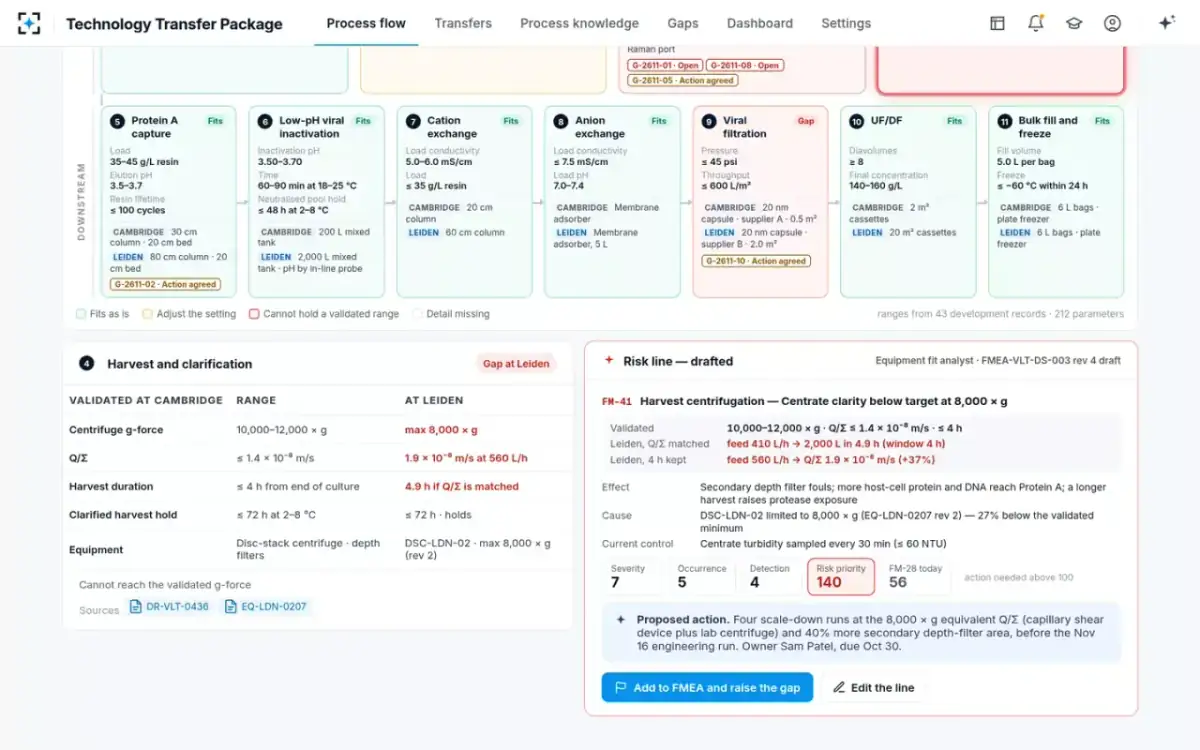
The failures not worth paying for are the ones two documents already contained. On the worked transfer the harvest step is the example. The process was validated at 10,000–12,000 × g with a flow-to-settling-area ratio at or below 1.4 × 10⁻⁸ m/s and a harvest finished within four hours of the end of culture. The receiving site's disc-stack centrifuge was limited, at its current equipment revision, to 8,000 × g. Match the validated ratio and the feed drops to 410 L/h, so 2,000 L takes 4.9 hours against a four-hour window; keep the four hours and the ratio runs above the validated value. Neither option is inside the validated range, and both numbers were sitting in documents the site already had.
That comparison produced a drafted risk line — severity 7, occurrence 5, detection 4, a risk priority of 140 against an action threshold of 100 — and a proposed action: four scale-down runs at the equivalent ratio for 8,000 × g, plus 40% more secondary depth-filter area, before the run. The arithmetic is the same whether it is done in week two or discovered in month five. Only the price changes.
The harvest step, compared, and the risk line drafted from it
How many batches does process validation need?
There is no fixed number in the US guidance. It asks instead for a judgement, based on sound science and the manufacturer's overall product and process understanding, about how much assurance the whole body of evidence carries. Three remains a common answer, and the benchmarking study used here builds its model on exactly that: "Three PPQ or consistency batches are included in the model, required to support the process characterization and validation package necessary for regulatory review for approval" (Farid and colleagues, mAbs, 2020).
For a site transfer, Europe offers a route to fewer. Annex 15 says that for products "transferred from one site to another or within the same site, the number of validation batches could be reduced by the use of a bracketing approach. However, existing product knowledge, including the content of the previous validation, should be available" (§5.5). That second sentence is the condition that decides whether the concession is available to you. Existing product knowledge has to be available — not archived somewhere, available — and a transfer whose parameters cannot be traced back to the studies that set them has no bracketing argument to make. Where each process parameter comes from is the same evidence under a different question.
What a failed engineering run costs
A failed run is paid for in four currencies, and only the first appears on an invoice. Costing it properly is what turns "we should compare the equipment earlier" from an opinion into a decision.
The batch. The benchmarking study models a monoclonal antibody facility and prices batches by scale: at 2,000 L it puts the cost of a batch at $1.36 million, $0.98 million direct plus $0.38 million indirect, and at 6,000 L at $3.12 million, $2.51 million direct plus $0.61 million indirect. Direct cost there means labour, consumables, reagents and utilities; indirect means the facility's maintenance, insurance, taxes and capital charge spread over the campaign. Those are the study's model figures for its own scenario, not a measure of your plant, but they are the right order of magnitude to reason with until you substitute your own.
The people. The same study assumes that "for every unit of FTE year workload, the cost incurred to the company was assumed to be $250,000", a figure that includes salary, on-costs, management and infrastructure. One person-month is therefore about $20,800, and a six-person transfer team held for an extra month while a scale-down study is run and a deviation is closed is about $125,000. That is our arithmetic on the study's assumption, not a figure the study publishes.
The slot. The study's model runs ten batches a year through a clinical facility. On that basis one lost suite slot is a tenth of that facility's year, and the real cost is whatever was queued behind it — which, in a network running ten transfers at once, is somebody else's engineering run.
The clock. This is the one that can outweigh the others, and it only applies when the fix changes something you have filed. For drug applications, the FDA's drug shortages task force sets out the arithmetic plainly: "FDA approval of a PAS can take up to 4, 8, or 10 months depending on whether an inspection is required, and the applicant meets certain requirements" (Drug Shortages: Root Causes and Potential Solutions, page 44). A difference found in week two is a change to a document that has not been filed. The same difference found in the run, after a submission has gone in, can be a supplement.
The same harvest difference, found two ways
Found on paper, in week two: Four desk-days of equipment comparison. At $250,000 per person-year over a 220-day working year, about $4,500 of effort (our arithmetic).
Found in the run, in month five: A full-scale batch. In the benchmarking study’s model, $1.36 million at 2,000 L.
Found on paper, in week two: Four scale-down runs and a larger secondary filter area, scheduled into the weeks already set aside for studies.
Found in the run, in month five: The same four scale-down runs and the same filter change, plus a deviation, an assessment and a re-run.
Found on paper, in week two: Untouched. The run is still forty days away and the slot is unbooked.
Found in the run, in month five: A slot consumed, and the next one is whenever the campaign plan allows.
Found on paper, in week two: Nothing has been filed, so the change is an edit to a draft.
Found in the run, in month five: If the submission has gone in, a supplement — a prior approval supplement for a major change, which the FDA puts at up to 4, 8 or 10 months for drug applications.
Found on paper, in week two: A transfer lead, a receiving-site lead and a development scientist, arguing about a calculation.
Found in the run, in month five: The same three, plus quality, plus operations, plus whoever owns the launch date.
Found on paper, in week two: A drafted risk line with its inputs shown, and a gap with an owner and a due date.
Found in the run, in month five: A deviation, an investigation and a risk assessment written after the fact.
The filing clock: four, eight or ten months
The filing clock deserves its own section because a failed run is easily costed as a batch and a delay, leaving out the term that can run longest. In the United States, a manufacturing change with substantial potential to have an adverse effect on product quality goes in as a prior approval supplement — for a biologics licence under 21 CFR 601.12(b), and under the parallel rule for drug applications. For drug applications, the agency's own shortages review gives the approval time as up to four, eight or ten months depending on whether an inspection is needed and whether the applicant meets certain requirements; a biologics supplement runs on its own review timetable. A change with moderate potential can instead go as a changes-being-effected supplement submitted at least thirty days before distribution, which may be implemented once the thirty days have passed and before any review is complete — and the same review notes that industry representatives would prefer more changes to be handled that way, precisely because it is so much faster.
Two practical consequences follow. First, the question "which supplement would this fix need" belongs in the gap discussion, not in the deviation report, because it can reorder the actions: a fix that stays inside the filed description is worth more than a technically better one that does not. Second, the time to find a difference is while the regulatory description is still a draft. Everything the transfer discovers before the filing is free of this clock; everything after it is not.
The working days a transfer package costs, task by task
If finding differences early is the cheapest insurance available, the next question is where the days to find them come from. On the worked transfer, the split from kick-off to a complete package draft is estimated at about twenty-six working days by hand. Two activities take more than two-fifths of that, and neither is judgement: building the parameter table with its ranges, class and source, and gathering the records to build it from.
An estimated split of a transfer's working days, by hand and with the software
The last pair is the honest one. Decisions, reviews and signatures take two days either way, because nothing in the list is reading or arithmetic: somebody has to choose which of two hold times transfers, and somebody has to sign. The reason the other five pairs move is that they are clerical, and the reason the total matters is that the days freed are the days available to compare equipment before a suite is booked.
Nine checks before you book the suite
Booking a suite is the moment the economics change, because from then on every discovery is made against a date. The nine checks below are the ones that tend to turn out, afterwards, to have been the cheap ones to run. Each is a question with an arithmetic or a document behind it, not a judgement call.
Nine checks to run before the suite is booked
- Every validated range compared against the receiving equipment limit, not every set point
A set point that fits inside a machine’s capability says nothing about whether the range does. This is the check that caught the harvest step on the worked transfer.
- The receiving equipment list is the current revision, re-read this week
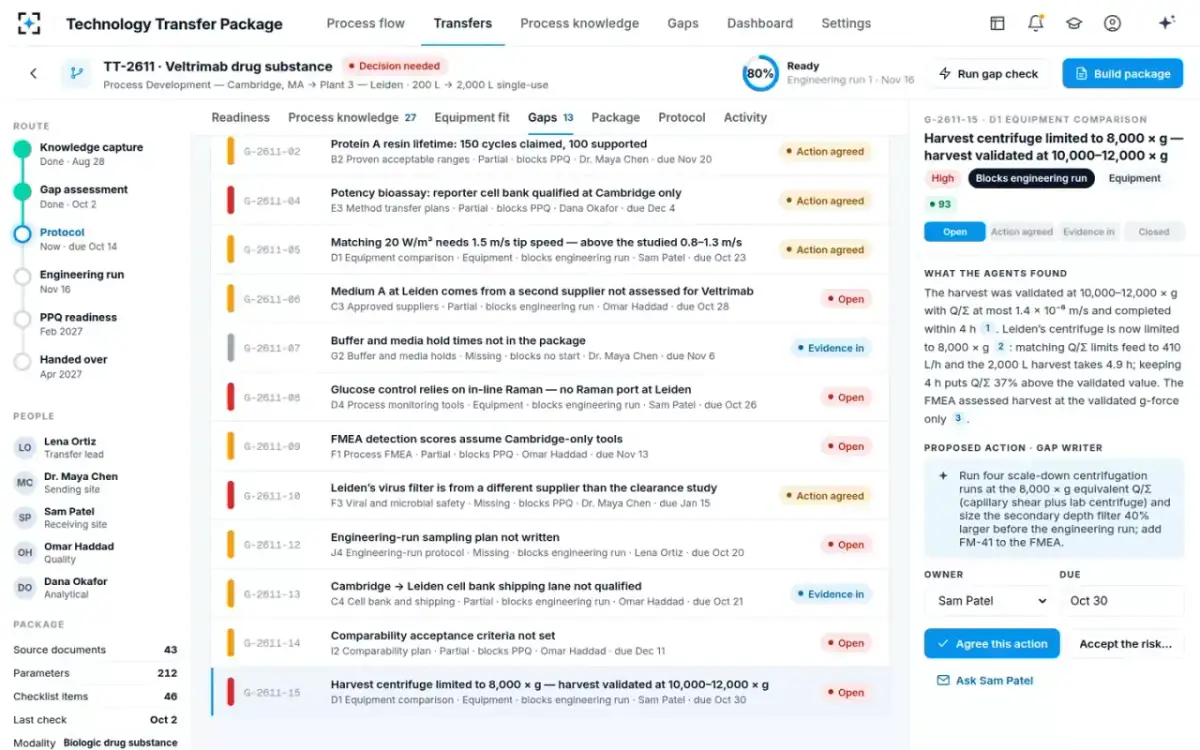
On the worked transfer a new revision issued two days before signature limited the harvest centrifuge to 8,000 × g, below the force the harvest was validated at.
- Every scale-dependent parameter has a scale rationale
A study or a calculation that says what happens to it at the new scale. Without one, the run is the study.
- Every parameter traces to the passage it came from
Annex 15 §5.5 makes existing product knowledge the condition for a reduced validation campaign; a number with no source cannot support that argument.
- Two sources that disagree have been decided, not averaged
A hold time of 48 hours in a batch record and 72 in a newer study is a decision with a reason, recorded, before the batch record is executed.
- The batch record has been walked, step by step, by the people who will run it
Annex 15 expects production personnel in the manufacture of validation batches; walking the record early is the cheap version of the same idea.
- The in-process sampling plan fits the decisions it informs
A result that arrives after the step it was meant to control is a test, not a control.
- Hold times fit the shift pattern and the calendar, not just the study
A 48-hour hold that lands on a Saturday night is a deviation waiting for a weekend.
- Each remaining gap has an owner, a date and a stated consequence if it slips
A gap list without consequences is a list; a gap that blocks the run is a decision someone has to take before the suite is booked.
A gap that blocks the engineering run, with its evidence and its owner
Why the costliest difference is the cheapest to find
Put the two sides of the harvest example next to each other and the argument stops being about software. Four desk-days of equipment comparison, at the benchmarking study's $250,000 per person-year over a 220-day working year, is about $4,500 of effort. The batch it protects, in the same study's model at 2,000 L, is $1.36 million. That is a ratio of roughly three hundred to one before the suite slot, the team's extra month or any filing clock is counted — and the comparison does not have to find the difference every time to be worth running. It has to find it once.
The reason sites do not run the comparison anyway is not that they disagree with the arithmetic. It is that doing it properly means holding every validated range, its class, its source and the receiving machine's limit in one place, in comparable units, and many transfers hold them across dozens of reports and spreadsheets. On the sample network the measures the dashboard keeps are exactly the ones that argument needs: how long a package takes to assemble, how many gaps were found before a start, what share of parameters are cited to a source, and how the gaps were found — 38% missing from the package, 33% partial for the receiving site, 19% equipment that does not fit, 11% two sources that disagree.
The measures that decide whether the comparison was worth running
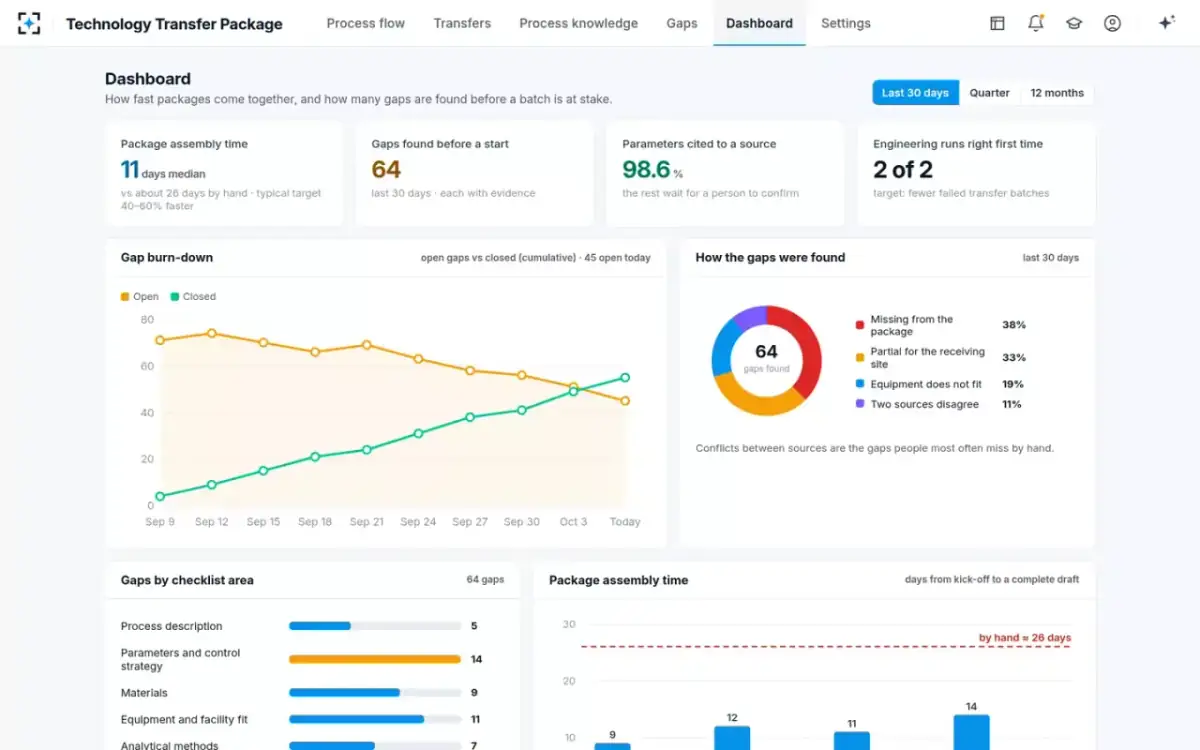
That last slice is the one worth arguing over at a kick-off. Nineteen per cent of the gaps are equipment that does not fit — the class the engineering run finds if nobody finds it first. Eleven per cent are two sources that disagree, the class that can go unnoticed until a batch record is executed against the wrong number. Between them they are the gaps whose discovery date decides what the transfer costs; how a gap is written so that it can be decided is where that work actually happens, and what to ask before buying software for it sets out how to test a tool on a transfer you have already closed.
Questions people ask
Is an engineering batch the same as a demonstration batch?
Usually, but the words are a company's rather than a regulator's, so check the definition in the procedure in front of you. Both describe a full-scale or near-full-scale batch run before qualification, to prove the process is executable. The distinction that matters is not the name but the disposition: whether the batch was made fully to GMP and whether its release was decided before it was run.
Can product from an engineering run or a PPQ batch be sold?
Qualification batches can be, where that was decided in advance: Annex 15 §5.14 says "Where validation batches are released to the market, this should be pre-defined", with the conditions of manufacture fully compliant with GMP, with the validation acceptance criteria, and with the marketing authorisation. Engineering runs normally are not released, because they are run before the qualification protocol and often with a reduced sampling plan — but the deciding factor is what was written down beforehand, not the label on the batch.
Do you need an engineering run for a site transfer?
No regulation requires one, and a transfer with strong existing product knowledge may go straight to qualification; Annex 15 §5.5 even allows a reduced number of validation batches for a site transfer on a bracketing argument. Whether you should is a different question, and it turns on how much of the equipment differs from the sending site and how much of the control strategy depends on instruments the receiving site does not have.
What is the difference between a prior approval supplement and a changes-being-effected supplement?
A prior approval supplement covers changes with substantial potential to have an adverse effect on product quality and must be approved before product made with the change is distributed; for drug applications the FDA's shortages review puts that at up to four, eight or ten months depending on whether an inspection is required. A changes-being-effected-in-30-days supplement covers changes with moderate potential, and product made with the change may be distributed once thirty days have passed, before review is complete. For a biologics licence the categories are set out in 21 CFR 601.12. Which one a fix needs can change which fix you choose, which is why the question belongs in the gap discussion.
Who decides that an engineering run has passed?
Whoever the transfer procedure names, against criteria written before the run rather than after it. The useful discipline is to write the acceptance criteria into the protocol at the same time as the sampling plan, so that "it looked fine" is not available as an answer. On the worked transfer the engineering-run criteria sit in the signed protocol alongside the sending site's own history for each attribute, which is what makes a result arguable rather than merely reported.
How much does a biopharmaceutical batch actually cost?
It depends entirely on scale, titre and facility, and the only honest answer is to use your own cost model. As an order of magnitude, the benchmarking study used on this page models $1.36 million for a 2,000 L batch and $3.12 million for a 6,000 L batch in a monoclonal antibody facility, split into direct costs — labour, consumables, reagents, utilities — and indirect costs for the facility itself. Those are model figures for the study's scenario, and they are far more useful as a ratio against the cost of finding a difference early than as an absolute.