Critical process parameters in pharma are the process settings whose variability affects a critical quality attribute, and the definition is the easy part — every teaching page has it. The hard part, and the part a technology transfer exposes, is that a parameter table is only worth the passage behind each number. A value with no traceable source is a value nobody can defend when a receiving site asks why the range is what it is; and a defect that easily survives into a transfer package is a limit that two documents give differently and nobody noticed. Botminds' Technology Transfer Package extracts each parameter from the development records with its set point, ranges, class, scale dependence and the passage it was read from, and when two sources disagree it shows both to a person instead of resolving them.
The transfer used here — its product, people and two sites — is sample data in the solution, invented rather than a customer's. Everything attributed to a guideline or a regulation is real and linked where it appears.
What is a critical process parameter?
ICH Q8(R2)'s glossary gives the definition the whole field works from: a critical process parameter is "a process parameter whose variability has an impact on a critical quality attribute and therefore should be monitored or controlled to ensure the process produces the desired quality".
Three things in that sentence get skipped. It is about variability, not importance: a parameter that is obviously fundamental to the process but whose realistic variation moves nothing is not critical in this sense. It requires an impact on a critical quality attribute, which means criticality is always relative to an attribute you have identified — you cannot classify parameters before you know what you are protecting. And the consequence is monitored or controlled: the designation is an obligation, not a badge. Calling something critical and then not controlling it is worse than not calling it critical at all, because the file now contradicts itself.
"A process parameter whose variability has an impact on a critical quality attribute and therefore should be monitored or controlled to ensure the process produces the desired quality."
ICH Q8(R2), Pharmaceutical Development, glossary
Critical, key, non-critical: what the three classes oblige
Many companies run a three-class scheme. Critical parameters affect a critical quality attribute. Key or key performance parameters affect process consistency, yield or productivity without affecting a quality attribute. Non-critical parameters affect neither within their realistic range. Only the first is defined by ICH; the second is industry practice, which is exactly why a transfer has to carry the company's own definition alongside the table — two firms' "key" can mean different things, and a receiving site that assumes its own meaning will under-control a parameter the sending site expected it to watch.
The three classes, and what each one obliges in a transfer
| Class | What it means | Control at the receiving site | In the protocol and the filing | In the risk assessment |
|---|---|---|---|---|
| Critical | Variability has a demonstrated impact on a critical quality attribute. | Monitored or controlled, with the operating range in the batch record and a deviation raised outside it. | In the parameter table with set point, operating and proven ranges; in the filing as part of the control strategy, with changes assessed for reportability. | Assessed, with the assessment covering the range the receiving equipment can actually reach — not only the validated one. |
| Key | Affects process consistency, yield or productivity, without a demonstrated impact on a quality attribute. | Monitored and trended; an excursion is a process event rather than a quality deviation, unless the procedure says otherwise. | In the parameter table with its class and the company's own definition of the class, because the word is not standardised. | Usually assessed, because a key parameter that drifts far enough can stop being key. |
| Non-critical | No demonstrated impact on quality or consistency within its realistic range. | Recorded; often a setting rather than a controlled parameter. | Listed, with the basis for the classification available. Absence from the table is not the same as classification. | Screened out with a documented rationale, not silently omitted. |
Who decides that a parameter is critical, and how it is documented
Nobody decides it alone, and nobody decides it in a meeting without evidence. Criticality is an output of development data and risk assessment, and EU GMP Annex 15 makes the documentation of that reasoning an explicit requirement: "The basis by which process parameters and quality attributes were identified as being critical or non-critical should be clearly documented, taking into account the results of any risk assessment activities."
The basis. Not the conclusion. That is the requirement that quietly fails in a transfer package, because the table arrives with a class column filled in and the reasoning behind each entry sits in a risk assessment nobody referenced and a characterisation study nobody cited. A receiving site then inherits a classification it cannot interrogate, and the first time someone asks whether a parameter really needs that control, there is no document to answer with.
The WHO technology transfer guideline makes the same set of material explicitly part of what has to move between the sites: "The critical quality attributes, critical process parameters, material attributes, control strategy and any other elements potentially impacting the quality of the product should be available (see also ICH guidelines)." Available — which a reviewer reads as available to the receiving unit, not merely existing somewhere at the sending one.
Set point and range: the three numbers a transfer carries
A parameter travels as three numbers, and a transfer that carries only the first has transferred a setting rather than a process. The set point is what the batch record instructs. The operating range — often called the normal operating range — is the band the process is executed and licensed inside, and leaving it is a deviation. The proven acceptable range is wider. ICH Q8(R2)'s glossary defines it as a characterised range of a process parameter within which operation, while keeping other parameters constant, yields material that meets the relevant quality criteria (ICH Q8(R2), glossary).
The phrase doing the work there is while keeping other parameters constant. A proven acceptable range is established one parameter at a time, so it says nothing about what happens when two parameters sit near their edges together. ICH Q8(R2) draws the conclusion itself, in a short sentence that saves a great deal of argument: putting several proven acceptable ranges together does not give you a design space.
For a transfer the practical use of the proven range is different from either of the other two. It is the headroom the receiving site has when its equipment cannot exactly reproduce the sending site's conditions — a documented statement of how far a parameter can move before the material is no longer acceptable, which is precisely the question an equipment difference raises. A receiving vessel that can reach 20 W/m³ only near its tip-speed limit is a different conversation when the proven range runs down to 12.
Scale-dependent parameters, and the rationale each one owes
Some parameters mean different things at different scales, and those are the ones a transfer is most likely to carry wrongly. An agitation speed in revolutions per minute is meaningless at a new vessel. A hold time often is not scale dependent. A harvest expressed as a g-force is ambiguous between machines of different geometry. ICH Q11 requires the rule rather than the number for exactly these steps, asking that scaling factors be included in the process description for manufacturing steps intended to span multiple operational scales where the step is scale dependent.
So a scale-dependent parameter owes two things a scale-independent one does not: a flag saying so, and a rationale — the study or calculation by which its value at one scale produces its value at another. In the solution, whether a missing scale rationale is a gap is a setting in the company's own transfer procedure, and it is off by default: turning it on makes every scale-dependent parameter without a study or a calculation a finding, which is a large number on a first run and a short list thereafter. Which criterion a process actually holds constant across a scale change, and what it gives up, is worked through in bioreactor scale-up parameters.
The receiving site has its own obligation in this area, and it is broader than parameters. The WHO guideline asks it to undertake the "determination of critical steps in manufacture, including hold times, end-points, sampling points and sampling techniques" — end-points and sampling techniques alongside the hold times, because a parameter measured at a different point, or by a different technique, is not the same parameter.
How do you trace a process parameter back to its source?
By keeping the chain unbroken, and the chain is longer than it looks. A value is set by a characterisation study, restated in a development report, entered into a parameter table, carried into a transfer protocol, transcribed into the receiving site's batch record, and finally signed for. Six steps, each one a transcription, each one a chance for the number to change or for the reason behind it to fall away.
The life of one value, step by step, and what is lost at each hand-off
| Step | What it is | What it should add | What is usually lost |
|---|---|---|---|
| The characterisation study | The experiment that found where a parameter can move without moving an attribute. | The evidence, the conditions it was run at, and the edges that were actually tested. | Nothing yet — this is the one document that holds the whole reason. |
| The development report | The study's findings written up as a conclusion about the process. | A statement of the proven range and the basis for the criticality classification. | The conditions other parameters were held at, which is what makes a proven range mean anything. |
| The parameter table | The process as a list: every parameter, its numbers, its class. | Normalised units, a consistent class scheme, and a source for each value. | Often the source. A table with no source column cannot be audited and will not be questioned. |
| The transfer protocol | The parameters as transferred, inside the document that governs the project. | The receiving site's commitment that it can hold each range on its equipment. | The distinction between operating and proven range, if the table only carries one. |
| The receiving site's batch record | The instruction an operator actually follows. | The set point and the operating range in the site's own format, with two signatures on the master record. | The proven range, and with it the headroom nobody knows exists when a deviation happens at 3 a.m. |
| The signature | The sending site attesting the content is accurate; the receiving site that it can execute it. | Accountability, with the meaning of each signature recorded. | Nothing, if the five steps above kept their sources. Everything, if they did not. |
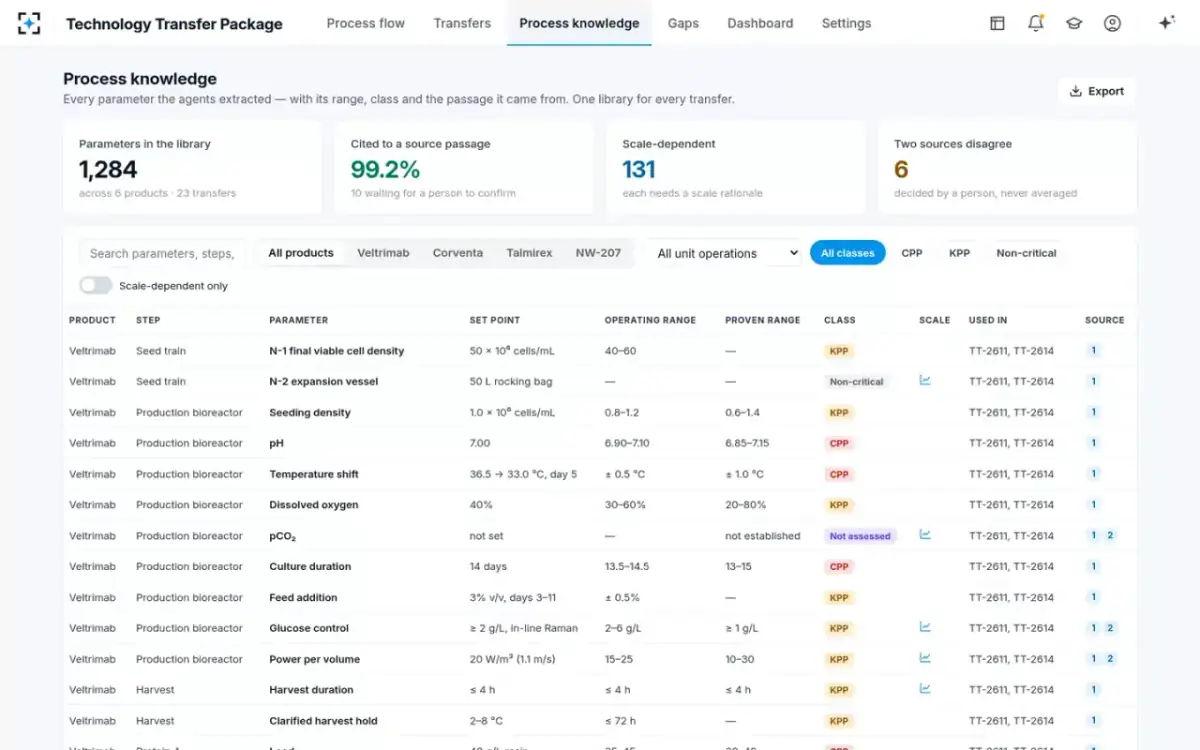
Every parameter with its ranges, its class and the passage it came from
Two documents, two values: a pool hold of 48 h and of 72 h
Here is the defect this page exists for. On the worked transfer, the master batch record holds the neutralised viral-inactivation pool at 2–8 °C for not more than 48 hours. A newer hold-time study finds the same pool stable for 72 hours, with high-molecular-weight species up 0.1% and charge variants unchanged; at 96 hours the high-molecular-weight species rose 0.4%. Both documents are current. Both apply. They give different answers for one limit.
What makes this hard is that every automatic resolution is wrong in an interesting way. Take the newer value and you have let a study overrule an executed process without a change assessment. Take the tighter value and you have thrown away a study somebody paid for and lost the knowledge that 72 hours is achievable. Average them and you have produced a number that appears in no document at all. All three are decisions, and all three destroy the fact that a disagreement existed — which is the one fact a reviewer most needs.
Both values, side by side, and a person choosing
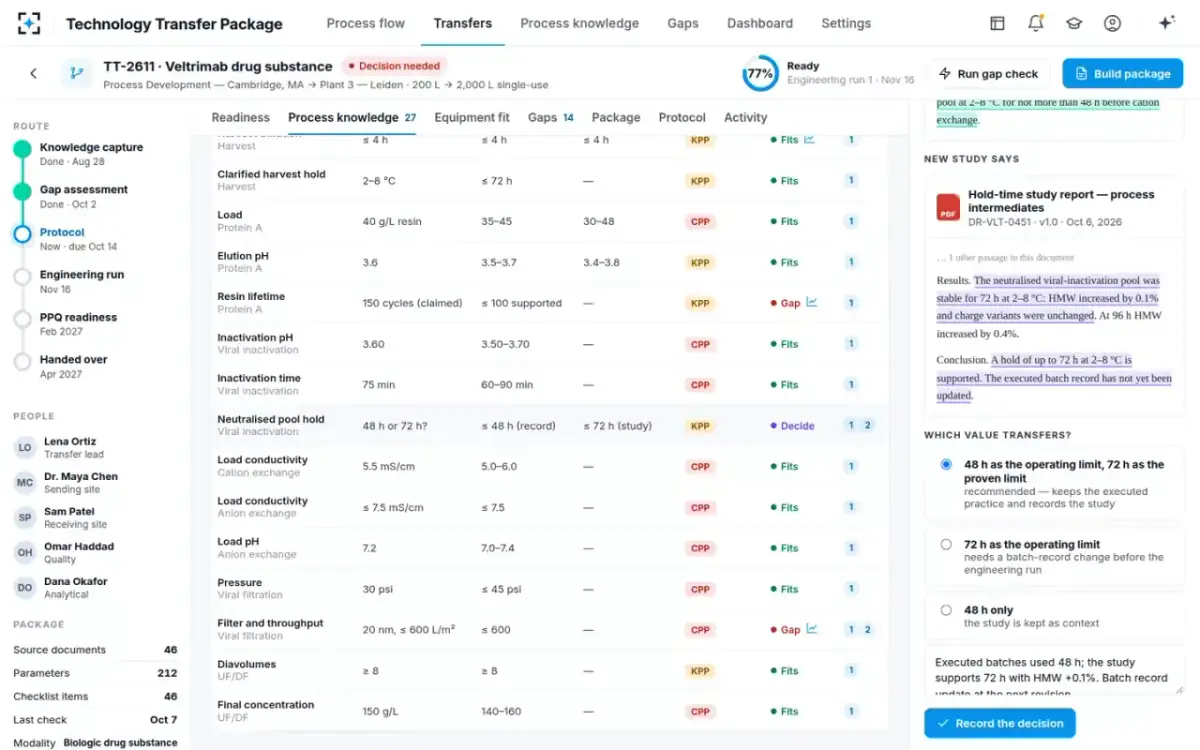
The resolution the transfer lead recorded keeps both facts, and it is the one the three-number model makes available: 48 hours as the operating limit, 72 hours as the proven limit, with her reason captured and the batch record flagged for revision at its next update. The receiving site inherits a limit it must work inside and a documented statement of what happens if it slips — which, on a hold time, is the difference between a deviation and an investigation.
There is a regulation standing behind the hold time itself. 21 CFR 211.111 requires that "When appropriate, time limits for the completion of each phase of production shall be established to assure the quality of the drug product. Deviation from established time limits may be acceptable if such deviation does not compromise the quality of the drug product. Such deviation shall be justified and documented." The rule anticipates that limits will sometimes be exceeded and asks for a justification — which is a great deal easier to write when a proven range exists than when it does not. How a disagreement like this is written up as a finding with an owner is set out in the tech transfer gap analysis.
Why a manually keyed value needs a second check
Parameter tables are built by people retyping numbers out of documents, and that is a known-defective process with a rule of its own. EU GMP Annex 11, on computerised systems, states it plainly: "For critical data entered manually, there should be an additional check on the accuracy of the data. This check may be done by a second operator or by validated electronic means."
Two things follow for a transfer package. First, the rule fits this case: a critical process parameter typed from a development report into a transfer table held in a computerised system is critical data entered manually, and the second check should not be treated as optional. Second, the rule names two ways to satisfy it — a second person, or validated electronic means — and a package assembled in a spreadsheet can easily end up with neither, because the spreadsheet sits outside the systems where either control would live.
Unit conversion is where this bites hardest, and it is unglamorous. A power per volume written in watts per litre in one report and watts per cubic metre in another differs by a factor of a thousand; a hold time in hours and in days; a temperature range written as a maximum in one place and as a band in another. Normalising units is one of the most mechanical tasks in building a parameter table and has one of the most expensive failure modes, which makes it the clearest candidate for the "validated electronic means" half of the rule — provided the normalisation shows the original as written as well as the converted value.
One line of a parameter table, annotated
All of which comes down to what a single row has to carry. Here is one, with what each field is for and the way it usually fails.
One parameter line, field by field, and what each one is actually for
Parameter
Production bioreactor — power per volume
Named by unit operation, so the same word in two steps is never one row.
Set point
20 W/m³
What the batch record tells the operator to run at. On its own it transfers nothing.
Operating range
15–25 W/m³
What the process is licensed and executed to run inside. A deviation outside it is a deviation.
Proven range
12–28 W/m³
What characterisation showed still produces acceptable material, other parameters held. Wider than the operating range, and not a licence to run there.
Class
Critical
Because its variability has a demonstrated effect on a quality attribute — not because it felt important.
Scale dependent
Yes — hold power per volume, state the impeller geometry
The rule by which the value changes with scale, which is what a receiving site needs instead of a speed in revolutions per minute.
Unit as normalised
W/m³, converted from W/L as written in the source
Normalising units is where a quiet factor-of-1,000 error enters a transfer package.
Source
Characterisation study, report DR-0318 v2.0, §4.2, Table 7, page 41
Document, version, section, table and page — enough for a reviewer to open it and disagree.
A table whose rows look like that is slow to build and fast to review, and the ratio is the point: the reviewer's time is the scarce resource in a transfer, and every field above removes a question they would otherwise have to ask. Where the parameter table then sits inside the package, and which section of the protocol it lands in, is set out in the transfer protocol, section by section.
Six checks before a parameter is allowed into a transfer package
- It cites a source passage
Document, version, section and page. A value whose source cannot be opened is a value the receiving site cannot defend to an inspector.
- Its class has a documented basis
Annex 15 asks for the basis on which a parameter was identified as critical or non-critical, taking risk assessment results into account — the reasoning, not just the label.
- Its units are normalised, and the original is still visible
Watts per litre against watts per cubic metre is a factor of a thousand, and conversion errors do not announce themselves.
- Operating and proven ranges are distinguished
They answer different questions. A table with one range column cannot say how much headroom a receiving site has.
- Scale dependence is flagged, with a rationale
A scale-dependent parameter owes the rule by which its value changes with scale, not only the value at the sending site.
- No two sources disagree about it unresolved
And if they do, the disagreement is shown rather than resolved — recorded as a conflict for a named person, with the reason for the choice captured.
Parameters in their place: eleven unit operations, each with its ranges
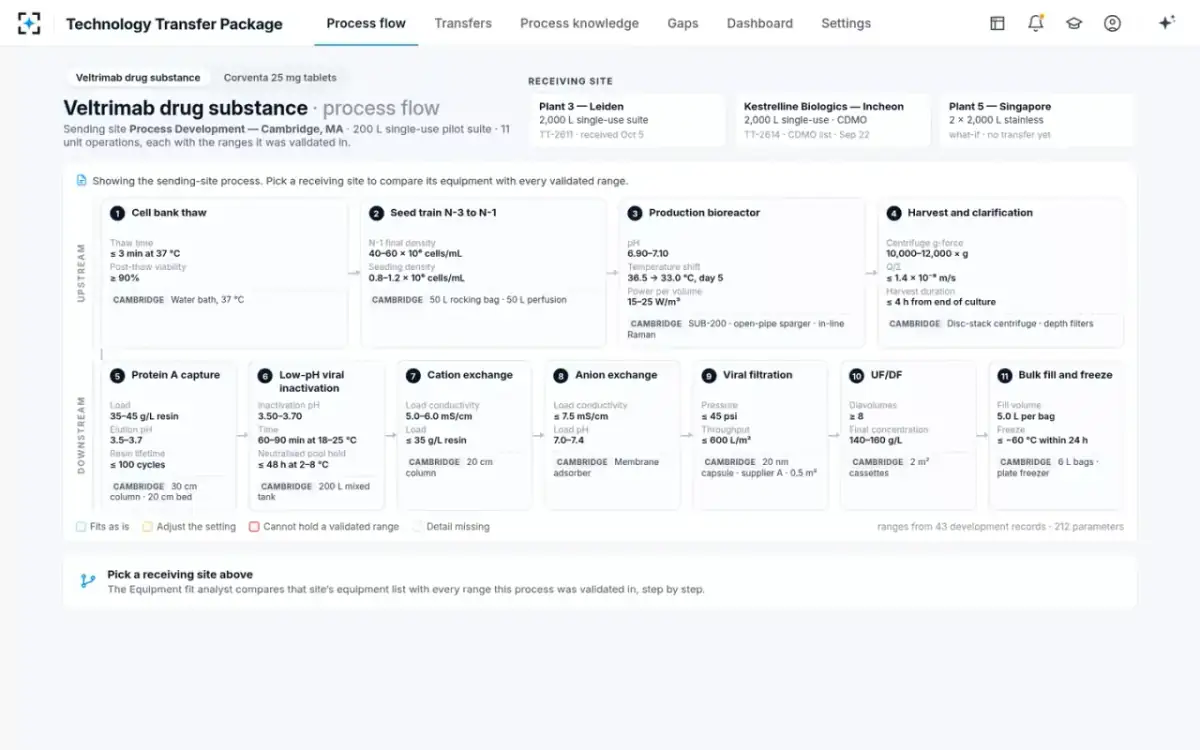
To see a parameter table built from the development records with every value carrying its passage, start from Technology Transfer Package.
Questions people ask
What is the difference between a critical process parameter and a key process parameter?
A critical process parameter is one whose variability affects a critical quality attribute, and the designation obliges you to monitor or control it. A key process parameter affects process consistency, yield or productivity without a demonstrated effect on a quality attribute. Only the first is defined by ICH; the second is industry practice and its exact meaning belongs to each company, which is why a transfer has to carry the sending site's own definition of the class alongside the table.
What is a proven acceptable range in a tech transfer?
A characterised range of a process parameter within which operation, while keeping other parameters constant, produces material meeting the relevant quality criteria. It is normally wider than the operating range, and that width is the headroom a receiving site has when its equipment cannot reproduce the sending site's conditions exactly. Because each one is established with the other parameters held, combining several proven acceptable ranges does not give you a design space — ICH Q8(R2) says so explicitly.
How do you trace a process parameter back to its source?
By carrying a reference with the value through every hand-off: the characterisation study that set it, the development report that stated it, the parameter table, the transfer protocol, the receiving site's batch record. The reference has to be specific enough to open — document, version, section, table and page — because a reference to a document alone leaves the reviewer searching. The field easiest to drop is the source at the parameter-table step, and once it is gone the chain cannot be rebuilt without redoing the reading.
What happens when two documents give different values for the same limit?
It should be recorded as a conflict and shown to a person. Taking the newer value, the tighter value or an average are each a decision dressed as data handling, and each one erases the fact that a disagreement existed. Often the best resolution keeps both facts — a hold recorded as 48 hours operating and 72 hours proven, say, with the reason captured and the older document flagged for revision — which gives the receiving site both the limit it must work inside and a documented statement of its headroom.
What is a hold time study?
A study that establishes how long material can be held at a defined step and condition before quality is affected — the data behind a time limit in the batch record. The US regulation requires that time limits for the completion of each phase of production be established where appropriate, and allows a deviation from one where it does not compromise quality, provided the deviation is justified and documented. A proven hold longer than the operating limit is what makes such a justification writable.
How many critical process parameters does a biologics process have?
There is no standard number, and a count on its own says little: it depends on how many unit operations the process has and how finely the company's scheme divides a step's settings. More useful is the ratio of parameters to sources. On the worked transfer here, 212 parameters came out of 43 development records for one drug-substance process — about five parameters per document, and about seven working days to build the table by hand on the solution's own estimate.