Technology transfer in the pharmaceutical industry is the work of moving a product, a process or an analytical procedure from the unit that developed it to the unit that will run it — development to a commercial plant, one plant to another, a company to a contract manufacturer — and then proving the receiving unit can make the same thing. The World Health Organization defines it as "a logical procedure involving the transfer of products, processes and knowledge, supported by relevant documentation and professional expertise". It is hard because that knowledge is scattered across dozens of development reports, batch records, risk assessments and equipment lists, and the part nobody wrote down lives with the people who ran the process. Botminds' Technology Transfer Package reads those records, builds the parameter table with every value cited to the passage it came from, and compares each step against the receiving site's own equipment list before a batch is at stake.
Two vocabularies run through this page. The rulebook's: the sending unit (SU) and the receiving unit (RU). And the plant's: Cambridge and Leiden, the two sites of the worked transfer used throughout. That transfer, its people, its product and its sites are sample data in the solution — invented, not a customer's. Everything cited to a regulator or a journal is real and linked where it appears.
One biologics drug-substance transfer, as Technology Transfer Package sees it
212parameters
read from 43 development records, each carrying the passage it came from
46items
on the transfer checklist for a biologic drug substance, in ten areas
12
gaps open on the worked transfer 40 days before its first engineering run
11days
to a complete package draft, against about 26 by hand
What is technology transfer in the pharmaceutical industry?
It is a documented procedure, not a handover. The WHO's 2022 guideline — Annex 4 of Technical Report Series No. 1044, which replaced the 2011 text — is explicit about what finishing it means: "A successful technology transfer project should result in documented evidence that the RU can routinely reproduce the transferred product, process or procedure against a predefined set of specifications, as agreed between the SU and RU." Three words in that sentence do the work. Documented: a conversation between two plants is not a transfer. Routinely: one good batch is not evidence. As agreed: the specifications the receiving site is judged against are negotiated up front, not discovered in review.
ICH Q10 places the same activity inside the pharmaceutical quality system and names what is actually being moved: "The goal of technology transfer activities is to transfer product and process knowledge between development and manufacturing, and within or between manufacturing sites to achieve product realisation." Knowledge, not paper. The paper is the carrier.
The textbook distinction between vertical and horizontal technology transfer in industrial pharmacy describes the direction of that movement. Vertical transfer moves a process down the development stages at one organisation — bench to pilot to commercial scale — and its hard problem is scale: the equipment changes under the process. Horizontal transfer moves a process sideways between organisations or sites at a comparable scale, and its hard problem is difference: two plants with the same nominal capability do not have the same machines. The WHO guideline does not use either word. It covers both, and the four phases below apply to each.
The four phases, and what each one has to produce
Section 12 of the WHO guideline suggests dividing the project into four phases, and each one owes a document that somebody has to authorise. The useful way to read them is backwards: Phase IV cannot conclude anything the Phase II protocol did not ask for, and the Phase II protocol cannot be written without the Phase II gap analysis.
The four phases of a technology transfer project, and the deliverable each one owes
Phase I
Project initiation
A unit identifies the need — lack of capacity, a move from development to a commercial site, or a transfer from one company to another — and the receiving unit says whether it is interested and able.
OwesA decision that this receiving unit "should be able to accommodate the intended activity" and has "the necessary technical expertise, technology and capability".
Authorised byThe sending and receiving units, with the marketing authorisation holder.
Phase II
Project planning
A joint team is formed, performs the gap analysis and risk assessment on the premises, equipment, materials, products and procedures, writes the transfer document and develops the control strategy.
OwesThe authorised transfer protocol or master plan, the gap analysis, the risk assessment and a control strategy covering risks, material attributes, test procedures, sampling and specifications, critical quality attributes and critical process parameters.
Authorised byThe joint team; the transfer document is authorised before execution.
Phase III
Project transfer execution
The receiving site identifies every difference in facilities, systems and capabilities and discusses it with the sending site; procedures, training, analytical procedures, trial batches and validation batches follow.
OwesSite operating procedures and documentation before routine production, transferred analytical procedures, the determination of critical steps including hold times and sampling points, and the validation runs.
Authorised byThe receiving site, with the sending site cooperating on impact.
Phase IV
Project review and close-out
Progress is monitored during and after the project, compliance with the protocol is verified, deviations and changes are investigated, and the data are evaluated statistically for trends against control limits.
OwesA transfer report that assesses the data, concludes, and states whether the team has achieved completion — with the supportive data stored and accessible.
Authorised by"The appropriate responsible person or persons" authorise the report.
Two things that teams treat as phases are not. Training is not a phase; it runs through Phase III, and where the receiving site "has limited manufacturing experience or the process being transferred is complex", the guideline asks the sending site to consider extensive training and on-site support before execution begins. And the engineering or trial batch is not a phase either: it sits inside Phase III, and the protocol has to have named its timing in advance, among the "approximate timing of key activities and deliverables, including the timing of trial production batches and validation batches".
Before any of it starts, the guideline sets eight general principles the project has to satisfy. They read like a project charter, and they are the cheapest list in the document to check yourself against: three of the eight are about knowing the difference between the two sites.
The eight things every transfer project must have, before the first batch
- A documented project plan
Covering the relevant aspects of the project. Not a schedule: the plan is what Phase IV is later verified against.
- A detailed quality risk management plan
Separate from the plan itself, and the thing a drafted risk line eventually lands in.
- A comprehensive gap analysis, with due diligence
Covering technical, quality and regulatory aspects — the phase that sets the schedule for everything after it.
- Similar capabilities between the two sites
Including facilities and equipment, where appropriate. "Similar" is the word that has to be tested, machine by machine.
- Knowledge of the differences in process ability
Including "the impact, risk and control strategies to overcome any differences". A difference you have described is not yet a difference you have controlled.
- Enough trained people, suitably qualified
A sufficient number with suitable qualifications and experience — at the receiving site, in time to run the trial batches.
- Effective process and product knowledge management
The reason a transfer package exists at all: ICH Q10 makes knowledge management an enabler of the quality system, not a document task.
- Effective communication and transparency between the sites
The principle that breaks quietly, when a receiving site does not say which of its machines cannot hold a range.
What the sending site owes the receiving site
Appendix 1 of the guideline lists, aspect by aspect, the documentation commonly required for a transfer. It is the closest thing the field has to a packing list, and it is worth reading as a gap list in advance: in each row, ask which document would turn out to be missing, out of date or held by a person rather than a system.
Documentation commonly required for a transfer, and where to look first in each row
| Aspect | What the guideline lists | Where to look first |
|---|---|---|
| Regulatory | The regulatory process description and the applicable regulatory documentation. | The list of what the change itself will have to be filed as, settled before the protocol is signed. |
| Starting materials | Master files, safety data sheets, the product development report, storage conditions, stability and forced-stability data, specifications, supplier qualification, references. | Forced-degradation data, which the receiving quality control laboratory needs to run a stability-indicating method. |
| Formulation | Formulation development reports, the master formula, material compatibility and interaction studies, specifications for delivery devices. | The compatibility study for a contact material the receiving site uses and the sending site never did. |
| Batch manufacturing | The master and an executed batch record, scale-up information, the risk assessment, critical process parameters, in-process control specifications, the scale-up protocol and report, process validation. | Scale-up information: the rationale for a scale-dependent parameter, rather than the number itself. |
| Packaging | Packaging material specifications, the master and executed packaging record, validation, the sampling plan, acceptance quality levels, packaging validation. | The acceptance quality level actually applied on the line, as against the one in the specification. |
| Finished product | The specification and the product dossier. | The least likely gap: these are the documents every team starts from. |
| Analytical procedures | Test procedures, procedure development, procedure validation, standard test procedures, instrument specifications. | Robustness data, without which the receiving laboratory cannot judge its own instrument against yours. |
| Quality control | Sampling procedures including in-process control, the stability testing protocol and procedures, release-test procedure validation. | The in-process sampling technique, as opposed to the sampling point. |
| Equipment and instruments | The list of equipment and instruments, preventive maintenance information, an overview of qualification. | The current revision of the receiving site's own list — the document this whole exercise turns on. |
| Cleaning | The cleaning validation master plan, cleanability and procedure development, procedures, health-based exposure level reports, analytical validation for cleaning, validation and recovery reports. | The health-based exposure level report, when the receiving site is multi-product and the sending site was not. |
| Other documents | Recalls and complaint reports, bio-batch and pilot-batch information, the history of changes and change management, hold time protocols and reports. | Hold time reports — a document that can disagree with the batch record, as it does on the worked transfer. |
The guideline is careful to call these examples: "all the required documents should be identified for the different tasks". In practice a company's own transfer procedure turns the list into a checklist for the modality. On the worked transfer the checklist is 46 items in ten areas for a biologic drug substance, and an item counts as found only when it carries cited evidence — the single rule that stops a checklist from becoming a self-assessment.
"A successful technology transfer project should result in documented evidence that the RU can routinely reproduce the transferred product, process or procedure against a predefined set of specifications, as agreed between the SU and RU."
WHO guidelines on technology transfer in pharmaceutical manufacturing, §1.7
Due diligence and gap analysis: the phase that sets the schedule
The guideline puts the gap analysis at the front of the project and says where it happens: the first steps of a transfer should include due diligence and a gap analysis, carried out through visits to both the sending and the receiving site. It then names eleven areas the analysis has to cover, from personnel and premises through computerised systems to waste management, and it names who does it: a team of qualified people, with the quality units of both sites recommended as participants.
This is the phase that decides the schedule, and the arithmetic is unsentimental. A difference found on paper costs a comparison and a study. The same difference found in the engineering run costs the batch, the suite time, the investigation and the re-run — and it arrives at the point in the project where there is least calendar left. The guideline is blunt about what a finding obliges: where the comparison identifies a gap or a difference, appropriate action should be taken, and it names adapting existing equipment or acquiring new equipment as two of the possibilities. Acquiring equipment is a lead time, and a lead time is only a schedule problem if you learn about it late. What a gap list has to carry to be worth anything — evidence, a severity, what it blocks, a proposed action and an owner — is set out in the tech transfer gap analysis, area by area.
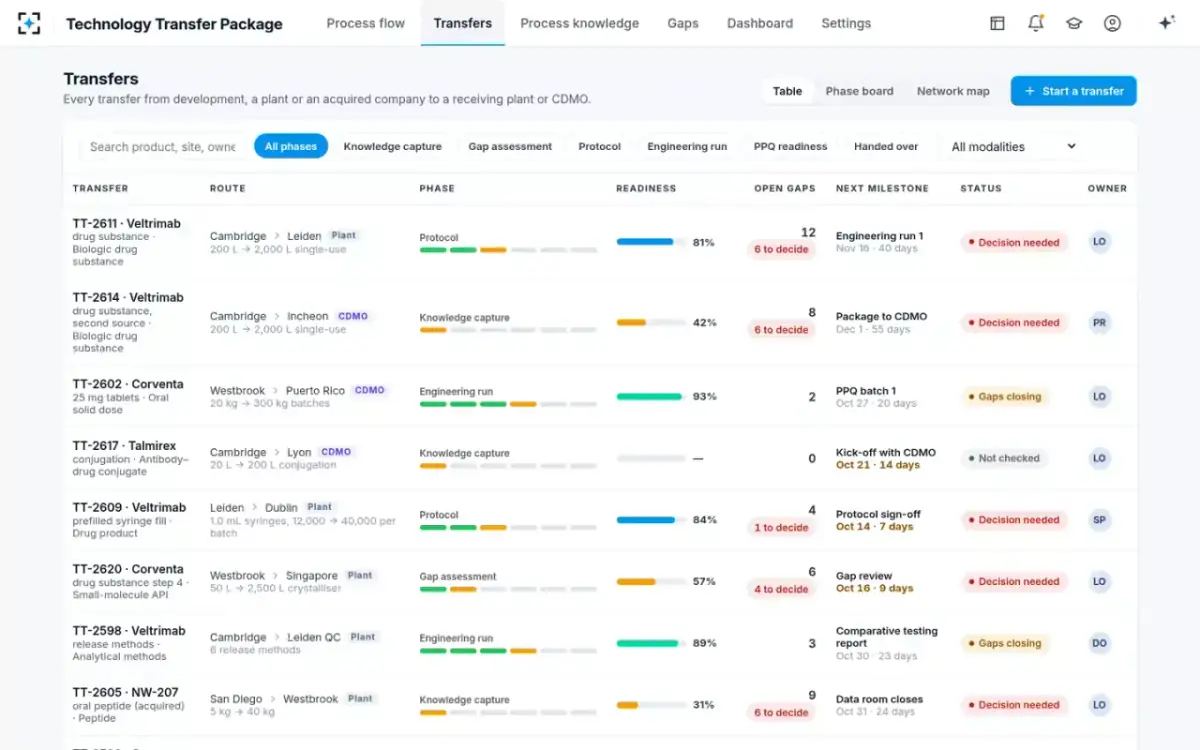
Ten transfers, ranked by what needs a decision
How long does a pharmaceutical technology transfer take?
Honestly: there is no reliable public benchmark. Transfer durations are commercially sensitive, vary by modality and by how much of the receiving site already exists, and they are rarely reported in peer-reviewed research. What is published is the cost and effort of the process development and manufacturing work a transfer sits inside. Farid and colleagues, benchmarking those contributions across a biopharmaceutical pipeline, found that "the costs for process development and manufacturing per market success were predicted to represent 13–17% of the R&D budget from pre-clinical trials to approval", modelling process development and manufacturing budgets of the order of $60 million for pre-clinical through Phase II material and $70 million for Phase III through regulatory review to deliver one market success a year, and assuming a Phase III process-development stage of about two years and some forty full-time-equivalent years of effort.
Two things follow for a schedule. First, the transfer is not the expensive part; it is the part that can waste the expensive part. Second, the figure a team can actually control is not the length of the project but the length of its documentation work — and that is measurable in a way the project is not.
Where a transfer package's working days go, by hand and with the agents
- Gathering reports, batch records, equipment lists4 d
- Building the parameter table7 d
- Comparing the receiving site step by step4 d
- Working the checklist, writing gaps5 d
- Drafting the package and protocol4 d
- Decisions, reviews, signatures2 d
- Gathering reports, batch records, equipment lists½ d
- Building the parameter table2 d
- Comparing the receiving site step by step1 d
- Working the checklist, writing gaps2½ d
- Drafting the package and protocol2½ d
- Decisions, reviews, signatures2 d
The shape of that comparison is the argument. The work that shrinks is reading, tabulating and comparing. The work that does not shrink is deciding — and the solution is built so that it cannot, because no agent in it decides or closes a gap, and a drafted risk line stays a draft until quality approves the risk assessment revision.
Process validation, the first engineering run and PPQ
A transfer and a process validation are different exercises that share a calendar. The transfer moves knowledge and proves reproducibility between two units. Process validation demonstrates that the commercial process at the receiving site consistently delivers quality product, and in the US framework it has three stages: process design, process qualification — which contains process performance qualification, the PPQ batches — and continued process verification. EU GMP Annex 15 ties the two together in one sentence: "For all products irrespective of the approach used, process knowledge from development studies or other sources should be accessible to the manufacturing site, unless otherwise justified, and be the basis for validation activities." The transfer package is how that access is delivered.
Between the protocol and the PPQ batches sits the engineering run — the first time the process is executed at the receiving site, usually not for sale. It is one of the project's most expensive instruments, and it is too easily spent answering questions a calculation could have answered. The FDA's process validation guidance is plain about the design-stage expectation: the functionality and the limitations of the commercial manufacturing equipment are to be considered in the process design, along with the variability contributed by component lots, operators, environmental conditions and the measurement systems in the production setting. Limitations, considered in the design. Not discovered in the suite. What an engineering run is actually for, and what it costs when it is asked to settle an arithmetic question instead, is the subject of the engineering batch in pharma.
What has to be filed when the manufacturing site changes
Once a product is approved, a transfer is a change to the approved application, and the filing obligation is separate from the technical work. For a US biologics licence, 21 CFR 601.12(a)(1) requires that an applicant "must inform the Food and Drug Administration (FDA) … about each change in the product, production process, quality controls, equipment, facilities, responsible personnel, or labeling established in the approved license application(s)". Equipment and facilities are named in the same breath as the process. A receiving site's different centrifuge is not only a technical gap; it is potentially a reportable change, and which reporting category it falls into depends on its assessed effect on identity, strength, quality, purity or potency.
The practical consequence for a transfer schedule is that the regulatory assessment cannot wait for the gap list to close. It needs the same comparison the gap analysis produces — what differs, by how much, and with what assessed effect — early enough that a prior-approval supplement's review time is inside the plan rather than appended to it. It is no accident that Appendix 1 puts the regulatory process description in its first row, or that a transfer protocol references the gap analysis rather than summarising it.
There is a public-health reason the authorities care. The FDA's Drug Shortages Task Force examined shortages between 2013 and 2017 and reported that "of the 163 drugs in shortage, 62 percent went into shortage after supply disruptions occurred that were associated with manufacturing or product quality problems". A transfer is how a second source gets built, and a transfer that goes wrong is one of the ways a single source stays single.
Analytical procedure transfer: four routes, and the long pole
The analytical side of a transfer runs on its own track and is the one most likely to be late, because the receiving laboratory cannot test process validation samples until its procedures are in place. The guideline is firm about the order: analytical procedures "should be implemented at the testing laboratory before the testing of samples for process validation studies is performed by the RU". It then names four ways to get there: "The transfer of the analytical procedure may be accomplished by several approaches, such as confirmation testing, comparability testing between SU and RU results, co-validation between laboratories, or through paper-based knowledge transfer." The choice "should be risk based and scientifically justifiable".
Four routes for an analytical procedure transfer, and what each one actually establishes
| Route | What the receiving laboratory does | When it fits | What it does not establish |
|---|---|---|---|
| Confirmation testing | Runs tests that, in the guideline's glossary, "confirm and validate the results obtained by another test". | A compendial or well-characterised procedure on equipment of the same kind, where the question is whether this laboratory can execute it. | Equivalence of the two laboratories' results on a sample neither has seen; nor robustness on the receiving instrument. |
| Comparability testing | Tests shared samples and compares its results with the sending laboratory's against pre-agreed criteria. | Release methods that carry a specification, and any potency or purity method where a systematic offset between laboratories would move a result against a limit. | Anything about samples outside the range tested — which is why the experimental design, not the pass, is the deliverable. |
| Co-validation between laboratories | Takes part in the validation itself, generating part of the validation data set at its own site. | A procedure being validated at the time of the transfer, or one where the receiving laboratory will own future changes. | A saving: it is the most expensive route in analyst time, and the one that has to be planned furthest ahead. |
| Paper-based knowledge transfer | Receives the procedure, validation reports and robustness data and implements without generating comparative data. | A procedure the receiving laboratory already runs for another product, or a low-risk procedure with a documented justification. | Evidence of anything. It is a risk decision, and the justification is the record that has to survive an inspection. |
Whichever route is chosen, §12.25 fixes the protocol's contents: the objective, scope and responsibilities of both units; a specification of materials and methods; the experimental design and acceptance criteria; documentation, including the report forms to be used; a procedure for handling deviations; and details of the test samples. On the worked transfer, six release methods go to the receiving site's quality control laboratory, the potency assay is the long pole, and the analytical development lead owns method gaps by default so that they are never nobody's.
Five differences nobody compared, and what each one cost
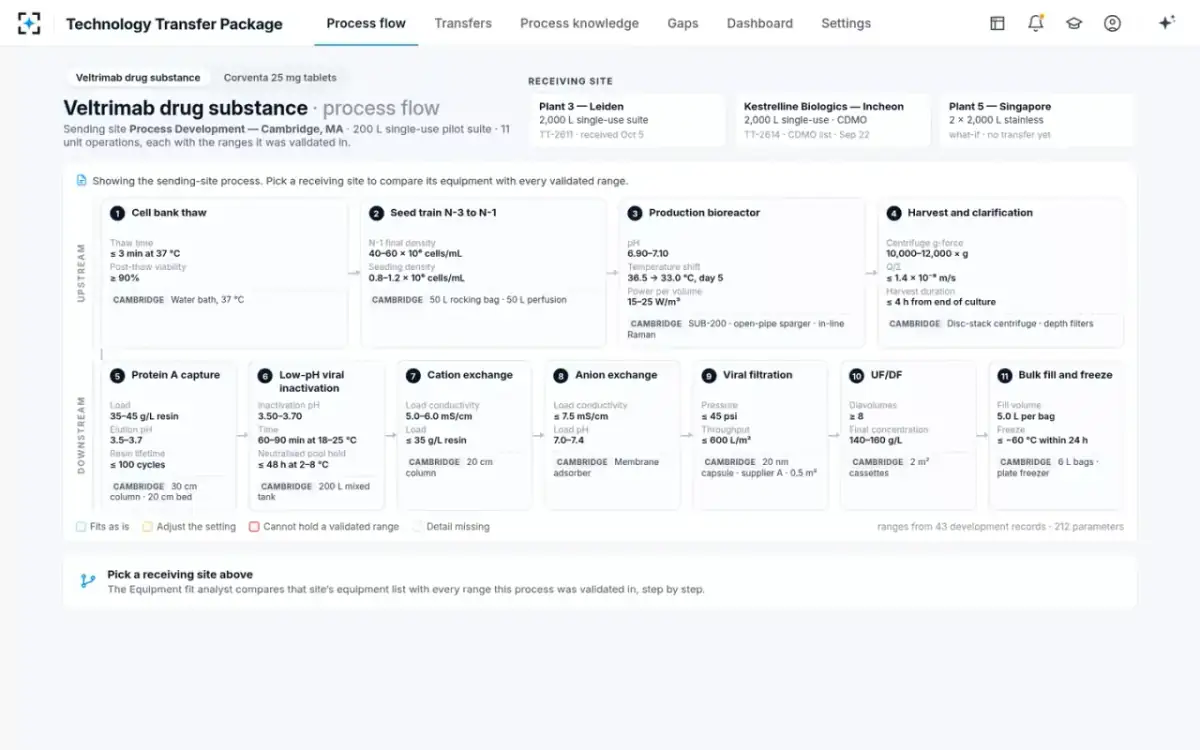
The abstract case for comparing on paper becomes concrete the moment you line two suites up. The worked transfer moves a monoclonal antibody drug substance from a 200 L single-use pilot suite at a development site in Cambridge, Massachusetts to a 2,000 L single-use suite at a plant in Leiden. Eleven unit operations, from cell bank thaw to bulk fill and freeze, with 212 parameters and their validated ranges read out of 43 development records. Compared against the receiving site's current equipment list, three steps came back unable to hold a validated range: the production bioreactor, viral filtration, and harvest and clarification.
The process, not a project plan: eleven unit operations with their validated ranges
Cambridge against Leiden: five differences, and what each one obliged
At the sending site, as validated: Harvest validated at 10,000–12,000 × g, with a maximum equivalent-settling-area ratio, finished within 4 h of the end of culture.
At the receiving site, and what it forced: The disc-stack centrifuge is limited to 8,000 × g. Matching the validated ratio holds the feed to 410 L/h, which puts the harvest at 4.9 h against a 4 h window. Raised as a gap that blocks the engineering run, with scale-down runs and more secondary depth-filter area proposed.
At the sending site, as validated: An open-pipe sparger; at 200 L, peak dissolved carbon dioxide stayed between 62 and 95 mmHg across every run and was never deliberately varied.
At the receiving site, and what it forced: A 1 mm drilled-hole sparger with overlay capped at 0.1 vvm, so carbon dioxide accumulates further. Nothing in the data says what the cell line does at a higher level: six 3 L runs at 120–180 mmHg proposed to find out.
At the sending site, as validated: The control strategy uses an in-line Raman probe for glucose through the production bioreactor.
At the receiving site, and what it forced: No port for it on the receiving vessel. The sampling plan drafted for the engineering run replaces it with off-line glucose twice daily — a control strategy change, so it travels as one.
At the sending site, as validated: Viral clearance claimed on a filter from one supplier, with the clearance study run on that membrane.
At the receiving site, and what it forced: A filter from a second supplier. The clearance claim does not carry across membranes, so the step is a gap until a study says otherwise — a lead-time problem, not a paperwork one.
At the sending site, as validated: The master batch record holds the neutralised viral-inactivation pool at 2–8 °C for not more than 48 h.
At the receiving site, and what it forced: A newer hold-time study supports 72 h. Two documents, two numbers, one limit: the conflict goes to a person, who records 48 h as the operating limit, 72 h as the proven limit, and her reason.
Four of those five are arithmetic or document comparison: things a person could do, given a week and the right eleven documents open at once. The fifth, the hold-time disagreement, is the one that is hardest to do by hand, because nobody is looking for it — it only appears when the same limit is read out of two sources and the values are put side by side. The scale-up decision behind the first two rows, and which criterion a transfer can actually hold constant, is worked through in bioreactor scale-up parameters.
The package: ten sections in the company template, every statement cited
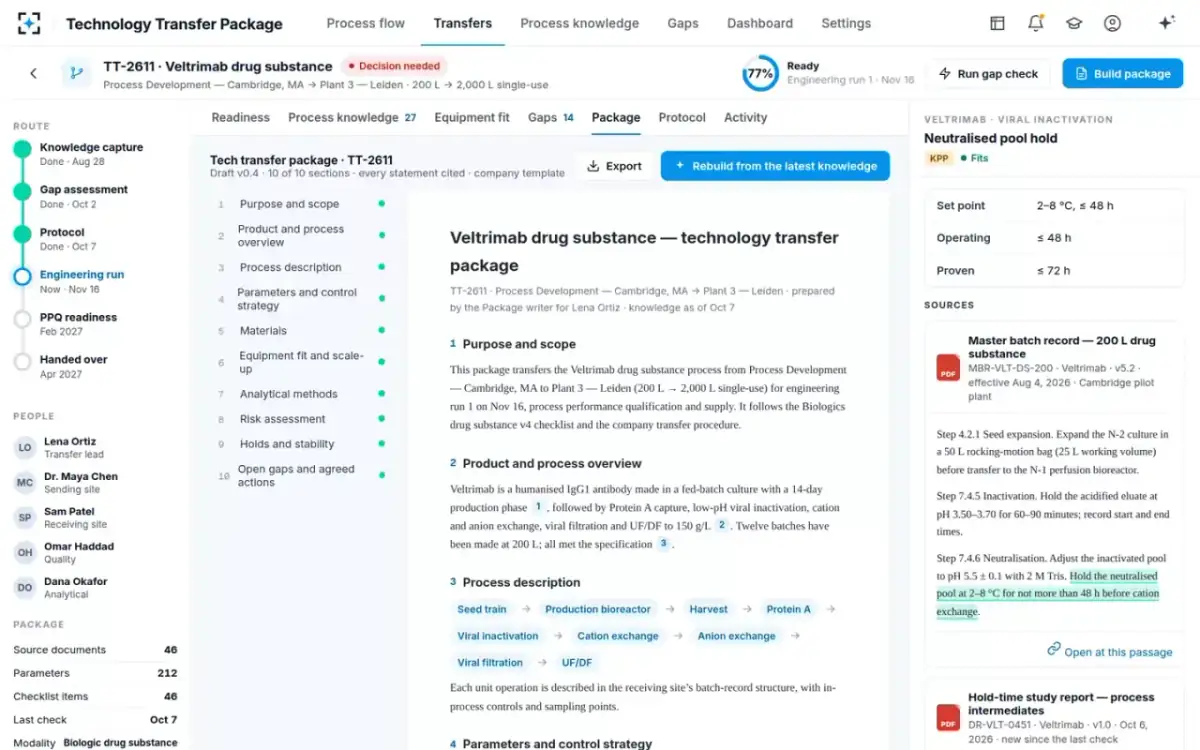
Where the solution stops is as important as where it starts. It drafts; people decide. The agents read and compare and propose, and every gap, every value chosen between two sources, every risk line and every signature belongs to a named person — the shape of the work after that is the transfer protocol, section by section. To see the whole transfer screen by screen, start from Technology Transfer Package.
Questions people ask
What documents are required for technology transfer?
Appendix 1 of the WHO guideline lists them by aspect: regulatory, starting materials, formulation, batch manufacturing, packaging, finished product, analytical procedures, quality control, equipment and instruments, cleaning, and a final row of recalls and complaints, bio-batch and pilot-batch information, change history and hold-time reports. The guideline calls these examples and asks that all required documents be identified per task, so a company's transfer procedure usually turns the list into a checklist by modality — 46 items in ten areas for a biologic drug substance, on the worked transfer here.
What is the difference between technology transfer and process validation?
A transfer moves product and process knowledge between two units and ends in documented evidence that the receiving unit can routinely reproduce the process. Process validation demonstrates that the commercial process at that site consistently produces acceptable product, across process design, process qualification and continued verification. They overlap in time and share documents — EU GMP Annex 15 requires development process knowledge to be accessible to the manufacturing site and to be the basis for validation — but the transfer report concludes about reproducibility and the validation report concludes about the process at one site.
Who is responsible for technology transfer?
The WHO guideline asks the marketing authorisation holder, the sending unit and the receiving unit to jointly establish a team that coordinates and executes the project, and recommends that both quality units take part in the gap analysis. In practice a named transfer lead, usually in manufacturing science and technology or CMC, owns the project; the receiving site owns the actions on its own equipment; and the transfer report is authorised by "the appropriate responsible person or persons" — which the company's own procedure has to name before, not after, the project.
What is vertical technology transfer in industrial pharmacy?
Vertical transfer moves a process down the development stages within one organisation — bench to pilot to commercial scale — so the dominant problem is scale dependence: the equipment changes under the process and a parameter that was fixed at one scale has to be recalculated at the next. Horizontal transfer moves a process between organisations or sites at a comparable scale, where the dominant problem is difference between two nominally similar plants. The WHO guideline uses neither term and covers both.
Why is technology transfer important in pharma?
Because it is how a process reaches the plant that will make it, and how a second source is built. The FDA's Drug Shortages Task Force found that of 163 drugs it examined in shortage, 62% went into shortage after supply disruptions associated with manufacturing or product quality problems. Transfers are also where development money is protected or wasted: in the Farid benchmarking study, process development and manufacturing were modelled at 13–17% of the research-and-development budget from pre-clinical work to approval.
How long does a pharmaceutical technology transfer take?
There is no reliable public benchmark — durations are commercially sensitive and rarely reported in peer-reviewed research. What can be measured is the documentation work inside the project. The solution targets about 11 working days from kick-off to a complete package draft for one biologics drug-substance transfer, against an estimated 26 by hand, with the decision, review and signature days deliberately unchanged.