A tech transfer gap analysis is the structured comparison of a sending site against a receiving site, done on paper, before a batch is at stake: what the process needs, what the receiving site has, and every place the two do not meet. It is hard work rather than clever work — it means holding two equipment lists, a parameter table and a shelf of development reports open at once and redoing the comparison each time one of them is revised — which is why it is so often reduced to a workshop and a spreadsheet of impressions. Botminds' Technology Transfer Package runs it as a comparison against a written checklist, marks each item found, partial, missing or in conflict with the evidence behind it, and writes the gaps that fall out of it for a person to decide.
The transfer used throughout, its two sites, its people and its product are sample data in the solution — invented, not a customer's. Every regulatory quotation is real and linked where it appears.
What is a tech transfer gap analysis?
The WHO guideline on technology transfer puts it at the very start of the project and is specific about how it is done: "When considering a technology transfer project, the first steps should include a process of due diligence and gap analysis through visits to the SU and RU." Visits, plural, to both the sending and the receiving unit. It is also one of the eight general principles the guideline requires of every transfer project — "a comprehensive gap analysis, including due diligence performed covering technical, quality and regulatory aspects" — and it is named again inside the planning phase, where the team performs it "based on the available data, information and knowledge of the premises, equipment, materials, products, procedures and other related information".
Three words in that last phrase carry the discipline. Available: the analysis is bounded by the documents you actually have, which is why a missing document is itself a finding rather than a reason to wait. Data, information and knowledge: three different things, and the third one is the one that lives in people and has to be asked for. Other related information: the escape hatch that stops the list below from being read as exhaustive.
The eleven areas the gap analysis has to cover
Section 4.4 names the scope, and it is wider than many teams run: "The gap analysis should further cover the capabilities and resources related to personnel, premises, equipment and instruments, utilities, cleaning, quality control, documentation, computerized systems, qualification, validation, and further health, safety and environment-related considerations, including waste management." Eleven areas. It is tempting to work two of them properly — equipment and analytical methods — and sample the rest.
The eleven areas, the question each is really asking, and the document that answers it
Personnel
Are there enough qualified people, and have they run anything like this?
Answered byOrganisation charts, training files, the receiving site's experience with the modality.
Premises
Does the room classification match, and does the material and personnel flow work?
Answered byFacility layouts, classification drawings, flow diagrams.
Equipment and instruments
Can each machine hold the range the step was validated in — not the set point, the range?
Answered byBoth equipment lists at their current revision, plus the qualification overview.
Utilities
Water quality, clean steam, gases, chilled supply: same grade, same capacity at peak?
Answered byUtility qualification reports and capacity studies.
Cleaning
Is this product the new worst case on a shared train, and does the limit survive it?
Answered byCleaning validation master plan, health-based exposure level reports, recovery studies.
Quality control
Can the receiving laboratory run every release and in-process method, on its own instruments?
Answered byMethod list with transfer routes, instrument specifications, robustness data.
Documentation
Does every value in the package point at a document that still exists and is current?
Answered byDevelopment reports, batch records, specifications, with their versions and effective dates.
Computerised systems
Which systems hold data the process depends on, and are they validated at the receiving site?
Answered bySystem inventories, validation summaries, data integrity assessments.
Qualification
Is each piece of equipment qualified for this use, or only for the use it was bought for?
Answered byInstallation, operational and performance qualification reports and their scopes.
Validation
What has to be revalidated here — process, cleaning, methods, hold times — and in what order?
Answered byValidation master plans, site-independent and site-dependent.
Health, safety and environment
Including waste: can the site handle this product's containment and its effluent?
Answered byContainment assessments, waste management procedures and permits.
Two areas are worth singling out because they are the ones that produce gaps nobody budgeted for. Cleaning, because a product that was made in a dedicated development suite can become the worst case on a shared commercial train, and the health-based exposure level calculation that follows is a study with a lead time. And computerised systems, because a control strategy that depends on an in-line measurement depends on a system at the receiving site, and "we have that instrument" is not the same as "that instrument is qualified for this and its data are in a validated system".
Who should be in the gap-analysis team
The guideline is unusually direct about staffing: "The gap analysis should be performed by a team of appropriately qualified persons with knowledge and experience in the field of good practices and the activity to be transferred. It is recommended that the quality units of the SU and RU participate in this activity."
Both quality units, not one. The reason is that a gap analysis is where the two sites' standards get compared, and standards are the thing each site is least able to see from the inside. A receiving site that has never run this modality will not know which of its ordinary practices the sending site treats as unacceptable, and the sending site will not think to say so, because to it those practices are simply how things are done. The people in the room should be able to answer, between them, what each step needs, what each machine can do, what the laboratory can measure, and what quality will accept.
"During the transfer process, the RU should identify any differences in facilities, systems and capabilities and discuss these with the SU. The SU should cooperate with the RU to understand the potential impact and satisfactorily address this in order to assure equivalent product quality."
WHO guidelines on technology transfer in pharmaceutical manufacturing, §12.20
That paragraph puts the obligation to find differences on the receiving site and the obligation to help understand them on the sending site, and it is the sentence to read aloud when a transfer starts going quiet. A receiving site that does not say which of its machines cannot hold a range is not protecting the schedule; it is moving the discovery to the engineering run.
A 46-item transfer checklist: found, partial, missing, in conflict
The scope becomes workable when a company turns it into a checklist for the modality. On the worked transfer — a biologic drug substance — that is 46 items in ten areas, and each item takes one of four states. Found means the item exists and the evidence for it is cited to a document, a version and a passage. Partial means something is there but incomplete: a parameter without its scale rationale, a method without robustness data. Missing means nothing answers it. In conflict means two sources answer it differently, which is the most interesting state and the one a tick-box checklist cannot express.
A biologic drug-substance transfer checklist, area by area, about six weeks before the engineering run
| Area | Items | Where it stands, and on what evidence |
|---|---|---|
| Process description | 5 | All five found: the eleven unit operations, their order, the flow diagrams and the equipment class each step needs. |
| Parameters and control strategy | 7 | Five found, one partial — the scale rationale for a scale-dependent parameter — and one in conflict, the neutralised pool hold. |
| Materials | 4 | Three found; the receiving site's qualification of one resin supplier is missing. |
| Equipment and qualification | 6 | Four found, two partial: the current revision of the receiving equipment list arrived mid-analysis, and one qualification scope does not cover this use. |
| Analytical procedures | 6 | Four found, one partial — robustness data for the potency assay — and one missing, the transfer route for a residual-host-protein method. |
| Holds and stability | 4 | Two found, one partial, one missing: no site-specific stability plan for the receiving site yet. |
| Risk assessment | 3 | Two found; the third is partial because the assessment covers the harvest at the validated force and not the force the receiving centrifuge can reach. |
| Cleaning | 4 | Two found, two partial: the receiving site's cleaning assessment covers the single-use train but not yet the shared buffer hold vessels. |
| Regulatory | 3 | One found, two missing: the reporting category for the site change is not yet settled, and nor is the comparability plan that would support it. |
| Packaging and labelling | 4 | Two found and two not applicable: this is a drug-substance transfer and the two packaging items belong to the downstream fill site. |
The 2 not applicable items are worth a sentence. A checklist that allows items to be waved away becomes a self-assessment, so the rule is that an item can be marked not applicable only with a reason recorded against it — here, two packaging items that belong to a downstream fill site. That rule costs very little and closes off an easy way for a readiness count to flatter a project.
How to write one gap: evidence, severity, what it blocks, an owner
A gap list can fail not because it misses findings but because the findings cannot be acted on. A line that reads "centrifuge capability — to be confirmed" survives three meetings and closes none. A gap that changes anything carries five things, and the first of them is the one teams skip.
The five parts of a gap a reviewer will accept
- The evidence, cited
The two documents being compared, each with its number, revision and the passage read. Without it, the reviewer is assessing your memory rather than the finding.
- A severity, from a written rule
The severity has to come from the transfer procedure's own scale, not from how worried the author was that morning. ICH Q9(R1) warns that subjectivity enters through "poorly designed risk scoring scales".
- What it blocks
The engineering run, the validation batches, the filing, or nothing yet. This is the field that turns a gap list into a schedule, and it is the one a project manager will actually read.
- A proposed action
Something specific enough to be rejected: a study with a design, a purchase with a lead time, a document to be revised. "Assess further" is not an action.
- An owner and a due date
A named person, usually at the site that owns the equipment or the method. A gap assigned to a function rather than a person is the kind still open at the signature step.
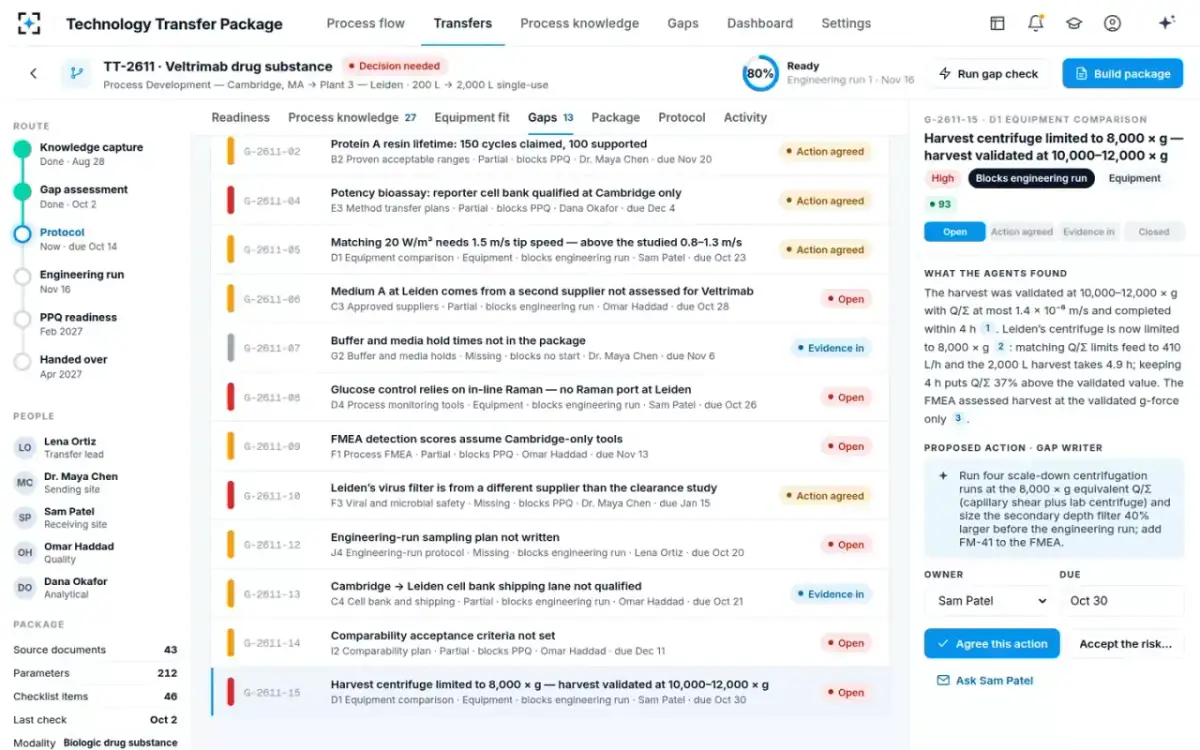
Here is one gap written to that standard, from the worked transfer. The harvest step was validated at 10,000–12,000 × g and has to be finished within four hours of the end of culture. The receiving site's current equipment list limits its disc-stack centrifuge to 8,000 × g. Evidence: the development report passage giving the validated range, and the equipment list revision giving the limit. Severity: high. What it blocks: the first engineering run. Proposed action: scale-down runs at the equivalent clarification duty the lower force allows, plus additional secondary depth-filter area, before the run. Owner: the receiving site's manufacturing science and technology lead. Due: about three weeks out. Every part of that is checkable, and none of it is a decision — the decision is whether to accept the action, and it belongs to the transfer lead.
One gap, with the evidence the agents read and the action they propose
Which gaps should stop an engineering run?
A useful rule is narrower than teams expect: a gap should stop an engineering run when running without it closed would make the run uninterpretable, unsafe, or a waste of the material. Everything else is a schedule problem, not a stop.
Uninterpretable is the common case. If the receiving centrifuge cannot reach the validated force, the harvest in the run is not the harvest the process was characterised with, and whatever the run produces cannot be read against the development data — so the run has not answered its question and will have to be repeated. If a method's transfer is incomplete, the samples cannot be tested, and a run whose samples cannot be tested is an expensive rehearsal. A missing site-specific stability plan, by contrast, blocks the validation batches rather than the engineering run, and a reporting category that is not yet settled blocks the filing. Writing that distinction into the what it blocks field, instead of marking everything high, is what lets the project schedule around the gap list instead of being held hostage by it.
The control that makes the rule bite is procedural rather than technical: the protocol cannot be signed while a gap that blocks the engineering run has no agreed action. Not closed — agreed. A gap can be open with a dated plan behind it and the project can proceed; a gap can be open with nothing behind it and the project cannot. Where that sits among the protocol's other signatures is set out in the transfer protocol, section by section, and what an engineering run is actually for is in the engineering batch in pharma.
When two documents disagree, the gap is in the knowledge
The fourth state on the checklist is the one worth building a process around. A conflict is not a missing document; it is two documents that both exist, both apply, and give different answers to the same question. On the worked transfer the master batch record holds the neutralised viral-inactivation pool at 2–8 °C for not more than 48 hours. A newer hold-time study finds the pool stable for 72 hours, with high-molecular-weight species up 0.1% and charge variants unchanged; at 96 hours the high-molecular-weight species rose 0.4%.
Neither number is wrong. The batch record describes what the process is licensed and executed to do; the study describes what the material can tolerate. The error would be to resolve them automatically — to take the newer value because it is newer, the tighter value because it is safer, or an average because it is neither. All three are decisions dressed as data handling, and all three destroy the information that there was ever a disagreement.
Two sources, two values, and three ways to settle it
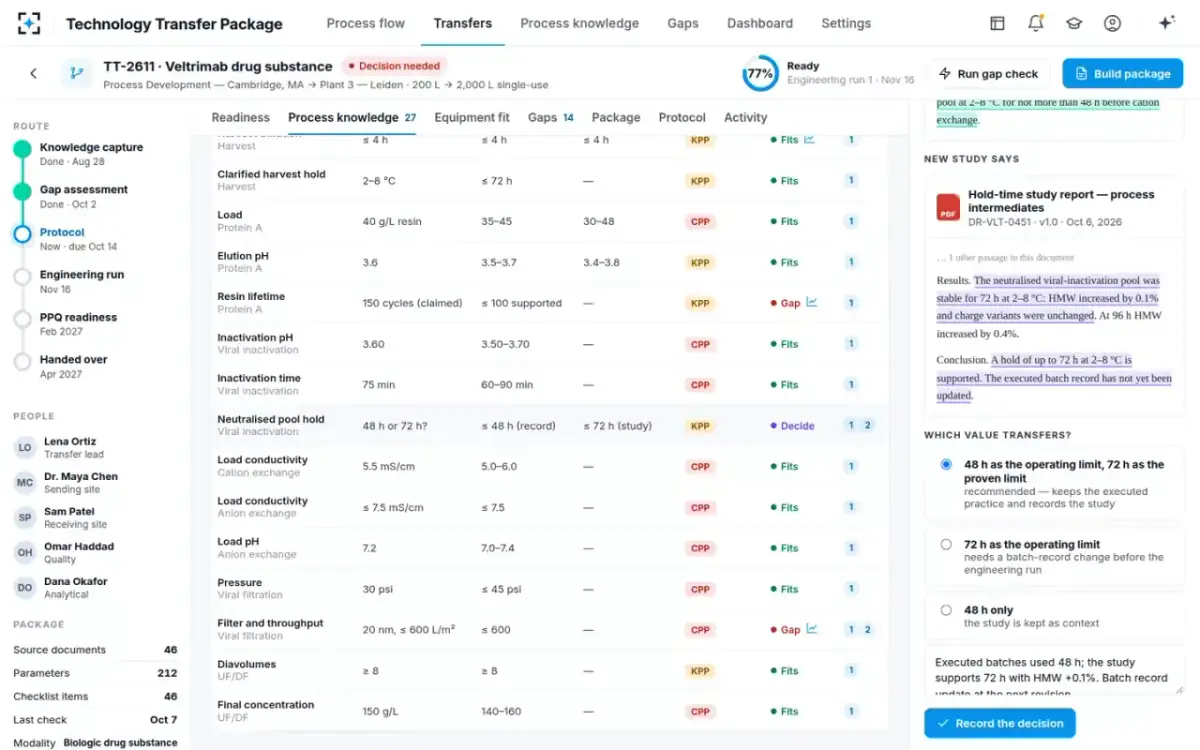
What the transfer lead chose here is the answer that keeps both facts: 48 hours as the operating limit, 72 hours as the proven limit, with her reason recorded and the batch record flagged for revision. The three numbers a parameter carries, and why the distinction between an operating and a proven range matters at a receiving site, are worked through in critical process parameters in pharma.
From a gap to a risk line, without inventing a number
Many gaps end up in a risk assessment, and that is where the analysis is most likely to go wrong, because a severity-occurrence-detection score looks like a measurement and is a judgement. ICH Q9(R1) names the trap directly: "Subjectivity can also be introduced when risk questions are inadequately defined, and when tools have poorly designed risk scoring scales." A risk priority of 140 is not more precise than "this would spoil the run"; it is the same judgement with arithmetic on top.
Two things make the arithmetic honest. The first is that the inputs are visible. A drafted risk line that shows the calculation, the equipment values it rests on and the passages they were read from can be argued with; a number in a cell cannot. The second is that the scale is written down in the transfer procedure before any gap is scored, including the threshold above which an action is obligatory. ICH Q9(R1) also sets the proportionality rule that keeps this from swallowing a project: "The level of effort, formality and documentation of the quality risk management process should be commensurate with the level of risk."
Q9(R1)'s annex names a tool commonly used for equipment differences: "FMEA can be applied to equipment and facilities and might be used to analyze a manufacturing operation and its effect on product or process." On the worked transfer a risk line is drafted for the harvest step from the centrifuge comparison, with its calculation and inputs shown, and it stays a draft until quality approves the revision to the assessment. The scale-up arithmetic that feeds lines like it — power per volume, tip speed, the clarification duty of a centrifuge — is in bioreactor scale-up parameters.
Re-running the analysis every time a document arrives
A gap analysis done once is a snapshot of a project that keeps moving. New revisions of the receiving site's equipment list arrive. Hold-time studies finish. A method gets a new validation report. Each of those can close a gap, open one, or create a conflict with something already in the package — and in a manual process none of them does anything until somebody remembers which parts of the comparison that document touched.
On the worked transfer, three documents arrived in five days: a hold-time study, a revision of the receiving site's equipment list, and a buffer hold-time study. Re-running the comparison across all 46 items took the agents a few seconds a step, and it produced exactly one thing a person had to look at — the hold-time disagreement. That is the right output. The value of re-running a comparison is not that it finds a lot; it is that it finds the one thing, reliably, on the day the document lands rather than the week before the run.
Three documents in, the whole checklist re-run, one new gap for a person
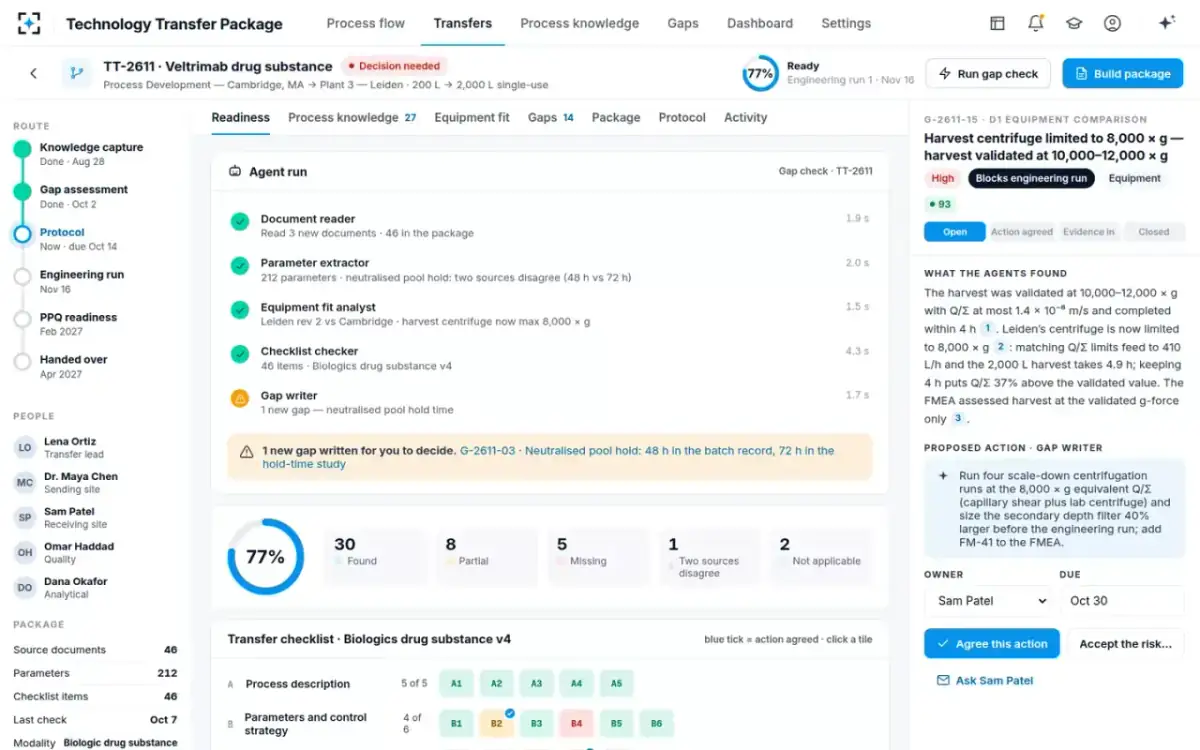
The frequency question answers itself once the comparison is cheap. A gap analysis that takes a week is run at milestones; one that runs on arrival is run on arrival, and the gap list stops being a document that is true on the day it was written. To see the comparison, the gaps and the decisions on one transfer, start from Technology Transfer Package.
Questions people ask
What is a gap assessment in pharma?
A structured comparison between what a requirement asks for and what a site actually has, documented so that each difference becomes an item somebody owns. In a technology transfer the requirement is the process as validated at the sending site and the site is the receiving one, and the WHO guideline scopes the comparison across eleven areas: personnel, premises, equipment and instruments, utilities, cleaning, quality control, documentation, computerised systems, qualification, validation, and health, safety and environment including waste management.
Who performs the gap analysis in a technology transfer?
A team of appropriately qualified people with knowledge and experience of good practices and of the activity being transferred, with the quality units of both the sending and the receiving site recommended as participants. Between them the team has to be able to say what each process step needs, what each machine at the receiving site can do, what its laboratory can measure, and what its quality unit will accept — which is why a single-site team produces a gap list with a predictable blind spot.
How do you write a gap in a technology transfer?
With five things: the cited evidence — both documents with their revisions and the passages compared; a severity taken from the transfer procedure's written scale rather than from the author's mood; what the gap blocks, whether that is the engineering run, the validation batches, the filing or nothing yet; a proposed action specific enough that someone could reject it; and a named owner with a due date. A gap missing any of the five tends to survive several meetings and close none.
What happens when two documents give different values?
It is recorded as a conflict and shown to a person. Taking the newer value, the tighter value or an average are all decisions disguised as data handling, and each one destroys the information that a disagreement existed. The useful resolution often keeps both facts — on the worked example here, a pool hold recorded as 48 hours operating and 72 hours proven, with the reason captured and the batch record flagged for revision at its next update.
Which gaps should stop an engineering run?
Those that would make the run uninterpretable, unsafe or a waste of material — a step the equipment cannot run inside its validated range, or a method whose transfer is incomplete so the samples cannot be tested. Gaps that block the validation batches or the filing instead should say so rather than being marked high, because that is what lets a project schedule around them. A practical control is that the protocol cannot be signed while a gap that blocks the run has no agreed action.
How often should a gap analysis be repeated?
Whenever a document arrives that could change an answer: a new equipment list revision, a finished hold-time or characterisation study, a new validation report. A manual comparison is expensive enough that it gets run at milestones, which is how a gap list becomes a snapshot of a project that has moved on. Automating the comparison does not make it find more; it makes it find the one changed thing on the day the document lands.