In banking, special assets is the desk — a group, a department, at a small bank one officer — that takes over a commercial loan once the bank's own regulatory rating says the loan has a well-defined weakness. It is an internal transfer, not a legal step: the loan keeps its contract, its interest rate and its maturity date, and the borrower keeps every obligation it had the day before. What changes is the rating, often the way interest is accounted for, and who inside the bank may speak for the loan. The hard part is that the file moves too — years of agreements, amendments, guaranties, credit memos, certificates, appraisals, letters and email — and the officer who inherits it has never read a page of it. Botminds' Special Assets File Review has six agents read that whole transferred file the day it arrives and draw it as a timeline the officer can question in plain words.
This page uses one fictional sample file to show what the desk inherits: Ridgeline Tower Partners LLC, an $18.4 million office loan made in 2019 by a bank called Alder Point, now $15,976,240 unpaid for 164 days. Every person, bank, firm, borrower and property in it is invented. The research figures come from the banking agencies and are linked where they appear.
The scale, the clock and the file
4.06%
of the largest banks’ non-owner-occupied commercial real estate loans were past due or on nonaccrual in the fourth quarter of 2025, against a pre-pandemic average of 0.58%
6months
of sustained performance a restructured loan generally needs under its new terms before examiners will put it back to pass
41min
to read one transferred file of 1,550 sources and draw its 38-event history
sample file
What are special assets in banking?
Special assets is where a bank puts the commercial loans it no longer expects to collect on the original terms without work. The names differ — special assets group, asset recovery, managed assets, problem loan workout — and the agencies do not require any particular structure. What they do require is that someone identify these loans and act on them. The interagency safety and soundness guidelines ask every insured bank for a system, scaled to its size and business, that finds problem assets early and keeps them from getting worse: review asset quality periodically, set the total of problem assets against capital, and take corrective action to resolve them (12 CFR part 30, appendix A).
So the desk exists to serve a rating, not a mood. A loan arrives because a rating has moved, and the rating has a definition written by the regulator rather than by the bank. That is the single most useful thing to understand about the words in the letter.
Two vocabularies run side by side, and people new to the desk mix them up constantly. The first is the bank's own internal grade, usually a scale of one to nine or one to ten, set by the bank's credit policy and meaning whatever the policy says it means. In the sample file the loan is graded "7 Substandard": the 7 is Alder Point's number. The second vocabulary is the regulator's, and it has exactly four words.
The four regulatory ratings, in the regulator's own words
The banking agencies use a common scale to identify problem credits, and it names four conditions: special mention, substandard, doubtful and loss. Everything else is a pass credit, and the OCC treats pass as a residual: a credit the four definitions do not reach is a pass credit, there is no regulatory definition of pass itself, and the regulatory scale draws no distinctions inside it (OCC, Rating Credit Risk). Three of the four words carry a consequence that has nothing to do with the borrower's experience of the loan. Substandard, doubtful and loss together make up the classified assets; pass and special mention sit outside that group.
Four words that decide what the bank must do, and one that is only a warning
| Regulatory rating | What the definition turns on | Adversely classified? | What it implies for the accrual of interest |
|---|---|---|---|
| Pass | No regulatory definition of its own; a pass credit is one the four definitions below do not reach. | No | Interest accrues normally. |
| Special mention | Weaknesses that are potential rather than present, which deserve management’s close attention because, left alone, they could erode repayment prospects or the bank’s credit position later. | No — expressly not | Nothing follows automatically. The OCC warns that special mention is not a halfway house between pass and substandard, and must not be used to dodge the harder judgement. |
| Substandard | The borrower’s current worth and paying capacity, or the pledged collateral, no longer protect the bank adequately, because of at least one well-defined weakness that puts collection of the debt at risk — with a distinct possibility of some loss if nothing is corrected. | Yes | A separate judgement. Where full collection of interest and principal is in doubt for a substandard asset, the OCC says it belongs on nonaccrual. |
| Doubtful | Everything wrong with a substandard asset, plus weaknesses that make collection or liquidation in full, on the facts and values as they stand today, highly questionable and improbable. | Yes | Required: the OCC treats nonaccrual as mandatory for a doubtful asset, because the probability of loss is high. |
| Loss | Uncollectible and worth so little that keeping it on the books as a bankable asset is not warranted. Not that there is no salvage value, but that writing it off should not be deferred. | Yes | The loss is to be booked in the period the obligation becomes uncollectible. |
Read the special mention row twice, because it is the row most often misquoted in a borrower meeting. Special mention is a warning the examiner writes down and the bank must act on; it is not a classification, and a special mention loan is not a classified loan. Many banks nonetheless move special mention credits to a watch list inside the lending team rather than to special assets, and keep the transfer for the classified grades. That is a credit policy decision, not a rule.
The substandard row is the one that matters for the question on this page, because substandard is the line most desks transfer on. Its test is not "has the borrower missed a payment" but "does the loan carry a clear, identifiable weakness that puts repayment at risk". A loan can be contractually current and substandard at the same time, and the agencies say so directly: a current payment record can hide real credit risk, particularly where the way the loan was structured, or a habit of extending and renewing it, has papered over weaknesses and kept a borrower's inability to meet reasonable terms out of sight (88 FR 43115).
The regulatory definitions are used for all credit relationships — commercial, retail, and those that arise outside lending areas, such as from capital markets. The regulatory ratings special mention, substandard, doubtful, and loss identify different degrees of credit weakness.
OCC, Rating Credit Risk, Comptroller’s Handbook — on the reach of the four regulatory ratings
When does a loan move to special assets?
A loan moves when its rating moves, and the rating normally moves at one of four moments: the annual review, a covenant test the borrower fails, a payment that does not arrive, or a valuation that comes back low enough to change the story. The proposal usually comes from the relationship manager, because the agencies put the first identification there on purpose: in their description of an effective system, loan officers and line staff spot the emerging problem loans, and people independent of the credit approval process then assess them (85 FR 33278).
The second half of that sentence is the half borrowers never see. The downgrade is proposed by the person closest to the loan and then assessed by someone who is not. If the two disagree, a process agreed in advance decides, and the agencies describe where it usually lands: it may run through a formal appeal or an independent arbiter, or it may simply default to whichever rating shows the weaker credit. Which is why a relationship manager's confidence that the loan is fine is not, by itself, a reason the loan stays where it is.
One loan's path from pass to the desk, and who holds the pen
A person decides
Relationship managerProposes the downgrade — at the annual review, or when a covenant test, a payment or a valuation says the story has changed.
Never: Never settles the rating alone.
A person decides
Credit risk review, then the chief credit officerAssesses the loan independently of the credit approval process and concurs with or overrides the proposed rating; the chief credit officer approves the classification and the transfer.
Never: Never leaves a disputed rating open: the lower rating prevails unless new information changes it.
Agent
The file reader and the timeline builderCollect the file from the loan system, document imaging, the email archive and call notes; split every page into passages carrying their page and section; date 38 events on six lanes, and mark what should be in the file and is not.
Never: Never edit or delete a source, and never place an event without a source passage.
A person decides
Special assets officerReads the history, asks the file what was promised and to whom, sends the legal questions to counsel, and walks into the first borrower meeting having read the loan.
Never: Never has an uncited sentence put in front of them.
In the sample file the sequence is ordinary and the dates are tight. The loan is assigned to the officer on 5 October. The first meeting with the borrower is Tuesday 20 October. Fifteen days, of which the officer has perhaps four, and 1,550 sources to read before the borrower sits down and says the bank promised another extension.
What changes on the day it moves — and what does not
Three things change, and a borrower's finance director should be able to recite them, because almost everything else they are told at this point is wrong.
The day a loan transfers: the short list of what is different
Changes: The loan now carries a classified grade internally and is reported as such. Getting it back is not a matter of asking: examiners normally wait for the weaknesses to be corrected and for a spell of sustained performance on reasonable terms before they upgrade, and a plan for improvement is not enough on its own.
Does not change: The interest rate, the maturity date, the amortisation schedule and every covenant stay exactly as written.
Changes: Nonaccrual becomes a live question, and for a doubtful asset it is required. It is a judgement about collectability, not a consequence of the transfer.
Does not change: The borrower still owes the interest. Nonaccrual is the bank’s accounting, not forgiveness.
Changes: The relationship manager steps back; a special assets officer owns the file, and outside workout counsel is usually instructed.
Does not change: The borrower’s own obligations — to pay, to report, to insure, to maintain — are unchanged and still enforceable.
Changes: The whole relationship is re-read from the documents: guaranties, waivers, amendments, promises in email, payments taken after a default.
Does not change: Nothing in the signed documents is rewritten by the transfer. An entire-agreement clause means what it meant before.
The fourth row is the one that costs money. The transfer is the moment the bank stops managing a relationship and starts reading a file, and the reading is adversarial in a way the relationship never was. What a credit memo authorised is compared with what a letter actually said. A guaranty is checked against its signature page. An email is read next to the amendment that followed it. In the sample file that reading produces three conflicts and two missing items, and one of the conflicts is worth $2.40 million of guaranty.
Nonaccrual: the second thing that changes
Nonaccrual is where the biggest misunderstanding sits, including inside banks. Moving a loan to special assets does not place it on nonaccrual. They are different judgements made for different reasons, and the OCC describes nonaccrual as a condition of the loan rather than a consequence of where the file sits: a loan on nonaccrual, or about to go there, has problems severe enough that full collection of interest and principal is highly questionable, and such loans will almost always be classified (OCC, Rating Credit Risk).
Note the direction of that last sentence. Nonaccrual implies classified; classified does not imply nonaccrual. Banks follow the FFIEC call report instructions, which the OCC's booklet restates: as a general rule a bank stops accruing interest on an asset kept on a cash basis because the borrower's finances have deteriorated, on one where full payment of principal or interest is not expected, and on one where principal or interest is 90 days or more in default — unless that asset is both well secured and in the process of collection.
That exception does real work on a commercial file, and it is a documentation question before it is a judgement. Well secured means collateral whose realisable value would pay off the whole debt, accrued interest included, or a guarantee from a party able to pay. In the process of collection means collection is moving in due course, either through legal action or through other efforts that can reasonably be expected to bring repayment, or a return to current status, soon. In the sample file the property is valued at $14.8 million against $15,976,240 of principal — 107.9% loan to value — and the guaranty the bank thought it had is in dispute. Both halves of "well secured" turn on what the file can prove.
Does special assets mean the bank will foreclose?
No, and the agencies' own words are the best evidence a borrower has. Foreclosure is an outcome, not a department. The supervisory position is that loans "adequately protected by the current sound worth and debt service ability of the borrower, guarantor, or the underlying collateral generally are not adversely classified", and that a modified loan to a borrower who can repay on reasonable terms is not to be classified merely because the collateral is now worth less than the balance (88 FR 43115).
That last sentence is worth reading slowly if your property is worth less than your loan. Being underwater is not, on its own, a classification — let alone a foreclosure. The same statement tells examiners not to classify a performing commercial loan, or demand a partial charge-off on it, just because the collateral has fallen below the balance, and they "should not adversely classify loans solely because the borrower is associated with a particular industry that is experiencing financial difficulties". A weak sector, on its own, does not classify a loan.
What the bank wants from the desk, in most files, is a plan it can defend to an examiner. Whether the borrower can repay under reasonable terms is the question, and it is answered from the file and the borrower's numbers rather than from the label on the folder. What the acceleration clause actually lets a bank do, and what the Uniform Commercial Code says about the bare "deems itself insecure" power, is the other half of this question, read from the desk that has to prove it.
Workout, accommodation, restructuring: three words that are not synonyms
These three get used interchangeably in meetings, and they are not interchangeable in the supervisory vocabulary. An accommodation comes first and is small: the agencies "encourage financial institutions to work proactively and prudently with borrowers who are, or may be, unable to meet their contractual payment obligations during periods of financial stress", and such actions "may entail loan accommodations that are generally short-term or temporary in nature and occur before a loan reaches a workout scenario".
A workout is what follows when an accommodation is not enough: "longer-term or more complex loan arrangements with borrowers under a formal workout program". A restructuring is one shape a workout can take, with or without concessions to the borrower, and it is the shape that carries the heaviest documentation. What the examiner looks for in any of them is a plan: for each loan, a considered workout plan aimed at collecting principal and interest in the end, built on updated financial information on the borrower and all guarantors, current collateral valuations, an appropriate structure, and the legal analysis and signed agreements behind every change to the loan's terms (88 FR 43115).
The ordering matters for a borrower in the room. Asking for a 90-day interest-only period at the right moment is an accommodation; asking for the same thing after a maturity default, two missed certificates and a disputed guaranty is a workout negotiation, and a slower one.
What the desk reads first, and why it takes days
A transferred commercial file is not one document. In the sample file it is 412 documents and 2,316 pages — loan and security agreements, amendments, credit memos and annual reviews, covenant certificates, borrower financials, appraisals, inspection reports, servicing letters and correspondence — plus 1,138 emails and call notes from the relationship team, spread across four systems: the loan system, document imaging, the email archive and the CRM call notes.
By hand, the first read is about forty working hours shared between an officer and an analyst, spread over several days. The split below is our estimate from practitioner accounts rather than a published benchmark, and it makes one point plainly: most of the officer's and analyst's hours go not to judgement but to finding, opening and dating paper.
Reading one transferred file: about forty hours by hand, or 41 minutes in Special Assets File Review
- Pulling the file from four systems8 h
- Agreements, amendments, credit memos12 h
- Emails and call notes8 h
- Building the chronology6 h
- Checking guaranties and signature pages6 h
- Collect, read, date, split into passages, draw 38 events, list 14 promises, flag 3 conflicts and 2 gaps41 min
The reason the hours go there is mundane. Nothing in a bank's four systems agrees on what a document is called, who the counterparty is, or when something happened. A covenant waiver may exist as a credit memo approval, a letter to the borrower and an email thread, with three different dates and two different scopes. A chronology is only useful if it merges those three into one event and keeps all three sources attached to it, so that the officer can see which version of the waiver the bank actually sent.
What Special Assets File Review puts in front of the officer on day one
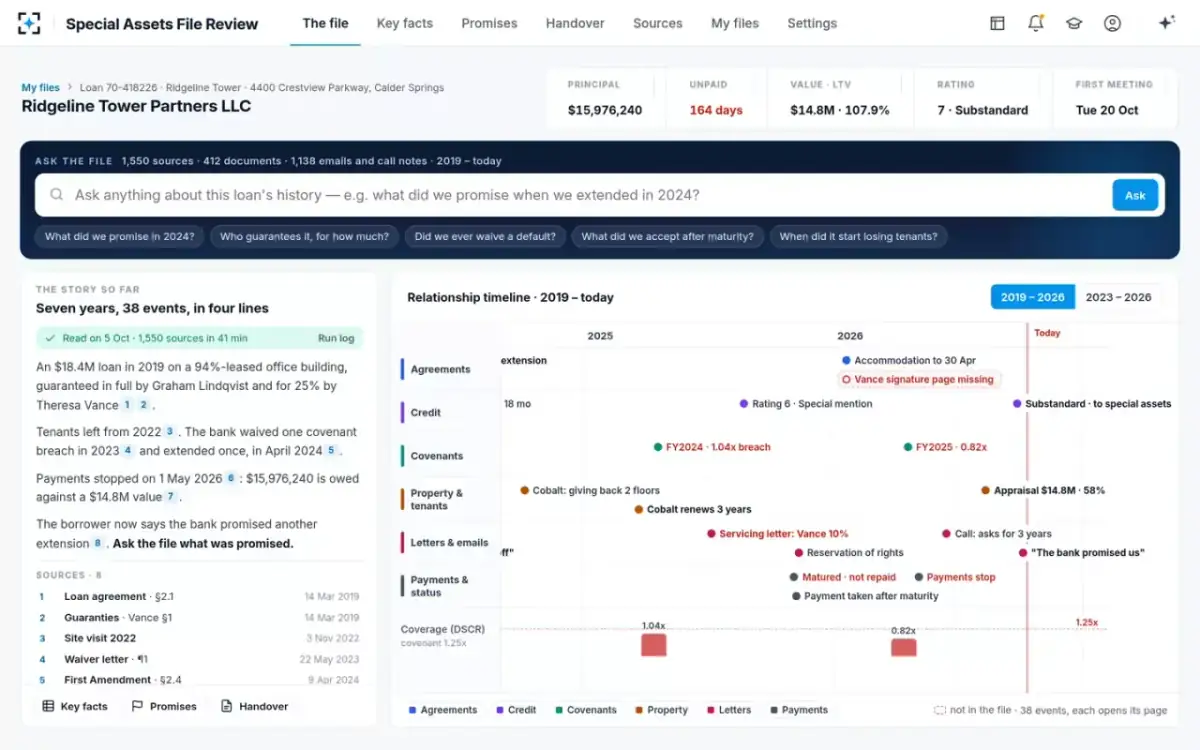
Two further details on that screen are worth naming, because they are the ones a workout counsel asks about first. Gaps are drawn, not hidden: the FY2021 compliance certificate that is not in the file, and the guarantor signature page that never arrived, appear on the timeline as absences with a request button beside them. And conflicts are marked with both pages rather than resolved — the solution reports that two documents disagree and never corrects either one. Which questions in a loan file a document reader may answer, and which five it may not, sets out where that line is drawn and why.
How many loans are we talking about
Fewer than the headlines suggest, and concentrated. Across all FDIC-insured banks the past-due and nonaccrual rate on the whole loan book was 1.56% in the fourth quarter of 2025, below the pre-pandemic average of 1.94%. The weakness is in specific portfolios. For non-owner-occupied commercial real estate at banks with more than $250 billion of assets, the rate was 4.06% — down for a fifth consecutive quarter from a 4.99% peak in the third quarter of 2024, and still seven times the 0.58% pre-pandemic average for that portfolio.
The FDIC adds the qualification that matters for how worried to be: those large banks "have lower concentrations of such loans in relation to total assets and capital than smaller banks, mitigating the overall risk". The industry's quarterly net charge-off rate was 0.63%, and 60 banks sat on the problem bank list at year end, 1.4% of all banks, which the FDIC describes as within the normal non-crisis range.
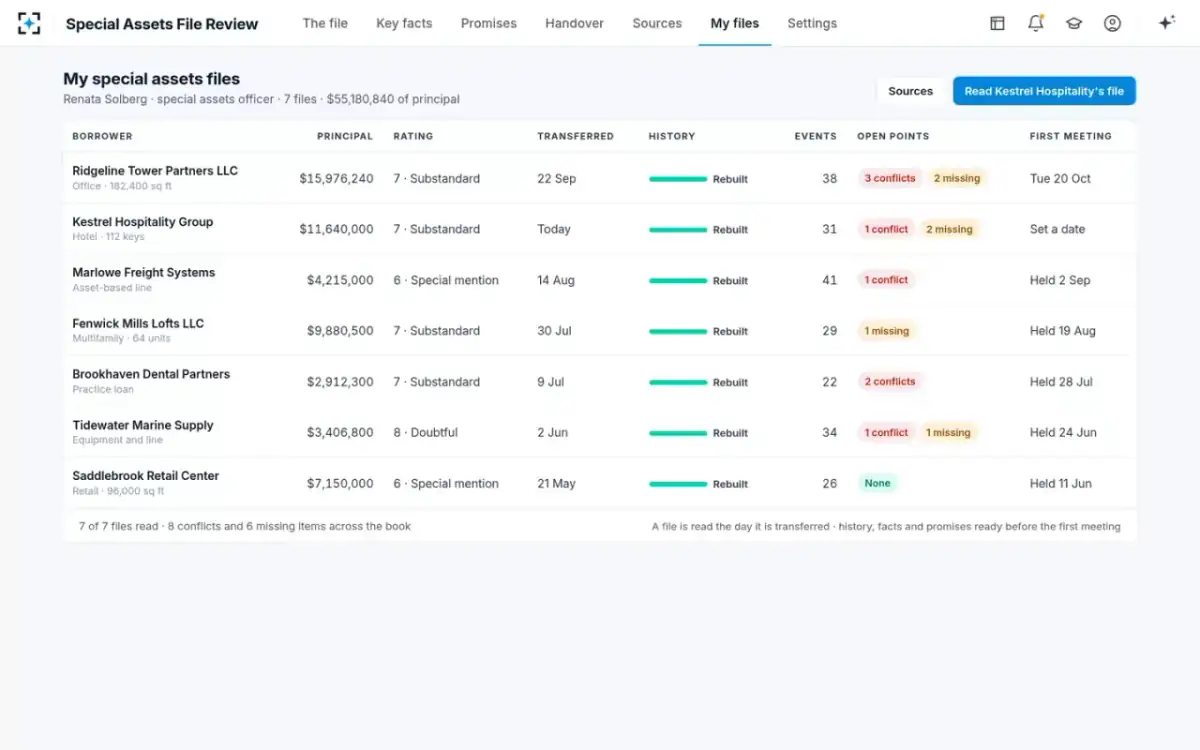
For a desk, those numbers describe a steady stream rather than a wave: a handful of files per officer, each needing a first meeting within a fortnight of transfer. In the sample bank the officer carries seven files and $55,180,840 of principal, two of them transferred this month.
Seven files, two of them new this month
If you have just been told your loan is going to special assets
Four things are true at once, and holding all four is the whole skill. The loan has been rated, by a definition you can read. The contract has not changed. The bank is now reading the relationship the way a litigator would, and so should you. And the bank would, in most cases, rather have a plan than a property — the agencies have put in writing that a prudent workout, properly documented, will not be criticised even if the modified loan ends up adversely classified.
What the first meeting is actually about is whether there is a repayment story the bank can defend. That is why the questions tend to be about global cash flow, guarantor capacity and current valuations, and why "we have always worked it out before" is a weaker answer than a schedule. Why the date on a reservation of rights letter matters more than its wording explains the other thing the bank is doing in those weeks, and what a payment accepted before the letter went out can cost it.
Questions people ask
Is special assets the same as a collections department?
No; they differ in scale and method. Collections works high volumes of consumer and small-balance accounts to a script, largely by contact and payment arrangement. Special assets works a small number of commercial relationships one at a time, each with its own documents, guaranties, collateral and negotiation, and each needing a plan the bank can defend to an examiner. A consumer card account goes to collections; an $18 million office loan with two guarantors goes to a desk.
What is a classified loan?
A loan the bank has rated substandard, doubtful or loss. Those three are the adverse classifications; special mention is a warning that expressly is not one. The OCC is explicit that pass and special mention exposures sit outside the classified group. A bank's internal grade of 6 or 7 usually maps to substandard, but the internal number is the bank's own and only the four regulatory words carry the supervisory meaning.
What does substandard mean on a commercial loan?
That the loan is inadequately protected by the borrower's current worth and paying capacity or by the collateral, and has a well-defined weakness that jeopardizes repayment of the debt, with a distinct possibility that the bank will take some loss if the weakness is not fixed. Note what is absent from that test: a missed payment. A loan that is current can be substandard if the weakness is well-defined, and the agencies warn that extensions and renewals can mask exactly that.
Who decides a loan goes to special assets?
The downgrade is normally proposed by the relationship manager and then assessed by credit risk review, which is independent of the credit approval process; the chief credit officer or a committee approves the classification and the transfer. Where the lender and the reviewer disagree, the agencies expect a pre-arranged process, which commonly defaults to the lower rating unless new information changes the picture.
What is a workout officer?
The person who owns a troubled loan from transfer to resolution: reading the file, meeting the borrower, instructing counsel, proposing a strategy and getting it approved. The title varies — special assets officer, workout officer, managed assets officer. The job is defined by what only that seat may do: speak for the bank on this loan, and sign the memo that says what the file contains.
Does a loan on nonaccrual stop owing interest?
No. Nonaccrual is the bank's accounting treatment: it stops recognising interest income it does not expect to collect, and payments received are generally applied differently. The borrower's contractual obligation to pay interest is unaffected, and interest usually continues to be charged on the loan. Nonaccrual is also a separate judgement from the rating — required for a doubtful asset, common but not automatic for a substandard one.