A continuing guaranty is a guarantee written to cover the borrower's present and future debts rather than one named advance, so it stays alive as facilities are drawn, repaid, renewed and amended underneath it. That is the textbook answer, and it is not the one a special assets officer needs. The question on a troubled loan is narrower and much harder: of the four or five documents in this file that say something about this guarantor, which one states the amount that stands today? Special Assets File Review exists for that question. It reads the whole transferred file the day it arrives, lists every guaranty, every amendment that names a guarantor, every letter that states an amount and every release, and marks the ones that disagree, with the page each rests on.
The worked example throughout is the sample file the solution ships with: loan 70-418226 to Ridgeline Tower Partners LLC, an $18.4 million office loan made on 14 March 2019, now $15,976,240 unpaid for 164 days and rated 7 Substandard. Every person, bank, firm, borrower and property in it is fictional. The research and the rules are real, and linked where they appear.
What is a continuing guaranty?
The Comptroller's Handbook puts it in one sentence. "Continuing guarantees extend liability for an obligor's present and future debts. (Also called an open guarantee.)" (OCC, Rating Credit Risk, appendix D.) Three consequences follow for the officer who inherits one. The guaranty is not spent when the loan it was signed beside is refinanced. It can reach credit extended years after the guarantor last read anything. And because it is open, its limits are usually written somewhere other than the first paragraph: a cap as a percentage or a dollar figure, a condition that releases part of it, a notice provision that lets the guarantor stop it running forward.
The same handbook sets the test for whether the document in front of you is any good. "Guarantee agreements should be as precise as possible, stating the specific credit facilities being guaranteed, under what circumstances the guarantor will be expected to perform, and what benefit the guarantor received for providing the guarantee." Read the instrument against those three, in that order, before you read anything else about the guarantor. A guaranty that does not identify the facility invites an argument about which debt it covers. One that does not say what triggers performance invites an argument about whether the bank has to sue the borrower first. One that does not record the consideration invites an argument that there was none.
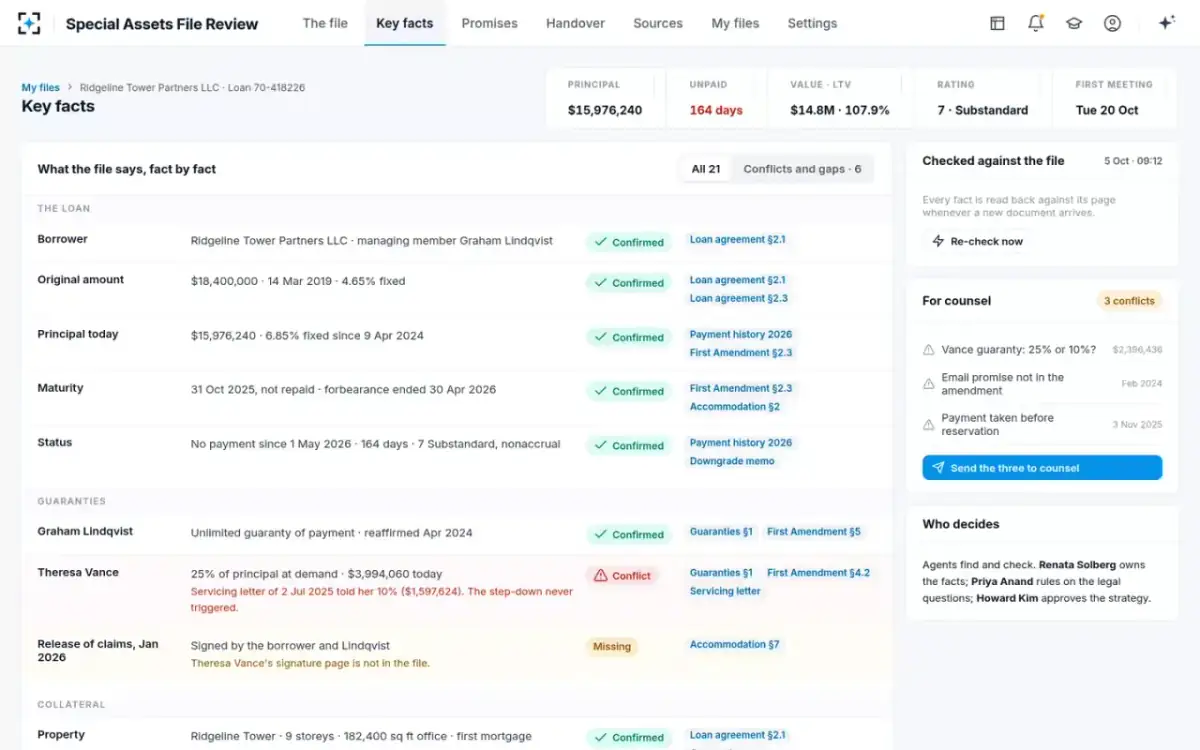
In the sample file both guaranties pass the first test and differ on the second. Graham Lindqvist, the borrower's managing member, gave an unlimited guaranty of payment, reaffirmed in April 2024. Theresa Vance gave a guaranty of 25% of principal at demand, which is $3,994,060 at today's balance. One of those numbers has four documents behind it. The other has one.
Seven forms of guarantee, in the regulator's own words
Most workout arguments about guaranties are arguments about form, conducted without naming the form. The handbook's appendix D lists the common ones and defines each in a line, which makes it the fastest way to settle what kind of promise is actually in the file. Note the pairs: continuing against contingent is about when liability attaches; payment against collection is about who the bank must chase first; irrevocable against revocable is about who can end it; declining stands alone, because it is the only form that changes size while everyone watches.
The seven common forms of guarantee, and what each one changes in a workout
| Form | The regulator's definition | What it decides for the officer counting recovery |
|---|---|---|
| Contingent | Require a specific event to occur before the guarantor is liable. | Find the event, and find whether it happened. A contingent guarantee nobody has triggered is not recovery. |
| Continuing | Extend liability for an obligor’s present and future debts. Also called an open guarantee. | Ask which facilities are inside it today, including any advanced after the guarantor stopped paying attention. |
| Collection | Extend liability only after default, and are conditioned on the creditor first exhausting legal remedies against the obligor. | Nothing is collectable until the bank has pursued the borrower. Price the delay, not just the amount. |
| Payment | Extend liability based on the debt’s contractual terms. The lender does not have to first seek the primary obligor’s performance. | The strongest ordinary form. Demand can go to the guarantor at the same time as the borrower. |
| Irrevocable | Cannot be terminated without the consent of the other parties. | A guarantor’s letter saying they are out does not end it. Look for the bank’s consent, signed. |
| Revocable | Can be terminated by the guarantor without any other party’s consent. | Date the revocation. Debt advanced before it usually stays guaranteed; debt after it usually does not. |
| Declining | Reduce the guarantor’s liability as certain conditions are met. For example, construction project guarantees are often linked to the construction’s progress. | The whole question is whether the condition was met, when, and what in the file proves it. |
Forms combine. A guaranty is usually continuing and of payment and irrevocable, and may also be limited in amount, which is exactly what Theresa Vance's is: continuing, of payment, capped at 25% of principal, payable on demand. The handbook is blunt about the ranking: "While an unconditional (or absolute) guarantee affords a lender the greatest protection, conditional and limited guarantees also provide lenders valuable protections." A limited guaranty is worth having. It is also worth reading twice, because a limit is a number, and a number is the thing a later document can quietly change.
What a declining guaranty is, and what a step-down condition requires
A declining guarantee, in the handbook's words, is one that "reduce[s] the guarantor's liability as certain conditions are met". In commercial real estate the condition is usually performance: a construction project reaching completion, a debt service coverage ratio holding for a period, an anchor tenant signing a long lease. The step-down is not automatic in the sense that matters. It is automatic only once the condition has occurred, and whether it occurred is a question of fact that has to be proved from the file.
So a step-down condition asks three things of a workout officer, and the file has to answer all three: was the condition met at all, was it met in time, and is there a document that evidences it. Each has a place to hide, and each has a different exit.
The step-down question, and the three places the answer hides
1 · Was the condition met?
Hides in: the thing the condition measures — a lease, a certificate, a coverage ratio — filed under its own name, years away from the guaranty.
No, or only in part → the guaranty stands at its full amount, and the file should say so in writing.
2 · Was it met in time?
Hides in: a deadline written in the amendment, not in the guaranty. A condition satisfied three months late is usually a condition not satisfied.
Late → a question for counsel, not a calculation. Ask whether the bank's later conduct treated it as met.
3 · Is there a document that proves it?
Hides in: nothing at all. The commonest answer is that the event happened and nobody put the evidence in the file.
Yes → the lower amount is the one to work with, and the evidence travels with it to the first meeting.
In the sample file the step-down sits at §4.2 of the First Amendment of 9 April 2024, a few lines below the extension clause everyone reads. It would have cut the Vance guaranty from 25% to 10% if Cobalt Health renewed its lease for at least five years by 30 June 2025. Cobalt renewed for three years, on 18 March 2025. The condition failed on length, not on the date, which is the kind of failure a reader skims past: there is a renewal in the file, signed, before the deadline, and it is the wrong renewal. The solution's reading marks §4.2 "not triggered" and cites the lease.
Can a letter reduce a guaranty?
Usually not by itself, and this is the point at which generalities become dangerous. What a guaranty requires in order to be reduced is written in the guaranty. Most commercial forms say that no amendment, waiver or release binds the bank unless it is in writing and signed by the bank, and a servicing letter stating a lower figure is ordinarily neither an amendment nor a signed release. That is a statement about this instrument's own terms, not a rule of law, and an officer should say it that way.
The general point sits in the commercial code, and it cuts the other way. A claim or right arising out of an alleged breach "may be discharged in whole or in part without consideration by agreement of the aggrieved party in an authenticated record" (UCC §1-306). A bank can give something up for nothing. What the code asks is that it did so by agreement, and in a record it authenticated. So the question a letter raises is never "can a letter do this" but "who signed this, with what authority, and is it a record the bank authenticated". That is a legal question with a factual bottom, and it belongs with counsel together with the letter itself.
The sample file has one. A servicing letter of 2 July 2025 told Theresa Vance her guaranty was 10%, or $1,597,624. Nobody has suggested the bank meant to halve its own position; the likeliest story is that a servicer read §4.2 and not the lease. But the letter went out, it is in the file, and the difference between the two readings is $2,396,436.
One guarantor, two numbers, in Special Assets File Review
25%
of principal at demand — what the guaranty instrument says
$3,994,060
the guaranty at today’s balance of $15,976,240
$2,396,436
the difference a servicing letter would make, if it were effective
4docs
in this file say something about this one guarantor
How do you release a guarantor? The release signed by two of three
A release is an agreement, and an agreement needs the signatures of the people it binds. In a workout that sounds obvious and fails constantly, because releases usually arrive inside something larger — an accommodation agreement, a forbearance, a restructuring — signed in counterparts, by people in four places, over a fortnight. The pages come back one at a time, the deal closes, and nobody reconciles the signature pages against the parties named on page one.
The sample file's accommodation agreement of 15 January 2026 is twelve pages, between Alder Point Bank, the borrower and the guarantors, and it contains a release of claims. Two of three signature pages are in imaging: the borrower's and Graham Lindqvist's. Theresa Vance's is not. The solution does not call that a defect, because it cannot know whether she signed and the page was lost or she never signed at all. It records the fact as a gap, marks the release Missing rather than Confirmed, and puts a Request against it. The difference matters: an officer who walks into a meeting believing a release is in place, when the party it mattered most to never signed it, is negotiating from a position the file does not support.
The signature page that never made it into the file
Missing signature pages are worth treating as a category, not an accident, because the fix is procedural and cheap. Three habits produce many of them. Counterparts collected by email and filed in a mailbox rather than imaging. Closing binders assembled by the originating team and never re-indexed when the loan moves desks. And amendments executed under time pressure, where the business signed first and the guarantor was chased afterwards.
The useful discipline is to reconcile parties to pages at the moment a document enters the file, which is what the file reader does on the way in: it notes any signature block left blank. For an inherited file the same check has to run backwards over every instrument that names a guarantor. The output is not an opinion. It is a short list of documents whose parties and pages do not line up, each with a Request button, so the analyst can ask the closing team or the law firm for the page before the first meeting rather than after it.
Twenty-one facts, each confirmed, in conflict, or missing
What supervisors look for before a guarantee improves a rating
A guaranty counted toward recovery is also a guaranty counted toward a rating, and the supervisory test is stricter than the legal one. The handbook: "If a guarantee is to enhance a credit's risk rating, the guarantor must display the capacity and willingness to support the debt. A presumption of willingness is usually appropriate until financial support becomes necessary. At that point, willingness must be demonstrated." On a loan that has been unpaid for 164 days, the moment described in the last sentence has arrived.
The interagency policy statement on commercial real estate workouts says the same thing in supervisory language, and adds the history test. A guarantee from "a financially responsible guarantor may improve the prospects for repayment of the debt obligation and may be sufficient to preclude adverse loan classification or reduce the severity of the loan classification", meaning one with the means, a demonstrated willingness and a reason to keep supporting the loan — by continuing payments, by paying it down, or by putting up more collateral. And examiners "should consider whether a guarantor has demonstrated the willingness to fulfill all current and previous obligations, has sufficient economic incentive, and has a significant investment in the project. An important consideration is whether any previous performance under its guarantee(s) was voluntary or the result of legal or other actions by the lender to enforce the guarantee(s)" (88 FR 43115, 6 July 2023).
Read together with the handbook's instruction that "a guarantor's financial statement should be analyzed to ensure that the guarantor can perform as required, if necessary, and that the statement acknowledges the guarantee", that gives the officer a short list for the file: a current statement, an acknowledgement of this guarantee in it, a record of what the guarantor has paid before and whether it was paid willingly, and evidence of their stake in the property. The safety and soundness standards make the same point from the underwriting end, asking institutions to weigh, before credit is committed, whether any guarantor is financially responsible, alongside the borrower's own condition (12 CFR part 30, appendix A). Nothing there is new work for a workout desk. All of it is work that has to be found in a file assembled by someone else.
Pricing the guaranty: the number, and the number at risk
A recovery estimate that carries one guaranty figure is hiding its own uncertainty. The honest form has two parts: the amount the instrument states, and the part of that amount that turns on a document somebody has to rule on. On this file that is $3,994,060 stated, of which $2,396,436 turns on one letter. Write it as two numbers and the credit committee can ask the right question, which is how quickly counsel can answer, not how confident the officer feels.
Four documents about one guarantor, and what each would make the number
What the document says: 25% of principal at demand, continuing and of payment. $3,994,060 at today’s balance.
What it would take for that to be the number: Nothing further. This is the instrument; every other row is an argument that it changed.
What the document says: Steps the guaranty down to 10% if Cobalt Health renews for at least five years by 30 June 2025.
What it would take for that to be the number: A five-year renewal. Cobalt renewed for three, on 18 March 2025, so the clause reads “not triggered”.
What the document says: Tells the guarantor her exposure is 10%, or $1,597,624.
What it would take for that to be the number: A ruling that the letter discharged the difference — who signed it, with what authority, and whether it is a record the bank authenticated.
What the document says: Contains a release of claims between the bank, the borrower and the guarantors.
What it would take for that to be the number: Her signature page. Two of three are in imaging; hers is not in the file, and the release depends on it.
The guaranty question, on its way to counsel with its pages
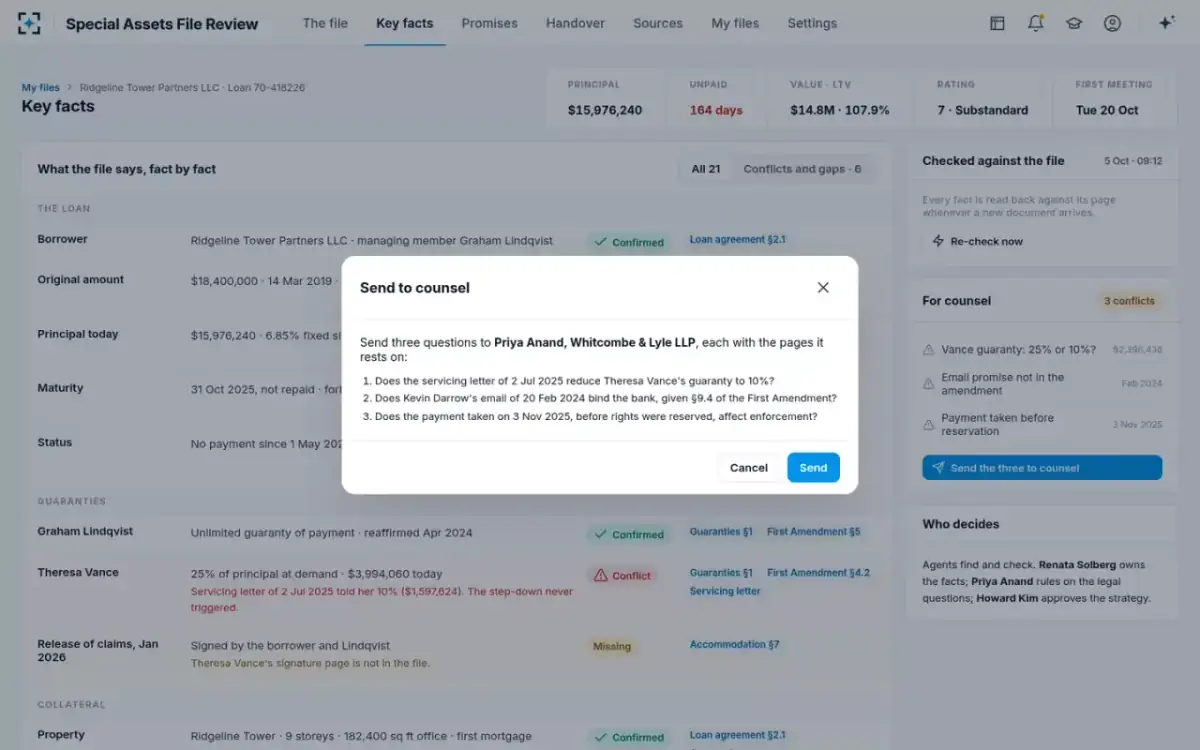
Two sibling questions sit next to this one and are worked through separately: what the bank promised the borrower in the same amendment, in what a modification is now that troubled debt restructuring has gone, and whether accepting money after a default cost the bank anything, in the reservation of rights letter and the payment taken before it.
The four documents to find before the first meeting
Everything above reduces to an audit an analyst can run on any inherited file in an afternoon, provided the file has been read. The order matters: instrument first, then everything that claims to change it, then everything the bank said about it, then the signatures.
The guaranty audit on a transferred file
- The instrument itself, with its date and its form
Which facilities, what triggers performance, what consideration, what cap. Name the form in the handbook’s words, so the next reader argues about the right thing.
- Every amendment that names the guarantor
Including the ones whose subject is something else. The step-down in the sample file sits two lines below an extension clause, in an amendment about the extension.
- Every condition in those amendments, and what happened to it
Find the lease, the certificate or the ratio the condition measures, and date it. A condition met late, or met in a smaller form, is an easy one to miss.
- Every statement of the amount the bank has made since
Servicing letters, demand letters, payoff quotations, emails to the guarantor’s counsel. Each one is a fact about what the bank said, whatever it turns out to mean.
- Every release, forbearance and accommodation, and its parties
Reconcile the parties named on page one against the signature pages actually held. Two of three is a gap, not a release.
- The guarantor’s last financial statement, and whether it acknowledges the guarantee
Supervisory expectations ask for capacity and demonstrated willingness once support is needed. A statement that does not mention the guarantee is a weak basis for either.
- The date of each of the above, on one line
Conflicts between documents are often resolved by sequence. A list in date order is the artefact counsel actually wants.
One guarantor, seven years of file, four acts that change the amount
- Guaranty signed, 14 Mar 2019: continuing, of payment, 25% at demand61 mo
- First Amendment §4.2, 9 Apr 2024: step-down to 10% on a five-year renewal15 mo
- Servicing letter, 2 Jul 2025: tells her 10%6 mo
- Release of claims, 15 Jan 2026: signed by two of three9 mo
Nothing in that audit is new to a workout desk. What is new is being able to do it on day one of a transferred file rather than week two, because the reading has already happened and every line carries the page it came from. To see the facts, the conflicts and the questions that went to counsel on one file, start from Special Assets File Review.
Questions people ask
What is the difference between a guaranty and a guarantee?
In this context, none. The OCC's handbook settles it in its first line on the subject: "A guarantee (also spelled guaranty) is the assurance that a contract will be duly carried out." American commercial documents tend to use guaranty for the instrument and guarantee for the act or the promise, and plenty of agreements use them interchangeably in the same paragraph. Nothing turns on the spelling; everything turns on the form, the cap and the conditions.
Does a continuing guaranty cover future loans?
That is what makes it continuing: it extends liability for the obligor's present and future debts. Whether it reaches a particular later advance depends on how the instrument describes the facilities it guarantees, and some continuing guaranties are drafted to cover all present and future obligations of the borrower to the bank, while others are tied to a named facility and its renewals. Read the definition of the guaranteed obligations, not the title of the document.
What happens to a guaranty if the loan is modified?
Most commercial guaranties contain consents in advance, under which the guarantor agrees that extensions, modifications and releases of collateral do not discharge them. Whether such a clause holds against a particular modification is a legal question, and it is the kind of question the solution sends to counsel rather than answering. The practical rule for a file is simpler: every amendment that touches the loan is also a document about every guarantor, and belongs in the guaranty audit even when it does not name them.
What if a guarantor never signed?
Then there is no guaranty from that person, and the first job is to establish which of two situations you are in: a page that exists and is not in the file, or a page that never existed. They look identical on day one. Treat it as an open gap, request the page from the closing team and the firm that closed the deal, and do not count the amount until it arrives. In the sample file two of three signature pages to a release are held and the third is not, which is why the release is marked missing rather than effective.
How do banks value a personal guarantee?
By capacity and by willingness, and the handbook asks for evidence of both. A guarantor's financial statement should be analysed to confirm they can perform if called on, and the statement should acknowledge the guarantee. Supervisors also look at what the guarantor has actually done before, and specifically whether earlier performance under a guarantee was voluntary or the result of enforcement action by the lender. A guarantee with no evidence of performance behind it should not improve the rating.
Does a guarantor have to be given notice?
It depends on the instrument. A guaranty of payment payable on demand generally requires a demand on the guarantor, in the form and to the address the document specifies, while a collection guarantee is conditioned on the creditor first exhausting legal remedies against the borrower. Notice provisions are also where revocation lives: a revocable guaranty is usually ended by written notice, with a date that divides debt advanced before it from debt advanced after. Find the notice clause before drafting any letter to a guarantor.