A reservation of rights letter is a lender's written statement that nothing it has done, or is about to do, gives up any right it has under the loan documents. It is one of the cheapest instruments in commercial lending and one of the harder ones to get wrong on the page: the form is familiar to every workout lawyer, and the Uniform Commercial Code expressly protects a party that performs, or accepts performance, under an explicit reservation. What is routinely got wrong is its position in time. The acts that may have cost a bank a right — a payment accepted, an extension discussed on the phone, a certificate never chased, a letter that told a guarantor the wrong number — happened before the letter, and a letter cannot reach backwards over conduct nobody wrote down. Botminds' Special Assets File Review exists for that gap: it reads a transferred file end to end and dates every act either side could rely on, so that counsel is advising on a sequence rather than on a recollection.
The example on this page is a fictional sample file: Ridgeline Tower Partners LLC, an $18.4 million office loan at a bank called Alder Point. Every person, firm and property in it is invented, as are the dates. Nothing here is legal advice, and whether any particular conduct waived any particular right is a question of state law on the documents — which is precisely the argument this page is making.
What is a reservation of rights letter from a lender?
It is a notice, not an agreement. The bank writes to the borrower, and usually to each guarantor, saying that identified events of default have occurred and continue, that the bank has not waived and does not waive them, and that it reserves all of its rights and remedies under the loan documents and at law. Nothing is granted, nothing is surrendered, and no new terms are created. It is normally the first thing a special assets desk sends after reading the file, and it is often sent while the bank is working towards a restructuring rather than towards enforcement — the two are not alternatives.
The code sentence behind it is short and unusually practical, because it says what words are sufficient.
A party that with explicit reservation of rights performs or promises performance or assents to performance in a manner demanded or offered by the other party does not thereby prejudice the rights reserved. Such words as "without prejudice," "under protest," or the like are sufficient.
Uniform Commercial Code § 1-308, Performance or Acceptance Under Reservation of Rights, as published by the Legal Information Institute
Two words in it decide everything that follows. "Explicit": the reservation has to be stated, not assumed, and not inferred from the bank's private intention. And "does not thereby prejudice the rights reserved" — the protection is for the rights that were reserved, which makes the identification of the defaults in the letter a substantive part of it rather than a formality. The provision also has a limit the code states in the next line: it "does not apply to an accord and satisfaction", so a payment tendered in full settlement is a different problem with a different answer.
The sentence that does the work, and the three that do not
Letters that fail do so for recognisable reasons, and almost none of them are about the reserving sentence itself. They fail because the letter identifies the defaults loosely, or grants something while reserving something, or reads as a threat and prompts a response the bank was not ready for, or goes out so late that the conduct it is meant to cover is months old.
Two letters about the same loan, and what each one leaves the bank holding
A letter that reserves: Names each event and the date it occurred, and says it continues.
A letter that merely complains: “The loan is in default in various respects.” Nothing is identified, so nothing in particular is reserved.
A letter that reserves: States explicitly that no act or omission — including accepting payments or continuing discussions — waives any right, and that all rights are reserved.
A letter that merely complains: Expresses concern and asks for a plan. Concern is not a reservation.
A letter that reserves: Nothing. No extension, no forbearance period, no promise not to act.
A letter that merely complains: “We will hold off while you work on this.” That is a commitment, and now it is in writing.
A letter that reserves: Sent as soon as the file has been read, so that it precedes the conduct it covers rather than following it.
A letter that merely complains: Sent weeks later, after a payment has been taken and two conversations have happened.
A letter that reserves: Advise on a documented sequence: this happened, then this, and the bank said this on that date.
A letter that merely complains: Advise on a gap, and ask what was said on the phone in the meantime.
The third row is the one that surprises people. Lenders rarely intend to grant anything in a reservation letter, but a sentence meant kindly — that the bank will not take action while discussions continue — is a sentence the borrower will produce later, and it is not covered by the reservation above it.
The anatomy of the letter, part by part — the shape, not a form to copy
The loan, the documents it is written under, and the specific events the bank says have occurred, each with its date. Vagueness here is the commonest defect: "various defaults" identifies nothing and dates nothing.
An explicit statement that nothing the bank has done or may do — including accepting payments, continuing to discuss the loan, or forbearing from acting — waives any right or remedy, and that all rights under the documents are expressly reserved.
No new commitment, no extension, no forbearance period, no agreement to negotiate, and no statement that the bank will not act. A letter that reserves rights in one paragraph and grants time in the next has done two things, and only one of them was intended.
Usually the information a workout will need in any case: current financial statements for the borrower and each guarantor, a rent roll, an updated valuation, insurance confirmation.
The bank, at the level its own policy sets — and reviewed by counsel before it goes, because the risk in it is legal rather than commercial.
Does accepting a payment waive a default?
It is the question every workout desk asks and the one no page can answer for you, because it turns on state law, on the documents, and on what else the bank did and said around the payment. What can be said is what the elements are. Waiver generally requires the intentional relinquishment of a known right, and conduct can evidence intention. Many commercial loan documents contain anti-waiver and no-oral-modification clauses written precisely to stop conduct from doing that work. And the code gives a party a way to take performance without that implication, which is what the reservation is for.
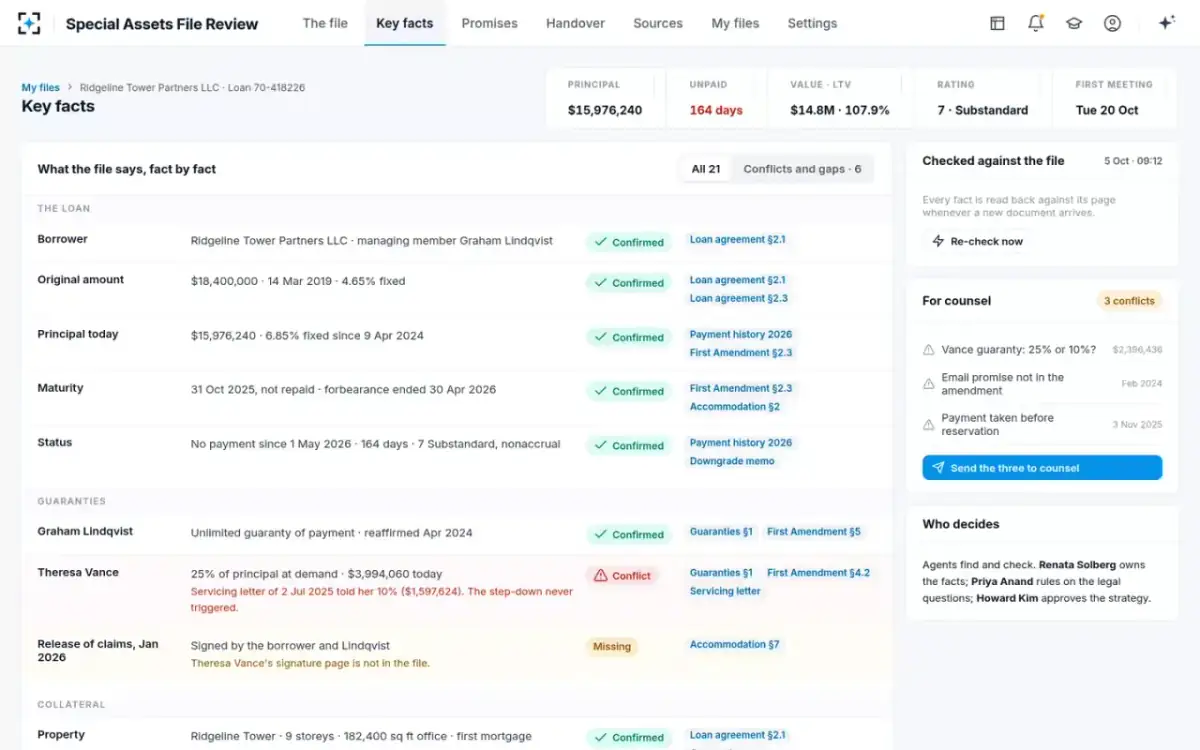
What is not in doubt is the shape of the risk. A payment accepted after a default, with no reservation on the file and no contemporaneous note of what was said when it was accepted, is an event the other side will characterise and the bank will have to answer for. In the sample file the bank's own desk flags exactly that and sends it to counsel as a question rather than resolving it: a payment of $115,133 taken on 3 November 2025, four days before the reservation of rights letter went out.
The code also supplies the related provision on giving a right up deliberately after the fact: "A claim or right arising out of an alleged breach may be discharged in whole or in part without consideration by agreement of the aggrieved party in an authenticated record" (§ 1-306). The phrase to notice there is "authenticated record" — a deliberate release of a right after a breach is contemplated as something written and signed, not something that happens by accident in a phone call.
Course of dealing: what repeated conduct can do to a contract
The deeper risk is not one payment but a pattern, and the code defines the two patterns that matter with some care. A course of performance is conduct within this transaction: it arises where the agreement calls for one party to perform again and again, and the other, knowing what that performance is and free to object, accepts it or goes along with it without objecting (§ 1-303(a)). A course of dealing looks wider, at "a sequence of conduct concerning previous transactions between the parties … fairly to be regarded as establishing a common basis of understanding for interpreting their expressions and other conduct".
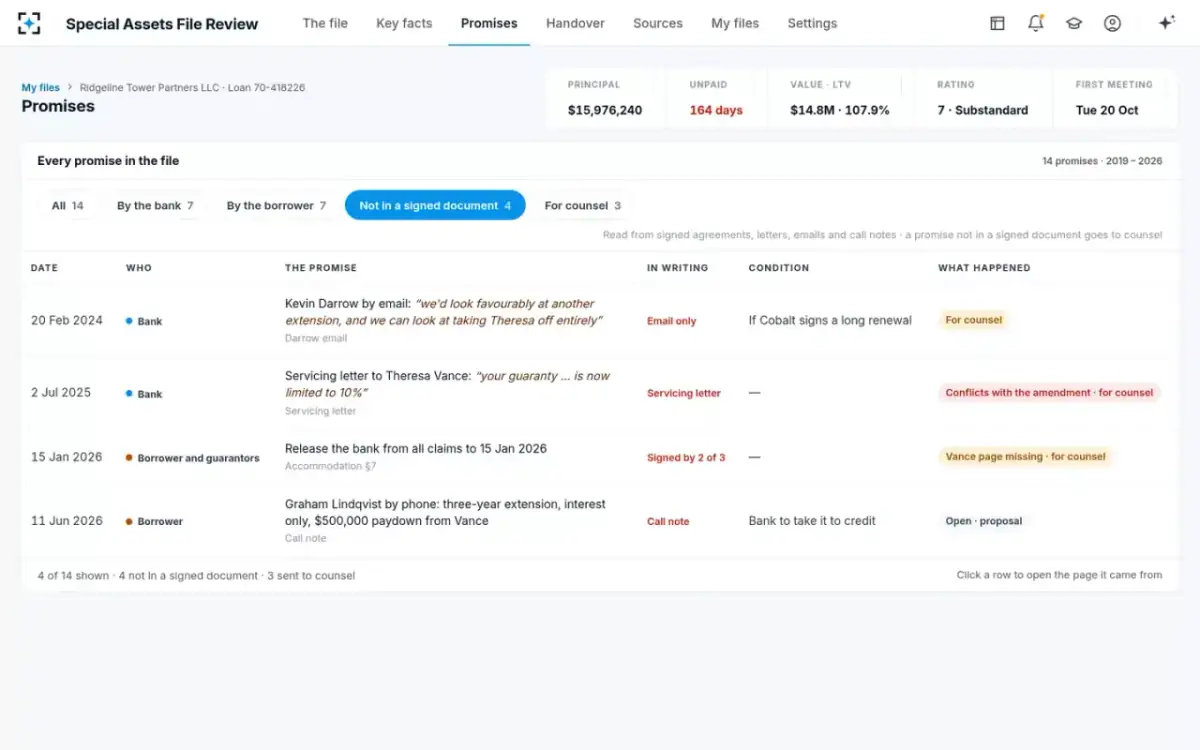
What either can do to a contract is set out in the same section, and it is more than evidential colour: a course of performance can be used to show that a term it contradicts was waived or modified (§ 1-303(f)). Read the elements of the first definition again with a troubled loan in mind — repeated occasions for performance, knowledge, opportunity to object, acceptance without objection — and the four quarters in which a bank took late payments without writing anything down stop looking like forbearance and start looking like a fact pattern.
The code does not leave express terms helpless. Where a consistent reading is unreasonable, "express terms prevail over course of performance, course of dealing, and usage of trade", and course of performance prevails over course of dealing. But that hierarchy is a rule of construction applied by a court after the fact, on the evidence in front of it — which is why the practical defence is not the hierarchy. It is a file that can say, to the day, what the bank did.
Waiver, forbearance, accommodation and amendment, kept apart
Four different instruments, routinely used as though they were one word, with different signatures and different consequences. Getting them confused in a credit memo is how a bank ends up believing it granted a one-off indulgence when the document it signed changed the deal.
Five things a bank can do about a default, and what each one costs it
| Instrument | What it is | Who has to sign | What it does to a later default |
|---|---|---|---|
| Reservation of rights | A notice that nothing done or omitted waives any right, and that all rights are reserved. | The bank alone; it is a notice, not an agreement. | Nothing — that is the point. It preserves what already exists and creates nothing new. |
| Waiver | A deliberate giving-up of a specified right arising from a specified breach. | The bank, in writing; the code contemplates a discharge "by agreement of the aggrieved party in an authenticated record". | Removes the waived default. A well-drafted waiver is explicit that it is one-off and not a waiver of anything else. |
| Forbearance | An agreement not to exercise remedies for a defined period, usually on conditions. | Both parties, and normally every guarantor, in a signed agreement. | Suspends enforcement without curing the default. The defaults survive the period unless the agreement says otherwise. |
| Accommodation | A short-term or temporary arrangement made before a loan reaches a workout — the agencies’ own term for it. | Varies: sometimes a letter, sometimes an agreement. Documentation is where these go wrong. | Depends entirely on how it was papered. An accommodation nobody signed is conduct, and conduct is evidence. |
| Amendment | A change to the loan documents themselves — terms, covenants, maturity, amortisation. | Both parties and every guarantor whose obligation is affected. | Changes the contract going forward. Typically carries an entire-agreement clause that retires the correspondence before it. |
The guarantor line in the signature column is the one that catches banks out. An amendment or forbearance that affects the guaranteed obligation and is not signed by every guarantor leaves the bank holding a document it cannot fully rely on. In the sample file a release of one guarantor from January 2026 is signed by two of the three parties it needed, and the missing signature page is not in the file at all — which is why it is on the key facts sheet as a gap rather than as a fact.
Special Assets File Review marks twenty-one facts confirmed, in conflict or missing
Anti-waiver clauses, and why counsel still wants the letter
Almost every commercial credit agreement contains a clause saying that no failure or delay in exercising a right operates as a waiver, that no single exercise precludes another, and that no waiver is effective unless in writing and signed by the lender. Banks read those clauses as a complete answer. Workout counsel read them as a strong argument, which is a different thing: how far an anti-waiver clause survives sustained inconsistent conduct is a question courts answer on the facts, under state law, and the code's own rule that a course of performance can show a waiver or modification of an inconsistent term sits alongside it.
So the letter is not redundant where an anti-waiver clause exists. It is cheap insurance that converts a reliance on a boilerplate clause into an explicit, dated, contemporaneous statement — exactly the kind of evidence the code's own sufficiency language anticipates. Counsel asks for it for the same reason an auditor asks for a confirmation that is probably unnecessary.
The sequence that decides it: a payment on the 3rd, a letter on the 7th
Here is the sample file’s last twenty months, measured backwards from the letter. The point of the figure is the last bar, which is four days long against bars of hundreds.
How long before the letter each act happened — and the last one, four days
Four days is nothing in a bank's calendar and a great deal in an argument about conduct, because the question is not how long the gap was but which side of the letter the act fell on. Every bar on that chart happened without a reservation on the file: an email that went further than the amendment that followed it, a servicing letter that told a guarantor her exposure was 10% when the guaranty says 25%, and a payment taken while all of that was outstanding.
None of those is necessarily fatal, and the page is not claiming any of them is. The claim is narrower and harder to argue with: a bank that cannot produce that sequence, dated, with the page behind each entry, cannot get advice worth having on any of them. Counsel's first question on a conduct point is always the same — what did we do, and when?
What a file has to be able to prove
The supervisory standard for loan documentation is not written about waiver, but it lands on the same place. The safety and soundness guidelines expect documentation good enough to support an informed lending decision and an ongoing view of the risk, to keep any claim against the borrower enforceable, and to show that the loan has been properly administered and monitored (12 CFR part 30, appendix A). A file that cannot say when a payment was taken does not demonstrate monitoring, and a claim whose enforceability turns on undocumented conduct is not comfortably enforceable.
Six questions counsel will ask before advising, and the file must answer
- What was accepted, and on what date?
Every payment taken after a default, with the amount, the date it was received and how it was applied.
- What was said, by whom, and when?
Calls, meetings and emails with the borrower or any guarantor about the default, the maturity or an extension — including the ones that were never followed by a document.
- What was signed?
Every waiver, forbearance, accommodation and amendment, with the parties who signed and, just as important, the ones who did not.
- What was asked for and not received?
Certificates, statements, rent rolls and valuations requested and outstanding. A requirement the bank stopped chasing is conduct too.
- What did the bank send?
Notices, servicing letters and statements — including any that stated a number inconsistent with the documents.
- What is missing, and is it missing or was it never signed?
The two are different answers, and a file that cannot tell them apart will produce the wrong one under pressure.
Every promise either side made in Special Assets File Review, and the four never captured in a signed document
Who writes it, who signs it, and what is never in it
The letter is drafted by counsel or from counsel's form, reviewed against the actual documents, and signed by the bank at whatever level its own policy requires. What is never in it is a promise. Not an extension, not a forbearance period, not an undertaking to negotiate in good faith, not a date by which the bank will decide. Each of those is a separate instrument with separate signatures, and putting one inside a reservation letter is how a notice becomes an agreement.
The other thing never in it is a number nobody has checked. A letter that recites a payoff figure, a guaranty amount or a default date the file cannot support creates a second problem on top of the first — which is exactly what happened in the sample file when a servicing letter told a guarantor her exposure was 10%. Which guaranty amount stands when the file disagrees with itself follows that conflict to its end.
And the sequence question cuts both ways on timing: the letter cannot go out before the bank knows what it is reserving. That is the real argument for reading the whole file in the first days after transfer rather than in the week before the first meeting. Who decides what on a bad loan sets out the seats that have to move for it to happen.
Questions people ask
What should a reservation of rights letter say?
It identifies the loan and the documents, names each event of default and its date, states explicitly that no act or omission by the bank — including accepting payments or continuing discussions — waives any right, reserves all rights and remedies, and grants nothing. The code treats words such as "without prejudice" or "under protest" as sufficient to make a reservation explicit. The drafting itself is a matter for the bank's own counsel in the governing state.
When should a bank send a reservation of rights?
As soon as it knows what it is reserving, which in practice means as soon as the file has been read. The letter protects conduct from the point it is given onwards; it does not reach backwards over acts that preceded it. That is why a desk that spends a fortnight assembling the chronology before writing anything is taking a risk it did not need to take.
What is the difference between a waiver and a forbearance?
A waiver gives up a right arising from a specific breach, so that breach is gone. A forbearance leaves the breach in place and agrees not to exercise remedies for a defined period, usually on conditions. A waiver is typically a one-sided writing by the lender; a forbearance is an agreement signed by the borrower and normally by every guarantor. Confusing the two is how a bank intends an indulgence and signs away a default.
Can a waiver be oral?
Most commercial loan documents say no, through a clause requiring any waiver to be in writing and signed by the lender, and the code's provision for discharging a claim after a breach contemplates "an authenticated record". Whether an oral statement or a pattern of conduct can nevertheless affect a lender's rights, despite such a clause, is a question of state law on the particular documents — and it is one workout desks routinely send to counsel.
What is an anti-waiver clause and does it work?
It is the clause saying that no failure or delay in exercising a right operates as a waiver and that no waiver is effective unless written and signed. It is a strong argument rather than a guarantee: courts read it against the facts, and the code treats a course of performance as relevant to show a waiver or modification of a term inconsistent with that conduct. Counsel generally wants the reservation letter as well, because an explicit dated statement is better evidence than reliance on boilerplate.
Does a reservation of rights accelerate the loan?
No. It is a notice that preserves rights rather than an exercise of any of them, and it is commonly sent while the bank is working towards a restructuring. Acceleration is a separate step, usually requiring its own notice under the documents. A borrower receiving a reservation letter has been told the bank has read its file and is being careful — not that a demand is scheduled.