AI document review means having software read a body of documents and return something structured about them: what is in them, where, when, and in answer to what question. On an ordinary contract stack that is a single kind of work. On a troubled commercial loan file it is two kinds, and the buying mistake is treating them as one. The first is finding and dating what is there — reading 2,316 pages of agreements, amendments, certificates, appraisals, letters and 1,138 emails without getting tired at page 1,800, which is work a machine does better than a team because it does not get bored. The second is deciding what any of it means, and on a loan in workout that comes down to five questions which regulation and professional duty put with named people. Botminds' Special Assets File Review does the first and refuses the second, and this page argues that the refusal is the part a buyer should be writing into the contract.
The limits set out below are this solution's own settings, not an industry standard — the point of the page is that a buyer should be demanding their equivalent in writing from whoever they buy from. The worked example is a fictional sample file, in which every person, bank, firm and property is invented.
What is AI document review?
In its ordinary commercial sense it covers three different capabilities that get sold under one name. Extraction pulls named values out of documents of a known shape — a maturity date, a notice address, a covenant threshold. Classification and clause-finding identify what kind of document something is and where a kind of clause sits inside it. Question answering reads across a whole body of material and returns a written answer to a question nobody anticipated. The three have very different failure modes, and a demonstration that shows you the first will tell you almost nothing about the third.
A troubled loan file demands the third, which is why it is a hard test. The questions that matter on a workout are not "what is the maturity date" but "what did we promise this borrower in 2024, and what happened to the conditions we attached", and that cannot be answered by locating a clause. It requires reading a promise in one document, finding the condition it depended on, following the condition forward through two years of correspondence, and reporting what became of it — with the page behind every step, because the answer is going to be read by a lawyer.
Two kinds of work in one file: reading, and judging
Draw the line once and most of the buying questions answer themselves. On one side is everything that can be settled by pointing at a page. On the other is everything that cannot.
The authority map: what a page can settle, and what it cannot
Settled by a page — reading
- Collect every document, email and call note from the systems they live in
- Date each one, and classify it by what it is
- Split each into passages that keep their page and section
- Place dated events on a timeline and merge the memo and the email about the same meeting
- List every commitment either side made, and the condition attached to it
- Compare documents against each other and mark where they disagree
- Check each signature block against the parties the document names
- Mark what should be in the file and is not
- Answer a question in plain words, with the page each sentence rests on
Each of these has a right answer that can be checked against the source, which is what makes it measurable — and what makes an uncited sentence unacceptable.
Not settled by a page — judging
- Did conduct waive a right?Workout counsel, under the law of the governing state, on the documents and the dated sequence of what the bank did.
- Does a promise made outside a signed document bind the bank?Workout counsel. The file can show the promise, its date, its author and the clause that may supersede it; it cannot resolve them.
- What is this guaranty worth today?Counsel on scope and enforceability; credit on the guarantor’s capacity. Two different people, and neither answer is a quotation from a page.
- Is the loan collectable — what is the rating, and should it accrue?The lending side identifies; personnel independent of the credit approval process assess; the chief credit officer approves. The agencies put it there deliberately.
- What is the strategy — forbear, restructure, enforce?The chief credit officer, on the officer’s recommendation and with counsel’s view in writing.
None of these is answerable from the documents alone. Each depends on state law, on professional duty, or on a supervisory requirement about who may decide.
What makes the left-hand column suitable for a machine is not that it is easy. It is that every item on it is falsifiable: the event either has a source passage or it does not, the signature block is either signed by the named party or it is not, the quoted amount either matches the page or it does not. Falsifiable work can be measured, and unmeasurable work cannot be bought responsibly.
Five questions a document reader may not answer
The right-hand column above is short on purpose. Take them one at a time, because the reason each sits with a person is different, and a vendor's answer to "why do you refuse this?" tells you whether they have thought about it.
Whether conduct waived a right is a question of state law applied to a dated sequence of acts, and the answer can turn on what a court thinks is reasonable. A system can and should assemble the sequence — every payment taken after a default, every extension discussed, every notice sent — and hand it over. Resolving it is legal advice.
Whether an unsigned promise binds the bank is the same problem with an entire-agreement clause on top of it. In the sample file a relationship manager's email of February 2024 says more than the amendment signed seven weeks later, and the amendment contains a clause superseding prior correspondence. A reader that produced a confident answer there would be producing an opinion with no author.
What a guaranty is worth today splits into two judgements neither of which is a quotation: whether the instrument reaches this obligation, for counsel, and whether the guarantor could pay, for credit. The agencies frame the second as whether the guarantor has the means, a track record of actually paying, and a reason to keep supporting the loan (88 FR 43115) — none of which is written on any page.
Whether the loan is collectable — the rating and the accrual decision — is placed by supervisory guidance with specific people, and the placement is the point. The initial identification belongs to loan officers and line staff; the assessment belongs to "personnel independent of the credit approval process" (85 FR 33278). A system that proposed a rating would be inserting itself into a structure whose whole purpose is that a particular human is answerable for the grade.
What the strategy will be is the chief credit officer's, and it is the one nobody seriously argues about — which makes it a useful calibration. If a system is willing to draft a workout strategy, ask what else it is willing to decide.
Can AI review legal documents?
It can read them, and the courts have said plainly that there is nothing improper about that. In the federal sanctions decision in Mata v. Avianca, where fabricated citations had been filed, Judge Castel began by setting AI tools alongside the help lawyers have always used — junior lawyers, contract lawyers, legal databases — and said that using a reliable one is not improper in itself. In the next breath he said the rules still make the lawyer the gatekeeper for the accuracy of what is filed (S.D.N.Y., 22 June 2023).
Read the court's two points together and the shape of a sound design appears. Delegating the reading is normal and has always been normal — junior lawyers, contract lawyers, paralegals, databases. What is never delegated is the check. A system that makes checking easy is doing the right thing; one that makes checking unnecessary is claiming something it cannot deliver.
AI risk management efforts should prioritize the minimization of potential negative impacts, and may need to include human intervention in cases where the AI system cannot detect or correct errors.
NIST, Artificial Intelligence Risk Management Framework (AI RMF 1.0), January 2023
For a bank, the same principle arrives through risk management rather than through professional conduct, and the national framework states it as a design requirement in the sentence quoted here. The clause worth underlining is "cannot detect or correct". The question to put to a vendor is not whether their system makes mistakes. It is which mistakes it can catch itself, and what happens to the ones it cannot.
What a machine is genuinely better at: page 1,800
Three things, and they are worth being specific about because they are where the money is.
The first is exhaustiveness. A person reading 2,316 pages and 1,138 emails samples, whatever the instruction says; attention declines, and the email archive is usually the first casualty because it is the least rewarding to read. A machine reads the eighteen-hundredth page the same way it read the first. On the sample file that produces 38 dated events from 18,904 passages, and the useful ones are rarely in the agreements — they are in a servicing letter and a thread nobody opened.
The second is the negative finding. Noticing what is in a file is easy; noticing what should be in it and is not is hard, and it is the finding that most often changes a workout. A missing compliance certificate, a signature page for a release that two of three parties signed, call notes for two of five calls that appear in the diary: each of those is an absence that a person has to think of before they can look for it.
The third is cross-checking at scale. Comparing every stated amount against every other statement of the same amount, across seven years and four systems, is arithmetic — tedious, mechanical, and exactly the kind of work where a person's error rate is highest at the end of a long day.
Special Assets File Review reads 1,550 sources in 41 minutes, and decides nothing
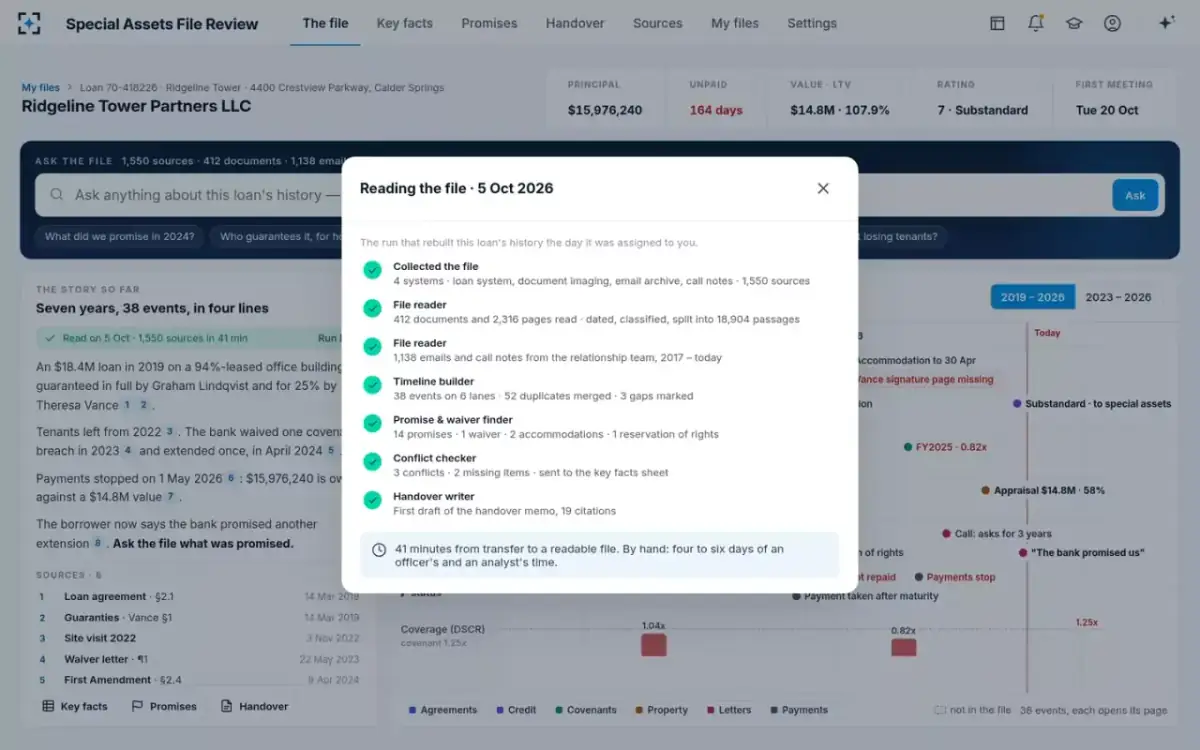
What each kind of source in a loan file gives up easily, and what it does not
| Source | Yields readily | Does not yield, whoever reads it |
|---|---|---|
| Loan and security agreements, amendments | Parties, dates, defined terms, section numbers, the text of a clause and what it is conditional on. | Whether a later instrument supersedes an earlier understanding — a construction question on the documents. |
| Credit memos and annual reviews | The bank’s own view on a date, the approval, and the conditions attached to it. | Whether a condition was ever communicated to the borrower, or only recorded internally. |
| Covenant certificates and borrower financials | The figures certified, the period, the signature and the date received. | Whether the calculation followed the agreement’s definitions rather than the borrower’s accounting. |
| Appraisals and inspection reports | The value conclusion, its date, its basis and its stated assumptions. | Whether the assumptions still hold — a credit judgement the agencies expect the bank to make. |
| Servicing letters and notices | What the bank told the borrower or a guarantor, and exactly when. | Whether the author had authority to say it, and what the statement does to the bank’s rights. |
| Who wrote what to whom and when, and the thread it sat in. | Whether a sentence was a commitment, a negotiating position or thinking aloud. | |
| Call notes | That a call happened, who was on it, and what the writer took away. | What the other party heard, and whether the note is complete. |
The refusal is the feature: what good systems decline to say
A system's limits are the part of it a bank will still be relying on in three years, so they deserve more attention in a demonstration than the accuracy figure. The ones built into this solution are listed below, not as a standard anyone else must meet, but as a concrete example of what the equivalent clause looks like when somebody has written it down.
One file, each step marked machine or person, each machine step carrying what it will not do
Agent
Reads and dates the fileEvery document, email and call note, dated, classified, split into passages that carry their page and section, with any blank signature block noted.
Never: Never edits or deletes a source, and reads only the mailboxes of the loan’s relationship team.
Agent
Draws the history and lists the promisesDated events on six lanes, duplicates merged, gaps marked; every commitment by either side, with its condition and what happened to it.
Never: Never places an event without a source passage, and never decides whether a promise binds the bank.
Agent
Answers questions, and compares documentsOne claim per sentence, each with the page it rests on; documents compared against each other and signature pages checked against the parties named.
Never: Removes an uncited sentence before it is shown; flags legal questions to counsel rather than answering them; quotes amounts rather than recalculating them; reports a conflict rather than correcting a document.
A person decides
The officer, counsel and the chief credit officerRead, decide, and sign: the officer that the memo reflects the file, counsel on the exposures, the chief credit officer on the strategy and the classification.
Never: No agent sends anything to the borrower, writes to the loan system, sets the strategy or proposes a settlement figure.
Three of those are worth dwelling on. Removing an uncited sentence before it is shown is a stronger commitment than flagging one, because it changes what the officer is ever exposed to rather than what they have to notice. Quoting amounts rather than recalculating them prevents a whole class of plausible-looking error: a number that is arithmetically consistent and not what any document says. And reporting a conflict rather than resolving it is the discipline that keeps a workout memo honest, because the temptation in every automated summary is to pick the more recent document and move on.
Special Assets File Review shows what is not in the file, as plainly as what is
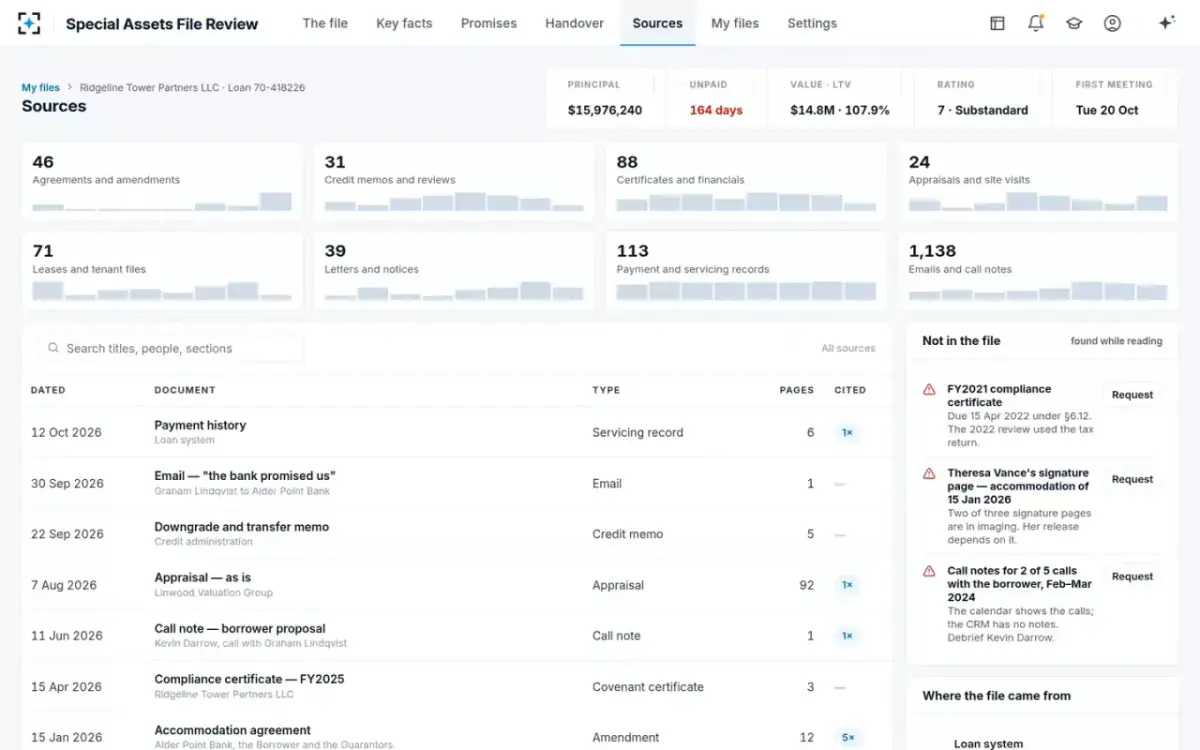
What the bank still owes, whoever reads the file
Buying a reader does not move a single supervisory obligation, and it is worth being concrete about which ones remain, because they are the acceptance criteria for any such purchase. The interagency guidance expects a loan review to reach, among other things, whether the credit and collateral documents are sufficient, whether liens were properly perfected, whether approvals followed the bank's own policies, and whether the borrower has kept to the covenants (85 FR 33278). Each of those is a conclusion a person reaches; a reader can only bring the evidence to the desk faster.
The same goes for controls. For short-term accommodations, the 2023 policy statement lists the prudent internal controls as full policies and practices, proper management approvals, an ongoing credit risk review function, and timely, accurate reporting (88 FR 43115). And the consequence of thin support is stated without ambiguity: where modifications lack adequate analysis and documentation, examiners use their own judgement on the classification until the bank can produce the information that backs its own grades.
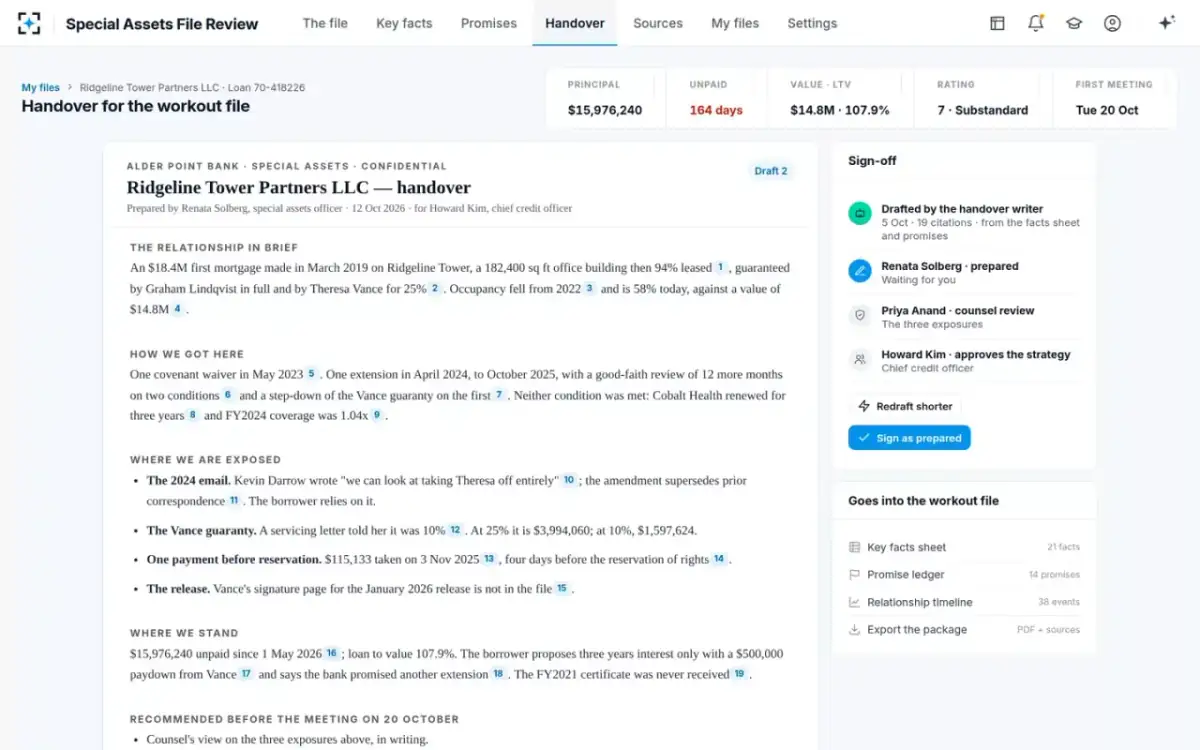
Read that last sentence as a procurement requirement. The value of a document reader to a bank is not that it writes the memo; it is that the memo it helps produce can be supported, line by line, when somebody asks. A system that produces fluent summaries without sources makes the examination harder, not easier.
A memo whose every factual sentence opens the page behind it
Twelve questions for the demonstration
Take your own worst file to the demonstration, not the vendor's. The questions below are the ones whose answers distinguish systems that have thought about a regulated file from systems that have not, and every one of them can be answered in the room.
Twelve things to ask while the software is on the screen
- What does it refuse to answer?
Ask it a waiver question and watch what happens. A system with no refusals has not been designed for this work.
- What does every sentence carry?
Document, page and section, or a paragraph of fluent text with a footnote at the end. The difference matters when counsel reads it.
- What happens to a sentence it cannot support?
Removed before anyone sees it, flagged for a human, or shown with a confidence score. Three very different products.
- What does it do with two documents that disagree?
Ask for a conflict from your own file. Look for both pages shown side by side rather than a resolution.
- What does it do with a document that should be there and is not?
A gap on the timeline with a request beside it, or silence. Silence is the expensive answer.
- Which mailboxes does it read, and over what period?
Scope is a governance question before it is a technical one, and it is the one your own counsel will ask first.
- Does it ever write back to the loan system?
A reader that can write is a different risk profile, and a different approval.
- Does it recalculate amounts, or quote them?
Recalculated figures look authoritative and are a common source of confident error.
- Who is told when something is flagged, and is it automatic?
Unsigned promises, guaranty changes and payments after a default going to counsel by rule is a different control from going when somebody remembers.
- How is accuracy measured, on what test set, and by whom?
The framework wants an accuracy figure to come with a clearly defined, realistic test set that looks like the conditions the system will really meet, and with the test method written down.
- What is kept, for how long, and who can see it?
Every question, answer and flag on an audit trail, with retention set to the bank’s own policy, and access following the loan’s team.
- What happens when a new document arrives?
Whether the facts already stated are read back against their pages, or whether the file quietly diverges from the truth after the first run.
Extraction and judgement: the difference in one question
The clearest demonstration of the distinction is to ask the same file one question two ways. A clause-finding tool answers the first; a workout needs the second.
The same forty pages, asked two different questions
What a clause-finding tool returns: “Find the extension provisions in this amendment.”
What a workout question actually needs: “What did we promise the borrower when we extended in 2024, and what happened to it?”
What a clause-finding tool returns: Section 2.4, with its text, and a confidence score.
What a workout question actually needs: A promise to consider in good faith a further extension of up to 12 months — not to grant one — conditional on two things; and what became of each condition.
What a clause-finding tool returns: None. The conditions are text in the clause.
What a workout question actually needs: The anchor tenant renewed for three years, not the five required, on 18 March 2025; coverage for the financial year was 1.04x against 1.20x required. Both with their pages.
What a clause-finding tool returns: Whatever else matched the pattern.
What a workout question actually needs: The clause a few lines below that was not triggered, and the email seven weeks earlier that said more than the amendment does.
What a clause-finding tool returns: Nothing is withheld, because nothing was judged.
What a workout question actually needs: Any view on whether the email binds the bank given the entire-agreement clause. That is counsel’s, and it leaves the file as a question with its pages attached.
What to insist on in writing before you sign
Five clauses, each of which turns something a vendor says in a meeting into something the bank can rely on in an examination. None of them is exotic, and a supplier that has built for this work will already have answers.
A stated refusal list. The judgements the system will not make, named, with what it does instead. This clause is often missing, and it is the one that matters most three years in when a new release changes behaviour.
Citation as a condition, not a feature. Every factual sentence carries its source, and sentences that cannot be supported are suppressed rather than shown. Specify what "supported" is checked against.
Measurement you can repeat. Accuracy stated against a defined test set drawn from your own files, with the method documented, and re-measured on each release. The framework's standard is the one to hold: a deployed system's validity and reliability are checked by continuing testing or monitoring that shows it still does what it was meant to.
Scope and retention as settings you control. Which systems are read, which mailboxes, over what period, what is kept and for how long, and who may see it — set by the bank, changed by the bank, on the audit trail.
No writes, and no outbound contact. The reader does not alter a source, does not write to the loan system, and never contacts a borrower or a guarantor. If any of those is wanted later, it should be a separate decision with a separate approval.
Those five turn a demonstration into a specification. What they do not do is make the file cheaper to read by itself — what reading a troubled loan file actually costs, and what the spend buys works through that arithmetic, and who decides what on a bad loan sets out the seats the refusals hand the work back to.
Questions people ask
What can AI document review not do?
On a troubled loan file, five things: decide whether conduct waived a right, decide whether an unsigned promise binds the bank, value a guaranty, decide whether the loan is collectable and how it should be rated, and set the workout strategy. The first three are legal or credit judgements; the fourth is placed by supervisory guidance with people independent of the credit approval process; the fifth belongs to the chief credit officer. None of them is answered anywhere in the documents.
Is AI document review accurate enough for banks?
The question is unanswerable as asked, because accuracy depends on the task. Finding and dating what is in a file is checkable against the source, so it can be measured and should be, on a test set drawn from the bank's own files with the method documented. Judgements are not checkable that way, which is the argument for not asking software to make them rather than an argument about any accuracy figure.
Can AI decide if a contract clause was breached?
It can show the clause, the test it sets, and the figures or events that bear on it, each with its page — which is most of the work and all of the evidence. Whether that amounts to a breach is a construction question on the documents, and on a loan in workout it is usually bundled with questions about waiver and conduct that counsel has to take as a whole.
Does a human still have to read the documents?
Someone accountable still has to read what the system produces and be able to check it, which is why citation matters more than fluency. The court's framing in the best-known sanctions case is the right one: using a reliable tool for help is unremarkable, but the professional remains the gatekeeper for accuracy. On a bank file the same duty arrives through the signatures on the memo.
Can AI read emails and call notes?
Yes, and on a workout they are often where the decisive material is — a promise made in February that the amendment in April did not repeat. The questions worth asking are about scope rather than capability: whose mailboxes, over what period, with whose approval, and what happens to the material afterwards. Those should be settings the bank controls, not defaults.
How do you audit an AI document review?
By checking a sample of its sentences against the pages they cite, by re-running a file you have already read by hand and comparing the two, and by keeping every question, answer and flag on an audit trail so that a reviewer can reconstruct what was asked and what came back. If the sentences do not carry sources, none of those three is possible.