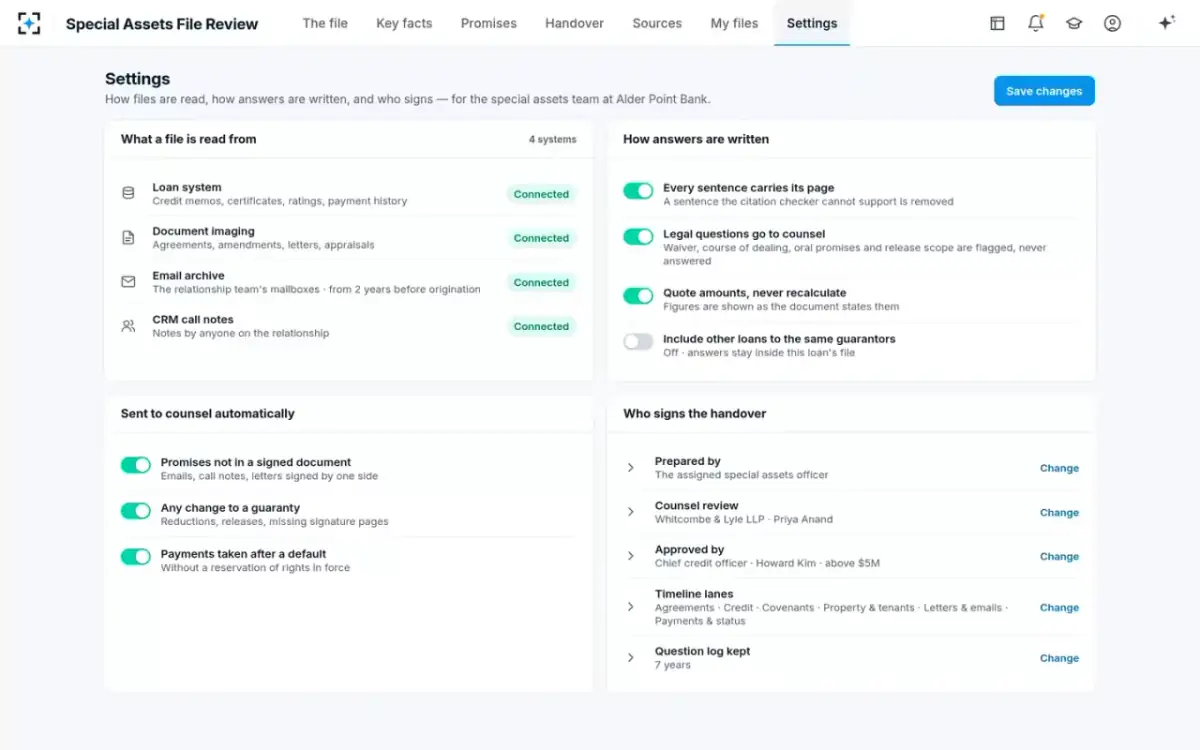
E-discovery email search — often written ediscovery — is the business of finding, preserving and producing electronic messages that bear on a dispute, and almost everything written about it is written for counsel after a dispute has started. A bank reading a troubled loan's correspondence is in a different position and has a harder first question: not how to search, but what it is entitled to search at all. Whose mailboxes, how far back, from which systems, and recorded how. Get the scope wrong in one direction and the search misses the sentence that decides the negotiation; get it wrong in the other and the bank has read mailboxes it had no business in. Special Assets File Review treats that question as a setting rather than a habit: in the sample file, the relationship team's mailboxes only, from two years before origination, with every absence listed rather than smoothed over.
The worked example is the sample file the solution ships with, loan 70-418226 to Ridgeline Tower Partners LLC: 1,550 sources, of which 1,138 are emails and call notes. Every person, bank, firm, borrower and property in it is fictional. One more thing to say plainly before the rules appear: the Federal Rules of Civil Procedure govern discovery in federal litigation. They do not govern a bank's internal review of its own file. They are used here as a ready-made discipline, because they are the most carefully argued public answer to exactly the question a buyer is trying to settle.
What is e-discovery email search?
In litigation it is one stage of a larger process: identify the people whose material is likely to be relevant, preserve it, collect it, search it, review it and produce what the other side is entitled to. The search itself — terms, date ranges, threading, de-duplication — is the part that gets productised, and it is the part a bank is least likely to get wrong, because searching an archive is a mature, well-understood job.
What a workout desk needs is narrower and starts earlier. It is not trying to produce anything to anyone. It is trying to answer four questions about its own relationship: what did we say we would do, what did we accept, what did we waive, and who said it. Those answers live in correspondence because that is where the relationship actually ran, and they have to be found before a first borrower meeting rather than after a complaint is filed.
Whose mailboxes can a workout team read?
That is a question for the bank's own policy, records and legal functions, and the answer should be written down before any search runs rather than reconstructed afterwards. The defensible default is narrow: the mailboxes of the people who worked the relationship — the relationship manager, their credit partner, the portfolio manager, the servicer — and nobody else. Narrow is not only safer; it is better reading, because a search across an institution returns mostly noise and buries the four sentences that matter.
The rules of discovery supply a useful discipline for drawing that line, in the form of a relevance test tied to proportion rather than to curiosity.
Rule 26(b)(1) of the Federal Rules of Civil Procedure lets a party seek any non-privileged material that is relevant to a claim or defence and proportional to the needs of the case (Rule 26(b)(1)). Proportional is then spelled out as six weights: how important the issues are, how much money is in dispute, which side has easier access to the information, each side's resources, how much the material matters to resolving the issues, and whether the burden or cost of getting it outweighs the likely benefit.
Nothing in that rule applies to a bank reading its own file. Read as a scoping test, though, it is exactly the right shape: relevance to a specific claim or defence rather than to a subject, weighed against burden, with the amount at stake as one of the factors. A desk that can answer "whose mailboxes, and why those" in that form has a scope it can defend to its own records function, to an examiner, and later to a court if the matter ever becomes one.
In the sample file the setting reads: the relationship team's mailboxes only. It is a line in the team's own rules, visible to everyone relying on the answers, and changing it is a decision somebody makes and signs rather than a query somebody types.
How far back should you search email in a loan file?
Further back than the problem, and the useful rule is to start before origination rather than at it. The reason is that the commitments which cause trouble in a workout are frequently made while the credit is being won: what the bank indicated it would do at renewal, what the sponsor said the property would be, which conditions were discussed and dropped. A window that opens on the closing date misses all of it.
The sample file's setting is two years before origination, which on a March 2019 loan means the search runs from 2017 to today. That is a choice, not a standard, and a bank should make it deliberately: long enough to catch the negotiation, short enough that the archive query is proportionate, and the same on every file so that the scope is a policy rather than an argument about one borrower.
Scoping a relationship's correspondence, step by step
A person decides
Credit administration names the relationship teamLists the people who worked this loan — relationship manager, credit partner, portfolio manager, servicer — and the dates each of them held it.
Never: Never a mailbox outside the loan’s relationship team, however interesting.
A person decides
Records and legal set the windowFixes the period, on a rule that applies to every file: in the sample file, from two years before origination to today.
Never: Never a window chosen to find one particular document.
A person decides
Technology names the systemsNames what is in scope — the email archive, the CRM call notes, document imaging, the loan system — and who owns each.
Never: Never a system read without its owner’s approval and a record of it.
A person decides
Counsel agrees what is excludedPrivileged material, personnel matters, other borrowers’ relationships, and anything the policy keeps out.
Never: Never an exclusion that is understood but unwritten.
Agent
The file reader runs itCollects and reads what the scope allows, dates and classifies each item, and splits it into passages carrying page and section.
Never: Never edits or deletes a source, and never reads outside the mailboxes named.
Agent
The file reader lists what is not thereMarks what should exist and does not — a certificate, a signature page, notes for a call the calendar shows — and puts a request against each.
Never: Never smooths over an absence, and never infers a document’s contents from its title.
A person decides
The officer records the scope with the answersKeeps what was searched, over what period, and what was excluded, alongside the history it produced.
Never: Never a search whose scope cannot be stated afterwards.
What proportionality in discovery means before anyone has sued
Proportionality in the rule is a balance, not a budget: the six weights are set against one another, and no single one — not even the amount at stake — settles the answer alone. The rules also recognise that some material is simply too expensive to reach: "A party need not provide discovery of electronically stored information from sources that the party identifies as not reasonably accessible because of undue burden or cost" (Rule 26(b)(2)(B)).
Applied before a dispute, those two ideas settle most scoping arguments in a workout. A $16 million exposure with a contested promise in it justifies reading four mailboxes over nine years. The same reading across forty mailboxes, or across the sponsor's other relationships with the bank, does not — the benefit falls away faster than the burden does. And a backup tape nobody has restored since 2018 is a reasonable thing to identify as out of reach and say so, which is a far better answer than quietly leaving it out.
Why a promise lives in email and not in the agreement
Because agreements are negotiated and correspondence is written. By the time a clause reaches an amendment it has been read by two sets of lawyers and says exactly what both sides could agree to. The sentence a borrower actually remembers was written by a relationship manager who was trying to keep a relationship, at a moment when nobody thought it would be read again.
The sample file is built on precisely that gap. The First Amendment of April 2024 promised that the bank would consider an extension in good faith on two conditions. An email of 20 February 2024, seven weeks before it, said something considerably warmer about a guarantor: "we can look at taking Theresa off entirely". Both are in the file. The amendment states that it supersedes all prior negotiations, correspondence and understandings, which is an argument rather than an end to it — and it is why the solution flags the email to counsel with its page instead of ruling on it.
What a transferred file is actually made of
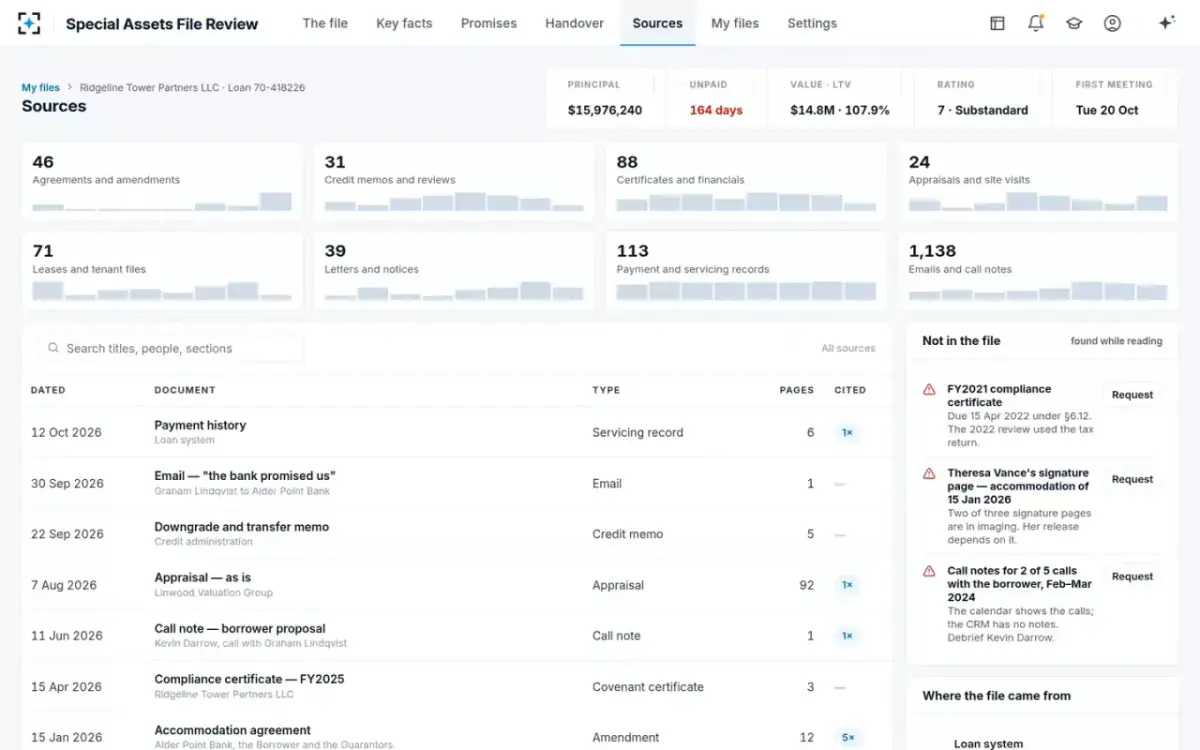
By source: 1,550 items in all
- Emails and call notes · 1,138 · 73.4%
- Documents · 412 · 26.6%
The 412 documents, by type
- Payment and servicing · 113 · 27.4%
- Certificates and financials · 88 · 21.4%
- Leases and tenant files · 71 · 17.2%
- Agreements and amendments · 46 · 11.2%
- Letters and notices · 39 · 9.5%
- Credit memos and reviews · 31 · 7.5%
- Appraisals and site visits · 24 · 5.8%
Do call notes count as part of the loan file?
In practice yes, and a scope that leaves them out is a scope with a hole in the middle. A call note is a contemporaneous record of what was said by someone who was there, which is exactly the kind of evidence a disputed promise turns on, and it is often the only record of a conversation that produced a commitment nobody put in writing.
They also fail differently from email. An email that was sent exists somewhere; a call note that was never typed does not exist at all, and nothing in the system will tell you it is missing unless something else says the call happened. That is why the calendar matters: in the sample file the search found notes for three of five calls with the borrower in February and March 2024, and listed the other two as missing items against the calendar entries that show the calls took place, with a note to debrief the relationship manager. An absence that can be named is a question someone can answer. An absence nobody noticed is a hole in the history.
Where a loan relationship's history lives, and how each source fails
| Source | What it holds | What is easy | What is hard, and what is usually absent |
|---|---|---|---|
| Loan system | Credit memos, covenant certificates, ratings, payment history. | Structured, dated, complete for anything with a number attached. | Narrative. It records that a waiver exists, rarely what it waived or why. |
| Document imaging | Agreements, amendments, letters, appraisals, closing binders. | The documents that closed. Indexing is usually good at the document level. | Signature pages collected by email after closing; anything executed in counterparts; whatever was filed under the wrong relationship. |
| Email archive | The relationship team’s mailboxes — where promises, warnings and the real chronology live. | Retrieval, once the scope is set. Archives are built to be searched. | Scope and authority, not search. Also whoever has left: a former relationship manager’s mail may be archived, deleted or in a different system. |
| CRM call notes | Notes by anyone on the relationship, including calls that produced commitments. | Short, dated, and often the only record of a conversation. | The notes nobody wrote. Reconcile against the calendar, because nothing else will show the gap. |
What happens if the email is deleted
Ordinary deletion under a retention schedule is not a scandal; it is what a retention schedule is for. The rules draw the line at a specific thing — material that should have been preserved and was not, because reasonable steps were not taken — and the consequences escalate with intent rather than with volume: where such information "is lost because a party failed to take reasonable steps to preserve it, and it cannot be restored or replaced through additional discovery", a court may order measures no greater than necessary to cure the prejudice, and "only upon finding that the party acted with the intent to deprive another party of the information's use in the litigation" may it presume the lost information was unfavourable, instruct a jury to do so, or dismiss the action (Rule 37(e)).
Again, that rule is about litigation. The practical lesson for a workout desk arrives earlier and is about honesty rather than law: when correspondence is not there, the history must say so. A chronology that reads smoothly because the gaps were silently skipped is worse than one with holes in it, because the reader cannot tell which parts are evidence and which are inference.
A search that can say what it did not find
This is the capability to buy for, and the one a demonstration is least likely to show unprompted. Any product can show what it found. The question is what happens to the three kinds of absence, which are genuinely different problems and want different answers.
Three kinds of absence, and what a reader should do about each
A document that should exist and does not
The FY2021 compliance certificate, due 15 April 2022 under §6.12. The 2022 credit review used the tax return instead.
Request it from the borrower, and find out whether it was never delivered or never chased. Either answer is a fact about how the relationship was run.
A page that exists somewhere outside the scope
A guarantor's signature page to the accommodation of 15 January 2026. Two of three signature pages are in imaging; hers is not, and the release depends on it.
Ask the closing team and the firm that closed the deal. Until it arrives, the release is a gap rather than a release, and the amount it would have affected stays in question.
A conversation with no note
Call notes for two of five calls with the borrower in February and March 2024 — the calendar shows the calls, the CRM has nothing.
Debrief whoever was on the call while they still remember, and write the note now, dated now. A late note that says when it was written is evidence; one that pretends to be contemporaneous is not.
The file counted by type, and what is not in it
What to ask before you buy, in writing
Scoping questions are easy to answer vaguely in a demonstration and hard to answer vaguely in writing. These are the ones that decide whether a search is something a bank can defend, and all of them can be put in a document the supplier signs.
The two discovery tests, turned into buying questions
- How is the scope expressed, and who sets it?
A named list of mailboxes and a date window held as a setting, or a query somebody types? Ask to see where it lives and who can change it.
- Can you state the scope in the proportionality form?
Relevance to a specific question, weighed against burden, with the amount at stake named. If the answer is "everything the bank holds", the scope has not been set.
- What happens to a source identified as not reasonably accessible?
It should be named and recorded as out of scope, not dropped. A search that silently omits a system is a search whose coverage nobody can state.
- What reasonable steps to preserve are in place, and are they evidenced?
Who is told to preserve, when, and how is it recorded? This is a question for the bank as much as for the supplier, and the answer belongs in the same document.
- Who approved reading each system, and where is that recorded?
Email archive owners, CRM owners, the records function. Approval that lives in somebody’s memory is approval that cannot be shown to an examiner.
- What does the product record about the run itself?
What was searched, over what period, how many items were read, what was excluded, and what was requested. Ask to see one from a previous file.
- Can it tell me what it did not find?
Missing documents, mailboxes outside scope, calls with no note. Ask for a demonstration on a file the supplier has not prepared.
Retention: what is kept, by whom, for how long
This page gives no retention advice, and a supplier who does should be treated carefully: retention periods come from a bank's own schedule, its regulators and its counsel, and they differ by record type and by jurisdiction. What a buyer can insist on is that the period is a setting rather than a product decision, and that the thing being retained is useful.
Two public expectations are worth holding in view while setting it. The interagency safety and soundness standards expect internal controls that include an organisation with clear lines of authority and responsibility for checking that policies are followed (12 CFR part 30, appendix A) — which is the governance half of a scope that somebody owns. And the interagency guidance on credit risk review systems is explicit that its function is not the same as the workout desk's: "The role of, expectations for, and scope of credit risk review as discussed in this document are distinct from the roles, expectations, and scope of work performed by other groups within an institution that are also responsible for monitoring, managing and reporting credit risk. Examples may be those involved with lending functions, independent risk management, loan work outs, and accounting" (85 FR 33278). A workout file review is not credit risk review, and should not be sold or scoped as though it were.
There is a third reason to keep the scope with the answers, and it comes from the risk framework rather than from banking: the NIST framework ties trustworthy AI to accountability, and accountability to transparency — how much the people using a system can learn about it and about what it produced (NIST AI 100-1). A reader who can see which mailboxes were read, over what window, and what was not found, can weigh the history in front of them. One who cannot is being asked to trust a summary.
Scope as a setting the bank owns
What the correspondence turns up is worked through next door: the promises that were never captured in a signed document, in the reservation of rights letter and the payment taken before it, and the letters that purport to change a guaranty, in which guaranty amount stands when the file disagrees. To see a file counted by source, with its gaps listed, start from Special Assets File Review.
Questions people ask
How do you search an email archive for a promise?
Not with keywords alone, because a promise rarely uses the word. The commitments that matter read like "we can look at", "I'd expect we'd be able to" and "leave that with me", and they are recognisable by shape rather than by term. The practical method is to read the correspondence around every dated event in the loan's history — each amendment, each waiver, each missed covenant — because that is when commitments are made, and then to put every candidate in front of a person with its date and its author.
Does email threading lose anything?
It can. Threading shows the most inclusive message in a chain and suppresses the rest, which is efficient and hides two things a workout cares about: who was on which version of the thread, and what was said in a branch that did not make it into the final message. For scoping a relationship's history, treat threading as a reading aid rather than as a filter, and make sure the underlying messages remain addressable.
Is a workout file review the same as e-discovery?
No. E-discovery is a litigation process with obligations to another party, a court and a schedule. A file review is the bank reading its own material to understand its own position, with nothing to produce to anyone. The techniques overlap and the discipline is worth borrowing, but the obligations do not transfer, and nobody should tell a bank that running a file review satisfies a discovery obligation or vice versa.
Can a bank read a former employee's mailbox?
That depends on the bank's own policies, its employment arrangements and the law where the mailbox and the person sit, and it is a question for records and legal rather than for a supplier. What matters for scoping is that former relationship managers are usually central to a troubled loan's history — the sample file's most consequential email was written by one — so the question has to be answered deliberately before the search, not discovered halfway through it.
What happens to privileged material in the mailboxes?
It should be excluded by a rule agreed with counsel before the search runs, and the exclusion should be written down rather than understood. The same applies to personnel matters and to other borrowers' relationships. In the sample file the setting that would let answers reach other loans to the same guarantors is visible, and off, which is a scope decision rather than a technical limit.
Do the Federal Rules of Civil Procedure apply to a bank's internal file review?
No. They govern discovery in federal litigation between parties. They are used on this page because their proportionality and preservation provisions are the best-argued public answer to the scoping question a bank faces anyway, and because a scope expressed in that form is one the bank can defend later if the matter does become litigation. Your own retention schedule, policies and counsel govern what you may read and keep.