How much AI contract review costs is the wrong question asked in the right place, because every published answer prices the work per document or per seat and a troubled loan file is not bought that way. The file is read once, by two expensive people, under a deadline nobody controls, and what it buys or loses is measured in days before a meeting and in exposures found or missed. This guide gives no price — scope, systems and volume decide that, and anyone quoting a figure before seeing your files is quoting a different problem — but it gives the unit, the three costs that belong in the comparison, and the test you can run on one of your own closed files. Special Assets File Review is the solution the example comes from: six agents read a whole transferred file the day it arrives and draw it as a cited history the officer can question in plain words.
The worked example is the sample file the solution ships with, loan 70-418226 to Ridgeline Tower Partners LLC, $15,976,240 unpaid and rated 7 Substandard. Every person, bank, firm, borrower and property in it is fictional, and the figures marked as the sample file's are from that file, not from a customer. The by-hand totals are our estimate from practitioner accounts; there is no published benchmark for them, and this page says so wherever it uses one.
How much does AI contract review cost?
The honest answer has three parts, and only the first is a price. There is what the supplier charges, which varies with the systems to be connected, the volume of files and what is being produced at the end. There is what the bank spends internally to make it work, which is mostly connection and configuration and is usually underestimated. And there is what the bank is already spending on the same work by hand, which is almost never measured and is the only number that makes the first two meaningful.
Most published answers to this question quote the first part per document or per page, which is defensible for a contract repository where the unit of work genuinely is the contract. In a workout it is not. Nobody reads a troubled loan file document by document; they read it relationship by relationship, looking for what was promised, what was waived, what was guaranteed and what was accepted, and the answer to any of those usually spans four documents and an email. Pricing per document measures the thing that is easy to count rather than the thing that is being bought.
Why price per document is the wrong unit
Three reasons, each of which a procurement analyst can test against their own files. First, the quantity is wrong: a file of 412 documents and 2,316 pages also carries 1,138 emails and call notes, and in the sample file the single most consequential sentence in the whole relationship is in an email, not in an agreement. Second, the work is not proportional to the count: adding a hundred routine servicing records costs almost nothing to read and changes nothing, while one accommodation agreement with a missing signature page changes the recovery estimate. Third, and most important, a file is read once. There is no run rate to amortise a per-document price across. The question is what happens on one file, before one meeting, on one date that is already in the diary.
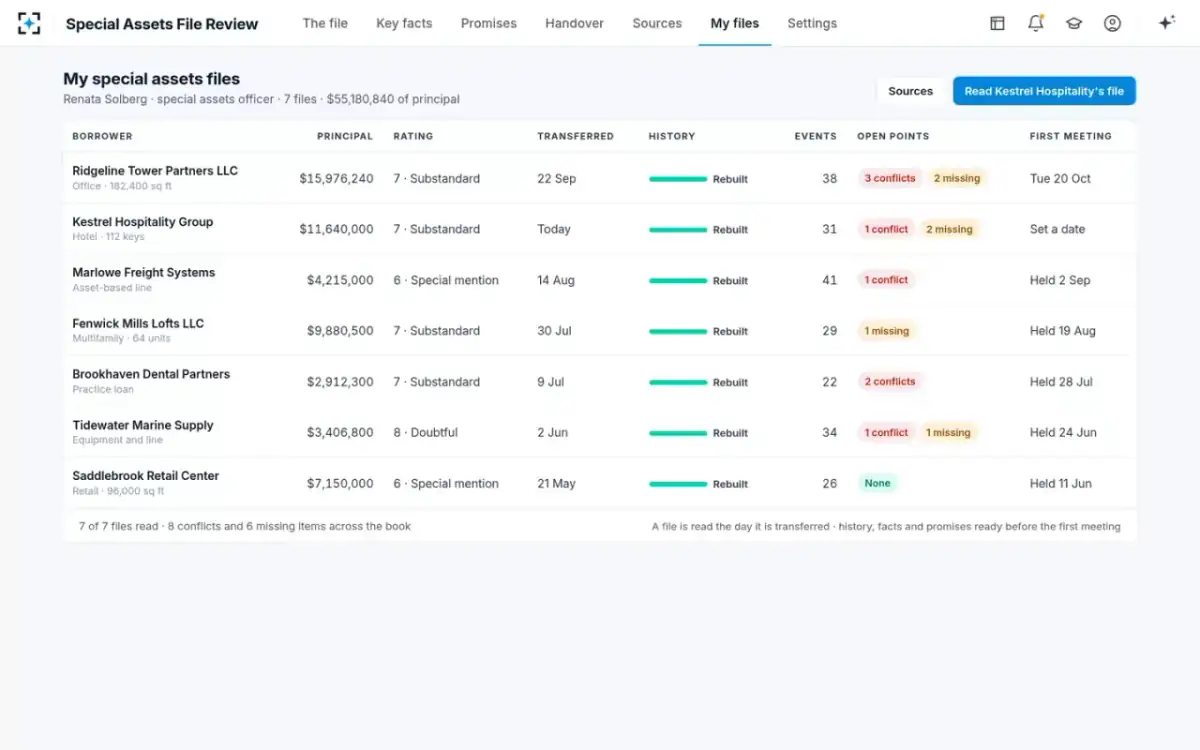
So the unit is the transferred file. It is the unit the desk actually works in — in the sample file, seven files and $55,180,840 of principal on one officer's desk, each with its own first meeting date — and it is the unit a credit committee can act on.
Three units of cost, and what each hides
| Unit | What it measures | What it hides | Can a credit committee act on it? |
|---|---|---|---|
| Per page or per document | Volume processed. Easy to count, easy to quote, easy to compare between suppliers. | That emails and call notes carry the promises; that most pages are routine; that one document can change the whole estimate. | No. It answers a question about throughput, not about whether a workout starts informed. |
| Per seat or per user | Access. Useful for a tool people live in all day. | That a workout officer touches a given file intensely for two weeks and then rarely. Seats price presence, not reading. | Only for budgeting. It says nothing about what the file review changes. |
| Per transferred file | The actual job: one relationship, read once, before one meeting, to a standard the bank owes anyway. | Nothing, if the four lines below it are honest — days to the first meeting, officer and analyst hours, exposures found before the meeting, rework when a new document arrives. | Yes. It is the unit the desk works in and the unit the deadline is attached to. |
How long does it take to review a commercial loan file?
For a commercial real estate file transferred to special assets, our estimate is four to six days of an officer's and an analyst's time, spread over a longer elapsed period because neither of them is doing only this. That estimate comes from practitioner accounts of the work rather than from a published study; we have not found a benchmark for it, and a desk that wants its own number should take it from its own files before believing ours.
The split matters more than the total, because it is where the comparison is actually made. Pulling the file from four systems is clerical and nearly all of it disappears. Reading the agreements, memos, emails and call notes is the bulk of it. Building the chronology is slow, error-prone and entirely mechanical. Checking the guaranties and the signature pages is the part that is usually skipped when the meeting is on Tuesday.
Where a transferred file's hours go, by hand and after the reading is done
By hand: about 40 hours of an officer’s and an analyst’s time (estimated)
- Pulling from four systems · 8h · 20%
- Agreements, amendments, memos · 12h · 30%
- Emails and call notes · 8h · 20%
- Chronology · 6h · 15%
- Guaranties and signature pages · 6h · 15%
After: about 1 hour of a person’s time on the same five tasks (estimated, sample file)
- Systems · 0.1h · 10%
- Agreements · 0.3h · 30%
- Emails · 0.2h · 20%
- Chronology · 0.1h · 10%
- Guaranties · 0.3h · 30%
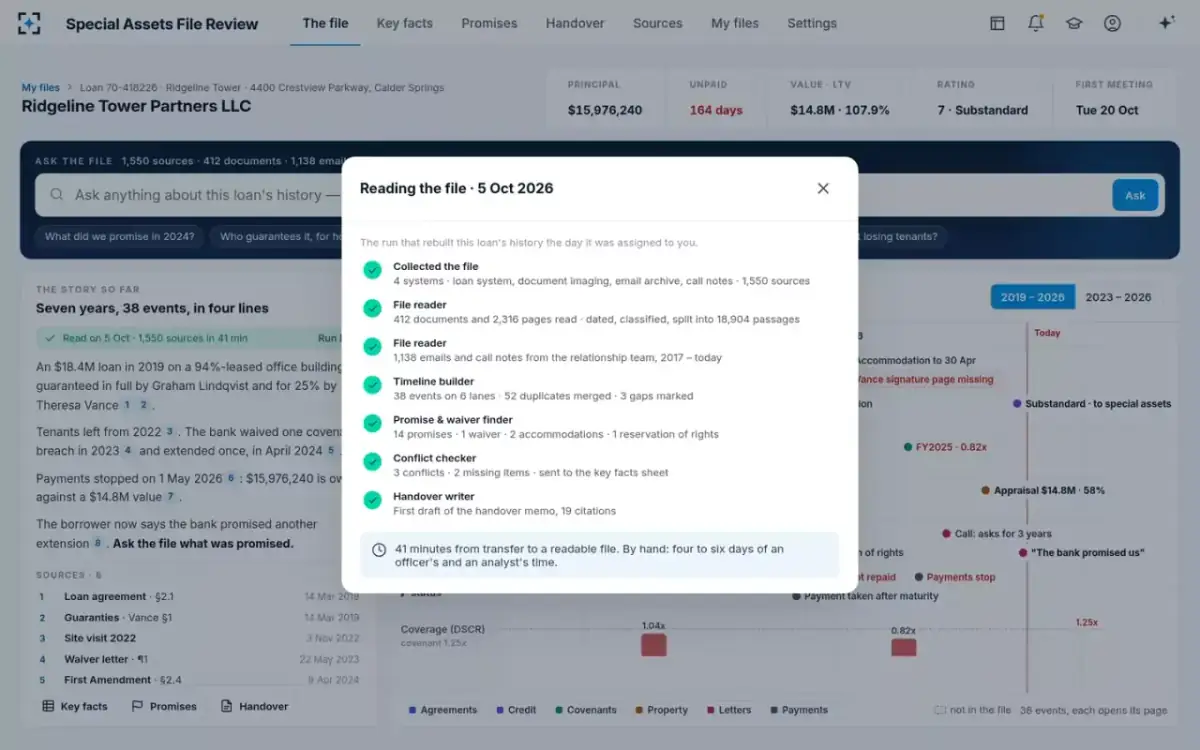
Read the lower bar carefully, because the honest reading of it is not that the work went away. It is that the shape changed: almost none of the remaining hour is spent collecting or transcribing, and almost all of it is spent on the two things a person should be doing — reading the guaranty position and reading what the agreements actually say. In the sample file the reading run itself took 41 minutes from transfer to a readable file, over 1,550 sources, producing 38 events, 14 promises, 3 conflicts and 2 missing items, with a first draft of the handover carrying 19 citations.
The three costs of one transferred file
Set against each other, the costs of a transferred file divide into three, and they behave completely differently. Two of them are bounded and can be estimated in advance. The third cannot, which is the reason the comparison is worth making at all.
What one transferred file costs, and what the reading returns
Officer and analyst time before the first meeting
hours to rebuild the history × the people who do it
Our estimate: four to six days on one commercial real estate file, from practitioner accounts, with no published benchmark. Bounded, and the easiest of the three to measure on your own closed files.
Priced by the desk that loses the time
The supervisory work the bank owes anyway
updated information + current valuations + structure and covenants + legal agreements
Expected of a well-conceived workout plan whoever does the reading. Reading faster does not remove a line of it; it changes when in the fortnight the line gets done.
Priced by credit administration
The exposure found late, or not at all
unbounded, and discovered by the other side
A promise in an email the signed amendment does not carry; a guaranty a letter purported to halve; a payment accepted before rights were reserved. Each is a fact about leverage, and none of them is on a per-page price list.
Priced by nobody until it lands
Exposures found before the meeting
conflicts and gaps named, with their pages, while there is still time
In the sample file: three conflicts and two missing items on day one, including $2.40M of guaranty in question because a servicing letter told a guarantor 10% when her guaranty says 25%. That is an amount in question, not an amount recovered.
Realised by the officer and counsel
What the bank owes anyway, whoever does the reading
A business case that claims a file review tool removes supervisory work is a business case that will not survive its first conversation with credit risk review. The work is owed. The 2023 interagency policy statement sets out what management must have done for a workout not to be criticised, and the list is about analysis and documents, not about who typed them. The 2020 guidance on credit risk review systems makes the same point about frequency and emphasis: the function exists for "timely and accurate identification of credit weaknesses so that action can be taken to strengthen credit quality and minimize loss" (85 FR 33278). The word doing the work there is timely.
What the policy statement requires, and whether reading faster changes it
- Current, complete financial information on the borrower, the project and every guarantor
Does not change. Someone still has to obtain it. What changes is knowing on day one which guarantors there are and which of them a later document purported to release.
- A current valuation of the collateral the loan and the plan rely on
Does not change. The appraisal is ordered and paid for either way; the sample file carries one at $14.8M against $15,976,240 of principal.
- A suitable structure and covenants, with any paydown or extra-collateral requirements
Does not change, but it is proposed better informed: a structure proposed in ignorance of an unsigned promise is a structure that gets renegotiated.
- Legal analysis, and agreements for every change of terms
Does not change in substance, and changes a great deal in cost: counsel is cheaper when the three questions arrive with their pages attached than when counsel has to find them.
- Review and evaluation of significant loans at least annually, on renewal, or more often on deterioration
Does not change. Credit risk review usually looks at significant loans each year and at renewal, and sooner when something inside or outside the bank suggests the credit may be slipping.
- An independent, ongoing credit review function behind it
Does not change. The safety and soundness standards expect credit review that is independent and continuing, with its findings reported to management and the board.
The cost you cannot price: the exposure found late
The first two costs are bounded. The third is not, and it is the one the per-page comparison cannot see at all, because it is a cost that lands on the negotiation rather than on the budget. An exposure the bank finds on day one is an argument the bank can prepare for. The same exposure found by the borrower's counsel, in the meeting, is an argument the bank concedes while it works out what happened.
The sample file has four of them, and they have nothing in common except that each lives somewhere a hurried reader does not look. A relationship manager's email of February 2024 going further than the amendment signed seven weeks later. A servicing letter of July 2025 telling a guarantor her exposure was 10% when her guaranty says 25% — $2,396,436 of difference, in question until counsel rules, and on no price list. A payment of $115,133 taken on 3 November 2025, four days before rights were reserved. And a release of claims whose third signature page is not in the file.
None of those is a number the business case can book. All of them are reasons the business case is being written. The honest way to put them to a committee is as a question: on the last five files this desk transferred, what did we find after the first meeting that we would rather have found before it, and what did it cost us in the negotiation?
The unit the desk actually works in
What should be in the business case, and what to leave out
A business case for file review fails in a credit committee for one of two reasons: it counts things nobody cares about, or it claims savings in people the bank is not going to lose. The four lines below avoid both. They are measurable on closed files, they are about the work rather than the software, and none of them requires a headcount assumption.
Four lines that belong in the business case, and three that do not
In: four lines a committee can test
- Days from transfer to an informed first meeting. Measure it on your last ten transferred files, from the transfer date to the date the officer could answer the four questions the borrower actually asks.
- Officer and analyst hours spent rebuilding the history. Ask the two people. Do not price the hours; report them, and let the committee decide what their time is worth.
- Exposures found before the first meeting, and after it. The ratio is the whole argument, and both halves are in the files already.
- Rework when a new document arrives. How often a late appraisal, a found signature page or a produced email forced the chronology to be rebuilt by hand.
Out: three lines that prove nothing
- Pages processed. A measure of the file, not of the work. A file with more routine servicing records is not a harder file.
- Documents ingested. Counts collection, which is the cheapest part of the job and the part that was never the problem.
- Questions asked. Usage, not outcome. A desk asking many questions may be well served or may be unable to find anything.
The hidden costs of AI document review, on both sides of the comparison
Both sides of this comparison hide costs, and a buyer who only hunts for them on the supplier's side will get the decision wrong in the other direction. On the product side: connecting four systems rather than one, and the access rules that come with the email archive; the configuration of what goes to counsel automatically and who signs; the work of agreeing what a file is read from and how far back; and the standing cost of checking, because a cited history still has to be read by a person who opens the citations that carry the argument.
On the by-hand side the hidden costs are larger and much less visible, because they are already in the run rate. The chronology rebuilt twice because a document arrived late. The analyst's week spent finding a page someone remembers. The call to outside counsel that starts with forty minutes of context. The meeting that went ahead half-read and the concession that followed. And the file that was read properly, by a good officer, in time — at the cost of the two other files on the same desk that were not.
How to measure it on one of your own closed files
The comparison does not need a pilot, a steering committee or a year. It needs one closed file whose outcome you already know, and a willingness to write down what actually happened.
One file, two clocks — and what each clock still leaves for a person
By hand (our estimate): Four to six days of an officer’s and an analyst’s time, spread across the fortnight before the meeting.
With the file read first (sample file): 41 minutes from transfer, on the day the file was assigned.
By hand (our estimate): A chronology in a spreadsheet, as complete as the time allowed, and a memory of what was read.
With the file read first (sample file): 38 events on six lanes, 14 promises, 3 conflicts, 2 missing items, and a draft handover with 19 citations.
By hand (our estimate): Recall, then a search afterwards. The answer arrives after the room has moved on.
With the file read first (sample file): 8.6 seconds over 64 passages, with every sentence carrying the page it rests on.
By hand (our estimate): Everything, including the collecting and the transcribing.
With the file read first (sample file): Reads what was found, decides the strategy, signs the handover — and counsel still rules on every legal question.
By hand (our estimate): Updated information, current valuations, appropriate structure and legal agreements are owed either way.
With the file read first (sample file): The same four. What moves is when in the fortnight they get done, and how informed the proposal is.
41 minutes, step by step, with what each step produced
What a serious proposal says about volume
Volume is where a per-file unit has to be honest, because the number of transferred files a bank will have is not a decision it gets to make. The FDIC's Quarterly Banking Profile for the fourth quarter of 2025 reported that, at banks with more than $250 billion in assets, the past-due and nonaccrual rate on non-owner-occupied commercial real estate loans fell for a fifth straight quarter, to 4.06%, down from a 4.99% peak in the third quarter of 2024 but still far above the 0.58% pre-pandemic average (FDIC, 24 February 2026). Improving, and still several times where it was.
A proposal that prices a fixed annual volume is making a forecast on the bank's behalf. A proposal that scales with files transferred is pricing the thing that actually varies. And a proposal worth taking to a committee says what happens in the bad case — when four files land in a month and three of them have first meetings a fortnight out — because that is the case the business case is really about.
What the reading can and cannot decide is set out in what a document reading agent may decide on a loan file, and the test for whether its citations hold is in the test a cited loan history must pass. To see one file read, with its conflicts and its gaps, start from Special Assets File Review.
Questions people ask
Is AI contract review worth it?
On a workout desk the question is answerable only per file, and the test is whether the first borrower meeting happens informed or half-read. Where a desk is routinely meeting borrowers before the file has been read — because the transfer-to-meeting window is two weeks and the reading is four to six days of two people's time — the answer is usually yes. Where files arrive rarely and the desk has time to read them properly, the case is much weaker, and an honest supplier will say so.
How do you price document review per page?
You can, and for a contract repository it is a reasonable unit. For a troubled loan file it measures the wrong thing: the pages are mostly routine, the decisive material is often an email or a call note, and the file is read once rather than at a run rate. If you are given a per-page quotation, convert it to a per-file figure using your own files' actual page counts before comparing it with anything.
What is the cost of reviewing a loan file by hand?
In time, our estimate is four to six days of an officer's and an analyst's time for a commercial real estate file, from practitioner accounts rather than a published study. In money, it depends on rates we will not invent for you; take your own. The larger cost is usually not the hours but what is not reached within them, which is why the four lines in the business case above count exposures found before and after the meeting rather than hours alone.
What is the ROI of AI document review?
Built from three things, two of which are measurable on files you have already closed: the officer and analyst hours returned, the supervisory work that has to happen either way and therefore does not count as a saving, and the exposures found before the meeting rather than after. The third is the one that moves a negotiation and the one no price list carries, so state it as a count of findings on your own closed files rather than as a modelled amount.
What does it cost to get a file review wrong?
It is not a fixed amount, and that is the point. On the sample file one servicing letter put $2,396,436 of guaranty in question — an amount in question, not an amount lost, and what it is worth is counsel's ruling. Found on day one it is an argument the bank prepares for; found by the borrower's counsel in the meeting it is an argument the bank concedes while it works out what happened.
Does the price depend on how many documents we have?
Partly, and less than a per-document quotation implies. What drives effort is the number of systems a file has to be read from, how far back the correspondence goes, and how many files are transferred in a period — not the page count of any one of them. When comparing proposals, ask each supplier to price the same thing: one transferred file, read from your four systems, to the point where an officer could walk into a first meeting.