A special assets department at a bank is the group that takes a commercial loan once it has been classified, and the useful way to design one is not by headcount but by decision. Four decisions have to be made on every troubled loan, and they are not interchangeable: what the file actually says, what the loan's rating is, what the bank's rights are, and what the strategy will be. The interagency guidance settles two of them before you start — the rating assessment has to come from someone independent of the credit approval process, and when the lender and the reviewer disagree, the lower rating usually stands. Botminds' Special Assets File Review takes the first decision's donkey work, reading the whole transferred file and drawing it as a cited history, and deliberately refuses the other three.
The people on this page work a fictional sample bank, Alder Point, and a fictional sample file: Ridgeline Tower Partners LLC, an $18.4 million office loan now $15,976,240 unpaid, with a first borrower meeting on Tuesday 20 October. The supervisory sentences quoted come from the agencies' own guidance and are linked where they appear.
What does a bank's special assets group do?
It takes the loans the lending team can no longer manage as a relationship and turns each one into a defensible plan: read the file, rate the credit honestly, establish what the bank may and may not do, negotiate or enforce, and report the result upward. The agencies do not prescribe a department. What they prescribe is a function, and they are explicit that it can sit anywhere: the credit risk review guidance lets parts of the work fall to underwriting, loan administration, a workout group or any other unit, including running the bank's internal reporting on problem loans and keeping the rating process honest (85 FR 33278).
That flexibility is the reason the design question is about seats rather than boxes on a chart. A bank with $900 million of assets and nine classified loans does not need a department; it needs to know which person holds which pen, and to be able to show an examiner that the person holding the rating pen is not the person who made the loan.
Four decisions, four seats
Here are the four, in the order they bite on a newly transferred file, with what each seat may never decide. The "may never" column is the one worth arguing over in a policy review, because it is where most desks are vague and most examinations find it.
The four seats on one transferred file, and what Special Assets File Review changes about each
Today
Seven files, two transferred this month, a first borrower meeting usually within a fortnight of transfer — and days of reading before the first of them. “I cannot negotiate a file I have not read, and I have not time to read it.”
With agents
Walks into the first meeting with the history, the promises and the conflicts already drawn and cited, and asks the file anything else in plain words.
Still theirs: what the strategy proposal is, what goes to counsel, and the signature that says the memo reflects the file
Today
Pulls documents from four systems and builds the chronology in a spreadsheet. “Half my week is finding the page someone remembers.”
With agents
Starts from the drawn timeline and the source list, chases the documents marked missing, and edits the draft rather than assembling it.
Still theirs: whether an event is really one event, and which gaps are worth chasing
Today
Asks for every time the bank said yes, in writing or not — and gets it late, or in pieces, or not at all.
With agents
Gets the promises that are not in a signed document, every guaranty change and every payment taken after a default, each with its page.
Still theirs: waiver, course of dealing, the scope of a release, and whether an unsigned promise binds the bank
Today
“Before I approve a strategy I want the whole story on one page” — and the one page takes a week to write.
With agents
Reads a cited handover memo the officer has signed and counsel has reviewed, and approves the strategy and the classification.
Still theirs: the classification, the strategy, and whether the exposure is acceptable
Notice what the four seats have in common: each owns a decision that the one before it cannot make. The analyst cannot decide whether a promise binds the bank. Counsel cannot decide whether the bank will foreclose. The officer cannot approve their own classification. And none of them can decide what the file says — that is a question of evidence, and the only honest answer is a page.
Does loan review have to be independent of the lender?
Not of the lender personally, but of the credit approval process — and the distinction matters when you are deciding who on a small team may review what. The guidance is precise about it: an assessment counts as independent when the reviewers neither control the loan nor belong to, or answer to, the people who approved it.
Two things follow. First, independence is not an organisational chart test but a control-and-influence test, which is why the guidance can accept a loan officer as a reviewer in one bank and not in another. Second, the agencies put reporting lines behind it: with or without a dedicated department, the prudent arrangement is for credit risk review to report straight to the board or a board committee, with senior management handling only the administration, and only so far as that leaves the reviewers' independence intact.
The guidance pairs independence with a second requirement, and the two are meant to work together: an effective system has loan officers and line staff flagging the emerging problem loans, and people independent of the credit approval process assessing them. Read that as a two-part staffing requirement rather than a preference for one over the other. The lending team is kept in the identification loop on purpose: the people who talk to borrowers every week usually see trouble coming before anyone else does. The guidance follows that at once with the warning that a bank should not lean on them too heavily for it.
The independence test, as the guidance actually writes it
- The reviewer does not control the loan
Not a question of title. Someone with authority over the credit, or over the person who holds it, is not independent of it.
- The reviewer is not influenced by the approval chain
Being outside the lending department is not enough if the approval chain runs through the reviewer’s manager.
- Pay does not move with the rating
Where staff who also lend are used as reviewers, the guidance asks that the grades they assign have no bearing on what they are paid.
- Qualified for the portfolio in front of them
Reviewers are qualified by education, experience and formal credit training, and know the bank’s own lending guidelines for the loan types it offers.
- The function reports to the board or a board committee
Directly, as a matter of prudence, with administration by senior management only where it does not compromise independence.
- Outsourcing moves the work, not the duty
The board may hand the function to an independent third party, but keeping the review system sound stays the board’s own responsibility. Using the external auditor raises its own independence questions.
What happens when the officer and the reviewer disagree
This is the question that makes experienced lenders nervous, and the guidance answers it twice. First, procedurally: differences between lenders and reviewers are settled by a process agreed before the dispute, whether a formal appeal, an independent arbiter, or a rule that the weaker rating applies.
Then, substantively, with the default stated outright: where review sees a worse credit than the portfolio managers do, the lower grade usually stands, and it moves up only if someone inside the bank brings new information that persuades the independent reviewer or arbiter to agree to the higher one.
In practice that sentence is an evidence rule, and it is why the transferred file is worth so much on the day of a dispute. The new information that wins the reviewer over is not an opinion about the borrower's prospects; it is a document, a date and a page. A lender who believes the loan is better than a 7 has to produce the renewed lease, the certificate, the valuation or the guaranty that says so — and produce it fast enough to matter, because the rating stands at the lower grade while the argument runs.
The analyst's half of the job: finding the page someone remembers
Most of the hours on a newly transferred file are not spent deciding anything. They are spent locating paper. The sample file holds 412 documents and 2,316 pages plus 1,138 emails and call notes, across the loan system, document imaging, the email archive and the CRM, and no two of those systems agree on what a document is called or when it happened.
Where the first week on a transferred file actually goes
By hand: an officer and an analyst, about 40 working hours
- Pulling the file from four systems · 20%
- Agreements, amendments, credit memos · 30%
- Emails and call notes · 20%
- Building the chronology · 15%
- Checking guaranties and signature pages · 15%
What of that is judgement rather than retrieval
- Judgement: what it means, what to do about it · 30%
- Retrieval: finding, opening, dating, sorting · 70%
This is the half of the job a document-reading system is actually for, and the reason the analyst's seat changes more than anyone else's. The work that disappears is retrieval. The work that stays is the judgement inside retrieval: whether the memo, the letter and the email thread about a waiver are one event or three; whether a gap in the file is an oversight or a document that was never signed; which of the missing items is worth a request to the former relationship manager and which is noise.
What the agencies require of the file itself does not change with the method. The safety and soundness guidelines expect loan documentation that shows the loan was properly administered and watched, and that keeps any claim on the borrower enforceable (12 CFR part 30, appendix A). A chronology that cannot name the page behind each event demonstrates nothing.
Where counsel comes in, and what is never an agent's call
Workout counsel is a seat, not a phone call at the end. The questions that go there are a short and recognisable list: whether conduct has waived a right, whether a promise made outside a signed document binds the bank, what a release actually released, and what a payment accepted after a default does to enforcement. None of them is answerable from the file alone, because each depends on state law and on conduct as a court would read it.
The useful discipline is to send those questions early, in writing, with their pages attached — and to send only those. In the sample file the officer sends three before the end of the week: whether a servicing letter of 2 July 2025 reduced a guarantor's exposure from 25% to 10%; whether a relationship manager's email of 20 February 2024 binds the bank given the amendment's entire-agreement clause; and whether a $115,133 payment taken on 3 November 2025, four days before the bank reserved its rights, affects enforcement.
Three questions to counsel, each with the pages it rests on
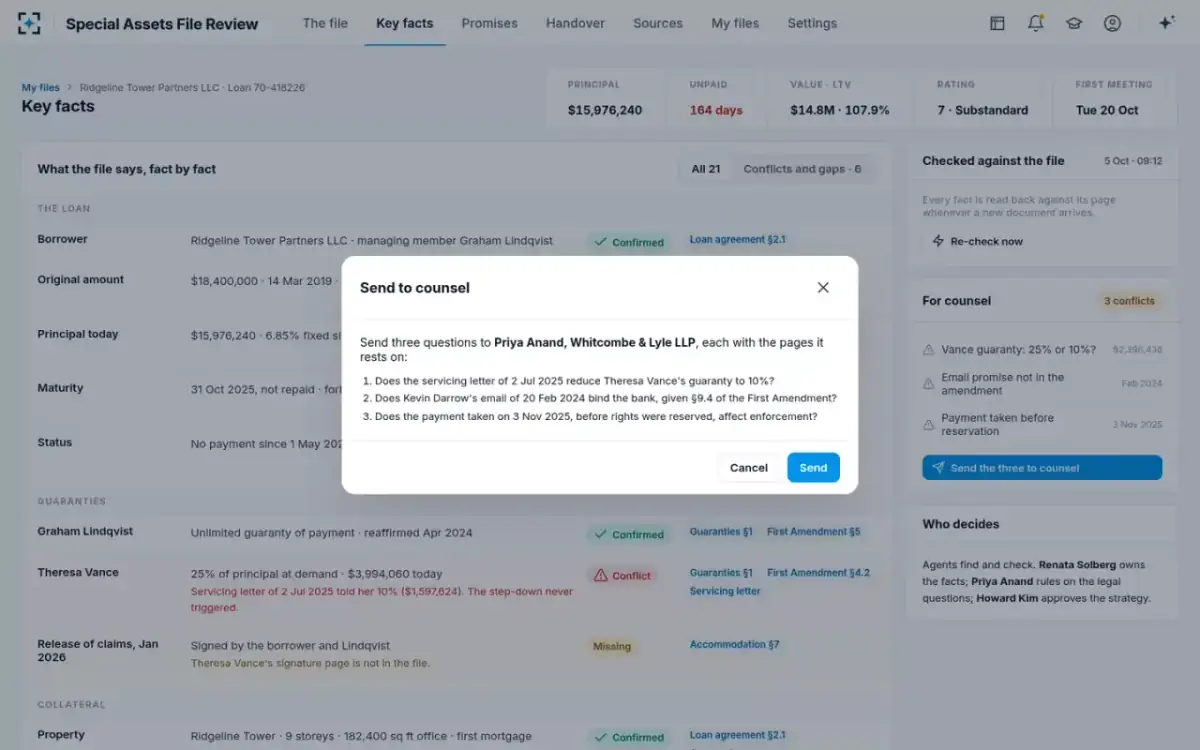
That refusal is a design decision with a reason behind it, and it is the same reason the guidance keeps the rating away from the approving lender: a judgement is only worth something if the person making it is accountable for it. The five questions in a troubled loan file that no document reader may answer works through the whole list, and what a buyer should insist on in writing.
Who signs the handover, and in what order they sign it
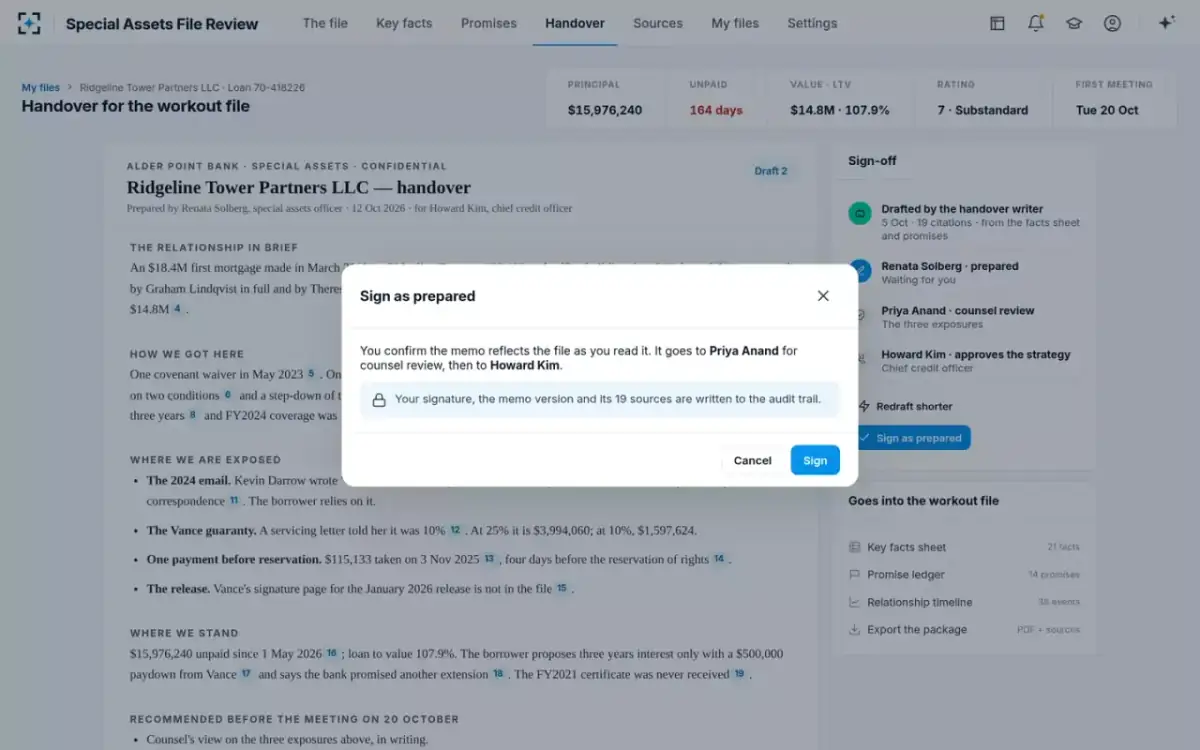
Three signatures, in a fixed order, each meaning something different. The officer signs that the memo reflects the file as they read it — a statement about evidence. Counsel reviews the exposures — a statement about law. The chief credit officer approves the strategy and the classification — a statement about risk. Collapsing any two of those into one signature is how a desk ends up with a memo nobody will stand behind.
One handover memo in Special Assets File Review, and what each signature certifies
Agent
The handover writerDrafts the memo in five parts from the facts sheet and the promise list: the relationship in brief, how we got here, where we are exposed, where we stand, and what to do before the meeting. Nineteen citations, each opening its page.
Never: Never sends anything to the borrower, never sets the workout strategy, and never proposes a settlement figure.
A person decides
Special assets officer signs as preparedConfirms the memo reflects the file as they read it. The signature, the memo version and its sources go to the audit trail.
Never: Never signs for the legal view or for the strategy.
A person decides
Workout counsel reviewsRules on the exposures: the guaranty amount in dispute, the unsigned promise, the payment taken before rights were reserved.
Never: Never sets the classification.
A person decides
Chief credit officer approvesApproves the strategy and the classification. In the sample bank this reviewer is required above $5 million, and who signs is a setting.
Never: Never approves a strategy without the memo and counsel’s view in writing.
Sign as prepared, then counsel, then the chief credit officer
What the board hears, and how often
Quarterly, in most banks, and the guidance says so plainly: good communication usually means taking the review results to the board, or the right board committee, every quarter. What goes up is not a loan list. The guidance describes full reporting as trends over time in the quality of the whole portfolio, whether internal policies are adequate and followed, the quality of underwriting and of risk identification, compliance with laws and regulations, and how management has answered substantive criticism.
Two further obligations sit around the quarterly reporting. The board or a board committee reviews and typically approves the credit risk review policy, and its scope, at least once a year. And anything unresolved does not wait for the quarter: deficiencies and weaknesses "that remain unresolved beyond the scheduled time frames for correction" go promptly to senior management and the board or the committee.
Escalation on one desk: who hears it first, who decides, who is told
| What has come up | Who hears it first | Who decides | Who is told, and when |
|---|---|---|---|
| A rating dispute between the lender and the reviewer | Credit risk review | The pre-arranged process; absent new information the lower rating stands | The chief credit officer; the board committee in the quarterly reporting |
| A legal question — waiver, an unsigned promise, a release | The special assets officer | Workout counsel | The chief credit officer, in the memo, before the strategy is approved |
| A document that should be in the file and is not | The workout analyst | The officer, on whether to request or to proceed without it | Counsel, where the gap bears on enforceability |
| Two documents that disagree | The officer, with both pages | Counsel if the conflict is legal; the officer if it is factual | The chief credit officer, as an exposure in the memo |
| A change of strategy — from accommodation to enforcement | The chief credit officer | The chief credit officer, on the officer’s recommendation with counsel’s view | The board committee, with the quarterly problem loan reporting |
| A correction that misses its time frame | Senior management | Senior management, promptly | The board or board committee, promptly — not at the next quarter |
A small bank with no dedicated desk
A $600 million bank with four classified loans cannot staff four seats, and the guidance does not ask it to. It says the opposite: a smaller or simpler bank may staff its review with qualified people — loan officers, other officers or directors — so long as they are independent of the loans in front of them, because cost and volume may not justify a separate department.
The route it offers is specific. A smaller bank may use an independent committee of outside directors, or qualified staff who had no part in making or approving the particular loans under review and whose pay does not depend on the grades. Some or all of the function may also be performed by a qualified third party. What does not scale down is the duty: the board still owns the system, whoever performs it.
So the small-bank design is usually three seats rather than four, with the lending officer who did not make the loan acting as reviewer, an outside firm as counsel, and the chief credit officer or a board committee approving. The file problem, though, does not scale down at all. An $18 million loan with seven years of history has the same 2,316 pages whether the bank has $600 million of assets or $600 billion, and the smaller bank has fewer hours to read them. What reading a troubled loan file actually costs sets that arithmetic out.
What examiners look at when they look at the desk
Not the organisation chart. The 2023 policy statement lists what examiners evaluate in a workout program, and the list reads as a specification for a desk: a prudent workout policy that lets the bank adjust the plan "if sustained repayment performance is not demonstrated or if collateral values do not stabilize"; management infrastructure to track the volume and complexity of workout activity; "documentation standards to verify a borrower's creditworthiness, including financial condition, repayment ability, and collateral values"; information systems and internal controls that track loan performance and risk; collection procedures; collateral administration "to ensure proper lien perfection"; and an ongoing credit risk review function (88 FR 43115).
Read that list against a desk that keeps its chronologies in individual spreadsheets and its promises in people's memories, and the gaps are obvious. Most of the items are not about judgement at all; they are about whether the bank can show its work. That is a reasonable test to apply to your own desk before an examiner does: pick a classified file at random and ask how long it takes to produce every promise the bank has made on it, with the page each one rests on.
Questions people ask
How is a special assets team staffed?
By decision rather than by headcount. Four decisions have to belong somewhere: what the file says, what the rating is, what the bank's rights are, and what the strategy will be. Larger banks give each its own seat — officer, analyst, counsel, chief credit officer — and add a credit risk review function independent of lending. Smaller banks combine seats, with the constraint that the rating assessment stays away from whoever approved the credit.
Who decides to downgrade a commercial loan?
The proposal usually comes from the relationship manager, because the agencies deliberately keep first identification with the people who see the borrower. The assessment comes from someone independent of the credit approval process, and the classification is approved by the chief credit officer or a credit committee. The transfer to special assets follows the classification; it is not itself a decision about the credit.
What happens if the loan officer disagrees with the risk rating?
A pre-arranged process decides, which may be a formal appeal or arbitration by an independent party. The common default is the lower rating: where the reviewer sees worse credit quality than the lending side, that rating prevails unless the lending side produces additional information sufficient to win the reviewer's concurrence. Until then the loan carries the lower grade.
Does workout counsel have to be outside counsel?
No. Nothing in the supervisory guidance requires outside counsel, and many banks use in-house lawyers for most of a workout. Banks commonly instruct an outside firm where enforcement, bankruptcy or litigation is in view, or where the questions are about conduct the bank's own staff took part in. What matters more than the firm's address is that the legal questions are asked in writing, early, with the documents attached.
How often does the board hear about problem loans?
Typically quarterly for the review results, with the credit risk review policy and scope approved at least annually by the board or a board committee. Anything that misses its correction deadline does not wait for the quarter: unresolved deficiencies are to be reported promptly to senior management and the board or board committee.
Can a small bank run a special assets desk?
Yes, and the guidance is written to let it. Smaller institutions may use an independent committee of outside directors, or staff — including loan officers or directors — who were not involved in originating or approving the specific credits and whose pay is not influenced by the ratings assigned. The function may also be outsourced to a qualified third party. The board's responsibility for the system stays with the board either way.