A loan acceleration clause lets a lender declare the whole unpaid balance of a loan immediately due once an event of default named in the documents has occurred, usually after any notice and cure period has run. For a bank calling a commercial loan, the clause is the starting point rather than the answer: the desk has to show that the event happened, that the notices were given, that the bank has not waived the default by its own conduct and, where the clause is an "at will" or "deems itself insecure" power, that it acted in good faith under the Uniform Commercial Code. That proof sits in thousands of pages of agreements, amendments, certificates and email, which is why the special assets desk reads the file before it decides anything. Botminds' Special Assets File Review rebuilds the loan's history from that file, with every sentence tied to the page it rests on, so the officer and workout counsel decide on the documents rather than on memory.
The guide is written for special assets officers, the credit leadership that approves a demand, and the people who brief outside counsel. The worked example is a fictional sample file (Ridgeline Tower Partners LLC, an $18.4 million office loan made in 2019 with $15,976,240 unpaid), and nothing here is legal advice; acceleration is governed by the documents and the law of the governing state.
The right to call is written; the case for calling is proved
1-309
the UCC section that limits an “at will” or insecurity clause to a good-faith belief that payment is impaired
4.06%
past due and nonaccrual on non-owner-occupied CRE at banks over $250 billion, Q4 2025; the pre-pandemic average was 0.58%
1,550
documents, emails and call notes the desk reads on the sample file before its first meeting with the borrower
What does a loan acceleration clause let a bank do?
It lets the bank turn a payment schedule into a single sum due now (remaining principal, accrued interest, and whatever fees, costs and prepayment amounts the documents provide for) once a listed event of default has occurred. It does not by itself foreclose, appoint a receiver, sue a guarantor or fix a deficiency; each of those is a later step with its own procedure under state law.
Three different powers are routinely confused, and the desk should know which one it holds before anyone drafts a letter. A demand note is payable whenever the holder asks; nothing has to go wrong first. An acceleration clause depends on an event of default, and usually on notice and the expiry of a cure period. An insecurity clause ("if the lender at any time deems itself insecure") sits between them and is the one the code restricts. A loan that has simply reached maturity is none of these: it is due on its own terms, and the question becomes extension rather than acceleration.
The choice of power changes the evidence the bank needs. A demand note needs proof of the demand. An event of default needs proof of the event, the notice and the lapse of cure. An insecurity clause needs proof of the bank's reasons for believing payment was impaired, as they stood on the day it acted.
Events of default the desk must prove, not just cite
Commercial credit agreements list many more events of default than a missed payment, and the desk's first task is to identify which event it relies on, the section it sits in, the date it occurred, and what the document required before the bank could act on it. The common shape of these lists in commercial real estate lending is below; the wording, cure periods and materiality thresholds are negotiated deal by deal.
Common events of default, and what the file must show for each
| Event of default | What triggers it | What the file must show before acceleration |
|---|---|---|
| Payment default | Principal, interest, escrow or a fee unpaid when due. | The due date, the non-payment, and any grace period run. |
| Financial covenant breach | A coverage, leverage or net-worth test failed on the agreement’s own definitions. | The certificate or the bank’s own calculation, the test date, and any equity-cure right exhausted. |
| Reporting default | Financial statements, a compliance certificate or a rent roll not delivered. | The deadline, the request, the notice and the cure period, which is often days. |
| Material adverse change | A material adverse effect on the borrower, property or ability to perform. | The change, why it is material, and contemporaneous evidence; usually relied on alongside a concrete default. |
| Cross-default | A default under another loan, a swap, a ground lease or an affiliate’s obligation. | The other default, and that it has continued past its own cure period where the clause requires it. |
| Misrepresentation | A certificate, rent roll or borrowing base that was wrong when given. | The statement, the document, and evidence it was untrue at the time. |
| Collateral events | Insurance lapsed, taxes unpaid, an unpermitted transfer or lien, a lost key lease. | The event and any notice; the quiet defaults nobody noticed for months. |
| Insolvency events | A bankruptcy filing, a receiver, an assignment for creditors. | Usually automatic acceleration, and the bankruptcy stay that then limits enforcement. |
Two consequences follow. A borrower who is current on payments can be in default, and the late certificate or lapsed policy is often the strongest ground the bank has because it is documentary. And defaults that the bank held without acting on, sometimes for quarters, raise the question the next two sections answer: what the bank's own conduct has done to its rights.
Can a bank accelerate on an insecurity clause? Good faith under UCC 1-309
Yes, but only on a good-faith belief that payment is impaired. Article 1 of the Uniform Commercial Code, enacted in each state's own commercial code, cuts a bare "at will" or insecurity power down to that standard.
“A term providing that one party … may accelerate payment or performance or require collateral or additional collateral “at will” or when the party “deems itself insecure,” or words of similar import, means that the party has power to do so only if that party in good faith believes that the prospect of payment or performance is impaired.”
Uniform Commercial Code §1-309
Good faith is defined in the same article as "honesty in fact and the observance of reasonable commercial standards of fair dealing" (§1-201(b)(20)), and every duty under the code carries it: "Every contract or duty within the Uniform Commercial Code imposes an obligation of good faith in its performance and enforcement" (§1-304). The standard is partly objective, so a bank is judged by what it knew and did, not only by what it says it believed.
The next sentence of §1-309 matters most to the desk: "The burden of establishing lack of good faith is on the party against which the power has been exercised." That is the borrower. The allocation favours the bank only if the bank's file can answer the borrower's evidence: a dated valuation, a covenant calculation, a downgrade memo, the information requested and not received. A bank whose reasons were assembled after the letter went out is relying on a burden it may not be able to hold. How far §1-309 reaches a real-estate loan, and what else state law adds, is a question for counsel in the governing state.
Has the bank waived the default? Course of performance and the non-waiver clause
Possibly, and the file is where the answer lies. A bank that accepted late payments for a year, discussed an extension after a covenant breach, or said nothing for four quarters has created a course of performance, and the code treats conduct as part of the bargain: a course of performance "is relevant in ascertaining the meaning of the parties' agreement, may give particular meaning to specific terms of the agreement, and may supplement or qualify the terms of the agreement" (§1-303(d)).
Credit agreements answer with a non-waiver clause (no delay or failure to exercise a right waives it), and the code itself says that where the two cannot be read together, express terms prevail over course of performance. How a court in the governing state weighs a written non-waiver clause against years of tolerated defaults depends on the documents and the facts, which is precisely why the desk needs every payment taken, every letter sent and every call noted, in date order, before it relies on a default the relationship team lived with.
The practical tool is the reservation of rights letter: sent when a default is first known, it tells the borrower that accepting payments or talking about a workout is not a waiver. Its date relative to the payments taken around it matters more than its wording, as the reservation of rights letter, and the payment taken before it works through.
The workout sequence before a demand
Most desks follow the same order: a trigger inside the bank, a downgrade and transfer, a full reading of the file, a reservation of rights, an information request, and only then a choice between accommodation, restructuring, forbearance and demand. Skipping steps saves days and costs evidence.
From a weak annual review to a decision on demand, in the order a desk can defend
A person decides
Trigger and downgradeA failed covenant test, a missed payment or a low valuation; the loan is re-rated and transferred to special assets, and the borrower is often not yet told.
Never: Treats the downgrade as a decision to enforce.
Agent
File rebuiltCollects agreements, amendments, guaranties, certificates, memos, letters, email and call notes; dates every event; lists every promise and every conflict between documents.
Never: States anything without the page it rests on.
A person decides
Special assets officerReads the history, sends a reservation of rights, and asks for current financials on the borrower and every guarantor.
Never: Takes a payment on a known default before rights are reserved.
A person decides
Workout counselAdvises on the events of default, notices, waiver risk and the enforceability of each guaranty.
Never: Works from a summary with no citations.
A person decides
Credit leadershipApproves accommodation, restructuring, forbearance or demand, on the officer’s recommendation and counsel’s advice.
Never: Approves a demand on a file whose conflicts are unresolved.
On the sample file, the agents rebuilt the history the day the loan was assigned: 1,550 sources split into passages, 38 dated events on six lanes, 14 promises by either side, 3 conflicts between documents and the items missing from the file: a compliance certificate, a guarantor's signature page and the notes of two calls. The officer's first week goes on those exceptions rather than on finding the documents. Who sits at each of these seats is described in inside a special assets department.
Why calling the loan is usually the bank's last choice
Because acceleration converts a weak loan into a demand the borrower cannot meet, and leaves the bank with an enforcement project, legal cost and an uncertain recovery while the asset sits classified on its books. The federal agencies record the alternative in writing: "The agencies have found that prudent CRE loan accommodations and workouts are often in the best interest of the financial institution and the borrower" (Policy Statement on Prudent CRE Loan Accommodations and Workouts, 2023).
The same statement removes the supervisory reason a bank might give for refusing a workout. Institutions that implement prudent accommodations after a comprehensive review of the borrower's financial condition "will not be subject to criticism for engaging in these efforts, even if these arrangements result in modified loans that have weaknesses that result in adverse classification", and modified loans to borrowers able to repay on reasonable terms will not be classified "solely because the value of the underlying collateral has declined" below the balance.
The market a commercial real estate workout desk is calling loans into
None of this means a bank should not call. It means the decision to call is itself something examiners will look at, alongside the classification and the allowance, and that a desk which can show it considered a workout on full information is in a stronger position whichever way it goes. The accounting for a modification, since troubled debt restructuring accounting was retired, is covered in what a modification is now.
What examiners expect to see behind a workout or a demand
The 2023 policy statement lists what management should have in place for each workout, and the same file serves a demand: current information on everyone who owes, current collateral values, a realistic view of cash flow, and the legal analysis of the documents.
The evidence a desk should hold before choosing between workout and demand
- Updated financials on the borrower, the project and every guarantor and sponsor.
The policy statement’s first element of a well-conceived workout plan; the same information decides whether a demand on a guarantor is worth making.
- A current valuation of the collateral.
As is, and where relevant as stabilised; the classification of a collateral-dependent loan turns on it.
- Global debt service coverage on realistic projections.
Including the cash flow available from guarantors.
- The legal analysis of the documents.
Which events of default are available, notices given and due, cure periods, waiver risk, and each guaranty’s amount and condition.
- A risk rating that matches the analysis.
Substandard means a well-defined weakness that jeopardises liquidation of the debt, not a feeling about the sector.
- Clear communication to the borrower and guarantors.
The statement calls it prudent to give “clear, accurate, and timely information about the arrangement to the borrower and any guarantor”.
The extension the borrower says it was promised
The most common obstacle to a clean acceleration is not a missing default but a remembered promise. The sample file has one, and it is typical: the borrower says the bank promised another twelve months; the signed amendment says something narrower.
One remembered promise, against the clause it was made under
What the borrower recalls: “The bank said there would be another twelve months if we kept the building full.”
What the signed First Amendment says: A promise to consider in good faith a further extension of up to 12 months (not to grant one) if two conditions were met.
What the borrower recalls: One condition, about the tenant.
What the signed First Amendment says: The anchor tenant renews for at least five years by 30 June 2025, and coverage for the 2024 financial year reaches 1.20x.
What the borrower recalls: “The tenant renewed.”
What the signed First Amendment says: The tenant renewed for three years on 18 March 2025, and 2024 coverage was 1.04x. Neither condition was met.
What the borrower recalls: An email from the relationship manager in February 2024 that went further than the amendment.
What the signed First Amendment says: Section 9.4 supersedes “all prior negotiations, correspondence and understandings”. Whether it disposes of the email is for counsel on both sides.
The promise to consider "in good faith" is itself a duty the bank must be able to show it performed: what it considered, when, and why it said no. That is the reason the desk wants the relationship manager's email found and read before the meeting rather than produced by the borrower's counsel after the demand. On the sample file, the conflict between the email and the amendment is one of three sent to workout counsel as questions, each with the pages it rests on.
Special Assets File Review opens the page the promise is actually on
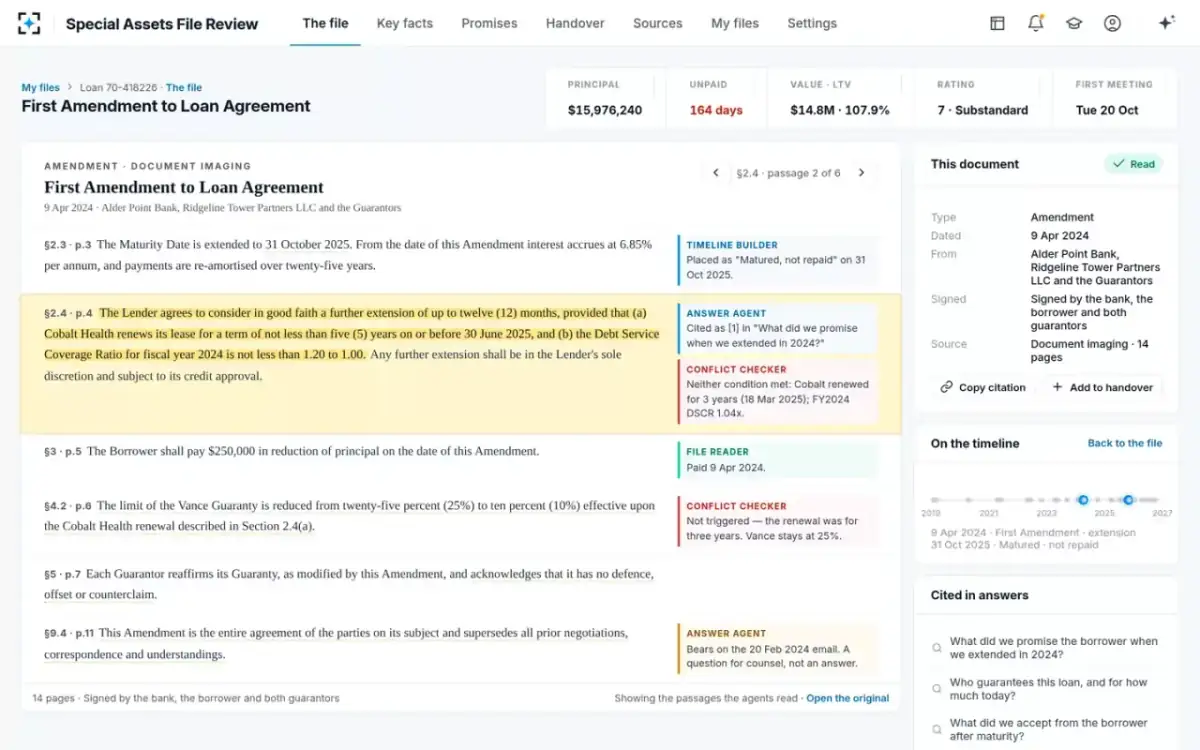
Where Special Assets File Review fits before an acceleration
Special Assets File Review does the reading. When a loan is assigned to the desk, its agents collect the file from the loan system, document imaging, the email archive and call notes, place every event on a dated timeline, list each promise by either side with its condition and what happened, flag conflicts between documents and the items missing from the file, and answer the officer's questions (such as "what did we promise in 2024?") with each sentence checked against its page. On the sample file that question is answered in 8.6 seconds from 64 passages.
What the bank promised, answered from the file with the page attached
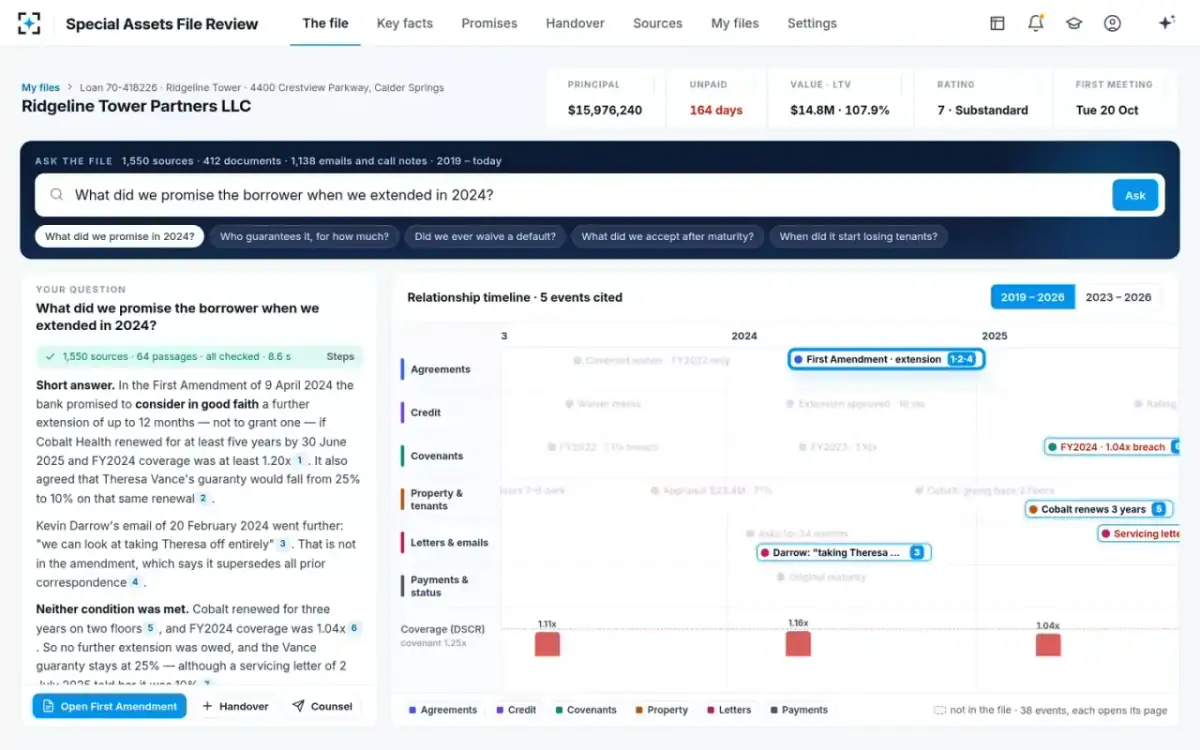
It does not decide whether to call the loan, and it does not give legal advice. The officer reads, asks, decides what goes to counsel and signs the handover; counsel advises on the events of default, notices and waiver; credit leadership approves the strategy. What changes is the quality of the record those people decide on: a history in which every statement can be checked, prepared before the first meeting rather than reconstructed after the borrower's lawyer has written.
Questions people ask
Can a bank accelerate a loan for a covenant breach while payments are current?
If the credit agreement lists the covenant breach as an event of default, yes, subject to any notice, cure or equity-cure rights in the document. Payment status does not cure a separate default. Whether the bank should is another question: the 2023 interagency policy statement records that prudent workouts are often in the interest of both bank and borrower.
What does "deems itself insecure" mean in loan documents?
It is a power to accelerate or demand more collateral when the lender judges the loan unsafe, without a listed event of default. UCC §1-309 limits it to cases where the lender "in good faith believes that the prospect of payment or performance is impaired". The burden of proving lack of good faith is on the borrower, which rewards a bank with contemporaneous evidence.
Does accepting late payments waive the bank's right to accelerate?
It can, depending on the documents and state law. Under UCC §1-303 a course of performance can qualify the terms of an agreement, though express terms prevail where the two cannot be reconciled. Most credit agreements include a non-waiver clause, and a reservation of rights letter sent before payments are taken is the usual protection.
Is a reservation of rights letter the same as acceleration?
No. A reservation of rights tells the borrower that the bank knows of a default and that taking payments or discussing a workout does not waive its remedies. It preserves the right to accelerate rather than exercising it; acceleration requires a separate notice or demand under the documents.
Do examiners criticise banks for working out a CRE loan instead of calling it?
Not if the workout is prudent and based on a comprehensive review. The 2023 policy statement says such arrangements "will not be subject to criticism", even if the modified loan is adversely classified, and that loans to borrowers able to repay on reasonable terms will not be classified solely because collateral value fell below the balance.
What is lender liability when a bank calls a loan?
It is the risk that the borrower or a guarantor claims the bank acted in bad faith, broke a promise or waived the default it relied on. The defences are documentary: the event of default and its date, the notices, the reservation of rights, the bank's reasons on the day it acted, and how it handled any promise to consider an extension.