Troubled debt restructuring was the accounting label for a modification in which a lender granted a concession to a borrower in financial difficulty, and for institutions that have adopted the current credit-loss standard it no longer applies to new modifications. Much of what is still written under the term describes a regime those institutions have left. The supervisory tests that actually govern a workout did not move: a modified loan is still classified on its weaknesses, still placed on nonaccrual on the same test, still generally needs six months of sustained performance before an upgrade to pass, and still has to rest on updated information, current valuations and appropriate legal agreements. Which makes the real question a modification raises a file question rather than a disclosure one, and that is the question Special Assets File Review was built for: it reads the whole transferred file the day it arrives and draws what was modified, on what conditions, and what happened to each of them.
The worked example is the sample file the solution ships with: loan 70-418226 to Ridgeline Tower Partners LLC, an $18.4 million first mortgage of March 2019 on a 182,400 square foot office building, modified once in April 2024 and now $15,976,240 unpaid for 164 days at a rating of 7 Substandard. Every person, bank, firm, borrower and property in it is fictional. Nothing here is accounting advice; the reporting treatment of any particular modification belongs with the regulatory reporting instructions and your own accounting policy.
What is a troubled debt restructuring?
A troubled debt restructuring was a modification in which the lender, for reasons related to the borrower's financial difficulties, granted a concession it would not otherwise have granted — a lower rate, a longer term, deferred or forgiven amounts — and accounted for that fact separately. It was an accounting construct that lived in US generally accepted accounting principles, which is why it is an accounting standard that removed it and why supervisory expectations were almost untouched by its removal.
Keep it apart from the thing itself. The interagency policy statement on commercial real estate workouts defines the underlying act in a footnote, with no accounting in it at all: a restructuring is a change to the loan's terms that is formal and legally enforceable. Everything a workout desk does with a restructuring — propose it, document it, classify it, decide whether the loan accrues, decide when it may be upgraded — attaches to that act, not to the label that used to sit on top of it.
Was TDR eliminated, and for whom?
For institutions that have adopted the current credit-loss standard, yes, as regards new modifications. The agencies state it directly in the 2023 policy statement, describing the accounting change as one that "eliminates the need for a financial institution to identify and account for a new loan modification as a TDR" (88 FR 43115, 6 July 2023). The same document removed the troubled debt restructuring discussion from its own worked examples for that reason.
For everyone else, no, and the agencies say so in the next breath: "Financial institutions that have not adopted ASC Topic 326, 'Financial Instruments—Credit Losses,' or ASU 2022-02 should continue to identify, measure, and report TDRs in accordance with regulatory reporting instructions." So the answer to "was TDR eliminated" is a question about your own institution's adoption, not about the calendar. And on reporting generally the agencies point away from themselves: "For the regulatory reporting of loan modifications, financial institution management should refer to the appropriate regulatory reporting instructions for supervisory guidance."
What replaced troubled debt restructuring, in the agencies' own words
Nothing replaced it in the sense of a new label a workout officer has to apply. What took its place in practice is a vocabulary the agencies were already using, in which modifications sit inside two named activities of different size, and a supervisory framework that was never about the label.
The policy statement defines the smaller one in a footnote: "an accommodation includes any agreement to defer one or more payments, make a partial payment, forbear any delinquent amounts, modify a loan or contract, or provide other assistance or relief to a borrower who is experiencing a financial challenge." The larger one it also describes: a workout may be a renewal or an extension of the loan's terms, new credit, or a restructuring, with or without concessions to the borrower. A restructuring is one shape a workout can take. An accommodation is usually short term and may not be a restructuring at all.
What changed when the label went, and what did not
Before, for an institution on the old standard: Required: each new modification tested against the accounting definition of a troubled debt restructuring.
After, for an institution on the current standard: Changed. The agencies accept that the update eliminates the need to identify and account for a new modification as a TDR.
Before, for an institution on the old standard: Measured under the superseded impairment model once identified.
After, for an institution on the current standard: Changed. Measured under the current credit-loss standard; the agencies point to the call report instructions for identifying and disclosing modifications.
Before, for an institution on the old standard: Special mention if potential weaknesses remain; adverse classification if well-defined weaknesses jeopardise orderly repayment.
After, for an institution on the current standard: Unchanged. The same two tests, in the same words.
Before, for an institution on the old standard: A loan whose full collection of interest and principal is highly questionable will almost always be classified.
After, for an institution on the current standard: Unchanged. The modification does not decide the accrual question; the prospects for collection do.
Before, for an institution on the old standard: A period of sustained performance, generally six months, under the restructured terms.
After, for an institution on the current standard: Unchanged. The OCC booklet still says generally six months under the restructured terms before a pass rating.
Before, for an institution on the old standard: Sustained repayment for a reasonable period, generally at least six months of cash or cash equivalents.
After, for an institution on the current standard: Unchanged, in the 2023 policy statement’s own words.
Before, for an institution on the old standard: Updated information, current valuations, appropriate structure and covenants, appropriate legal agreements.
After, for an institution on the current standard: Unchanged. The same four elements, in the same policy statement.
Does a modification have to be classified? What did not change
A modification neither earns a classification nor avoids one; weaknesses do. The Comptroller's Handbook puts both tests in two sentences: special mention fits a formally restructured credit when potential weaknesses survive the restructuring, and adverse classification fits when well-defined weaknesses put orderly repayment at risk "under its modified terms" (OCC, Rating Credit Risk).
Read the second test carefully, because the phrase that matters is "under its modified terms". The question after a restructuring is not whether the borrower could have paid the old terms. It is whether the new ones are now in doubt. A loan modified onto a schedule the borrower can meet, with a sponsor who has put money in, can leave the criticised categories. A loan modified onto a schedule that only works if an assumption holds — a lease renewing, occupancy recovering, a sale closing — carries exactly the weakness the modification was meant to cure.
Accrual follows the same logic, not the paperwork: "A loan that is on nonaccrual or about to be placed on nonaccrual has severe problems such that the full collection of interest and principal is highly questionable. Nonaccrual loans will almost always be classified."
How long before a restructured loan can be upgraded
Generally six months of sustained performance under the new terms, and two different six-month clocks are worth keeping apart. The first is the rating clock, in the OCC's handbook: "Restructured loans require a period of sustained performance, generally six months, under the restructured terms before being upgraded to a pass rating." The second is the accrual clock, in the 2023 policy statement, and it applies to a restructured loan that has been on nonaccrual: it should not go back to accrual until the borrower has shown sustained repayment for a reasonable period, and the statement spells out what that means — "A sustained period of repayment performance generally would be a minimum of six months and would involve payments of cash or cash equivalents. It may also include historical periods prior to the date of the loan restructuring."
Two practical consequences for the accrual clock. Payments in kind, capitalised interest and amounts funded from the bank's own new advance are not the performance being described — it is cash. And the clock can sometimes start earlier than the signature, where the borrower was already performing before the restructuring was documented. The rating clock is less specific about what counts, but rests on the same evidence. Both are facts about a payment history, which means both are answerable only from the file.
The clock on an upgrade, and a file where the clock never started
- Modification signed, terms amended
- Sustained performance under the new terms, generally six months6 mo
- Rating reconsidered on the modified terms
- First Amendment signed, $250,000 curtailment paid the same day
- Payments made, then maturity passed on 31 Oct 2025 with the loan unpaid18 mo
- Forbearance to 30 Apr 2026, then no payment at all since 1 May 202611 mo
Accommodation, workout, restructuring: three different things
The three words are used interchangeably in most credit committees and mean three different things in the policy statement. Keeping them apart is not pedantry: each implies a different amount of work before it is granted, and a different answer when a borrower later says it was promised something.
Three words a workout file has to keep apart
| The word | What the agencies say it is | What it does to classification, and what it costs to grant |
|---|---|---|
| Accommodation | Any agreement to defer one or more payments, make a partial payment, forbear delinquent amounts, modify a loan or contract, or provide other assistance or relief to a borrower experiencing a financial challenge. Usually short term. | Nothing by itself. It buys time while the real question is worked out, and it should be dated and documented like anything else, because it is evidence of what the bank accepted. |
| Workout arrangement | The longer-term or more complex arrangement a bank proceeds to when short-term measures are not sufficient or have not succeeded. It can be a renewal, an extension, additional credit, or a restructuring with or without concessions. | Nothing by itself, but it is the stage at which the four elements of a well-conceived plan are expected: updated information, current valuations, appropriate structure and covenants, appropriate legal agreements. |
| Restructuring | A formal, legally enforceable modification in the loan’s terms. | Nothing by itself. Special mention if potential weaknesses remain; adverse classification where well-defined weaknesses jeopardise orderly repayment under the modified terms; generally six months of sustained performance before a pass rating. |
What documentation does a modification need?
The policy statement answers this in a list, inside a sentence about what examiners will accept. It is the most useful paragraph in the document for a workout officer, because it is the standard a modification will be judged against whether or not anyone writes the word restructuring on it.
A well-conceived workout plan, in the agencies' own list
- Fresh, complete financials for the borrower, the project, and every guarantor and sponsor
All guarantors, not the one who answers the phone. On a file where a guaranty has been amended, this is also where the guarantor’s capacity and willingness is evidenced.
- An up-to-date value for the collateral behind the loan and the plan
Current, and of the collateral supporting the plan — a valuation that assumes the plan has already worked is not supporting it.
- A sound structure, with covenants and any required paydowns or added collateral
The sample file’s amendment did this part: $250,000 of principal paid on the day it was signed, interest re-set and payments re-amortised over twenty-five years.
- The legal analysis and the signed agreements for every change to the terms
Where most inherited files are thin. The analysis exists somewhere; the agreement that records its conclusion often does not.
- An analysis of the borrower’s global debt service coverage
Built on cash flow projections that are realistic, and on whether the sources of repayment are available, lasting and within reach — the sponsor’s other obligations included.
- A prudent loan workout policy behind it
One that "permits the financial institution to reasonably adjust the loan workout plan if sustained repayment performance is not demonstrated or if collateral values do not stabilize" — the plan has to be able to change.
Do examiners criticise banks for modifying loans?
No, where the work above has been done, and the agencies say it twice. The protection is explicitly not conditional on the modified loan looking healthy afterwards: a bank that does a full review of the borrower's finances before agreeing a prudent accommodation or workout is not to be criticised for it, even when the modified loan ends up adversely classified. The condition attaches to the analysis, not to the outcome.
The sentence that sets the bargain says that, consistent with safety and soundness standards, examiners will not criticise a bank for workout arrangements even where the loans end up adversely classified, as long as management has done what the list above describes. It ends in a colon, and the list is what follows it.
While an appropriately designed restructuring should improve the collectability of the loan in accordance with a reasonable repayment schedule, it does not relieve the financial institution from the responsibility to promptly charge off all identified losses.
Policy Statement on Prudent Commercial Real Estate Loan Accommodations and Workouts, 88 FR 43115
That second sentence is the other half of the bargain, and the one workout desks forget: a restructuring buys time and a better schedule, not a reprieve from recognising a loss already identified. The rest is simple: do the analysis, hold the documents, and an adverse classification is not a criticism of the decision to modify. Fail to hold them and the agencies describe what happens next, in a passage worth reading as a warning about file quality rather than about judgement: where the analysis and documents behind a modification are inadequate, examiners apply their own reasonable judgement to the classification until the bank can produce what supports management's grades. An undocumented modification does not get the benefit of the doubt; it gets the examiner's own view until the bank can show its work.
One limit on all of this. The policy statement is directed to commercial real estate lending, and the agencies declined to extend it, noting only that "[c]ertain principles in this statement are also generally applicable to commercial loans that are secured by either real property or other business assets of a commercial borrower." It is not consumer guidance, and it does not purport to cover unsecured commercial lending.
Is an extension a restructuring? The clause that promised only to consider one
An extension is a modification of the loan's terms, so a formal, legally enforceable extension is a restructuring in the policy statement's sense, whatever anyone calls it internally. A promise to think about an extension is not an extension at all, and the difference between the two is where a workout meeting is won or lost.
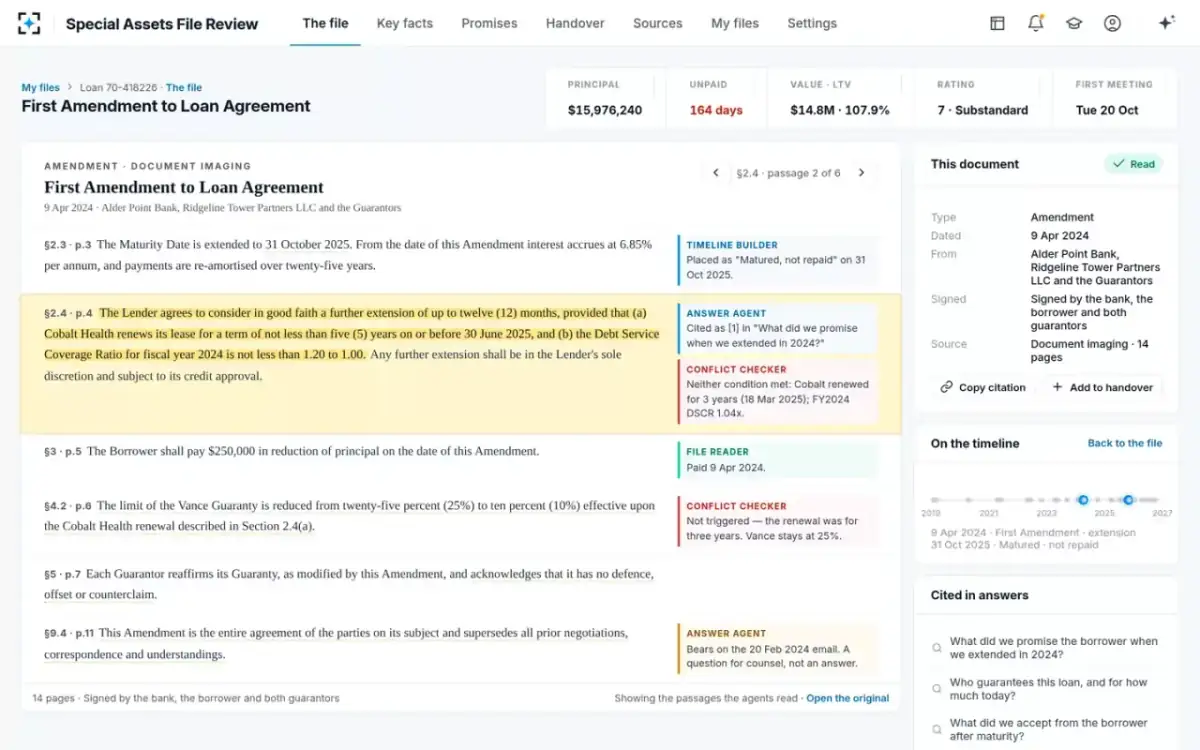
The sample file's First Amendment of 9 April 2024 did four things at once. It extended maturity to 31 October 2025. It re-set interest at 6.85% and re-amortised payments over twenty-five years. It took $250,000 of principal on the day it was signed. And at §2.4 it promised something much smaller than the borrower now remembers.
The clause the borrower is relying on, read line by line
"The Lender agrees to consider in good faith a further extension of up to twelve (12) months, provided that (a) Cobalt Health renews its lease for a term of not less than five (5) years on or before 30 June 2025, and (b) the Debt Service Coverage Ratio for fiscal year 2024 is not less than 1.20 to 1.00. Any further extension shall be in the Lender's sole discretion and subject to its credit approval."
"consider in good faith"
A promise to think, not to grant. The operative verb is the one borrowers and relationship managers both tend to drop when they recount the deal.
Condition (a): a five-year renewal by 30 June 2025
Not met. Cobalt Health renewed for three years, on 18 March 2025 — inside the deadline, and for the wrong term.
Condition (b): FY2024 coverage of at least 1.20x
Not met. FY2024 debt service coverage was 1.04x.
"sole discretion and subject to its credit approval"
Even with both conditions met, the outcome would still have required a credit decision. The clause never produced an entitlement.
Two clauses nearby carry most of the rest of the argument. At §4.2 the same amendment steps the Vance guaranty down from 25% to 10% on the same Cobalt renewal, which is why which guaranty amount stands turns on the identical finding. At §9.4 the amendment says it is the entire agreement of the parties on its subject and supersedes all prior negotiations, correspondence and understandings — which is what an email from the relationship manager seven weeks earlier runs into, and a question for counsel rather than for an agent.
The amendment open at the passage, with what disagrees with it in the margin
What a cited answer changes in the room
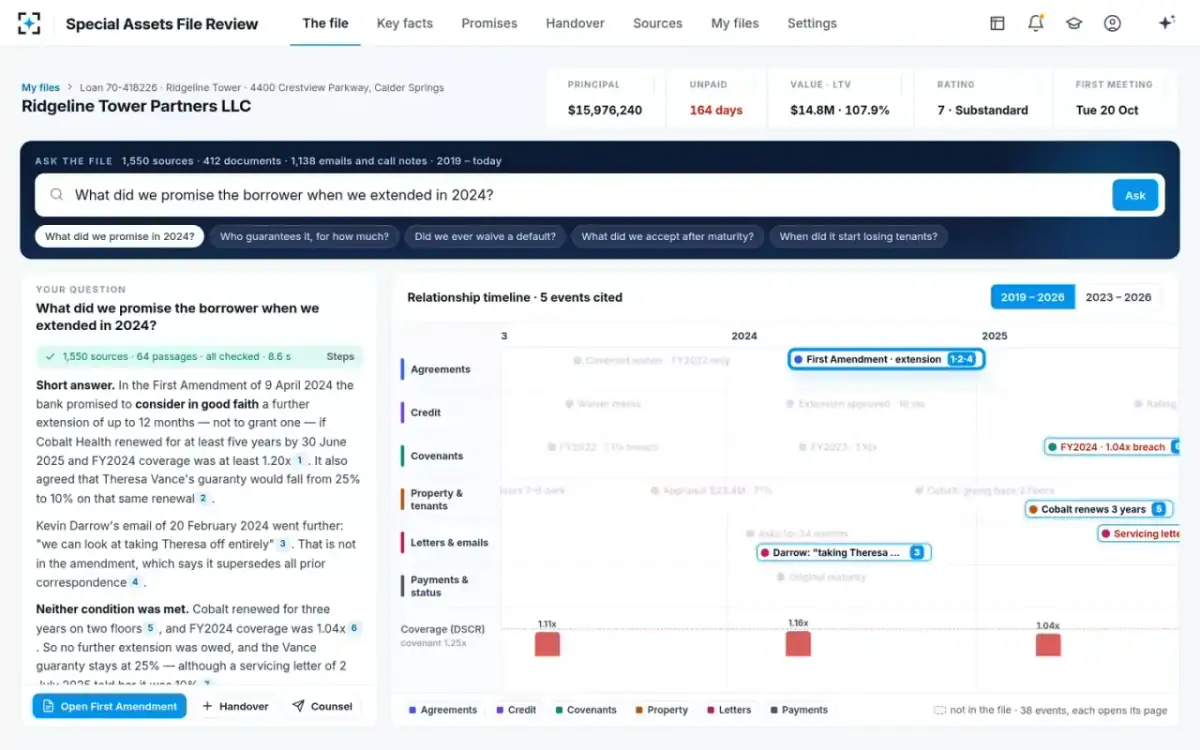
The borrower in the sample file says the bank promised another extension. That is not a dishonest claim; it is what a reasonable person remembers of a meeting and an email two and a half years later. The officer's problem is that disproving it by hand means finding the amendment, the lease, the fiscal-year statements and the email, in four systems, and holding all four in mind at once.
Asked in plain words, the file answers the question in 8.6 seconds over 64 passages, with every sentence of the answer tied to the page it rests on and the cited events lit on the relationship timeline. The answer is also careful in a way that matters here: it says what the amendment promised, says neither condition was met, and does not say whether the earlier email binds the bank. That is a legal question, and it goes to counsel with its pages rather than being answered.
One question, five events cited, every sentence carrying its page
What the modification leaves on the desk
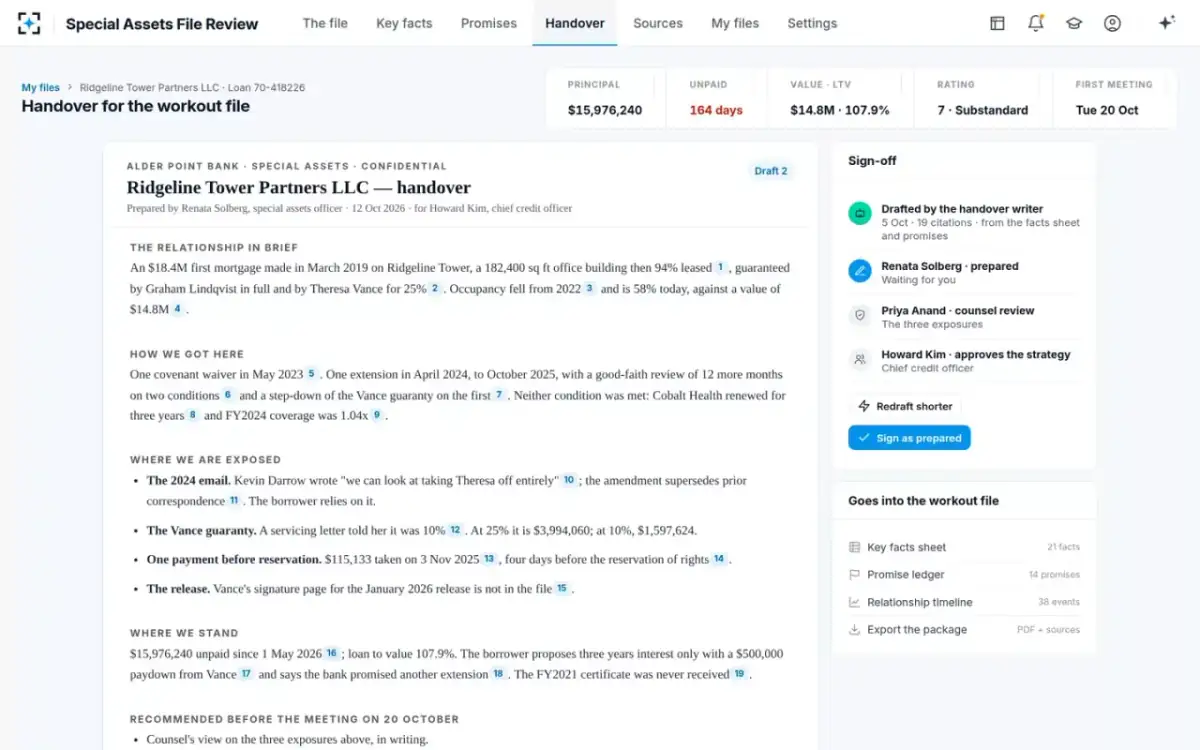
A modification is a promise the bank will be held to, and the file that records it is read twice: once by the people who made it, and once, years later, by a desk that was not in the room. The handover drafted on this file puts the point in one line under "how we got here": one covenant waiver in May 2023, one extension in April 2024 to October 2025, with a good-faith review of twelve more months on two conditions and a step-down of a guaranty on the first, and neither condition met. Four sentences, nineteen citations behind the memo, and a chief credit officer who can approve a strategy without taking anyone's word for the history.
The handover the modification eventually has to survive
What follows a modification that did not work is a different conversation, worked through separately in calling a commercial loan the bank can defend and in the reservation of rights letter, and the payment taken before it. To see the amendment, the conditions and the answer on one file, start from Special Assets File Review.
Questions people ask
What is a loan modification to a borrower experiencing financial difficulty?
It is the phrase that now does the work the troubled debt restructuring label used to do in disclosure: a change in terms granted to a borrower whose financial position is the reason for the change. The supervisory vocabulary for the same act is narrower and older — an accommodation if it is short term relief, a workout arrangement if it is longer or more complex, a restructuring if it is a formal, legally enforceable modification of the loan's terms.
Who still has to identify and report troubled debt restructurings?
Institutions that have not adopted the current credit-loss standard or the 2022 update. The agencies say those institutions "should continue to identify, measure, and report TDRs in accordance with regulatory reporting instructions". If you are unsure which side of that line your institution sits on, it is a question for your controller, not for the credit file.
Does a modification put a loan on nonaccrual?
Not by itself. Nonaccrual turns on whether full collection of interest and principal is highly questionable, and the handbook adds that such loans "will almost always be classified". A restructuring can be the moment the question gets asked honestly, which is a different thing from the restructuring causing the answer.
Is a covenant waiver a restructuring?
Usually not: a waiver gives up the right to act on a breach, without changing the loan's terms. It is still a dated act by the bank that belongs in the file, and a series of them can matter more than any single modification, because it is evidence of what the bank has accepted before. The sample file carries one, from May 2023, a year before the amendment.
Does the policy statement apply to loans that are not commercial real estate?
It is directed to commercial real estate lending. The agencies considered extending it and chose not to, saying instead that certain principles in the statement are also generally applicable to commercial loans secured by either real property or other business assets of a commercial borrower. Treat it as the standard for CRE and as well-argued practice elsewhere, not as a rule for consumer lending.
How does a modification change the risk rating?
Only through the weaknesses that remain after it. Potential weaknesses after a restructuring point to special mention; well-defined weaknesses that jeopardise orderly repayment under the modified terms point to adverse classification. Where neither is present, the loan can be upgraded to pass after a period of sustained performance under the modified terms, which the OCC puts at generally six months.