Fair claims settlement practices regulations set the minimum standards an insurer must meet in handling every claim: how fast it acknowledges, investigates and decides, what it must tell the claimant in writing, and what it may not demand. They do not stop when a claim is referred to the special investigations unit. In California, the regulations at 10 CCR § 2695.1 onward give an insurer 40 days from proof of claim to accept or deny, extended to 80 days, and in some cases suspended, only where specific information supports a belief that the claim is fraudulent, and the investigation must still be "thorough, fair and objective." The difficulty for a carrier is that two teams now touch one claim: the SIU, which may suspect fraud, and the adjuster, who still owes a decision on time. Botminds' SIU Case Management is case management software for special investigations units; it keeps the fraud case on its own board, on its own state clock, while the claim decision stays with the adjuster.
The rules quoted on this page are California's unless another state is named, and they are linked where they appear. The case examples come from the solution's sample SIU at a fictional carrier, Halden Mutual.
The California claim clock when fraud is suspected
15days
to acknowledge a claim, begin the investigation and answer a claimant’s communication
40days
from proof of claim to accept or deny, in the ordinary case
80days
where specific information supports a belief the claim is fraudulent
30days
between written notices while a decision is still pending
Do fair claims settlement practices regulations apply while the SIU investigates?
Yes. California's regulations exist to "delineate certain minimum standards for the settlement of claims" which, if violated "knowingly on a single occasion or performed with such frequency as to indicate a general business practice," are unfair claims settlement practices under Insurance Code § 790.03(h) (10 CCR § 2695.1). Nothing in them exempts a claim the SIU is looking at. What they do is adjust a few rules for suspected fraud: a longer decision period, permission to withhold information that would reveal the investigation, and in narrow cases a suspension of the clock.
A referral is not a finding. California requires the SIU to investigate every credible referral from claims staff, including automated ones, and a credible referral is simply one with a red flag (10 CCR § 2698.36(c)). Many will be closed as not fraud. For all of them, the claimant is owed the same standards of communication and timeliness as any other, adjusted only as far as the regulations allow.
The 40-day rule, the 80-day rule and the suspended clock
The ordinary rule is 40 days. "Upon receiving proof of claim, every insurer ... shall immediately, but in no event more than forty (40) calendar days later, accept or deny the claim, in whole or in part" (10 CCR § 2695.7(b)). Once the claim is accepted, payment follows within 30 days.
The fraud rule is conditional. Where there is "a reasonable basis, supported by specific information available for review by the California Department of Insurance, for the belief that the claimant has submitted ... a suspected false or fraudulent claim," the 40 days become 80. They may be "suspended until otherwise ordered by the Commissioner" only if the insurer has reported the claim to the state under Insurance Code § 1872.4 and "can demonstrate to the Commissioner that it has made a diligent attempt to determine whether the subject claim is false or fraudulent within the eighty day period" (§ 2695.7(k)).
Three claim clocks under California's regulations
- Acknowledge and begin, ≤ 15 days15
- Investigate and decide25
- Acknowledge and begin15
- Investigate and decide, with notices every 30 days65
- Acknowledge and begin15
- Diligent investigation within 80 days65
- Suspended until the Commissioner orders otherwise…
Each condition leaves something to prove. "Specific information available for review" means the reason for the 80 days has to be in the file, not in an investigator's head. The suspension needs both a state report and evidence of diligence. A claims compliance team auditing a suspected-fraud claim will look for exactly those two things, dated.
What the 30-day notice must say, and what it may leave out
If the insurer needs longer than the regulation allows to decide, it must say so in writing, within the period, and keep saying so. The notice "shall specify any additional information the insurer requires in order to make a determination and state any continuing reasons for the insurer's inability to make a determination," and is repeated "every thirty (30) calendar days until a determination is made or notice of legal action is served" (§ 2695.7(c)(1)).
The regulation also protects the investigation. Nothing in the notice or the denial rules requires an insurer "to disclose any information that could reasonably be expected to alert a claimant to the fact that the claim is being investigated as a possible suspected fraudulent claim" (§ 2695.7(c)(2)). The line between those two duties is where most notice errors happen: a letter that names the SIU says too much, and one that gives no reason at all says too little.
The notice must: Go out within the decision period, then every 30 days
The notice need not: Wait for the SIU to finish before the first notice
The notice must: Name the additional information required to decide
The notice need not: Say that the claim is being investigated as possibly fraudulent
The notice must: State the continuing reasons the insurer cannot yet decide
The notice need not: Disclose what the SIU suspects or who referred the claim
The notice must: Where a decision waits on an event, say so and estimate when
The notice need not: Promise a date the investigation cannot support
"Thorough, fair and objective": the limits on what the investigation may ask
The SIU's investigation is bound by the same standard as the adjuster's. "Every insurer shall conduct and diligently pursue a thorough, fair and objective investigation and shall not persist in seeking information not reasonably required for or material to the resolution of a claim dispute" (§ 2695.7(d)). An SIU that keeps adding records requests unrelated to the loss is building a claims-practice problem, whatever it suspects.
Specific tools carry their own limits. California bars an insurer from requesting or requiring a polygraph "unless authorized under the applicable insurance contract and state law," and allows a medical examination only on "a good faith belief that such an examination is reasonably necessary." Examinations under oath are governed by the policy and by state law, and states write different protections into them.
Examination under oath rules in three states, as they bind the insurer
| State | What the insurer may require | What protects the examinee |
|---|---|---|
| California | An EUO where the property policy provides for one | Insurance Code § 2071.1: the insured may be represented by counsel and may record the examination in its entirety |
| Florida (no-fault) | Submitting to an EUO is part of complying with the policy and "a condition precedent to receiving benefits" | Questions limited to relevant information; requesting EUOs without a reasonable basis as a general business practice is an unfair practice |
| New York (no-fault) | An EUO, when needed, on objective standards | Reimbursement of lost earnings and reasonable travel costs |
The examination-under-oath record then becomes evidence in the fraud case and in any later claims dispute, which is why claims counsel usually reviews any quotation from it before a referral leaves the building. Examination under oath vs deposition covers how the two differ in who asks and how the transcript is used.
Who decides the claim when the SIU is involved?
The claims adjuster, on the claim's merits, inside the claim clock; the SIU decides only whether it believes fraud occurred and whether to report it. Keeping those decisions apart is what lets each one meet its own rules. A claim decision that reads like a fraud finding can draw a complaint and a market conduct question; a fraud referral that argues the claim gives the state less to act on.
One claim, two tracks: who decides what while the SIU investigates
A person decides
Adjuster refersSpots red flags and refers the claim to the SIU, and keeps handling the claim and its notices.
Agent
Intake reads the referralOpens the case with what it read in the claim file and a score of the claim’s indicators, never of the person.
Never: Never contacts the claimant
A person decides
Investigator investigatesInterviews, requests records, attends the EUO, and decides the finding.
Agent
Board kept currentStatements, chronology and evidence index kept with sources; the state referral drafted from the board.
Never: Never decides or files
A person decides
Adjuster decides the claimReceives the SIU summary and accepts or denies the claim in writing, inside the regulation’s period.
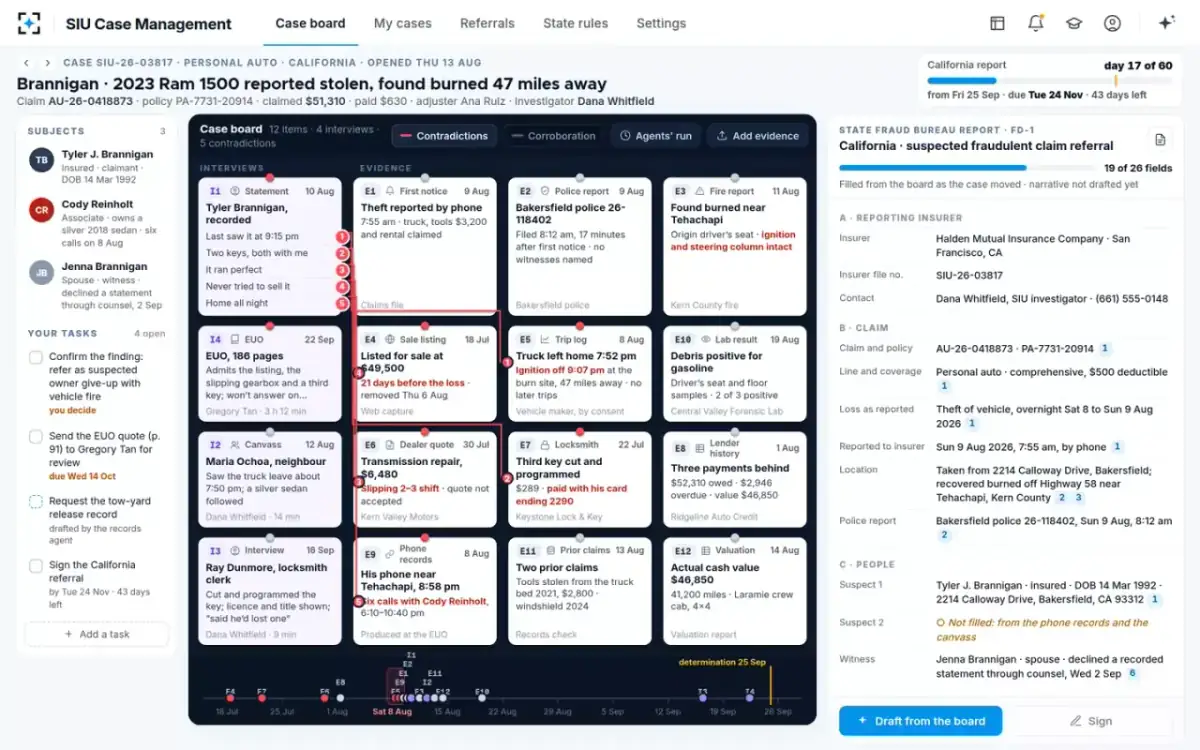
In the sample case, a pickup reported stolen and found burned, the adjuster received the SIU's summary on the day the determination was made. The claim decision and its letter were the adjuster's; the state referral was the SIU's, on California's 60-day clock from the determination. The California SIU annual report counts how such cases end.
Every interview in the file: why the claim file must reconstruct the investigation
California will not let a claim be denied on an undocumented conversation. "No insurer shall deny a claim based upon information obtained in a telephone conversation or personal interview with any source unless the telephone conversation or personal interview is documented in the claim file" (§ 2695.7(l)). Claim files must hold "all documents, notes and work papers ... in such detail that pertinent events and the dates of the events can be reconstructed," kept for the current year and the four before it (10 CCR § 2695.3).
That rule reaches into the SIU's work. A canvass interview, a recorded statement or a call to a locksmith that the SIU relies on, and that the adjuster's denial rests on, has to be documented where the claim file can show it. An SIU that keeps its interviews only in its own notes, out of reach of the claim file, can leave the adjuster with a denial the regulation does not allow.
The whole case on one board, each item with its source
Writing the denial on a claim the SIU suspected
A denial must give its reasons in full, but not the investigation. California requires a first-party denial "in writing" with "a statement listing all bases for such rejection or denial and the factual and legal bases for each reason given," including the policy provision relied on, and a statement that the claimant "may have the matter reviewed by the California Department of Insurance," with the address and telephone number of the unit that reviews claims practices (§ 2695.7(b)(1) and (3)). The same section does not require the insurer to disclose information that would reveal a fraud investigation.
Checks on a claim file before a suspected-fraud claim is denied
- The decision is inside its period
40 days, or 80 with the specific information for suspected fraud in the file, or a documented suspension.
- Every 30-day notice went out
Each naming the information required and the continuing reason, none revealing the investigation.
- Every interview relied on is documented
In the claim file, with its date, as § 2695.7(l) requires.
- Each basis for denial is stated
Factual and legal, with the policy provision, condition or exclusion named.
- The Department review statement is included
With the address and telephone number of the claims-review unit.
- The letter decides the claim, not the fraud
No conclusion of guilt; any state referral stays on the SIU’s own track.
How other states connect the fraud report to the claim clock
Some states tie the two tracks together explicitly. Minnesota's statute provides that an insurer's proper notice of suspected fraud to the Bureau of Criminal Apprehension "tolls any applicable time period in any unfair claims practices statute or related regulations, or any action on the claim against the insurer ... for bad faith, until 30 days after determination by the Bureau of Criminal Apprehension and notice to the insurer that the Bureau of Criminal Apprehension will not recommend action on the claim" (Minn. Stat. § 60A.952, subd. 4).
California reaches a similar result by a narrower route: suspension needs the state report and demonstrated diligence within 80 days. In both, the date the insurer reported to the state becomes part of the claim file's defence, which is a reason to keep the report's date and confirmation with the case rather than in a coordinator's inbox. Insurance fraud reporting requirements by state compares the reporting deadlines in ten states.
Training and the annual certification
California makes claims handlers' knowledge of the regulations an annual, signed obligation. Every insurer must adopt written standards for prompt investigation and processing, and "provide thorough and adequate training regarding the regulations to all their claims agents," certified each year under penalty of perjury, by 1 September, including for independent adjusters it retains (10 CCR § 2695.6).
SIU staff who touch claim communications are part of that population in practice, and the SIU's own training under its anti-fraud plan sits beside it. A useful test for both programmes is whether an investigator knows which of their actions the claim file must show, and which facts must never appear in a letter to the claimant. The anti-fraud plan and SIU staffing covers the SIU's training obligations.
Where SIU Case Management fits
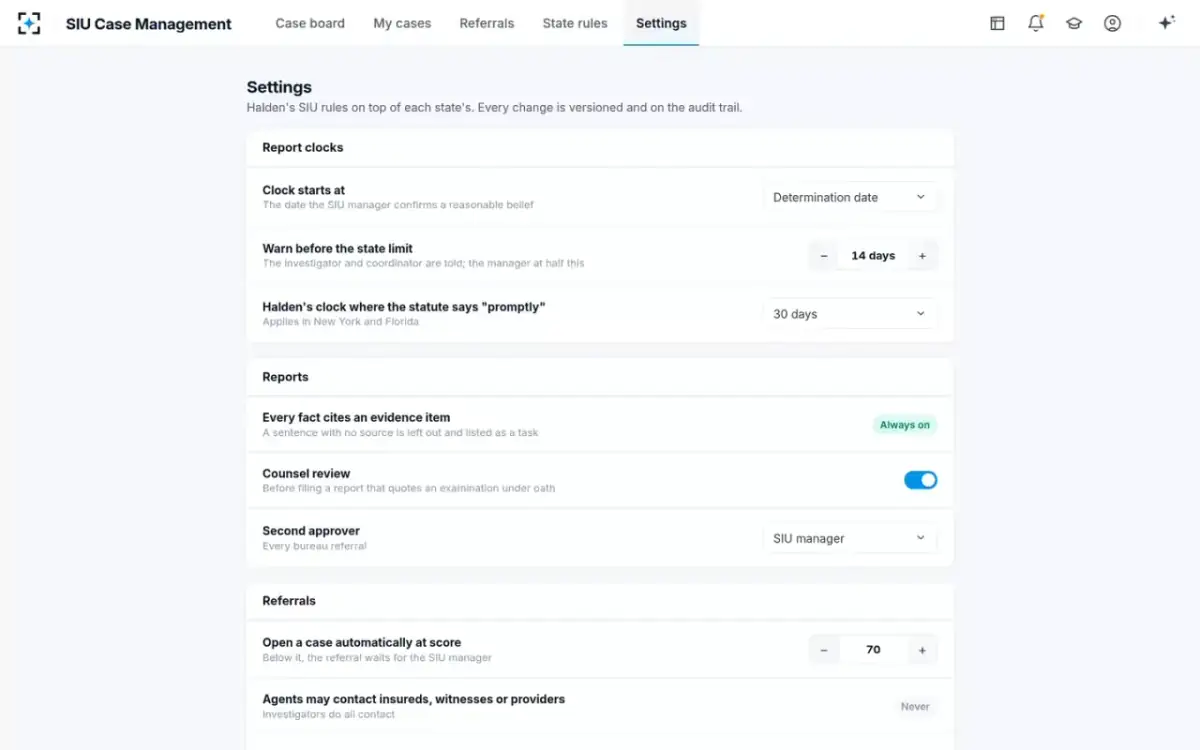
The solution runs the fraud case so that the claim track can meet its rules. Each case runs on the clock of the state the claim is in from the determination date, every interview and record sits on the board with its date and source, and the state referral is drafted from the board with each fact cited. The agents never contact a claimant, a witness or a provider, never decide a finding and never file.
What it does not do is decide or send the claim. The adjuster keeps the claim decision, its notices and its letter, and sees the SIU's summary when the SIU shares it. That separation is a design choice the regulations reward: the claim is decided on its merits inside its period, and the fraud report stands on its own evidence.
The SIU's rules: clocks, citations, counsel review and what agents may not do
Questions people ask
Can an insurer delay a claim for an SIU investigation?
Only within the regulations. In California the decision period rises from 40 to 80 days where specific information available to the Department supports a belief of fraud, and may be suspended only if the insurer has reported to the state and shown diligence. Written notices are owed every 30 days until a decision is made.
Does the insurer have to tell the claimant the SIU is investigating?
No. California's regulations do not require an insurer to disclose information that could reasonably be expected to alert a claimant that the claim is being investigated as possibly fraudulent. The notices must still name the information the insurer needs and why it cannot yet decide.
Can a claim be denied on what an SIU interview revealed?
Yes, if the interview is documented in the claim file. California bars a denial based on a telephone conversation or personal interview that is not documented there, and requires claim files detailed enough to reconstruct events and dates.
Where are California's fair claims settlement practices regulations defined?
In Title 10 of the California Code of Regulations, sections 2695.1 onward, issued under Insurance Code § 790.03(h), which lists sixteen unfair claims settlement practices. The regulations set minimum standards whose knowing breach, or breach often enough to be a general business practice, is an unfair practice.
Do claims staff need annual training on the regulations?
In California, yes. Insurers must train all claims agents on the regulations and certify it annually under penalty of perjury by 1 September; independent adjusters the insurer retains are covered too, either by the insurer's training or by their own certification.
Does reporting suspected fraud to the state stop the claim clock?
In some states. Minnesota tolls unfair claims practices periods and bad-faith actions from a proper report to its Bureau of Criminal Apprehension until 30 days after the Bureau says it will not recommend action. California allows suspension only with a state report and demonstrated diligence.