An anti-fraud plan for insurance is the document a carrier files with a state regulator describing how it detects, investigates and reports suspected fraud: the special investigations unit, its staff and procedures, the training it gives claims and underwriting people, and how it refers cases to the state. New York, Florida and others require one by statute, and the NAIC publishes a guideline for its contents. The section that is hardest to write well is the rationale for staffing, because Florida and New York both name "an assessment of the optimal caseload" an investigator can handle in a year, and no regulator publishes the number. A carrier has to derive it from its own policies, claims, referrals and hours. Botminds' SIU Case Management is case management software for special investigations units: its agents keep each case board, chronology and evidence index current and draft the state referral from the board, which changes how many hours a case takes and therefore what a defensible caseload is.
The rules on this page are quoted from statutes, regulations and the NAIC guideline, linked where they appear. The hours and caseload in the worked examples come from the solution's sample SIU at a fictional carrier, Halden Mutual, or are labelled as illustrative arithmetic.
What regulators attach to an anti-fraud plan
3,000
auto, workers’ compensation or health policies a year that oblige a New York insurer to file a plan
$2,000
a day: Florida’s maximum fine for an insurer that fails to comply
6mo
New York allows to put an approved plan into effect
5h
of continuing anti-fraud training a year California requires of SIU staff
What does an insurance anti-fraud plan have to contain?
Every version asks the same five things: who investigates, how they find cases, how they investigate, how they report to the state, and how people are trained. Florida's statute is the most compact. Every admitted insurer must keep a designated anti-fraud unit or contract the work out, adopt an anti-fraud plan, name an employee responsible for it, and file the plan and a description of the unit electronically with the Division of Criminal Investigations, then annually. The plan must acknowledge procedures for detecting, investigating and mandatorily reporting fraud, describe the training, chart the unit's positions, and give "the rationale for the level of staffing and resources being provided for the anti-fraud investigative unit" (Fla. Stat. § 626.9891(3)).
New York asks for more. A plan under 11 NYCRR 86.6 must establish a full-time SIU "separate from the underwriting or claims functions," describe its organisation down to "the geographical location and assigned territory of each investigator," set out referral criteria and who may refer, provide for in-service training with "the approximate number of hours," coordinate with other units for civil actions, include a fraud detection and procedures manual, and give an implementation timetable no longer than six months from approval. The NAIC's guideline, which binds only where a state adopts it, adds a description of "any case management system and/or computer program used to memorialize SIU referrals received and investigations conducted" (NAIC GL-1690).
Four versions of the anti-fraud plan, side by side
| New York | Florida | California | NAIC guideline | |
|---|---|---|---|---|
| Who must have one | Auto, workers’ comp and A&H insurers writing 3,000+ policies a year | Every admitted insurer | Most licensed insurers keep an SIU under 10 CCR 2698.30–.43 | Model for states to adopt |
| Unit | Full-time SIU, separate from claims and underwriting, or a contractor | Designated unit, or a contractor | SIU of employees or contracted entities | Employees or contracted entities |
| Staffing rationale | Required, including optimal caseload per investigator | Required, including optimal caseload per investigator | Judged by demonstrated compliance; factors listed | Org chart and position overviews |
| Ongoing report | Annual report by 15 March on experience, performance and cost effectiveness | Fraud data by line, by 1 March | SIU annual report, 90 days after the June notice | Tracking of referrals, investigations and outcomes |
| Training | Introductory and refresher sessions, hours stated | 2 hours initial, 1-hour course a year | Orientation within 90 days; 5 hours a year for SIU staff | Described in the plan |
Why regulators ask for the reasoning behind SIU staffing
Because they will not set a headcount themselves, and staffing is where an SIU most easily falls behind its obligations. New York's regulation asks for "the rationale for the level of staffing and resources," and lists criteria it may rest on: "number of policies written and individuals insured in New York, number of claims received with respect to New York insureds on an annual basis, volume of suspected fraudulent New York claims currently being detected, other factors relating to the vulnerability of the insurer to fraud, and an assessment of optimal caseload which can be handled by an investigator on an annual basis" (11 NYCRR 86.6(b)(3)). Florida's list is almost word for word the same.
California approaches it from the result. "The adequacy of an insurer's SIU staffing shall be determined by its demonstrated ability to establish, operate and maintain an SIU that is in compliance with these regulations," and the same factors may be considered (10 CCR § 2698.32(a)). An SIU whose referrals go out late, whose credible referrals sit uninvestigated, or whose closures carry no written reason has shown that its staffing was not adequate, whatever the plan said.
Outsourcing does not remove the question. New York requires a contract with an investigative vendor to "provide for specified levels of staffing," and where a vendor's investigators work for several insurers or states, the plan "must apportion the percentage of the investigator's efforts" to the insurer's New York cases. The NAIC guideline treats any change to "staffing, or outsourcing" as a material change to the plan.
How many cases can one SIU investigator handle?
No regulator publishes a figure, so the defensible answer is the carrier's own: annual investigator hours available, divided by the hours a case of each kind actually takes. Both New York and Florida ask for "an assessment" of optimal caseload, not a benchmark, and California's annual report collects the inputs to compute it rather than a target. A plan that cites an industry rule of thumb, with no link to the unit's own hours, answers the wrong question.
The hours per case depend on the line and on how the file is kept. A soft-tissue injury with one recorded statement, a staged-accident ring with eight claimants and a commercial arson with an examination under oath are different units of work. So the assessment should be by case type: how many of each the SIU opened last year, how many hours each took from opening to closure, and how many of those hours were investigation (interviews, surveillance, records, the EUO) as against writing (the chronology, the summary, the state referral).
That split is the lever. Investigation hours are set by the facts and by the law's requirements for a thorough investigation under 10 CCR § 2698.36. Writing hours are set by how many times the same facts are typed. A unit that types each fact four times, into the file, the timeline, the summary and the state form, carries a caseload ceiling that has nothing to do with investigation.
California's 2,080-hour formula for investigator time
California's SIU annual report asks for the "total hours of insurer employee time spent working on fraud investigations of suspected insurance fraud that occurred in California," and where that is impracticable to count, gives a formula (10 CCR § 2698.40(b)(7)). It apportions the national SIU's year to California by the state's share of investigations opened. The same arithmetic, run per case type, is the start of a caseload assessment.
California's alternative measure of SIU hours, worked on illustrative numbers
California share
CA investigations opened ÷ all investigations opened
Illustrative: 1,200 ÷ 4,800 = 0.25
From the annual report, item (b)(8)(C)
Staff apportioned
National SIU staff × California share
Illustrative: 40 investigators × 0.25 = 10
The SIU’s headcount
Hours reported
Staff apportioned × 2,080 hours
Illustrative: 10 × 2,080 = 20,800 hours
Reported with a note that the alternative method was used
Hours per investigation
Hours reported ÷ CA investigations opened
Illustrative: 20,800 ÷ 1,200 ≈ 17 hours
Our step: the input to a caseload assessment
Two corrections make the result usable. First, take out the hours that are not casework: California alone requires five hours of continuing anti-fraud training a year for SIU staff, plus leave, supervision, testimony and regulatory work. Second, weight by case type, since a unit whose openings shift from soft-tissue claims to organised rings will find its hours per case rising with no change in headcount. At the BLS median wage for the occupational group that includes insurance investigators, $78,000 in May 2025, an hour of investigator time costs a carrier about $37.50 in wages alone (our arithmetic over 2,080 hours, from the BLS Occupational Outlook Handbook).
Where an investigator's hours go on one referable case
On a case that ends in a state referral, the writing can rival the investigation. In SIU Case Management's sample unit, building the chronology, the summary, the state form and the referral narrative by hand is estimated at about nine hours per referable case. The interviews, the records requests and the EUO sit outside that figure, and so does the investigator's finding.
The writing on one referable case, by hand and with agents keeping the file
- Chronology from every source3 h
- Investigation summary2 h
- Re-keying into the state form2 h
- Referral narrative1.5 h
- Check sources, sign0.5 h
- Review drafts, check sources, sign1 h 20
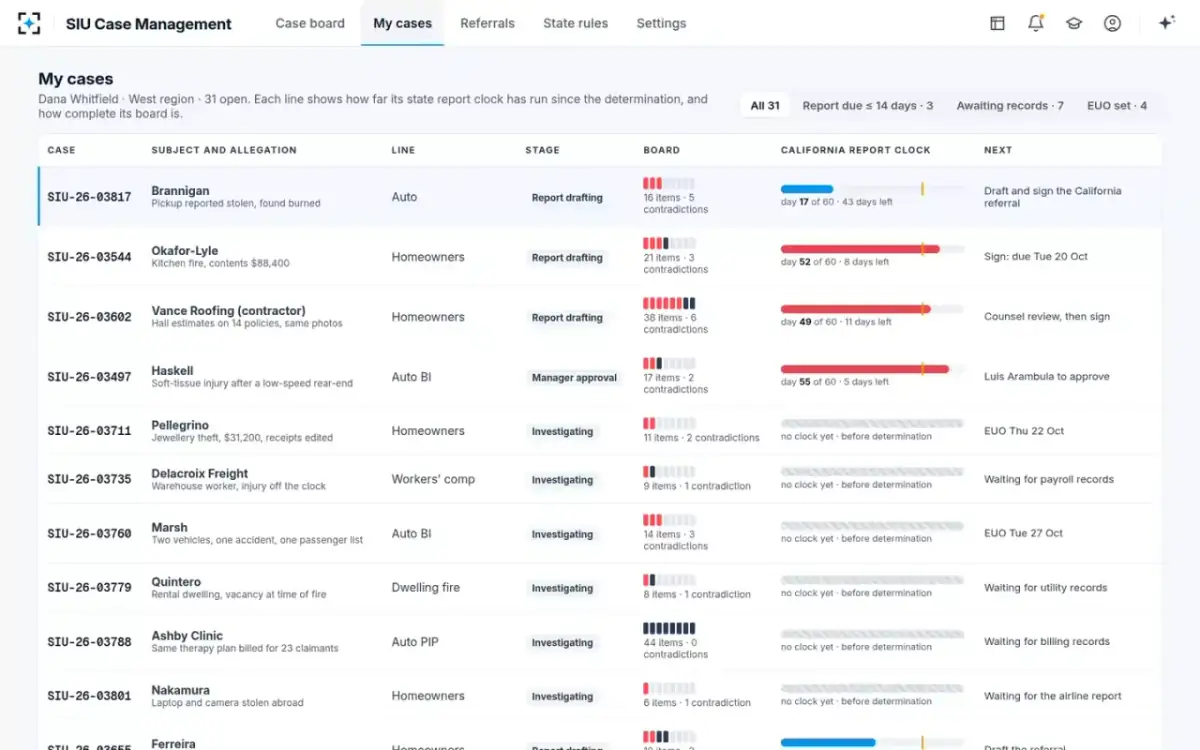
For a caseload assessment, the estimate matters in one direction: it shows how much of an investigator's year is clerical, and so how much a staffing rationale is really a rationale for typing. Those hours are also the ones that push referrals toward their deadlines. In the sample caseload of 31 open files, one kitchen-fire case was on day 52 of California's 60, with the narrative still to write.
Thirty-one open files, each on its state report clock
What should the plan say about referrals from claims?
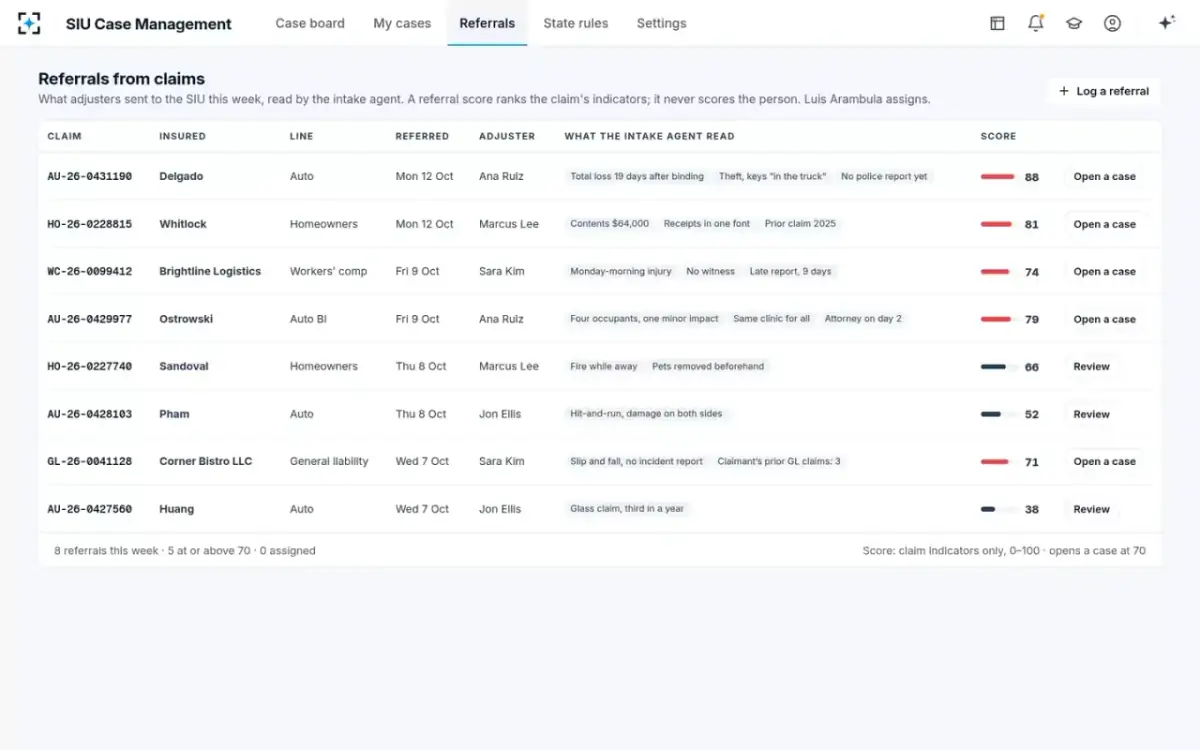
It should say who may refer, on what criteria, and how the SIU decides which referrals become investigations, because referral volume is the demand side of the staffing equation. New York requires "criteria for referral of a case to the unit for evaluation, and the designation of the individuals authorized to make such a referral." California requires the SIU to investigate "each credible referral of suspected insurance fraud that it receives from integral anti-fraud personnel, including automated or system-generated referrals," where a credible referral is one with a red flag (10 CCR § 2698.36(c)).
That last clause has a staffing consequence. A scoring model that raises more referrals raises the SIU's workload by rule, not by choice. California lets the SIU decline to open an investigation where a preliminary review shows it is "reasonably clear" the red flags are not fraud, but only with the reasons written into the claim file or the SIU file. A plan that adds automated referrals without adding the review time for them is understaffed on the day it is filed.
This week's referrals, read and scored before the manager decides
Training hours the plan commits the unit to
Every plan promises training, and the hours come out of the same year as the caseload. California requires an anti-fraud orientation for newly hired employees "within ninety (90) days of commencing assigned duties," and that "SIU personnel shall receive at least five (5) hours of continuing anti-fraud training per calendar year" (10 CCR § 2698.39). Florida requires two hours of initial training for anti-fraud unit staff and a one-hour course every year after. New York asks the plan to state "the approximate number of hours to be devoted to these sessions and their frequency."
The annual report then asks for proof. California's report must include the training plan "and proof that the training occurred," for the insurer's own staff and its contracted entities. A unit that cannot produce attendance records for its vendor's investigators has a gap in its plan, not just in its files. The California SIU annual report covers what the rest of that filing asks for.
What will an examiner test against the plan?
That the unit does what the plan says, at the volume the plan claims. A plan is a set of promises about staffing, procedures and timeliness, and each one leaves evidence in case files. The checklist below is what an SIU director should be able to produce for any year the plan covered.
Eight things an SIU should be able to show for each year of its anti-fraud plan
- Headcount and hours by state
Staff, contracted hours, and the method used where hours were apportioned.
- Referrals received and investigations opened
By line, with the written reason for each credible referral not investigated.
- The outcome of each investigation
Closed, paid, denied, referred to the state, or civil action; the NAIC guideline names outcome tracking.
- Referrals filed inside each state’s period
With the determination date that started each clock.
- A written summary for every investigation
Answering the regulator’s questions and stating whether the investigation is complete.
- Training delivered, with proof
Orientation dates, annual hours, and the same for contracted investigators.
- Vendor contracts and how they are monitored
Staffing levels the contract specifies, and the share of each vendor investigator’s effort.
- Changes to staffing or outsourcing
Each one reported as the state requires; the NAIC guideline treats them as material.
How SIU Case Management changes the staffing arithmetic
It moves hours from writing to investigating, and it keeps the numbers a plan and its annual report need as a by-product of the work. Each case lives on one board: statements, records, interviews and photos are pinned as they arrive, the chronology builder lays every event in order with its source, and the bureau report drafter fills the state form from the board, citing each fact. In the sample case, the referral came back with 41 citations to 16 sources, and one fact without a source was left out and handed to the investigator as a task.
The staffing questions stay with people. The agents never contact an insured, a witness or a provider, never decide a finding and never file. The investigator signs, claims counsel reviews any examination-under-oath quotation, the SIU manager approves and the fraud reporting coordinator files. What changes is that the SIU director can count, per case type, how long cases actually take, which is the "assessment of optimal caseload" the plan asks for. Pricing investigation management software per case works through the cost side, and insurance fraud reporting requirements by state covers the clocks the staffing has to meet.
Questions people ask
Which insurers need an anti-fraud plan?
It depends on the state. Florida requires every admitted insurer to adopt one and file it with the Division of Criminal Investigations. New York requires a fraud prevention plan from insurers writing 3,000 or more auto, workers' compensation or accident and health policies a year, and from certain health plans. Many other states have their own filing rules.
Is there a standard SIU investigator caseload?
No regulator publishes one. New York and Florida require the plan to include the carrier's own assessment of the optimal caseload one investigator can handle in a year, alongside policies written, claims received and suspected fraud detected. California judges staffing by whether the SIU actually complies with its regulations.
Can an insurer outsource its SIU?
Yes, in New York, Florida and California, but the insurer stays responsible. New York requires the vendor contract to be filed with the plan and to specify staffing levels, and the plan must apportion each shared investigator's effort to New York cases. California's annual report asks for every contract and how it is monitored.
How often is an anti-fraud plan filed?
Florida requires the plan and a description of the unit to be filed and then filed annually, with fraud data by line due by 1 March. New York requires an annual report on the plan by 15 March describing its experience, performance and cost effectiveness. California's SIU annual report is due 90 days after the Department's June notice.
What happens if an insurer does not follow its anti-fraud plan?
Florida may fine an insurer up to $2,000 a day until it complies, and separately for failing to follow its plan or unit description. In New York the superintendent may require amendments after reviewing the annual report. In California, staffing adequacy is judged by demonstrated compliance during examinations.
Does a case management system belong in the anti-fraud plan?
The NAIC guideline asks for an overview of any case management system used to document referrals received and investigations conducted, and for how the insurer tracks referrals, investigations opened and their outcomes. States that adopt the guideline expect that description in the plan.