The California SIU annual report is the filing that 10 CCR § 2698.40 requires from licensed insurers each year: a description of the special investigations unit's staff, procedures, training and contracts, and counts of California claims processed, claims referred to the SIU, investigations opened, suspected frauds reported to the Department and to district attorneys, and civil fraud actions filed. It is due 90 days after the Department mails its notice in June, it is filed through the Department's online portal, and an officer signs it under penalty of perjury. The hard part is not the form. It is that most of the counts are the sum of how individual cases ended, and an SIU that closes cases without a written ending cannot add them up with confidence. Botminds' SIU Case Management is case management software for special investigations units: its agents keep each case board, chronology and evidence index current, so the ending of every case, and the evidence for it, sits in the case itself.
The rules here are the regulation's and the Department's, linked where they appear. The cases come from the solution's sample SIU at a fictional carrier, Halden Mutual, whose people and claims are invented.
The filing in four numbers
1,100+
insurers file an SIU annual report with the Department each year
13
items of content the regulation requires, from staffing to civil actions
90days
after the Department’s June notice: the report’s due date
15 Sep
2026: the Department’s stated due date for the 2025 report
What is the California SIU annual report?
It is the yearly statement by which each insurer shows the Department that its SIU exists, is staffed and works. The regulation requires a report "at the time its initial Certificate of Authority is issued, and annually thereafter," and lets an insurer in a holding company group meet the requirement through a "primary reporting insurer" that runs the group's SIU and reports for it (10 CCR § 2698.40(a)). The Department says it receives reports from "over 1,100 insurance companies each year."
The report is not filed and forgotten. The Department's SIU Compliance Review Program "analyzes and evaluates the content, accuracy, completeness, and timeliness of the report," and uses what it finds in "a risk assessment which determines which insurers should be selected for SIU compliance review" (CDI, SIU Compliance Review Program). Among the criteria the Department lists are discrepancies in the report, the quality and quantity of fraud referrals, prior review findings, complaint volume and late responses to its demands. A weak report is how an SIU invites an examination.
When is the SIU annual report due in California?
Ninety days after the Department mails its notice, which it issues in June each year. The regulation says: "The annual report shall be due no later than ninety (90) days after the date of mailing of the notification by the Department. The Department shall issue the notification in June of each year." For the 2025 report, the Department's page states that the portal is open and the "report due date is September 15, 2026 by 11:59 PM" (CDI, SIU Annual Report).
The report covers the last calendar year, so the counts for 2025 are filed in the late summer of 2026. That gap is where trouble starts: by the time the report is prepared, the cases it counts may have closed many months earlier, and the people who closed them may have moved on. An SIU that keeps each case's ending as it happens can produce the report in days; one that reconstructs it from email, claim notes and memory spends the summer on it.
The thirteen items the report must contain
The regulation lists thirteen items, and a "complete, accurate, and truthful" report must answer every one on the Department's form (10 CCR § 2698.40(b)). Most are descriptions that change slowly. Five are counts or lists that change every year and come from case files.
What the California SIU annual report asks for, and where each answer comes from
| Item | What the regulation asks | Where the answer lives |
|---|---|---|
| (1) Insurer | Certificate of Authority number, lines written in California, contacts; for a primary reporting insurer, the insurers it serves | Corporate and licensing |
| (2)–(3) People | SIU personnel on California investigations, or the contracted organisation; staff who communicate with the Fraud Division | SIU roster |
| (4) Methods | Written procedures for detecting, investigating and reporting; fraud patterns and trends by line; how integral anti-fraud personnel are made to refer | SIU manual |
| (5) Training | The training plan, topics, how receipt is ensured, and proof that training occurred | Training files |
| (6) Organisation | A description or chart of the SIU and integral anti-fraud personnel | SIU manual |
| (7) Staffing and hours | Staff numbers, whether they work only California, total hours on California investigations, contracted hours, and how the insurer measures the SIU’s effectiveness | Time keeping and case files |
| (8) Claims and referrals | California claims processed; claims referred to the SIU; referred claims that became investigations | Claims system and case files |
| (9) Reports to the state | Incidents of suspected fraud reported to the Department and to district attorneys | Case files |
| (10) Changes | Significant changes, made or expected, that affect the SIU | Management |
| (11) Lines and policies | Every line issued in California, active policies per line, each product or program | Underwriting |
| (12) Contracts | A full copy of each contract used for compliance and how it is monitored | Vendor management |
| (13) Civil actions | Civil fraud actions started in California: type, case name, county, court, case number and the Department case number | Case files and counsel |
Item (7)(F) deserves more thought than it usually gets: "A description of how the insurer measures the effectiveness of its SIU." The NAIC's antifraud plan guideline points to the measures a regulator expects, asking how the insurer tracks "the number of SIU referrals received, the number of investigations opened, the outcome of investigations conducted" (NAIC GL-1690). An SIU that cannot count its outcomes cannot describe its effectiveness, whatever the narrative says.
How each case ending feeds the report's counts
Every referral ends in one of a handful of ways, and each ending lands on a different line of the report. Counting them reliably means deciding, at closure, which ending applies and writing it down with its date and reason. The table below maps the endings an SIU sees to the report's items.
Five ways an SIU case ends, and the report line each one moves
| Ending | What the rules require at closure | Report lines it moves |
|---|---|---|
| Not opened after preliminary review | Reasons the red flags are not fraud, written into the claim file or SIU file (§ 2698.36(c)) | (8)(B) referred, not (8)(C) opened |
| Investigated, suspicion dispelled | The written summary with findings and the basis for them (§ 2698.36(a)(5)) | (8)(B) and (8)(C) |
| Investigated, claim denied | The summary; the claim denial itself stays a claims decision | (8)(B) and (8)(C) |
| Referred to the Fraud Division or a district attorney | Referral inside the statutory period, stating whether the investigation is complete (§ 2698.37) | (8)(B), (8)(C) and (9) |
| Civil action by the insurer | Case name, county, court, case number and the Department’s case number from its acknowledgment letter | (13), usually after (9) |
Two endings cause most counting errors. The first is the referral never opened: it counts as a referral received but not as an investigation, and without the written reason the regulation requires, the gap between (8)(B) and (8)(C) is unexplained. The second is the claim that settled before the investigation finished. The NAIC's guideline says that "a claim may contain evidence of suspected insurance fraud regardless of the payment status," and at the November 2024 meeting of California's Fraud Assessment Commission the Department said such a claim should still be referred (FAC minutes). An SIU whose case list closes when the claim closes will under-count line (9).
What should a closed SIU case file hold?
Enough to explain the ending to someone who was not there: an examiner, a prosecutor, or the officer who signs the annual report. California's rule for the investigation summary sets the core. It must be "specific to the investigation at hand," "separate from any other document," include "the investigators' findings regarding the suspected insurance fraud and the basis for their findings," and state "whether or not the investigation is complete" (10 CCR § 2698.36(a)(5)).
What a closed case should carry, so it can be counted and defended
- The referral, its source and its red flags
Who or which system referred it, when, and on what indicators.
- The decision to open, or the written reason not to
The second is required in California when a credible referral is not investigated.
- The summary, answering the regulator’s questions
Facts, suspected misrepresentations and who made them, materiality, witnesses, documents, and whether the investigation is complete.
- The ending, its date and who decided it
One of the endings above, so the case lands on the right report line.
- Proof of each state filing
Agency, date, channel and confirmation; amended referrals linked to the first.
- Any civil action
Court, county, case number and the Department’s case number.
- Evidence as received
Fingerprinted and with its handlers, so it can be produced unaltered.
- Hours worked on the case
The input to item (7)(C), or to the alternative method where hours are not kept.
The closed file also has to stay retrievable. On a written request, a California insurer must release claim notes, investigation files and investigator notes within 30 days, or 60 for workers' compensation (10 CCR § 2698.34). A file that is complete but cannot be found inside a month fails the same test as one that was never written.
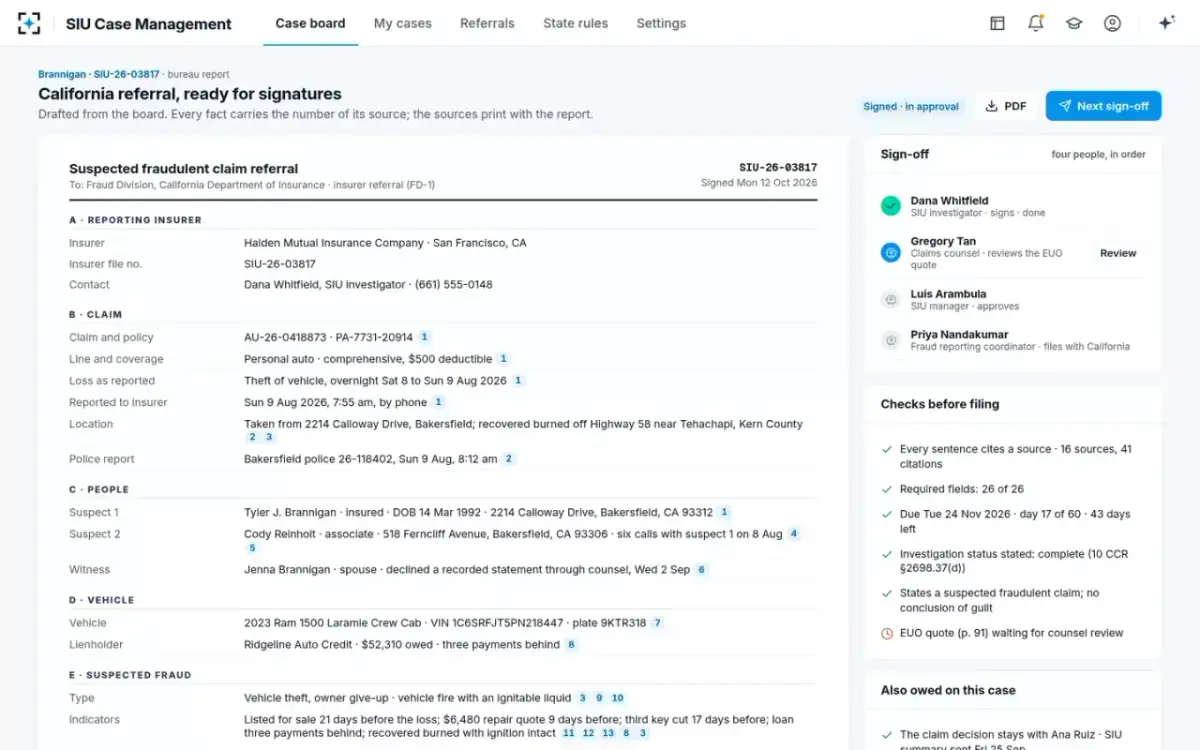
A referral ready to file, with the investigation status stated
Who signs the annual report, and what are they attesting to?
An officer of the insurer, under penalty of perjury. The regulation requires a statement "signed under penalty of perjury pursuant to the laws of the state of California," by an officer who "attests to the accuracy of the reported information and the signor's personal knowledge of the existence and proper maintenance of an SIU" (10 CCR § 2698.40(c)). The insurer must keep a copy for the Department's examinations.
That attestation changes what the SIU manager's spreadsheet is worth. An officer signing for referral and investigation counts needs to know they could be rebuilt from case files if an examiner asked. Counts that trace to individual cases, each with its ending and date, can be. Counts assembled by hand from the claims system, the SIU's list and the coordinator's inbox usually cannot, and the Department lists report discrepancies among the reasons it selects insurers for review.
Who owns each part of the annual report, before and after the case keeps its own ending
Today
Closes a case with a memo, and the outcome lives in a spreadsheet someone fills in next summer.
With agents
Signs a closing summary drafted from the case board; the ending, its date and its reason are part of the case.
Still theirs: the finding
Today
Reconciles referral counts from claims against the SIU’s own list each June.
With agents
Sees referrals received, investigations opened and endings by line as cases move.
Still theirs: the determination and every approval
Today
Rebuilds the year’s state filings from email confirmations.
With agents
Files each referral from the case, with the date and confirmation kept on it.
Still theirs: the filing
Today
Attests to numbers assembled by hand from several systems.
With agents
Attests to counts that trace back to individual case files.
Still theirs: the attestation under penalty of perjury
What the state does with the referrals the report counts
Most referrals inform the state's picture of fraud and never become state investigations, which is why their quality matters more than their number. Texas's Department of Insurance received 23,857 fraud reports in fiscal 2025 and opened 172 investigations (TDI). New York's Insurance Frauds Bureau received 39,676 reports of suspected health-care fraud in 2025, most of them no-fault auto, and opened 73 health-care fraud investigations (DFS).
Reports received against investigations opened, in two states
California's Department has said how it treats weak referrals. At the November 2024 Fraud Assessment Commission meeting it described flagging poor-quality FD-1 referrals at intake for its SIU compliance team, adding a check box to note when a referral lacks information, and contacting large insurers when many of their referrals are closed for lack of evidence. It closed 875 cases for lack of resources in fiscal 2022-23 (FAC minutes). The annual report's count of referrals and the quality of each one are read together. The FD-1 form in California follows one fact from the examination under oath into the referral.
Building the annual report from case files with SIU Case Management
The solution keeps the ending of each case as part of the case, so the year's counts are a query, not a project. Referrals from claims arrive with what the intake agent read and a score of the claim's indicators; the SIU manager decides which become investigations, and a referral not opened carries its written reason. Each investigation ends with a summary drafted from the board, stating whether the investigation is complete, and each state filing keeps its date and confirmation on the case.
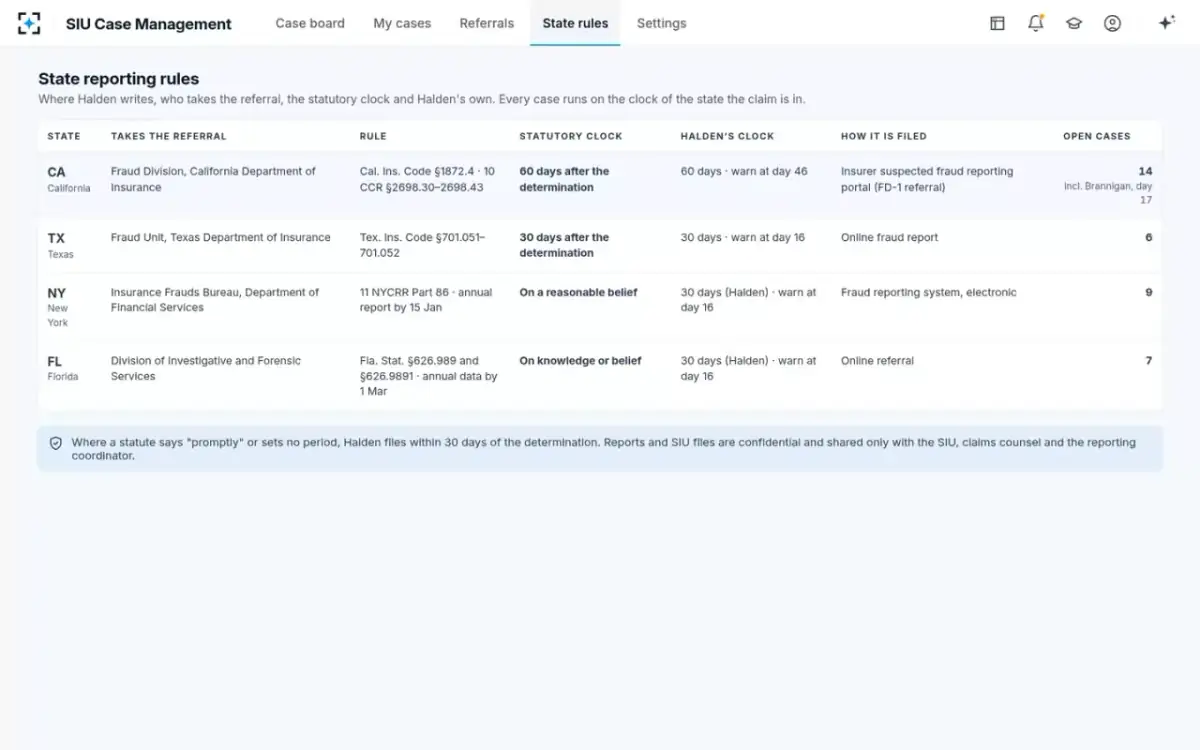
What stays with people is everything the report attests to. The investigator decides the finding and signs; the SIU manager confirms each determination and approves each referral; the fraud reporting coordinator files; an officer signs the annual report. The agents never contact anyone, never decide a finding and never file. The anti-fraud plan and SIU staffing covers the hours side of item (7), and fraud reporting requirements by state covers the clocks behind item (9).
Each state's referral rule and clock, kept with the cases
Questions people ask
When is the California SIU annual report due?
Ninety days after the Department mails its notice, which it issues in June each year. For the 2025 report, the Department's page gives a due date of 15 September 2026 at 11:59 pm, filed through its online portal.
Who has to file the California SIU annual report?
Licensed California insurers, when their Certificate of Authority is first issued and every year after. An insurer in a holding company group may rely on a primary reporting insurer that runs the group's SIU and reports its information truthfully, accurately and completely.
Who signs the SIU annual report?
An officer of the insurer, in a statement signed under penalty of perjury attesting to the accuracy of the information and personal knowledge that the SIU exists and is properly maintained. The insurer keeps a copy for the Department's examinations.
How are SIU hours reported if they are not tracked?
The regulation allows an alternative: divide California investigations opened by all investigations opened nationwide, multiply by the national SIU staff, then by 2,080 hours, and note that the alternative was used. Contracted SIU hours are reported separately.
Does a claim paid before the investigation ends still count?
Yes, if the SIU forms a reasonable belief of fraud. The NAIC's guideline says a claim may contain evidence of suspected fraud regardless of payment status, and California's Department has said a claim settled before the investigation finished should still be referred, which then counts among reports to the Department.
What happens if the report has errors?
The Department evaluates each report's content, accuracy, completeness and timeliness, and lists report discrepancies among the criteria it uses to select insurers for an SIU compliance review. Corrective actions from earlier reviews are followed up the same way.