AI in mortgage underwriting can take over the reading and the arithmetic, not the part that decides. The clearest test is the file underwriters find hardest: a self-employed borrower, where qualifying income has to be rebuilt from two years of personal and business tax returns before anyone can say whether the loan works. AI agents can now read those returns, fill the cash-flow worksheet and run the trend and liquidity tests in about a minute and a half. What they cannot do is the thing the agency guides actually require: a written judgement that the income is stable and will continue, signed by someone the lender answers for. Botminds' Self-Employed Income Calculation was designed around that line. Six agents do the reading and the arithmetic; the underwriter decides and signs. This page looks at where the line falls, file by file and role by role, and what it means for how a lender staffs and controls underwriting.
Underwriting is already automated in part, and growth has slowed
283,000
loan officer jobs in 2025, the BLS occupation that includes loan underwriters
BLS Occupational Outlook Handbook
1%
projected growth 2025–2035, slowed by “productivity-enhancing technology in loan processing”
Will AI replace mortgage underwriters?
AI will take over much of what underwriters do by hand, and very little of what they are accountable for. The Bureau of Labor Statistics counts underwriters inside its loan officer occupation and already notes that "Most firms use underwriting software, which produces a loan recommendation based on the applicant's financial status", and that for simple consumer loans "the underwriting process may be fully automated" (BLS Occupational Outlook Handbook). Its projection for the decade to 2035 is slow growth of 1%, explicitly because of technology in loan processing.
That is the shape of the change: fewer hours on mechanics, not fewer decisions. The recommendation on a loan already comes from software, as the BLS notes. What has not been automated is the income on a complicated file, because no system can be handed a self-employed borrower's income. It has to be built, and the building involves choices the guides say a lender must make and write down.
What does a mortgage underwriter do with tax returns?
On a self-employed file the underwriter turns tax returns into a monthly income the lender can defend. Fannie Mae treats anyone with a 25% or greater ownership interest in a business as self-employed, and FHA uses the same line (Selling Guide B3-3.5-01; HUD Handbook 4000.1). Before approving the loan, Fannie requires the lender to analyse five things: the stability of the income, the location and nature of the business, the demand for what it sells, its financial strength, and its ability "to continue generating and distributing sufficient income" to pay the mortgage.
The work under those five words is concrete. The underwriter reads the 1040 and its schedules, the business return (1065, 1120-S or 1120) and each K-1, then adds back depreciation and other non-cash expenses, takes out one-time gains, applies the borrower's ownership share, compares the years, decides whether a decline has stopped, and tests whether a partnership or S corporation could actually pay out the income it allocated. Federal law sits underneath: the ability-to-repay rule requires the income relied on to be verified with "third-party records that provide reasonably reliable evidence", and names an IRS tax-return transcript as one (12 CFR 1026.43(c)(4)). Then the lender writes it down. Fannie requires "a written evaluation of its analysis of a self-employed borrower's personal income", and a second written analysis of the business when business returns are required.
The arithmetic itself is set out, line by line, on the agency worksheet; our Form 1084 walkthrough follows it row by row.
Why the self-employed file is still the hardest file in the stack
It is the file where the documents are least like income. When the CFPB removed Appendix Q from the qualified mortgage rule, it recorded that in its lender survey "underwriting for self-employed borrowers was one of the most frequently reported sources of difficulty" under that appendix, and it pointed lenders instead to the Fannie, Freddie, FHA, VA and USDA handbooks as verification standards (General QM final rule, December 2020). Researchers studying the pre-2008 low-documentation boom found self-employed borrowers chose those loans partly "because their income is often difficult to certify" (Jiang, Nelson and Vytlacil, hosted by FHFA).
The errors show up in review. In FHA's own post-endorsement reviews of fiscal year 2022 loans, borrower income was the largest single area of material findings, 22.17% of the total, and the examples HUD listed include "Self-employment income was not calculated based on the average gross self-employment income earned over the previous two years" and self-employment losses that were never subtracted (HUD, FHA Quality Assurance Update, January 2023). And the population is large: the Census Bureau counted 30.4 million nonemployer businesses in the United States in 2023 (U.S. Census Bureau, November 2025), each a potential Schedule C on a mortgage application.
What can AI calculate in self-employed income, and what must an underwriter conclude?
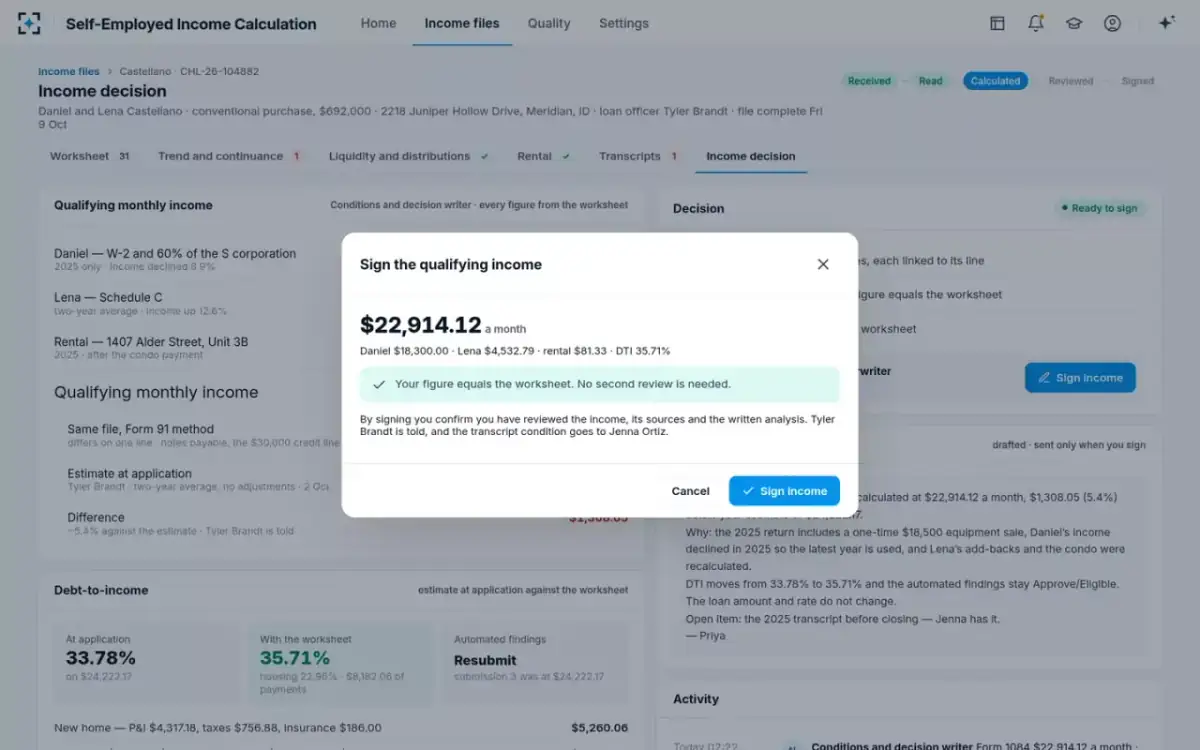
AI can find, read, cite and calculate; the underwriter concludes. Take the sample file the solution ships with, on fictional borrowers: Daniel and Lena Castellano, a $692,000 conventional purchase, 42 pages of returns. He owns 60% of an S corporation; she runs a photography business on Schedule C; they rent out a condo. In 91 seconds six agents read the pages, filled 19 worksheet lines, linked all 31 figures to their line on a return, matched the 2024 transcript and raised a condition for the missing 2025 one, computed the current ratio, and drafted the written analysis.
Then came a question no agent should answer alone. Daniel's income fell 8.9%, from $240,960 to $219,600. The company's year-to-date profit and loss statement suggests the fall has stopped. Is the right figure the latest year, at $18,300.00 a month, or the two-year average, at $19,190.00? Fannie's text does not say "use the lower year"; it requires the lender to judge the trend, and for an S corporation it says business income can be used only if it "is stable and consistent" and "the sales and earnings trends are positive" (B3-3.7-02). Even Fannie's own calculator stops at this point: a "Declining" trend in its findings generates a message requiring the lender to document that the income "has stabilized" (Income Calculator user guide). The tool flags; a person concludes.
With agents doing the mechanics, most of the minutes left are the underwriter's
One file, about 10½ minutes
- Agents: sort, fill, test, match (5 steps) · 24%
- Underwriter: review and signature · 76%
The split matters for accuracy as much as for speed. Every adjustment the agents make carries its rule and its source line, so the underwriter reviews reasons rather than re-keying numbers. On the sample file the agents found the loan officer's quick estimate at application overstated income by $1,308.05 a month, 5.4%, mostly because of a one-time equipment sale and the declining year. The underwriter still had to agree.
How each role around the income file changes
Every role keeps its decision and loses its retyping. The underwriter stops rebuilding income and starts from a filled worksheet. The processor gets one named condition instead of a vague "file incomplete". The loan officer hears early, in plain words, when income moved. Quality control opens a worksheet where every adjustment explains itself.
Self-Employed Income Calculation and the five people who carry an income file
Today
Rebuilds qualifying income from two years of personal and business returns by hand, line by line.
With agents
Starts from a filled worksheet with every figure tied to its line, reads the reasons, and edits the drafted analysis.
Still theirs: the conclusion on trend and continuance, and the signature
Today
Hears about income defects when quality control writes them up after closing.
With agents
Sees every override and every second review as it happens, with findings counted by type.
Still theirs: second reviews and the credit policy settings
Today
Is told the file is incomplete and works out which year or schedule is missing.
With agents
Gets one named condition, such as the 2025 transcript before closing, with the reason attached.
Still theirs: the borrower conversation
Today
Quotes from a quick two-year average and learns late that the income moved.
With agents
Gets a plain note when the income changes by more than a set percentage: new figure, why, new DTI.
Still theirs: the call to the borrower
Today
Re-underwrites closed loans without the reason behind each adjustment.
With agents
Opens the worksheet with the source line, guide section and arithmetic for each adjustment.
Still theirs: the independent re-check
The manager's view changes most. On the sample lender's quality screen, every worksheet signed in a month is counted with its median minutes, its findings by type and each override's second review. That is supervision the manager could not have before, because the reasons lived in the underwriter's head or a spreadsheet tab.
What skills will underwriters need when agents do the arithmetic?
Fewer keystrokes and more judgement, written down. The underwriters who do well will be the ones who can read a business, not just a return, and explain their conclusion in a paragraph a reviewer accepts. Fannie asks the lender to evaluate the business "through its knowledge of other businesses in the same industry" (B3-3.5-01): that is industry judgement, not data entry.
Seven skills that matter more once agents fill the worksheet
- Reading a business from its returns
Gross receipts, margins and expenses by year: is the business shrinking, or did it invest?
- Writing the analysis
A conclusion on stability and continuance that a quality control reviewer can follow without asking.
- Challenging a figure at its source
Opening the cited line on the return and asking whether the adjustment fits it.
- Knowing where programs differ
FHA writes a formula for declining income; Fannie asks for judgement. The same file can give two answers.
- Judging continuance
Whether a year-to-date P&L shows a decline has stopped, and what documents would prove it.
- Owning overrides
When to depart from the worksheet, and how to write the reason a second reviewer will read.
- Understanding the tools
What each agent may and may not do, and what the lender must be able to tell an investor about it.
Who answers for the income when an AI touched it?
The lender does, and through the lender the person who signed. Fannie Mae made this explicit in April 2026. Lender Letter LL-2026-04 says that a seller using AI or machine learning in origination "must ensure compliance with applicable laws and the Lender Contract", keep policies that are "communicated to appropriate personnel who have job responsibilities in areas that use AI/ML", name an owner who reviews them "at least annually", govern vendor AI as strictly as its own, and, on request, "promptly disclose the types of AI/ML used, the purpose and manner for such use" (Fannie Mae LL-2026-04). The letter took effect 120 days after publication. FHFA's own guidance to the Enterprises calls some AI uses high-risk and in need of "more robust risk management" (FHFA AB 2022-02).
Accountability also depends on what the underwriter could see at the time. In 2016 Regions Bank paid $52.4 million to settle False Claims Act allegations and admitted a pattern of "curing" quality control findings "by obtaining documentation that was not available to the underwriter at the time the loan was approved" (U.S. Department of Justice, 2016). An income worksheet that shows, for every figure, the page it came from and the moment it was used is the opposite of that: it fixes what the underwriter knew when she signed.
The signature stays with a person
What a lender should staff for when agents fill the worksheet
What changes is where an underwriter's value sits. If agents fill the worksheet, the underwriter who can only fill worksheets has less to offer, and the one who can defend an income conclusion to an investor, an examiner or a False Claims Act lawyer has more. The underwriting decision itself also stays in human hands by rule in places: FHA requires a loan whose self-employed income fell more than 20% over the analysis period to be downgraded from its automated scorecard to manual underwriting (HUD Handbook 4000.1). The details of that rule, and how it differs from Fannie Mae's, are in FHA's 20 percent decline rule against Fannie's trend test.
The agents can tell an underwriter that income fell 8.9%. Only the underwriter can say, in writing, that it has stopped falling, and sign it.
Self-employed income: what agents do, what underwriters decide
| Task | Who does it | Why it sits there |
|---|---|---|
| Classifying 1040s, schedules, K-1s, business returns | Agents | Mechanical; every page cited |
| Extracting each figure with its year, page and line | Agents | Mechanical; never infers a figure not on the page |
| Add-backs, subtractions, ownership share | Agents, under the program’s listed rules | Rules are written; each adjustment names its rule |
| Matching returns to IRS transcripts | Agents | A comparison; mismatches go to a person |
| Trend, decline, continuance | Agents draft; underwriter concludes | The guides require a judgement in writing |
| Overrides of the worksheet | Underwriter, with a second review | Departures need a named reason |
| Signing the qualifying income | Underwriter | The lender answers for it |
How the six agents divide the reading, step by step and second by second, is traced in automated income calculation in 91 seconds.
Questions people ask
Can AI calculate self-employed income?
It can calculate it, and cite every line it used, but it should not conclude on it. On the fictional sample file in Botminds' Self-Employed Income Calculation, agents filled a 19-line cash-flow worksheet from 42 pages in 91 seconds. The decision on whether a declining income is stable remains a written judgement the lender owes under Fannie Mae and FHA rules.
Do lenders still need manual underwriting?
Yes, and some self-employed files require it. HUD Handbook 4000.1 says that if business income shows a greater than 20 percent decline over the analysis period, the lender must downgrade the loan and underwrite it manually. On a manually underwritten FHA loan the lender must then document that the business income is now stable.
Does automated underwriting already decide self-employed loans?
It recommends; it does not verify the income for you. Fannie Mae says the documentation Desktop Underwriter asks for "may not be adequate for every borrower and every situation", and if the lender cannot establish that income is stable from what it has, the income must be removed and the loan resubmitted (B3-3.1-01).
Is AI allowed in mortgage underwriting?
Yes, under governance. Fannie Mae's Lender Letter LL-2026-04, published 8 April 2026 and effective 120 days later, requires sellers that use AI or machine learning in origination to keep policies, name an owner, govern vendors' AI and disclose their use on request. It does not ban any use; it makes the lender answerable for it.
Who is responsible if an AI tool gets the income wrong?
The lender, under its representations and warranties to the investor or its certification to FHA. A vendor's tool does not move that duty, which is why the worksheet should show the source line and rule for each figure and the name of the person who signed.
What will an underwriter's day look like with AI?
More files reviewed and fewer rebuilt. On the solution's fictional sample lender, the median time from a complete file to a signed worksheet fell from 68 minutes by hand to 11 with the agents; the design target is 10. Those are sample figures, not a customer's result, but the shape is the point: the minutes left are reading and deciding.