Tax return analysis software for mortgage lending reads a self-employed borrower's personal and business returns and produces the qualifying income and the written cash-flow analysis behind it. It competes with two things most lenders already have: a spreadsheet version of Fannie Mae's Form 1084, and Fannie Mae's own Income Calculator, which is free. All three are allowed. Fannie lets a lender use Form 1084, any other cash-flow analysis, or an automated tool, provided it applies the same principles as Form 1084. So the choice is not about permission. It is about what each method leaves the lender owning: keying every figure, proving where each one came from, checking it against the IRS, covering FHA and VA files, and carrying the risk of a wrong number for the life of the loan. Botminds' Self-Employed Income Calculation is one kind of software in this market, built with agents; this page compares the three methods honestly, including where our solution is not the answer.
The same written analysis, two ways of producing it
A Form 1084 spreadsheet: A person finds each figure on the return and types it in.
Software that reads the returns: Read from the return PDFs, each with its year, page and line.
A Form 1084 spreadsheet: Whatever the underwriter enters; the reason lives in a comment, if anywhere.
Software that reads the returns: Applied from the program’s listed rules, each with its reason and guide section.
A Form 1084 spreadsheet: A separate step, often a glance at the transcript total.
Software that reads the returns: Line by line, with “no record” turned into a named condition.
A Form 1084 spreadsheet: One template per program, maintained by someone in credit policy.
Software that reads the returns: Conventional, FHA and VA methods side by side, with versions dated.
A Form 1084 spreadsheet: A number and a spreadsheet tab.
Software that reads the returns: Every figure linked to its line, every adjustment to its rule, and the signature.
A Form 1084 spreadsheet: None.
Software that reads the returns: Only if it is a Fannie Mae-approved vendor tool, used without manual overrides; otherwise none.
What is tax return analysis software for mortgage lending?
It is software that does the underwriter's reading of a tax return, not a taxpayer's filing. The searches people type, "tax return analysis software" and "ai tax return review software", mix the two, but the mortgage version has a narrow job: classify the 1040 and its schedules, the 1065, 1120-S or 1120 and each K-1; extract the lines that feed the cash-flow worksheet; apply the program's adjustments; and output a monthly income with a written analysis that can sit in the loan file.
The written analysis is the deliverable that matters, because the guide requires it. Fannie Mae says "A copy of the written analysis and conclusions or the Findings Report generated by Income Calculator must be retained in the loan file" (Selling Guide B3-3.5-01). After the CFPB removed Appendix Q in 2020, the agency handbooks became the reference standards for verifying this income, and self-employed borrowers were the case lenders had found hardest (General QM final rule). Any tool should be judged on whether its output meets those handbooks, not on whether it reads a PDF.
Option 1: the spreadsheet worksheet
The spreadsheet is the default, and it is not wrong. Fannie Mae publishes Form 1084 as a worksheet that "may be used to prepare a written evaluation" (Form 1084), and many lenders keep an Excel version with the formulas built in. That is why "self employed income calculation worksheet excel" is among the most typed searches in this field. It costs nothing to license and every underwriter knows it.
Its costs are hidden in people and in risk. Every figure is found and typed by hand, so the time scales with pages. Formulas drift between copies, and a policy change, such as Fannie's renumbering of the self-employment sections in October 2026, has to be pushed to every desk. Nothing ties a figure to its line, so quality control re-reads the return to check it. And the spreadsheet does not know when it is being used for an FHA file whose rules differ: HUD requires the lesser of the two-year and one-year averages, where Form 1084 is a two-column worksheet with no averaging rule on it at all (HUD Handbook 4000.1).
Is a spreadsheet acceptable instead of Form 1084?
Yes, if it applies the same principles. Fannie Mae accepts its own Form 1084, another type of cash-flow analysis, or an automated tool that follows Form 1084's principles, and requires a copy of the written analysis in the file (B3-3.5-01). What the spreadsheet must show is the same set of rows: Schedule C, D, E and F adjustments, partnership and S corporation shares, corporate earnings at 100% ownership, and the subtractions for notes payable and non-deductible meals. A spreadsheet that skips a row is the error, not the spreadsheet itself. The rows are mapped in Form 1084, line by line.
Option 2: Fannie Mae's Income Calculator
The Income Calculator is free, Fannie-hosted, and the one route to relief open to every lender. Fannie describes it as a service that "uses tax return data to quickly calculate income for borrowers with income from self-employment, business ownership, and rental properties consistent with Fannie Mae Selling Guide policy", and its findings report can stand in for the written analysis (Income Calculator user guide; B3-3.1-03). If the lender qualifies the borrower at no more than the calculator's figure, follows the conditions and links the evaluation to the Desktop Underwriter casefile before delivery, Fannie offers enforcement relief on the accuracy of the income calculation. Where that relief stops is the subject of the Income Calculator relief line.
It also has a narrow input. Someone must key each figure, or import a pre-defined data file; it does not take the tax return PDFs themselves. It evaluates each borrower and business separately, so one borrower with two businesses needs two evaluations. It holds no names, Social Security numbers or employer numbers, so it never sees the documents. And it reads tax data only as entered, without the underwriter's view of what recurs. The judgement stays outside it, and so does the transcript check.
Option 3: software that reads the returns
Software takes away the keying, and the better kind takes away the re-checking. Extraction tools read the PDFs and populate a calculator; Fannie lets approved technology service providers "extract data from tax returns and auto-populate the required fields within Income Calculator" (B3-3.1-03). Agent-based software goes further. In Botminds' Self-Employed Income Calculation six agents read the returns, match them to IRS transcripts, build the worksheet under the program's method, test trend and K-1 liquidity, draft the written analysis and write the conditions, and the underwriter signs.
One category of software carries relief of its own. Fannie Mae will not enforce representations and warranties on the calculation of self-employment income by a Fannie Mae-approved vendor tool, if the inputs are accurate and complete, the lender makes no manual overrides of the tool's output, the income entered in Desktop Underwriter matches the tool's and the loan is delivered with the special feature code Fannie specifies (A2-2-04). That is a real advantage, and it comes with a real constraint: no overrides means the underwriter's judgement cannot change the tool's figure without giving up the relief. Botminds' Self-Employed Income Calculation does not claim approved-vendor status; its design keeps the underwriter's override, with a second review, and leaves relief to the Income Calculator.
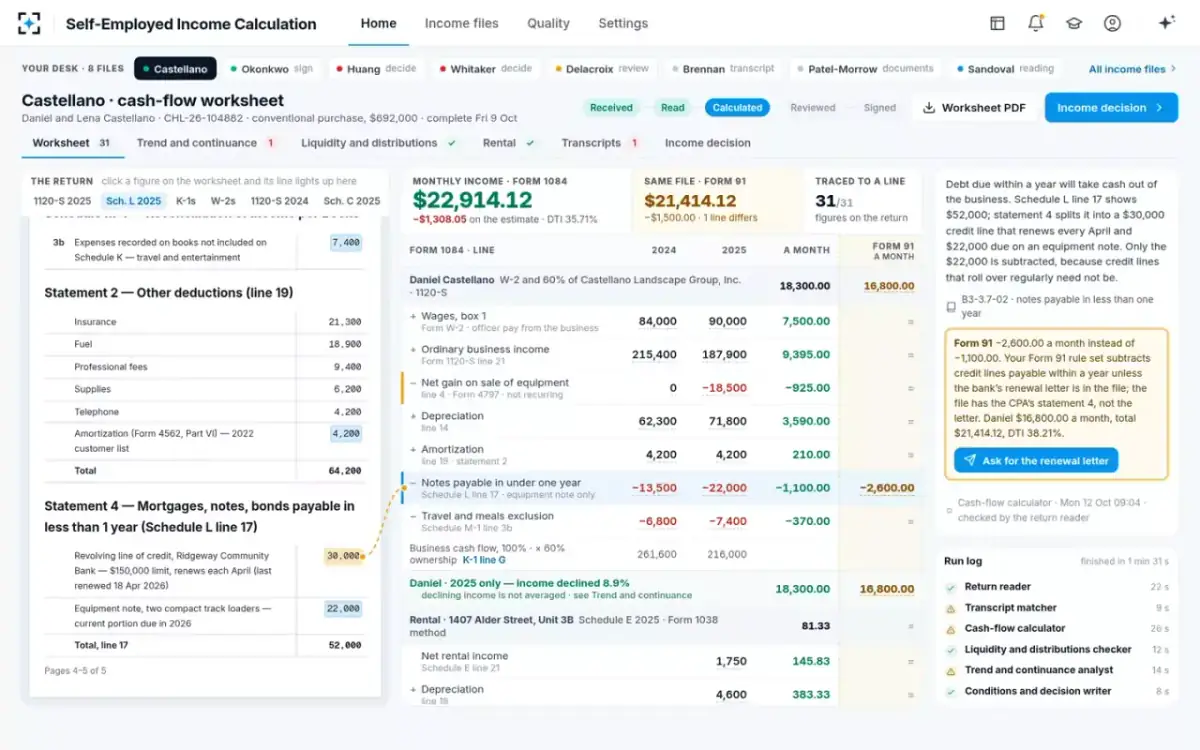
On the fictional sample file the solution ships with, that meant 42 pages, 19 worksheet lines and 31 figures each linked to its return line, in 91 seconds, with a Form 91 column beside the Form 1084 one so the underwriter sees the single line where the two methods differ.
Two methods on one file, with the line where they part
What does the Fannie Mae Income Calculator not cover?
It covers Fannie Mae policy for self-employment, business ownership and personal rental income, and not much else. It applies Fannie's Selling Guide, not HUD Handbook 4000.1 for FHA or the VA's rules. Its user guide says rental income reported on business returns is not yet supported. It does not read documents, match transcripts or check that what was keyed is what the return says; that integrity stays with the lender. And when it finds a declining trend it asks the lender to document that the income has stabilized, which is a human conclusion (Income Calculator user guide).
Three methods, side by side
| Form 1084 spreadsheet | Fannie Mae Income Calculator | Software that reads the returns | |
|---|---|---|---|
| Licence cost | None | None | Priced by vendor |
| Who enters figures | Underwriter | Underwriter, an import file or an approved provider | The software, from the PDFs |
| Figure linked to its return line | No | No | It should be: ask to see it |
| IRS transcript match | Separate step | No | It should be: line by line |
| Programs | Whatever the template covers | Fannie Mae only | Depends on the product: ask for FHA and VA |
| Written analysis | Typed by the underwriter | Findings report | Drafted, edited and kept by the underwriter |
| Rep and warrant relief on the income | No | Yes, if its conditions are met | Only an approved vendor tool, or by feeding the Income Calculator |
The calculator gives relief on the arithmetic. It cannot give relief on what it was never shown.
What does income calculation software cost to own?
Price it against the work it removes and the risk it moves, not against the free spreadsheet. List prices are rarely published, and we will not quote any. The useful frame is a sum of four terms, in your own numbers. The background is a loan that already costs a lot to make: the Mortgage Bankers Association's members reported production expenses of $11,094 per loan in 2025 (MBA, April 2026).
The cost of owning income calculation software, as a sum
Underwriter hours released
self-employed files a month × minutes saved per file × loaded hourly cost
Price minutes at your own rates; BLS reported a mean of $45.56 an hour for credit analysts in May 2023.
Priced by underwriting
Defects and repurchases avoided
income findings in QC before − after × cost of a finding
A repurchase or an indemnification on one loan can outweigh a year of review hours.
Priced by credit risk
Licence and integration
subscription + connection to the document store and origination system
Ask what is needed to read your documents and to send the income to your automated underwriting.
Priced by IT
Governance and validation
AI policy, vendor oversight, back-test and annual review
Fannie Mae’s LL-2026-04 requires all four for AI used in origination.
Priced by risk and compliance
The fourth term is new. Since Fannie Mae's Lender Letter LL-2026-04 took effect, a seller using AI or machine learning in origination must keep policies on its development and use, name an owner who reviews them at least annually, and govern "subcontractor and vendor use of AI/ML" to the same standard (LL-2026-04). A buyer of AI tax return review software takes on that work; a vendor that can show its limits, its trace and its version history makes it smaller. FHFA describes representations and warranties as the lender's assurance that a loan meets the Enterprises' guides, with a repurchase request among the remedies when it does not (FHFA); the second term is where that risk is priced.
What the sample lender's screen shows after a quarter with the agents
68 → 11min
median minutes from a complete file to a signed worksheet, by hand and with the agents
4 → 0
income defects in quality control, 58 loans sampled in Q1 against 61 since July
38%
of files where income moved more than 5% from the estimate at application
How do I compare income calculation tools on my own files?
Run them on files you have already closed and reviewed. Pick a sample that includes the hard cases: a declining year, an S corporation whose distributions fall short of K-1 income, a partnership, a Schedule C with mileage and home office, a one-time gain, a missing transcript. Give each tool the same documents and hold back your own worksheets and quality control findings. Then count three things: figures that match yours, figures that differ for a reason you accept, and figures that are wrong.
Nine questions for any tax return analysis software
- Does it read the PDFs you actually receive?
Scans, e-filed copies, statements attached at the end; ask what happens to an unreadable page.
- Does each figure link to a page and line?
Click a number; the line should appear. If not, QC will re-read the return.
- Which programs, and which versions?
Fannie, Freddie, FHA, VA, and the date of the guide each rule set follows.
- How does it treat a declining year?
It should apply your written policy and say so, not average silently.
- Does it test K-1 income?
Distributions against allocated income, then a liquidity ratio with its inputs shown.
- What does it do with notes payable?
Can it tell a renewing credit line from a note that falls due, and on what evidence?
- Does it match transcripts?
Line by line, with a named condition when the IRS has no record.
- How would relief work?
Is it a Fannie Mae-approved vendor tool, and on what conditions, or does it feed the Income Calculator?
- Who signs, and what is logged?
A person signs; overrides get a second review; every step is on the file.
Which method fits which lender?
Volume and program mix decide it more than features. A lender closing a handful of self-employed loans a month, almost all conventional, may do best with the Income Calculator and a careful underwriter, because relief on the calculation is worth more than speed. A lender with a large FHA or VA share needs a method that applies those programs' rules, which the calculator does not. A lender whose pipeline is waiting on income, or whose quality control keeps finding the same adjustment errors, needs the reading and the trace that only software provides, and can still pass its figures to the calculator for relief. How to put the two together is covered in what to put around the Income Calculator API.
Questions people ask
What is the best tax return analysis software for mortgage?
The one that produces a written analysis your quality control can check without re-reading the returns, for every program you lend under. Test candidates on closed files you have already reviewed; a demonstration on the vendor's sample tells you little about your own borrowers.
Is AI tax return review software allowed by Fannie Mae?
Yes. Fannie Mae accepts automated tools that apply the principles of Form 1084, and its April 2026 Lender Letter LL-2026-04 sets governance requirements for sellers that use AI in origination rather than banning it. The lender stays responsible for the income.
Do I need software if the Income Calculator is free?
Not for relief, unless the software is one of Fannie Mae's approved vendor tools. Software earns its place by reading documents, matching transcripts, covering FHA and VA files and leaving a trace, none of which the calculator does. Many lenders will want both.
Can a spreadsheet replace Form 1084?
Yes, if it applies the same principles and the written analysis is kept in the loan file. Fannie Mae accepts Form 1084 or any cash-flow analysis that follows it.
Where does Botminds' Self-Employed Income Calculation not fit?
It does not replace automated underwriting, and, since it does not claim Fannie Mae approved-vendor status, it does not on its own bring Fannie Mae's representation and warranty relief. It calculates from tax returns under agency methods, so it is not a bank-statement income tool.