Fannie Mae Form 1084, the Cash Flow Analysis, is the worksheet a lender uses to turn a self-employed borrower's personal and business tax returns into income the borrower can rely on. Fannie's own description is that it "may be used to prepare a written evaluation of the analysis of income related to self-employment", and that the purpose is "to determine the amount of stable and continuous income that will be available to the borrower for loan qualifying purposes" (Form 1084, June 2019). It has eleven numbered sections: six for the 1040 and its schedules, four for partnership and S corporation income, one for a regular corporation. Each row names the return line it reads and whether it adds or subtracts. Filling it by hand means finding every one of those lines across two years of returns. Botminds' Self-Employed Income Calculation, a set of agents for mortgage underwriters, fills it with each figure linked to its page and line. This page walks the form row by row.
Form 1084 at a glance: each section, the return it reads, and what the instructions say
W-2 income from self-employment
Reads from: Form W-2 from the borrower’s own business
Instructions: Confirm by matching the employer number on the W-2 with the business’s; cross-check officer pay on Form 1120-S or 1120.
Schedule B interest and dividends
Reads from: Schedule B, K-1, 1099-INT or 1099-DIV
Instructions: Only interest or dividends paid by the borrower’s own business.
Schedule C, sole proprietorship
Reads from: Schedule C line 31 and its expense lines
Instructions: Net profit; deduct non-recurring other income and the meals exclusion; add back depletion, depreciation (with mileage depreciation), business use of home, amortization and casualty loss.
Schedule D capital gains
Reads from: Schedule D
Instructions: Recurring gains only; a one-time sale stays out. Business capital losses need not be counted.
Schedule E royalties
Reads from: Schedule E
Instructions: Royalties less their expenses, depletion added back. Rental income goes on Forms 1037 or 1038 instead.
Schedule F farming
Reads from: Schedule F
Instructions: Net farm profit; add back non-taxable co-op and CCC payments that continue, depreciation, amortization, depletion, business use of home.
Partnership: K-1 (Form 1065) and business adjustments
Reads from: K-1 boxes 1–3 and guaranteed payments; Form 1065, Form 8825, Schedule L, Schedule M-1
Instructions: Add-backs and subtractions on the business; subtotal × ending capital percentage.
S corporation: K-1 (Form 1120-S) and business adjustments
Reads from: K-1 boxes 1–3; Form 1120-S, Form 8825, Schedule L, Schedule M-1
Instructions: Add-backs and subtractions on the business; subtotal × stock ownership percentage.
Regular corporation
Reads from: Form 1120 page 1, Schedule L, Schedule M-1; Schedule B of the 1040
Instructions: Taxable income less tax, adjustments, less dividends already counted; usable only at 100% ownership.
What is Fannie Mae Form 1084?
It is a two-column worksheet, one column per tax year, that lists the income and adjustments Fannie Mae recognises for self-employment, with a sign beside each: plus, minus, or plus-or-minus. The current edition is dated June 2019: three pages of form and five of instructions. It sits beside Form 1088, the Comparative Income Analysis, which compares gross income, expenses and taxable income across years (Form 1088). Form 1084 measures the cash; Form 1088 measures the trend. A self-employed file usually needs both kinds of analysis.
Form 1084 in four numbers
11
numbered sections, from W-2 income from the borrower’s own business to a regular corporation
2
year columns, and no line for averaging them or turning them into a monthly figure
8
pages in the June 2019 edition: three of worksheet, five of instructions
100%
ownership required before a regular corporation’s earnings can be used
Is Form 1084 required?
The analysis is required; the form is not. Fannie accepts Form 1084, another cash-flow analysis that follows the same principles, an approved vendor tool or its Income Calculator, whose findings report "can be used to satisfy the requirements for the lender to prepare a written analysis" (B3-3.1-03). The one place the Guide names the form outright is the one-year exception: when a lender documents a business with a single year of returns, "the lender must complete Fannie Mae's Cash Flow Analysis (Form 1084) or any other type of cash flow analysis form that applies the same principles. A copy of the written analysis must be included in the permanent loan file" (B3-3.5-01).
So "how to fill out Form 1084" is really "how to apply its principles", whether on Fannie's PDF, in a spreadsheet or in software. The rows below are those principles.
What lines of Schedule C go on Form 1084?
Section 3 reads six things from Schedule C: net profit or loss, other income, depletion, depreciation, business use of home, and amortization or casualty loss, and it subtracts the meals exclusion. Net profit comes from line 31. Line 3b deducts "other income" unless it recurs, because it "represents income that is not directly related to business receipts". Line 3d adds back depreciation, and the instructions add a detail many worksheets miss: "Vehicle depreciation included as part of the standard mileage deduction may be added back by multiplying the business miles driven by the depreciation factor for the respective year" (Form 1084 instructions).
Schedule C to Form 1084 section 3, with a sample sole proprietor
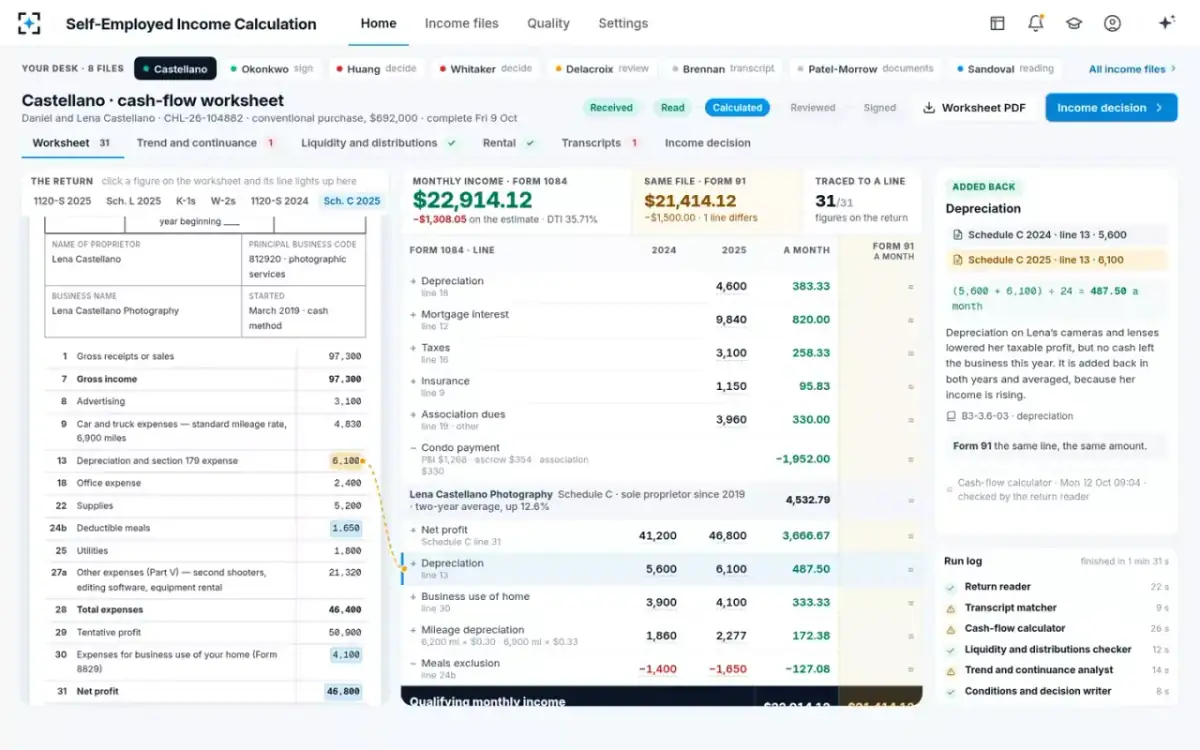
| Form 1084 line | Schedule C source | Lena, 2024 | Lena, 2025 |
|---|---|---|---|
| 3a Net profit or (loss) | Line 31 | $41,200 | $46,800 |
| 3b Non-recurring other (income) loss | Line 6, other income | $0 | $0 |
| 3c Depletion | Line 12 | $0 | $0 |
| 3d Depreciation | Line 13, plus mileage depreciation | $5,600 + $1,860 | $6,100 + $2,277 |
| 3e Non-deductible meals | Line 24b (the excluded share) | −$1,400 | −$1,650 |
| 3f Business use of home | Line 30 | $3,900 | $4,100 |
| 3g Amortization / casualty loss | Part V other expenses; Form 4684 | $0 | $0 |
| Cash flow | $51,160 | $57,627 |
The meals line confuses people. Schedule C line 24b shows the deductible half of business meals; the other half was spent but excluded for tax. Form 1084 subtracts the excluded share because "These expenses, to the full extent they are incurred, are taken into account". On the sample file the deductible amount and the excluded amount are the same, $1,650 in 2025.
Sections 4 to 6: capital gains, royalties and farms
These are short, and each has one trap. Section 4 counts only recurring capital gains, and warns against business gains "which are sporadic or result from a one-time transaction"; business capital losses on Schedule D "do not have to be considered", even if they recur. Section 5 is for royalties only: rental income from Schedule E goes on Fannie's rental worksheets, Forms 1037 and 1038 (B3-3.6-05). Section 6, for farms, adds back the non-taxable portion of continuing co-op and Commodity Credit Corporation payments as well as the usual non-cash items. A note on page 1 says Form 4797, sales of business property, is left off "due to its infrequent use"; a lender can add an analysis of it when needed.
Partnership and S corporation rows: the proportionate share
Sections 7 to 10 split each pass-through business in two: the K-1 lines the borrower received, and the adjustments to the business's own cash flow. For an S corporation, line 9a takes ordinary income from box 1 of the K-1 and line 9b net rental income from boxes 2 and 3. Section 10 then adjusts the business: non-recurring income or loss, depreciation (on the 1120-S and Form 8825), depletion, amortization and casualty loss, less notes payable within a year and less non-deductible travel and entertainment from Schedule M-1. The subtotal is multiplied by the borrower's stock percentage on the K-1. Partnership sections 7 and 8 work the same way, using the ending capital percentage, adding guaranteed payments with a two-year history, and deducting income passed through from other partnerships unless it has been documented.
Two details trip careful readers. First, the notes-payable line (8f, 10e, 11i) reads Schedule L, "end of year column", and is "not required for lines of credit or if there is evidence that these obligations roll over regularly". Second, the instructions for the partnership and corporation versions of that line still say "Schedule L of Form 1120S", a carry-over in Fannie's text; read it as the business's own Schedule L. Before any of the K-1 rows count, the borrower must have received the income or the business must be able to pay it, the test worked through in how to calculate K-1 income for a mortgage.
Form 1084 filled, with the source line beside each figure
The corporation rows: section 11
A regular corporation's earnings count only when the borrower owns all of it; the form says so above the section. Line 11a starts from taxable income on page 1 of Form 1120, 11b subtracts the corporation's tax, and 11c and 11d take out gains and other income that will not recur. Lines 11e to 11h add back depreciation, depletion, amortization and casualty loss, and "the full amount" of net operating loss and special deductions. Line 11l subtracts dividends the corporation paid the borrower, because they appear on the borrower's Schedule B and "are therefore being double-counted" (Form 1084 instructions). The Selling Guide adds the condition the form only hints at: the business must have "adequate liquidity to support the borrower's withdrawals of cash without having severe negative effects" (B3-3.7-03).
What Form 1084 does not do
It does not average, judge a trend, test liquidity or check the IRS. The form stops at a total for each year. Deciding whether to average two years, use the lower one or rely on a recent profit and loss statement belongs to the written analysis around it; Form 1088 supplies the trend, and Fannie's profit and loss guidance supplies the year to date (B3-3.7-04). The liquidity ratio is described in the instructions but not calculated on the form. And nothing on it checks that a figure matches the IRS transcript.
It also says nothing about FHA. HUD Handbook 4000.1 has its own method: the lesser of the two-year and one-year averages of self-employment income, a manual underwrite after a decline of more than 20%, and its own list of add-backs (HUD Handbook 4000.1). A lender using Form 1084 on an FHA file is using the wrong rules. How the two programs part on a declining year is set out in FHA self-employed income decline against Fannie's trend test.
Form 1084 vs Freddie Mac Form 91
Form 91 is Freddie Mac's counterpart, the income analysis for self-employed borrowers on loans sold to Freddie. The two work from the same returns and most lines agree; where they part, it is usually on a judgement the forms frame differently, and a lender's own policy can widen the gap. On the fictional sample file in Botminds' Self-Employed Income Calculation, every line was worked both ways and 18 of 19 agreed. The one that did not was notes payable: Form 1084 does not subtract a credit line that renews every April, while the sample lender's own Form 91 rule set subtracts it unless the bank's renewal letter is in the file. That is $1,500 a month on one borrower, and a DTI of 38.21% instead of 35.71%.
Which form governs depends on who buys the loan. The sample file was going to Desktop Underwriter, so Form 1084 was used, with the Form 91 result kept beside it. If the loan goes to Freddie, read Freddie's current Guide for each line; we have not relied on it here.
Self-employed less than 2 years, or one year of tax returns
Both are allowed under conditions, and the second is where the form is named. A borrower with under two years of self-employment can qualify if the latest signed personal and business returns show a full 12 months from the current business and the file documents earlier income at the same or higher level, in a field offering the same products or services or an occupation with similar responsibilities; the lender must weigh "the nature of the borrower's level of experience, and the amount of debt the business has acquired" (B3-3.5-01).
One year of personal and business returns is enough when the business has existed for five years and the borrower has owned 25% or more of it for each of those five years. The ownership history can be shown by documents such as "an IRS-Issued Employer Identification Number Confirmation letter, business license, articles of incorporation, or partnership agreements", and each business is assessed separately. With one year of returns there is only one column to fill, and Form 1084 or its equivalent must be completed and kept.
How many years of returns Form 1084 has to work with
- Two years of personal and business returns24 months
- A full 12 months on the latest returns12 months
- Plus prior income in the same fielddocumented
- Latest year only; business 5 years old, 25% owned for 512 months
How to fill out Form 1084 without the usual errors
- Use the right year columns
The most recent return is the last one scheduled to have been filed; label the columns by tax year.
- Match W-2s to the business
Line 1 is only wages from the borrower’s own company: check the employer number.
- Find the mileage depreciation
Line 3d allows it when the standard mileage rate was used; it hides inside car and truck expenses.
- Take out one-time income
Other income, gains on equipment or property and insurance proceeds come off unless they recur.
- Read Schedule M-1 for meals
The non-deductible travel and entertainment on a business return is on M-1, not the face of the return.
- Split Schedule L line 17
Short-term notes come off; renewing lines of credit need not. Use the company’s statement.
- Apply the right percentage
Ending capital for a partnership, stock percentage for an S corporation, 100% for a corporation.
- Write the conclusion
The form ends at a yearly total; the analysis must say which years are used and why.
Questions people ask
Where do I get Fannie Mae Form 1084?
Fannie Mae publishes it as a PDF with its instructions among its Selling Guide forms. Many lenders and mortgage insurers keep spreadsheet versions with the arithmetic built in; any version must apply the same principles as Fannie's form.
Does Form 1084 calculate the two-year average?
No. It ends with a total for each year. Averaging, using the lower year or relying on a year-to-date statement is a decision for the written analysis, informed by the trend on Form 1088.
What is the difference between Form 1084 and Form 1088?
Form 1084 turns each year's returns into cash flow. Form 1088 compares the business's gross income, expenses and taxable income across years to show whether it is growing, level or shrinking. Fannie's Income Calculator findings report can stand in for either.
Do I fill out Form 1084 for a borrower whose self-employment is a side business?
Not if that business's income is not used to qualify. Fannie Mae does not require the written analysis when the borrower qualifies only on other income, such as salary or retirement income, and the self-employment is a separate, secondary source of income or loss.
Can software fill out Form 1084?
Yes, and Fannie allows automated tools that apply the same principles. In Botminds' Self-Employed Income Calculation, on a fictional sample file, agents filled 19 worksheet lines from 42 pages in 91 seconds, each figure linked to its return line; the underwriter reviews and signs.