Form 4506-C, the IVES Request for Transcript of Tax Return, is the form a borrower signs so that a lender, through an IRS Income Verification Express Service participant, can get transcripts of the borrower's returns straight from the IRS. Each transcript costs $4; online requests come back in hours once the taxpayer approves them, and the old fax route takes two to three business days. Lenders want the transcript because the return in the loan file is the borrower's copy, and the transcript is what the IRS actually processed. For a self-employed borrower that comparison matters more than for anyone else, because the return is the whole income file. Botminds' Self-Employed Income Calculation, a set of agents for mortgage underwriters, compares every return with its transcript line by line and turns a missing year into a named condition. This page covers the form, the rejections, the mismatches and the "no record" answer.
Two versions of the same tax year
The return in the loan file: The borrower, often through a tax preparer.
The IRS return transcript: The IRS, through an IVES participant, after the borrower signs Form 4506-C.
The return in the loan file: Every page and schedule, including the business detail the worksheet needs.
The IRS return transcript: “Most of the line items of a tax return as filed”, but not every schedule line.
The return in the loan file: Whatever copy was handed over: filed, draft or amended.
The IRS return transcript: The original return as processed; later changes appear on the account transcript.
The return in the loan file: As soon as the return is prepared.
The IRS return transcript: Only after the IRS processes the return: weeks after e-filing.
The return in the loan file: Building the income: add-backs, shares, adjustments.
The IRS return transcript: Verifying the income: the lines that matter should agree.
What is the 4506-C IVES request for transcript of tax return?
It is the IRS form a taxpayer signs to send transcripts to a named third party through IVES. The IRS describes the program as letting "mortgage lenders, banks, credit unions and others, request taxpayer authorization for the IRS to provide tax transcripts and wage statements in the loan application process" (IRS IVES). The current form is the October 2022 revision. It names the IVES participant on line 5a, the client company on line 5d, the single tax form on line 6, any wage and income transcripts on line 7 and the periods on line 8.
Lenders use it because federal law points them to it. The ability-to-repay rule says a creditor "may verify the consumer's income using a tax-return transcript issued by the Internal Revenue Service" (12 CFR 1026.43(c)(4)). Fannie Mae requires every borrower whose income is used to sign a 4506-C at or before closing, and says that if transcripts arrive before closing, they "must be used to verify the income documentation provided by the borrower" (Selling Guide B3-3.1-02). FHA accepts a signed 4506, 4506-C or 8821 and transcripts from the IRS in place of signed returns (HUD Handbook 4000.1).
IVES and Form 4506-C in four numbers
$4
fee for each transcript requested through IVES
120days
from the borrower’s signature for the IRS to receive the form
1
tax form number per 4506-C: a 1065 and an 1120-S need two forms
4years
or tax periods a single 4506-C can cover
How long does a 4506-C take, and how much does an IVES transcript cost?
Hours online, two to three business days by fax, and $4 a transcript. The IRS says "IVES now provides transcripts in near real-time with taxpayer authorization through their online account", with "Transcript delivery in hours" through its web interface for single requests and its application-to-application channel for bulk ones; "The legacy faxing option is available with a 2-3 business day processing time" (IRS IVES). On the online route the lender keys the request and the taxpayer signs in their own IRS account; the paper form itself "cannot be uploaded" (IVES FAQs).
The cost adds up on a self-employed file more than it looks. Two years of a personal return and two years of an S corporation return is four transcripts on two separate forms; wage and income transcripts are charged per form type, per taxpayer, per year. Budget the requests when the file is set up, not when the underwriter asks.
Why does IVES reject a 4506-C?
Almost always for something missing or mixed on the form. The IRS's own answers list the causes plainly: "Forms with missing signatures will be rejected"; missing participant information on line 5a or client information on line 5d; more than one tax form on line 6; and the wrong boxes for electronic or authorised signatures (IVES FAQs). The form's own caution, printed twice, is "Do not sign this form unless all applicable lines have been completed" (Form 4506-C), and Fannie Mae repeats it: the borrower should not be asked to sign before the transcript, the years and the date are filled in (B3-3.1-02).
Nine reasons IVES rejects a 4506-C, and how to avoid each
- A missing signature
Every taxpayer listed on line 1a or 2a must sign; list a spouse only if their transcripts are wanted.
- Two tax forms on line 6
One form number per request: the 1040 on one 4506-C, the 1120-S on another.
- Line 5a incomplete
The IVES participant’s name, ID number, mailbox ID and address are all required.
- Line 5d blank or “NA”
The client company must be named, even when it is the participant itself.
- E-signature box not checked
An electronically signed form must say so; a wet signature with the box checked is rejected too.
- Authorised representative box
If someone signed for the taxpayer, the box must be checked.
- Signed too long ago
The IRS must receive the form within 120 days of the signature date.
- Signed before it was filled
Complete lines 5 to 8 first; date the form the day the borrower signs.
- E-signatures the participant may not take
Only participants authorised for electronic signatures can submit e-signed forms; others are rejected.
What does a return transcript show, and what doesn't it?
It shows most of the return as originally filed, and nothing that changed later. The form's instructions say a return transcript "includes most of the line items of a tax return as filed with the IRS" and "does not reflect changes made to the account after the return is processed"; transcripts exist only for the 1040 series, 1065, 1120, 1120-H, 1120-L and 1120-S, and only for "the current year and returns processed during the prior 3 processing years". The account transcript shows later adjustments; the record of account combines the two (Form 4506-C instructions). The IRS adds that "A tax return transcript usually meets the needs of lending institutions offering mortgages" (IRS, Transcript types).
"Most of the line items" is the catch for business owners. Fannie Mae notes that transcripts may not give enough detail to support the income, and then the lender must get the actual returns, schedules or K-1s, unless the schedule income is positive and not being used to qualify (B3-3.1-02). A Schedule C transcript line gives net profit; it does not give the depreciation, home office and mileage the worksheet adds back. Fannie's Income Calculator material makes the same point from the other side, noting that some allowable add-backs are not found in 4506-C transcript data. The return builds the income; the transcript proves the return was the one filed.
What if tax transcripts don't match the return?
Stop and find out why before the income is used, and keep the explanation. Fannie Mae requires the lender to retain the 4506-C or the transcripts "and any subsequent explanation or documentation of discrepancies in the loan file for QC review", and to write the transcript requirement into its quality control plan (B3-3.1-02). The common innocent causes are an amended return (the return transcript shows the original; the account transcript shows the change), a draft handed over instead of the filed copy, or a different year. The uncommon cause is a return that was never filed in the form shown.
Compare the lines that carry the income, not just the total. On the fictional sample file in Botminds' Self-Employed Income Calculation, the 2024 match covers six lines: wages $84,000, Schedule C business income $41,200, Schedule E income from the S corporation and rental $130,660, taxable interest $1,120, the deductible part of self-employment tax −$2,911 and adjusted gross income $254,069. All six agree. A return that matched only on adjusted gross income could still hide a Schedule C figure moved into Schedule E.
Return against transcript, line by line, with the 2025 “no record” answer
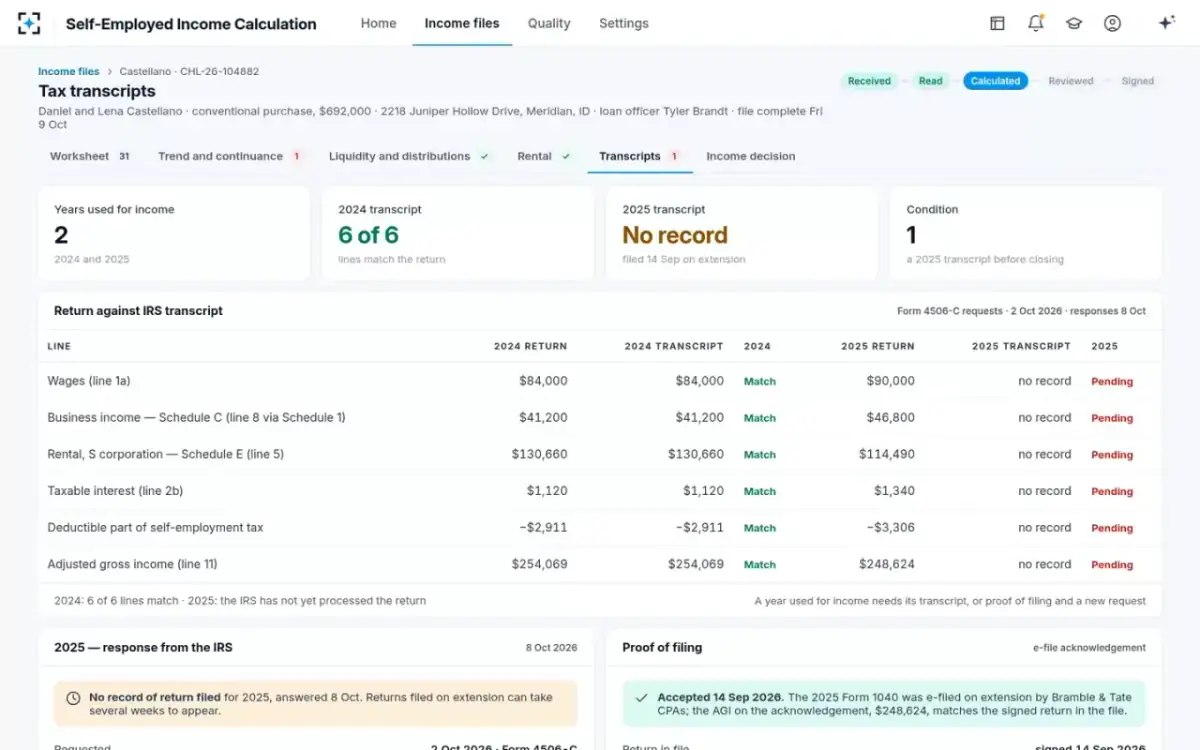
"No record of return filed": what it means for a mortgage
Usually that the IRS has not finished processing the return, not that it was never filed. The IRS's own guidance on transcript timing, written for returns filed by the April deadline, says to allow two to three weeks after an electronic return is submitted, and six to eight weeks after a paper return is mailed, before asking for a transcript; where a balance was due and paid later, three to four weeks after the payment (IRS, Transcript availability). A return filed on extension in September can still be missing in early October.
From filing to a transcript the lender can get
- IRS processing2–3 wks
- Payment posts
- IRS processing3–4 wks
- Mail and processing6–8 wks
- Accepted 14 Sep to request 2 Oct18 d
- Answered 8 Oct: no record6 d
Fannie Mae has a rule for exactly this window. For an application dated from 1 July to 14 October, when the most recent year's return has not been obtained, the lender must collect the extension (Form 4868) or proof of its e-filing or of the estimated tax payment, compare the tax liability with the prior year "as a measure of income source stability and continuance", and "Obtain IRS response from the filing of IRS Form 4506–C confirming that no transcripts are available for the applicable tax year" (Selling Guide B1-1-03). A "no record" answer, kept in the file, is part of that documentation. Where the return has been filed and is being used, as on the sample file, the transcript should follow, and the condition makes sure someone asks for it.
Do lenders need business tax transcripts?
When business returns are used to qualify, yes, and on a separate form. Fannie Mae's example is exact: a self-employed borrower with two years each of personal and business returns completes "one IRS Form 4506-C to request transcript of the personal tax returns, and a separate IRS Form 4506-C to request transcripts of the business returns" (B3-3.1-02). The IRS rule behind it is that "Only one form type can be requested per 4506-C (i.e., a 1065 and an 1120 cannot be requested on the same F4506-C)" (IVES FAQs). For a corporation the form is signed by an officer with authority to bind it; for a partnership, by someone who was a partner during the period.
Which 4506-C a typical self-employed file needs
| Borrower’s business | Personal 4506-C | Business 4506-C |
|---|---|---|
| Sole proprietor, Schedule C | Form 1040, two years | None: the business is on the 1040 |
| Partner, K-1 from Form 1065 | Form 1040, two years | Form 1065, two years, when business returns are used |
| S corporation owner | Form 1040 and W-2 wage transcripts | Form 1120-S, two years, when business returns are used |
| Owner of a C corporation | Form 1040 and W-2 wage transcripts | Form 1120, two years |
| Two businesses of different types | Form 1040 | One form per business form type |
4506-C vs 4506-T
Form 4506-C is the lender's route; Form 4506-T is the taxpayer's own request for transcripts. The IRS lists 4506-T among the ways an individual can order any transcript type, alongside its online account and automated phone service (IRS, Transcript types); 4506-C sends transcripts to a named IVES participant for a loan. Fannie Mae also accepts an alternative such as IRS Form 8821 if it authorises the release of comparable information and the borrower expressly permits disclosure to Fannie Mae (B3-3.1-02).
The match as a control, not paperwork
The transcript is one of the few checks in a self-employed file that comes from outside the borrower and the lender, which is why waiving it is a warning sign. In its 2015 False Claims Act complaint against Quicken Loans, the Justice Department alleged a case in which the borrower "was self-employed and condition 22 of the AUS certificate required Quicken to obtain signed tax returns or information directly from the IRS for the most recent two years", and an employee "granted an exception to HUD's income verification requirements" (U.S. v. Quicken Loans, complaint). Those were allegations; the point for any lender is how easily a transcript condition becomes an exception.
A year without a transcript should be a named condition with an owner, never a silent pass.
That is how the solution treats it. Every tax year used for income needs its transcript, or proof of filing and a new request, before closing; the sample lender can move that to before approval in its settings. IVES policy can also change: the IRS announced a policy change in January 2024 and then suspended it in March after hearing from stakeholders (IRS statement, March 2024), so the transcript step is a setting a lender reviews, not a fixed script. How the transcript check fits with the rest of the income work is traced in automated income calculation in 91 seconds, and the years a file needs are set out in Form 1084, line by line. Fannie's rule that two years of signed returns or IRS transcripts with all schedules can document a self-employed borrower is in B3-3.5-01.
Questions people ask
What is 4506-C IVES?
IVES is the IRS Income Verification Express Service, and Form 4506-C is the borrower's signed authorisation for an IVES participant to receive their transcripts. Lenders, or vendors acting for them, are the participants; each transcript costs $4.
How long is a signed 4506-C good for?
The IRS must receive it within 120 days of the signature date, and Fannie Mae treats it as valid for 120 days after the borrower completes and signs it. It can cover up to four years or tax periods.
Can the lender use the transcript instead of the return?
Sometimes. Fannie Mae accepts IRS transcripts of the most recent two years in place of signed returns when they are complete, legible and include all applicable schedules; when the transcript lacks the detail needed, the actual returns, schedules or K-1s are still required.
Must a borrower sign a 4506-C if the lender already has the returns?
Yes. Fannie Mae requires each borrower whose income is used to sign a 4506-C at or before closing. If the transcripts arrive before closing, an additional signed form is not needed.
What should a lender do with a "no record" answer?
Keep it, check proof of filing such as an e-file acknowledgement, and request again once the IRS has had time to process the return. In the window Fannie Mae allows before the October filing deadline, the "no record" response is part of the required documentation for a year not yet filed.